
Entering the cryptocurrency market is often the primary focus for new investors. Much attention is paid to onboarding, selecting the right exchange, and making that initial purchase. However, the process of exiting the market, or "off-ramping," is equally critical. This strategy involves converting digital assets back into local currency or goods.
A robust off-ramp strategy requires understanding the various methods available for selling Bitcoin. It also demands a grasp of how liquidity functions across different platforms. Furthermore, investors must navigate the technical aspects of transaction fees and network costs that can eat into potential profits.
To manage this process effectively, one must understand the mechanics of the Bitcoin network itself. This includes how wallets function, how transactions are constructed, and how fees are determined. Without this knowledge, an investor might find themselves paying excessive fees or facing unexpected delays when they attempt to access their funds.
The Role of Liquidity in Selling
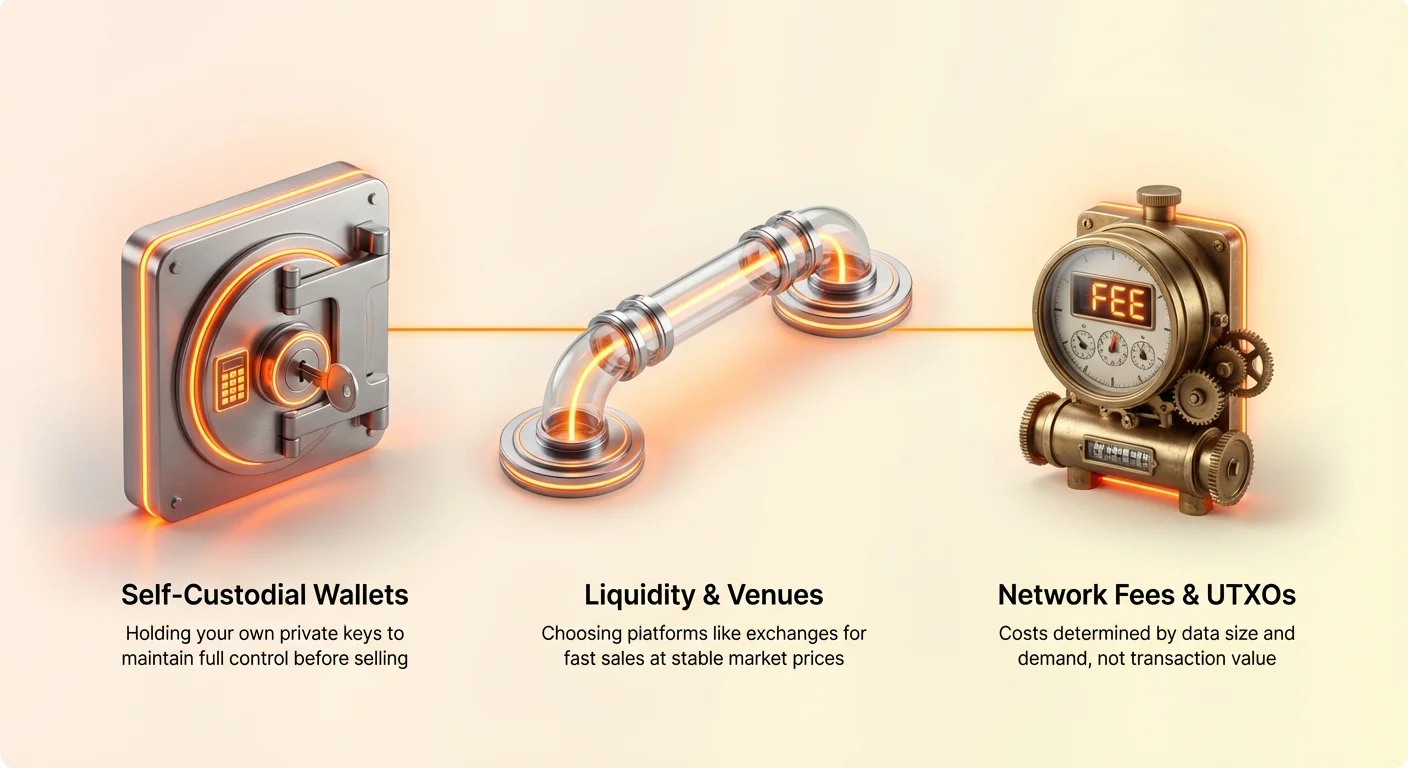
Liquidity refers to how easily an asset can be converted into cash without significantly impacting its price. In the context of Bitcoin, liquidity varies greatly depending on the venue chosen for the sale. High liquidity platforms allow for large sales to occur almost instantly at the current market rate.
Centralized exchanges typically offer the highest level of liquidity. These platforms match buyers and sellers in a high-frequency environment. For an individual looking to sell a significant amount of Bitcoin, these venues usually provide the most stable price execution.
Conversely, peer-to-peer marketplaces or smaller brokerage services may have lower liquidity. This can result in a wider spread between the buying and selling price. In some cases, a seller might have to wait longer to find a buyer willing to transact at their desired price point.
Understanding Profit and Loss Calculations
Before executing a sale, it is essential to understand the mathematical reality of the investment. A common misconception among newcomers is that they must own a whole Bitcoin to see a profit. This unit bias can lead to confusion regarding how gains are calculated.
Profit is determined by the percentage increase in value, regardless of the fractional amount owned. If an investor holds 0.1 BTC and the price of Bitcoin doubles, the value of that 0.1 BTC also doubles. The raw dollar amount of the profit is proportional to the amount invested.
| Holding Size | Price Increase | Initial Value | Final Value |
|---|---|---|---|
| 1.0 BTC | 100% | $10,000 | $20,000 |
| 0.5 BTC | 100% | $5,000 | $10,000 |
| 0.1 BTC | 100% | $1,000 | $2,000 |
Understanding this math is vital for setting realistic price targets. It removes the psychological barrier of needing "whole" coins. It clarifies that financial goals are met through percentage growth rather than the number of units held.
Custodial vs. Self-Custodial Considerations
When preparing to sell, the location of the funds is a primary concern. Bitcoin can be held in custodial wallets or self-custodial wallets. A custodial wallet is one where a third party, such as an exchange, holds the private keys. A self-custodial wallet is one where the user controls the private keys.
The Risks of Exchange Wallets
Keeping funds on a centralized exchange offers convenience for immediate selling. The assets are already on the trading venue, eliminating the need for a network transfer time. However, this convenience comes with significant counterparty risks.
When funds are on an exchange, the user does not technically possess the Bitcoin. They possess a claim to the Bitcoin. If the exchange faces insolvency, bankruptcy, or a security breach, the user may lose access to their assets.
Furthermore, exchanges can freeze accounts. If a user is deemed a security risk or triggers an internal fraud alert, withdrawals can be halted. This lack of control means the user must ask for permission to move or sell their own money.
The Security of Self-Custody
Self-custodial wallets eliminate third-party risk. The user holds the private key, which is often represented by a recovery phrase of 12 to 24 words. This phrase acts as the master key to the funds.
In a self-custody model, no permission is needed to transact. The user can send their Bitcoin to any address at any time. This autonomy is the core value proposition of cryptocurrency.
However, this method requires the user to be responsible for their own security. If the recovery phrase is lost, the funds are unrecoverable. Therefore, users typically keep funds in self-custody for the long term and only move them to an exchange when they are ready to sell.
Methods for Selling Bitcoin
There are multiple avenues for converting Bitcoin into fiat currency. Each method involves trade-offs between speed, privacy, fees, and convenience.
Centralized Cryptocurrency Exchanges
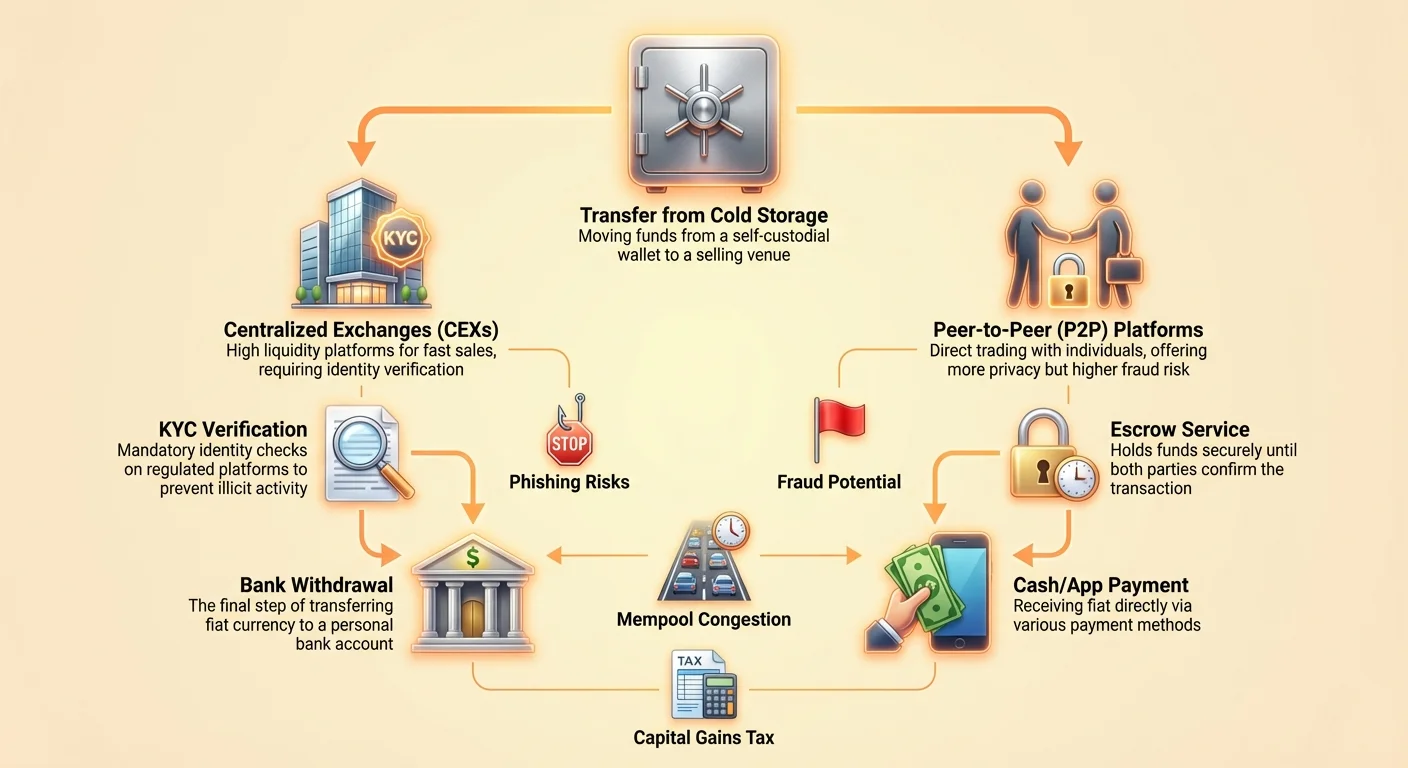
Centralized exchanges (CEXs) are the most common route for selling. The process involves creating an account and verifying identity through Know Your Customer (KYC) protocols. Once verified, the user deposits Bitcoin into the exchange's wallet.
After the deposit is confirmed, the user can place a sell order. The exchange matches this order with a buyer. Once the sale is complete, the fiat currency appears in the user's exchange account. From there, it can be withdrawn to a linked bank account.
This method is generally the most cost-effective for larger amounts due to high liquidity. However, it is not private. The exchange collects personal data, and the withdrawal process to a bank can take several business days depending on the banking system.
Peer-to-Peer (P2P) Trading
Peer-to-peer platforms facilitate direct trades between individuals. These platforms act as a matchmaking service. Sellers post advertisements detailing their price and accepted payment methods.
When a buyer initiates a trade, the Bitcoin is typically locked in an escrow service provided by the platform. The buyer then sends payment directly to the seller. This could be via bank transfer, payment apps, or even cash in person.
Once the seller confirms receipt of payment, the Bitcoin is released from escrow to the buyer. P2P trading offers more privacy and a wider range of payment options. However, it carries a higher risk of fraud if users do not utilize the reputation systems and escrow features correctly.
Bitcoin ATMs
Bitcoin ATMs are physical kiosks that allow users to sell Bitcoin for cash. This is often the fastest way to get physical currency. The user sends Bitcoin to a QR code provided by the machine. Once the transaction is confirmed on the network, the machine dispenses cash.
The downside to ATMs is the cost. Transaction fees at these kiosks are typically much higher than online exchanges. Additionally, limits are often placed on how much cash can be withdrawn at once.
Spending as an Off-Ramp
Selling Bitcoin for cash is not the only way to realize value. A direct off-ramp involves spending the cryptocurrency directly on goods and services. This bypasses the need to convert to fiat currency first.
A growing number of online retailers accept Bitcoin directly. Major companies in travel, electronics, and e-commerce have integrated crypto payment gateways. In these instances, the user simply scans a QR code at checkout.
For retailers that do not directly accept crypto, gift cards offer a bridge. Users can purchase gift cards for major brands using Bitcoin. This effectively allows for the purchase of almost any consumer good using digital assets. This method is often faster than selling on an exchange and waiting for a bank transfer.
Transaction Fees and Network Costs
Every time Bitcoin is moved from a self-custodial wallet to an exchange or a buyer, a network fee must be paid. This fee is not determined by the value of the Bitcoin being sent. It is determined by the data size of the transaction and the current demand for block space.
The UTXO Model and Costs
To understand fees, one must understand the Unspent Transaction Output (UTXO) model. Bitcoin balances are not stored as a single number like a bank account. They are stored as a collection of "outputs" from previous transactions.
Imagine receiving two payments of 0.5 BTC each. The wallet reports a balance of 1 BTC. However, on the blockchain, this exists as two separate 0.5 BTC "notes."
When the user decides to sell that 1 BTC, the transaction must gather both of those "notes" as inputs. This data takes up space in the block. If a user has received one hundred small payments of 0.01 BTC, sending 1 BTC requires combining one hundred inputs.
This complex transaction requires much more data than sending a single 1 BTC input. Since miners charge fees based on data size (satoshis per byte), consolidating many small inputs into one transaction is significantly more expensive.
Fee Customization
Most modern self-custodial wallets allow users to customize the network fee. During periods of high congestion, fees rise as users compete to have their transactions included in the next block.
If a user is in a rush to move funds to an exchange to catch a specific price, they may choose a "Fast" fee setting. This attaches a higher fee to the transaction, incentivizing miners to prioritize it.
Conversely, if the user is not in a rush, they can select a lower fee. The transaction may take longer to confirm, but the cost savings can be substantial. If the fee is set too low, the transaction may remain in the "mempool" (the waiting area) for hours or days until network traffic subsides.
Address Formats and Efficiency
The type of Bitcoin address used can also impact the cost of the off-ramp process. Over time, the Bitcoin protocol has been upgraded to improve efficiency. These upgrades have introduced new address formats that reduce the data size of transactions.
Legacy addresses, which start with the number "1," are the original format. Transactions originating from these addresses take up the most space and are the most expensive.
SegWit (Segregated Witness) addresses, which start with "3" or "bc1," were introduced to fix this. They segregate signature data from the transaction data. This effectively reduces the size of the transaction, leading to lower fees.
The newest upgrade, Taproot, uses addresses starting with "bc1p." These offer further efficiency and privacy improvements. Using a wallet that supports SegWit or Taproot can result in significant savings on transaction fees when moving funds to be sold.
Security Risks During the Sale
The off-ramp process introduces specific security vulnerabilities that differ from holding. When users move funds to sell, they often interact with websites and external services. This exposes them to phishing attacks.
Phishing and Fake Sites
A common scam involves fake exchange websites. Attackers create websites that look identical to legitimate exchanges. They use similar URLs to trick users into entering their login credentials.
Once the attacker has the credentials, they can drain the account. It is vital to verify the URL and ensure the connection is HTTPS secured. Users should avoid clicking on links in emails or search engine ads, as these are common vectors for phishing.
Address Verification
When sending Bitcoin from a personal wallet to an exchange to sell, the destination address must be precise. Bitcoin transactions are irreversible. If funds are sent to the wrong address, they are lost forever.
Malware exists that can monitor a computer's clipboard. When a user copies a Bitcoin address, the malware swaps it for an address controlled by the attacker.
To prevent this, users must verify the characters of the address before confirming the transaction. Checking the first few and last few characters is a good habit, but checking the entire string is safer.
Privacy and Identity Verification
Selling Bitcoin on regulated platforms requires the disclosure of personal identity. This is known as Know Your Customer (KYC) compliance. Regulated businesses are required by law to collect this data to prevent money laundering and tax evasion.
KYC Requirements
When signing up for a centralized exchange or brokerage, users generally must provide a government-issued ID. They may also need to provide proof of address and a selfie. This links the Bitcoin addresses used for deposits directly to the user's real-world identity.
This lack of privacy is a trade-off for the liquidity and convenience of the exchange. Once the data is shared, the user must trust the exchange to protect it from data breaches.
Privacy in P2P Markets
Peer-to-peer markets can offer an alternative for those concerned about privacy. Some platforms do not require extensive KYC for smaller trade amounts. However, this varies by jurisdiction and specific platform policies.
Even in P2P trades, digital footprints remain. If a bank transfer is used, the banking system will record the transaction. True privacy in selling is difficult to achieve when interfacing with the traditional banking system.
Managing Volatility and Timing
The price of Bitcoin is volatile. The value can fluctuate significantly in the time it takes to move funds from cold storage to an exchange. This period of transfer creates a risk window where the user is exposed to market movements but cannot yet trade.
The Transfer Delay
If the network is congested, a transaction might take an hour or more to confirm. In that time, the market price could drop. This is why understanding fee settings is crucial. Paying a premium for a faster block inclusion can be worth it to close the risk window.
Some investors keep a portion of their stack on exchanges to react instantly to price moves. However, this reintroduces the custodial risk mentioned earlier. Balancing the safety of cold storage with the agility of having liquid funds is a constant management challenge.
Capital Gains and Record Keeping
While this guide focuses on the mechanics of selling, the aftermath of the sale involves financial tracking. Every sale of Bitcoin is a taxable event in many jurisdictions.
To accurately calculate profit or loss, one must know the cost basis of the specific coins being sold. The cost basis is the original value of the Bitcoin when it was acquired.
Because wallets manage multiple inputs (UTXOs), different parts of a Bitcoin balance may have different cost bases. If a user bought 0.5 BTC at $10,000 and another 0.5 BTC at $50,000, their total is 1 BTC. If they sell 0.5 BTC when the price is $30,000, the profit calculation depends on which "chunk" they sold.
Keeping detailed records of every acquisition and every sale is necessary. This includes dates, transaction fees, and the fiat value at the time of the transaction. Modern wallets and exchanges provide transaction histories, but compiling them across different platforms is often the responsibility of the user.
Conclusion
A successful off-ramp strategy is about more than just finding a buyer. It involves a careful evaluation of custody, choosing the right venue for liquidity, and managing the technical costs of the network. Whether utilizing a centralized exchange for speed or a peer-to-peer platform for privacy, the seller must be aware of the trade-offs inherent in each method.
Security remains paramount throughout the process. From safeguarding private keys to verifying destination addresses and avoiding phishing attempts, vigilance is required until the fiat currency is safely in the bank. Understanding the underlying mechanisms of Bitcoin, such as UTXOs and network fees, empowers users to maximize their returns and minimize unnecessary costs during the exit process.
Plan your exit strategy carefully, prioritizing security and understanding fee structures to protect your financial interests.