
The world of cryptocurrency offers financial autonomy that traditional banking systems cannot match. This freedom comes with the responsibility of acting as your own bank. When you manage your own digital assets, there is no customer support hotline to reverse a transaction or reset a password if you lose your credentials. Understanding the mechanics of blockchain transactions is essential for navigating this landscape securely.
Every time you send value across a blockchain network, you are interacting with a decentralized ledger. This ledger relies on precision. A single wrong character in an address or a miscalculation in fees can lead to delays or loss of funds. Errors in this space generally fall into two categories. These are transmission errors, such as stuck or unconfirmed payments, and access errors, such as lost wallets or keys.
By learning how the network prioritizes data and how wallets manage access credentials, you can troubleshoot most common issues. Mastering these concepts transforms a terrifying experience like a stuck transaction into a manageable situation. The key lies in understanding what happens behind the scenes when you click "send" and knowing exactly how to recover your digital footing if a device fails.
Understanding Blockchain Transaction Mechanics
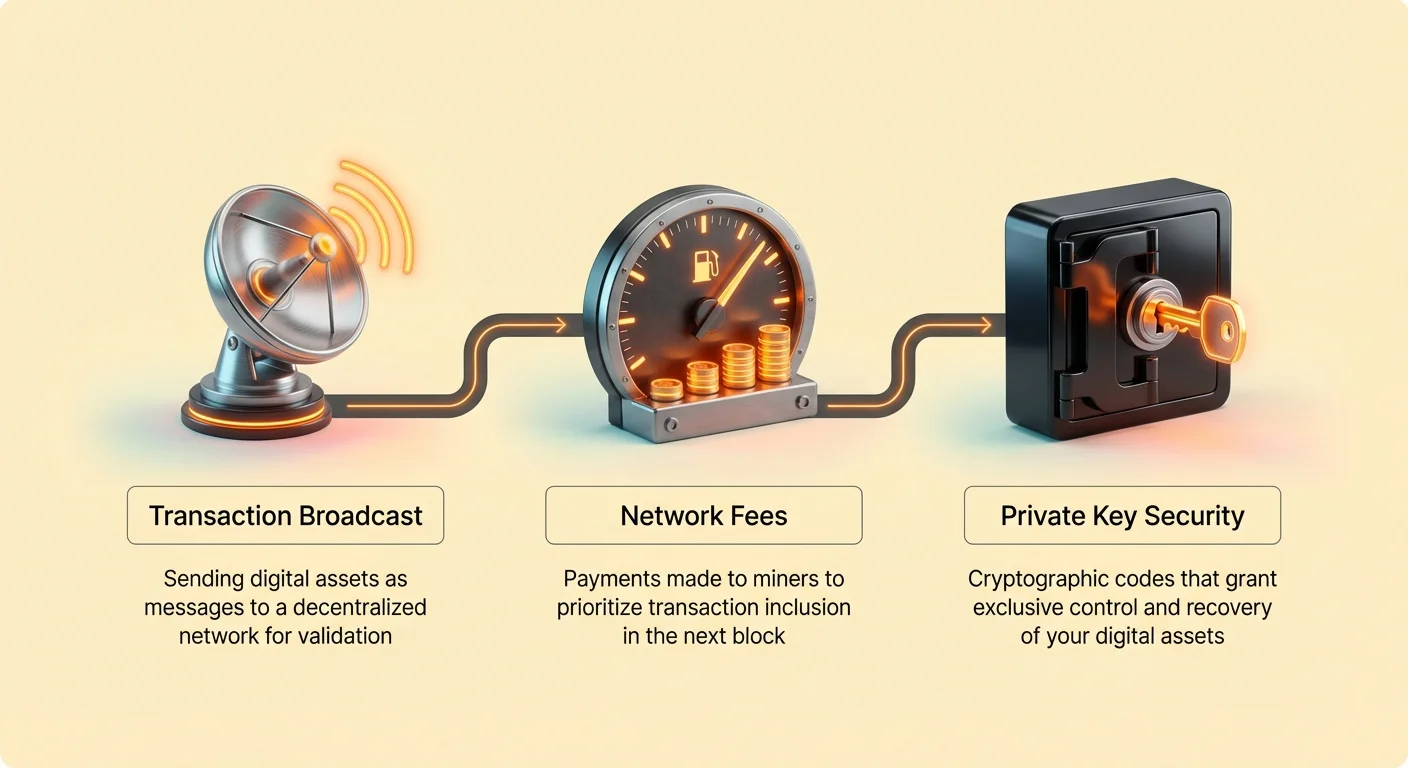
To troubleshoot errors effectively, you must first grasp how Bitcoin and other cryptocurrencies handle data. Unlike a bank transfer where a central database updates a balance, a crypto transaction is a message broadcast to a network of computers. This message must be validated and added to a block by miners.
The Unspent Transaction Output Model
Bitcoin operates on a system known as the Unspent Transaction Output model, or UTXO. When you receive bitcoin, you are not adding to a single nebulous balance. You are actually collecting digital "notes" of various values. If you receive 0.5 BTC from one person and 0.5 BTC from another, your wallet holds two separate 0.5 BTC outputs. Bitcoin's core ledger system ensures security.
When you attempt to send 0.8 BTC, your wallet must combine these two inputs to create the total. It sends 0.8 BTC to the recipient and returns 0.2 BTC to you as "change." This is identical to handing a cashier a twenty-dollar bill for a ten-dollar item. You hand over the whole bill and receive the difference back.
How Data Size Impacts Cost
This "change" mechanism is crucial for troubleshooting stuck payments. Transactions are measured in data size, typically bytes, rather than the monetary value being sent. A transaction that combines many small inputs (like pennies in a jar) requires more data than a transaction using a single large input.
Miners prioritize transactions that pay the highest fee per unit of data. If your wallet has to gather fifty small fragments of bitcoin to make a payment, the transaction size increases. If you do not attach a sufficient fee to cover that large data footprint, miners will prioritize smaller, more profitable transactions. This is a primary cause of unconfirmed payments.
diagnosing the Stuck Transaction
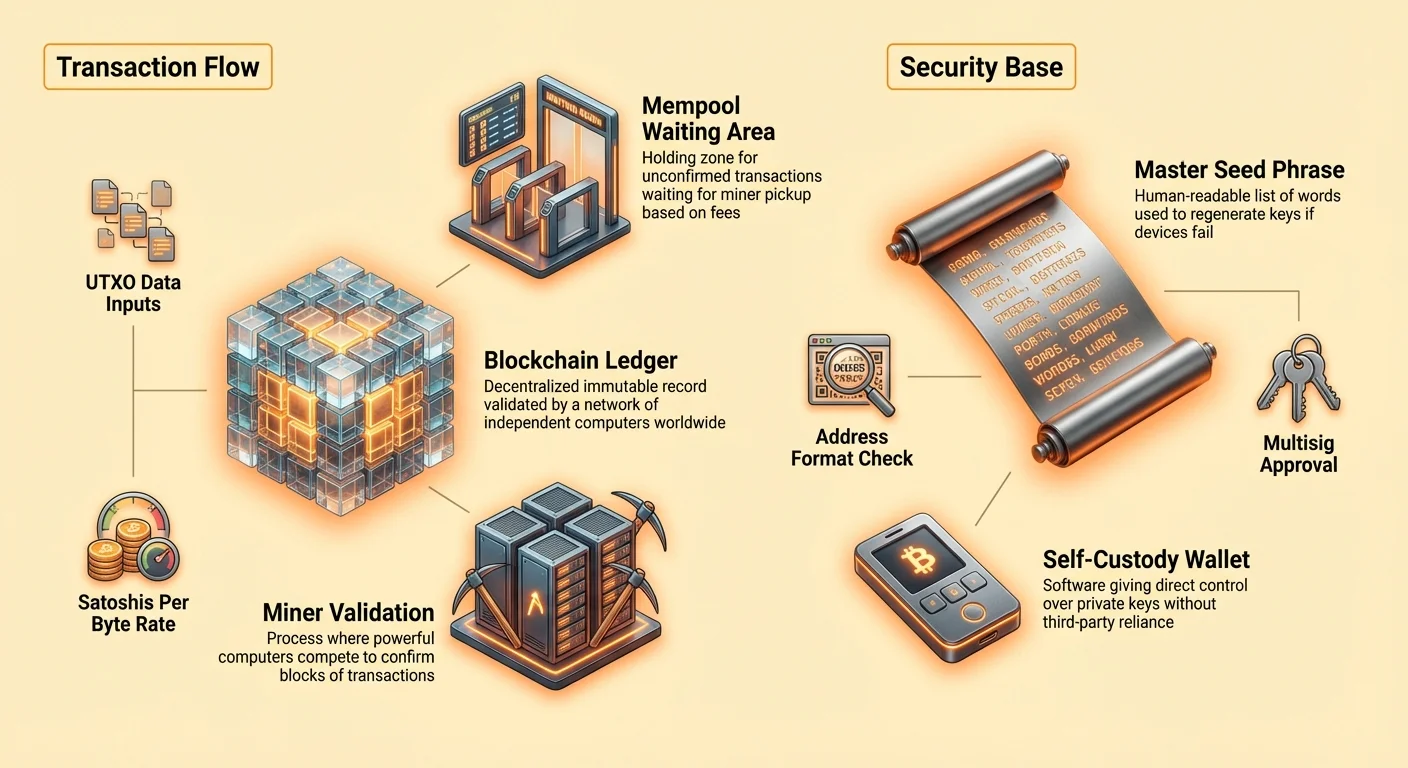
A "stuck" transaction is rarely lost. It is usually just sitting in the "mempool," which acts as a waiting room for unconfirmed transactions. When the network is busy, the list of pending transactions grows. Miners act as gatekeepers, selecting transactions from this waiting room to place into the next block.
Market forces determine admission. Users who attach higher fees are essentially bidding for a seat on the next bus. If you set a fee that is too low for the current market conditions, your transaction will remain in the waiting room. It will sit there until the congestion clears or until miners decide to process lower-fee items.
In the worst-case scenario, a transaction with an extremely low fee will eventually be purged from the mempool. If this happens, the network forgets the transaction occurred, and the funds effectively return to your wallet. They never actually left; they were just locked while attempting to travel. You can check the status of any payment by entering the transaction ID into a block explorer.
Navigating Network Fees and Congestion
Most modern self-custody wallets attempt to automate the fee estimation process. They calculate the current average price for block space and suggest a fee based on how quickly you need the transfer to complete. However, network conditions change rapidly.
Setting Priorities
Wallet apps often provide presets such as "Fast," "Medium," or "Eco." A "Fast" setting might target confirmation within the next 10 to 20 minutes, usually one or two blocks. This requires a higher premium. An "Eco" setting might target confirmation within an hour or more. This saves money but carries the risk of delays if a sudden influx of traffic hits the network.
Understanding these tiers is vital. If you are sending a time-sensitive payment, economizing on fees is risky. If the network suddenly becomes congested, your "Eco" transaction might get pushed to the back of the line.
Satoshis Per Byte
Fees are measured in satoshis per byte. A satoshi is the smallest unit of Bitcoin, representing one hundred millionth of a coin. Advanced users can manually set this rate. To do this effectively, you must consult a dedicated fee estimation tool that monitors the mempool.
If the current going rate is 50 satoshis per byte and you manually enter 5, your transaction will almost certainly get stuck. It is not an error in the software; it is simply a low bid in a competitive market. Troubleshooting this involves patience. You must wait for the network traffic to drop, allowing miners to pick up lower-cost transactions.
Common Address and Format Errors
One of the most anxiety-inducing aspects of crypto is the irreversibility of transactions. If you send funds to a valid address that you do not control, those funds are gone. However, many "errors" are actually format mismatches or user interface confusion rather than total loss.
Bitcoin addresses have evolved over time to support new features and efficiency upgrades. The original addresses, known as Legacy, start with the number "1." Newer formats like SegWit start with "3" or "bc1." The latest update, Taproot, uses "bc1p." While the network is generally backward compatible, confusion often arises when users do not recognize a new format.
Some older wallets or exchanges may not support sending to Taproot addresses. If you attempt to send funds and the wallet rejects the address as "invalid," it is likely a compatibility issue rather than a wrong address. Always verify that the service you are sending from supports the destination address format.
Additionally, clipboard malware is a rare but real threat. This malicious software monitors your clipboard for crypto addresses. When you copy a destination address and go to paste it, the malware swaps it for an address owned by the hacker. Always verify the first and last few characters of the address after pasting to ensure they match the source.
Wallet Recovery Protocols
Losing a device does not mean losing your funds. This is a fundamental concept of the blockchain. Your "wallet" does not actually store your money; it stores the keys that prove you own the money on the public ledger. As long as you possess the recovery credentials, you can regain access on any compatible device.
The Master Key
The foundation of wallet recovery is the seed phrase. This is typically a list of 12 to 24 random words generated when you first create a wallet. These words are a human-readable representation of your master private key. From this single phrase, the wallet software can mathematically derive all your individual addresses and balances. Mastering the seed phrase is crucial for recovery.
If your phone is destroyed or your computer crashes, you simply download a wallet app on a new device and select "Import" or "Recover." You will be prompted to enter your seed phrase. Once entered correctly, the software scans the blockchain and restores your full transaction history and balance.
Digital vs. Physical Backups
Storing this seed phrase is the single most critical security task for a crypto user. The gold standard is writing it down on paper and storing it in a fireproof, secure location. Never store it as a screenshot or a plain text file on a computer connected to the internet. If a hacker gains access to that file, they can drain your funds remotely.
Some modern wallets offer "cloud backup" solutions. These encrypted backups store a version of your recovery phrase in a personal cloud account, protected by a custom password. This offers a balance between convenience and security. It eliminates the risk of losing a piece of paper but introduces the need for a strong, memorable password to decrypt the file.
The Role of Self-Custody in Troubleshooting
The ability to resolve transaction issues often depends on the type of wallet you use. There is a distinct difference between custodial wallets, such as those found on centralized exchanges, and self-custody wallets.
In a custodial arrangement, a third party holds the private keys. If a transaction is stuck or an error occurs, you are entirely dependent on their technical support team. You cannot technically "push" a transaction or adjust fees because you did not sign the transaction yourself; the exchange did.
Self-custody wallets give you direct control. Because you hold the private keys on your device, you interact directly with the blockchain. This autonomy is powerful but unforgiving. If you lose your seed phrase in a self-custody setup, no company can reset it for you. The funds become mathematically unrecoverable.
Conversely, this control allows for advanced troubleshooting. If you need to migrate to a different wallet software because one is buggy, you can simply take your seed phrase and import it into a competitor's app. Your funds are on the blockchain, not locked inside the specific software you were using.
Multisig Wallet Considerations
Shared wallets, or multisig (multi-signature) wallets, introduce a different layer of complexity and security. These wallets require approvals from multiple private keys to authorize a transaction. For example, a "2-of-3" wallet involves three participants, and any two must sign a transaction for it to be valid. Practical Multisig offers robust organizational security.
Solving Single Point of Failure
Multisig setups are excellent for preventing the total loss of funds due to a single lost key. If one participant loses their recovery phrase, the other two can still access and move the funds. This redundancy acts as a fail-safe mechanism that standard wallets lack.
It also protects against physical threats or coercion. If a thief demands funds from a single user, that user physically cannot authorize the transfer without the cooperation of others. This structure is commonly used for corporate treasuries or family savings to ensure checks and balances.
Operational Risks
The downside is operational friction. Sending a transaction requires coordination. If a user initiates a payment, the funds will not move until the required number of co-signers log in and approve the request. If a co-signer is unavailable or forgets how to use the software, the transaction remains pending indefinitely within the wallet interface (not the mempool).
Troubleshooting these situations often involves communication rather than technical fixes. Users must ensure that all participants maintain their backups. If a "2-of-3" wallet loses access to two keys, the funds are permanently locked, just as they would be in a single-key wallet.
Best Practices to Prevent Transaction Errors
Prevention is far superior to troubleshooting. Developing a rigorous routine for sending and receiving digital assets can eliminate the vast majority of common errors. The irreversible nature of the network demands a "measure twice, cut once" approach.
| Pre-Check Item | Action Required | Goal |
|---|---|---|
| Address Verification | Check first/last 4 chars | Stops clipboard malware |
| Fee Assessment | Check mempool rates | Prevents stuck transactions |
| Test Transaction | Send small amount first | Verifies network & destination |
Sending a small test amount is a highly effective strategy, especially when dealing with large sums or new addresses. If the small amount arrives successfully, you can be confident that the path is clear for the remainder. This incurs a second transaction fee, but the cost is negligible compared to the peace of mind it provides.
Furthermore, keeping software updated is crucial. Developers frequently release updates to improve fee estimation algorithms and ensure compatibility with new address formats. Using outdated software increases the risk of broadcasting transactions with insufficient fees or incompatible parameters.
Conclusion
Navigating the complexities of cryptocurrency transactions requires a shift in mindset from passive reliance on banks to active management of digital keys. Most errors, from stuck payments to confusion over address formats, stem from the fundamental rules of the blockchain protocol. The network prioritizes data efficiency and cryptographic proof above all else.
Recovery is always possible as long as the seed phrase is preserved. This string of words is the ultimate failsafe, bridging the gap between lost hardware and recovered wealth. By securing this phrase and understanding how fees dictate transaction speed, users can operate with confidence. The blockchain is unforgiving of carelessness, but it rewards those who take the time to understand its architecture.
Your private keys are the only thing that truly matters; keep them offline, back them up, and you will never lose your money.