
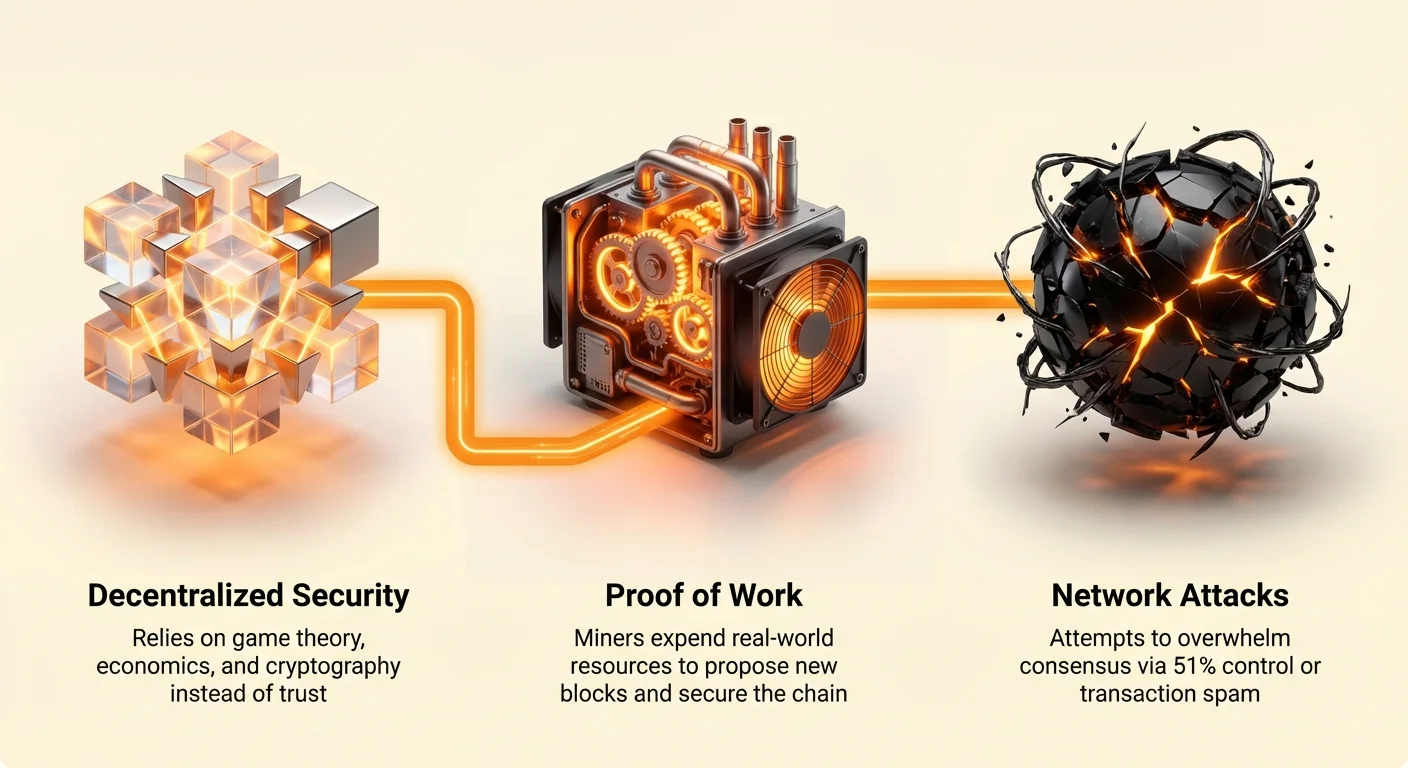
Network security in the realm of cryptocurrency operates differently than traditional cybersecurity. In centralized banking, security relies on firewalls, restricted access, and trusted employees. In decentralized networks like Bitcoin, security is a product of game theory, economics, and cryptography. The system assumes that participants do not trust one another. Therefore, the architecture must incentivize honest behavior while making malicious actions prohibitively expensive. The primary threats to this architecture are not password hacks, but rather attempts to overwhelm the consensus mechanism itself.
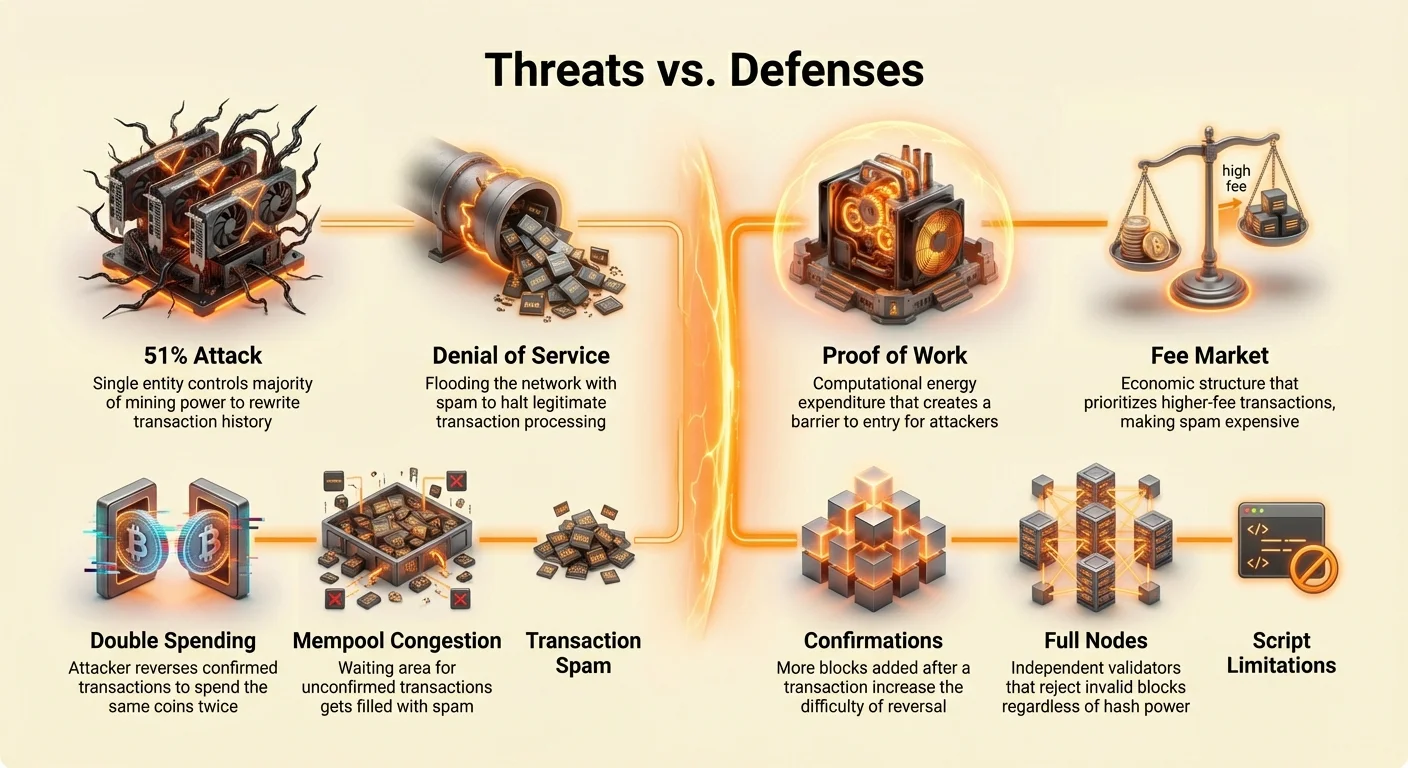
Two of the most significant structural risks to a blockchain are the 51% attack and Denial of Service (DoS) incidents. A 51% attack threatens the integrity of the ledger by allowing a single entity to rewrite transaction history. Denial of Service attacks aim to halt the network's ability to process legitimate transactions by clogging the system with spam. Understanding these risks requires a deep dive into the mechanics of mining, node validation, and the economic incentives that hold the network together.
The resilience of a blockchain is defined by how difficult it is to disrupt. This difficulty is measured in the computational power required to overtake the network or the financial cost necessary to spam it into stagnation. As cryptocurrencies evolve, the balance between operational efficiency and rigid security protocols remains the central challenge for developers and miners alike.
The Foundation of Consensus Security
The bedrock of Bitcoin’s security model is Proof of Work (PoW). This consensus mechanism requires network participants, known as miners, to solve complex mathematical puzzles to propose new blocks. This process is not arbitrary. It forces miners to expend real-world resources, specifically electricity and hardware, to participate in the network. This expenditure creates a barrier to entry for potential attackers. To modify the ledger, an attacker must replicate this work, which becomes exponentially more difficult as the network grows.
Proof of Work serves as a decentralized clock. It ensures that all participants agree on the order of transactions without needing a central authority. By linking blocks together cryptographically, the network creates an immutable chain. Changing a record in the past would require redoing the work for that block and every subsequent block. This makes historical alteration practically impossible on a mature network.
The security of this system relies on the distribution of mining power. If mining power is decentralized, no single group can dictate the state of the ledger. The competition for block rewards ensures that miners are constantly vying to find the next block. This race keeps the network secure because honest nodes will always reject invalid blocks, and honest miners will usually outpace an attacker who does not control a majority of the hash power.
Measuring Defense Through Hashrate
The total computational power dedicated to the network is known as hashrate. This metric serves as the primary indicator of a blockchain's physical security. Hashrate is measured in hashes per second, representing the number of calculations miners perform collectively to find a valid block hash. A higher hashrate implies a more secure network because it raises the threshold for a successful attack.
As the hashrate increases, the network automatically adjusts its difficulty. This difficulty adjustment occurs approximately every two weeks on the Bitcoin network. It ensures that blocks are produced roughly every ten minutes, regardless of how much computing power is online. This mechanism prevents miners from overwhelming the network and maintains a predictable supply schedule.
For an attacker, a high hashrate represents a massive financial wall. To challenge the network, they would need to acquire enough hardware and electricity to match the existing honest miners. On a network the size of Bitcoin, this involves billions of dollars in infrastructure and energy costs. This economic reality is what keeps the network secure against brute-force takeovers.
The Mechanics of a 51% Attack
A 51% attack occurs when a single entity or a colluding group acquires more than half of the network's mining power. With this majority control, the attacker possesses the ability to disrupt the consensus process. They cannot steal funds from other users' wallets, as they do not have the private keys required to sign those transactions. However, they gain control over the ordering of new transactions.
The primary power gained during such an attack is the ability to censor transactions. The attacker can choose to ignore specific transactions, effectively freezing assets by refusing to include them in blocks. Furthermore, they can mine blocks faster than the rest of the network combined. This allows them to create a longer chain of blocks in secret and then broadcast it to the network, overriding the honest chain.
This override capability is dangerous because of how blockchains resolve conflict. Nodes are programmed to accept the longest valid chain as the truth. If an attacker reveals a chain that is longer than the current public chain, nodes will switch to the attacker's version. This reorganization of the blockchain is the mechanism that enables double spending, the most severe financial consequence of a 51% attack.
The Double-Spend Vulnerability
Double spending is a problem unique to digital cash. In the physical world, you cannot hand the same five-dollar bill to two different people. In the digital realm, a file can be copied and sent to multiple recipients. Bitcoin solves this by maintaining a public ledger where every unit of currency is tracked. However, a 51% attack reintroduces this vulnerability by allowing an attacker to reverse confirmed transactions.
In a double-spend scenario, the attacker sends bitcoin to a merchant in exchange for goods or other assets. This transaction is included in the public blockchain. Simultaneously, the attacker mines a secret version of the blockchain where this transaction never happened. Instead, they include a transaction sending those same coins back to themselves.
Once the merchant accepts the payment and releases the goods, the attacker broadcasts their secret, longer chain. The network accepts this new chain as the truth. The transaction to the merchant disappears, replaced by the transaction returning the funds to the attacker. The merchant is left without the payment, and the attacker retains both the goods and the original cryptocurrency.
| Component | Public Chain Action | Attacker's Secret Chain |
|---|---|---|
| Transaction | Payment sent to Merchant | Payment sent to Self |
| Block Status | Confirmed and Visible | Mined privately |
| Final Outcome | Overwritten (Orphaned) | Accepted as Truth |
Confirmations as a Security Layer
To mitigate the risk of double spending, merchants and exchanges rely on confirmations. A confirmation occurs when a transaction is included in a block. Each subsequent block added to the chain represents another confirmation. The more confirmations a transaction has, the deeper it is buried in the blockchain's history.
Reversing a transaction with one confirmation requires overwriting one block. Reversing a transaction with six confirmations requires overwriting six blocks. Because the attacker must redo the Proof of Work for all those blocks while also outpacing the honest network, the difficulty increases exponentially with every new block.
For high-value transactions, recipients typically wait for six confirmations, which takes approximately one hour. This standard makes the cost of a double-spend attack exorbitantly high. An attacker would need to sustain 51% control for a full hour to reverse the transaction, incurring massive electricity costs and risking the devaluation of the very asset they are trying to steal.
Denial of Service and Transaction Spam
While 51% attacks target the integrity of the ledger, Denial of Service (DoS) attacks target the network's capacity. Every blockchain has a limit on the amount of data it can process per block. In Bitcoin, the block size is limited, which restricts the number of transactions that can be confirmed every ten minutes. A DoS attack attempts to fill this limited space with spam transactions.
By flooding the network with thousands of low-value or nonsense transactions, an attacker can clog the mempool. The mempool is the waiting area where unconfirmed transactions sit before miners pick them up. When the mempool is full, legitimate users must wait longer for their transactions to process.
This type of attack does not steal funds, but it damages the network's utility. If users cannot send money reliably, trust in the system erodes. In extreme cases, the network could become unusable for standard payments, as only users willing to pay exorbitant fees would be able to get their transactions confirmed.
The Fee Market as a Defense
Bitcoin employs a fee market to defend against spam and DoS attacks. Users attach a transaction fee to their payments to incentivize miners. Miners are profit-seeking entities. They will naturally prioritize transactions that offer the highest fees per byte of data. This economic structure acts as a filter for network usage.
In a spam attack, the attacker must pay fees for every transaction they broadcast. If they set the fees to zero, miners will simply ignore the spam. To actually clog the blocks, the attacker must pay fees competitive with legitimate users. This makes a sustained DoS attack incredibly expensive.
As the attacker floods the network, the demand for block space rises. Legitimate users respond by increasing their fees to jump the queue. The attacker must then raise their fees to maintain the congestion. This bidding war escalates the cost of the attack rapidly. Eventually, the attacker runs out of funds, or the cost becomes unjustifiable compared to the disruption caused.
Script Limitations and Processing Safety
Another vector for Denial of Service involves the computational resources of the nodes themselves. If a transaction required complex calculations to verify, an attacker could create a transaction that takes forever to process. This would freeze nodes across the network as they attempted to validate the malicious data.
Bitcoin mitigates this risk through its scripting language. Bitcoin Script is stack-based and intentionally limited. Crucially, it is not Turing-complete. This means it lacks certain complex programming functions, such as loops. A loop allows a program to repeat a task indefinitely. By removing loops, Bitcoin ensures that every transaction verification process has a definite end.
This design choice prioritizes security over flexibility. While it limits the ability to create complex smart contracts directly on the base layer, it ensures that no transaction can trap a node in an infinite processing cycle. This prevents attackers from crafting "poison pill" transactions that crash the software of validators.
The Role of Full Nodes
Miners produce blocks, but full nodes validate them. This distinction is vital for network security. A full node is a computer that stores the entire blockchain and enforces the rules of the protocol. These rules include checking that no coins are double-spent, that the block reward is correct, and that the transaction signatures are valid.
If a miner successfully performs a 51% attack and attempts to break the protocol rules—for example, by minting more bitcoin than allowed—the full nodes will reject the block. It does not matter if the attacker has 99% of the hash power. If the block violates the consensus rules, the nodes will treat it as invalid and refuse to propagate it.
This creates a system of checks and balances. Miners secure the order of transactions, but nodes define the validity of the network. Users running their own nodes contribute to this defense by independently verifying the ledger. This prevents miners from forcing unwanted changes onto the users, effectively stripping them of the power to alter the fundamental economics of the system.
Miner Incentives and Economic Security
The long-term security of the network depends on the profitability of mining. Miners are rewarded with newly minted bitcoin and transaction fees. This block reward is cut in half approximately every four years, an event known as the halving. The most recent halving reduced the reward to 3.125 bitcoins per block.
As the block reward decreases, miners become more dependent on transaction fees. If the price of bitcoin does not rise to compensate for the reduced reward, some miners may shut down their operations. This reduction in participation lowers the network's total hashrate.
A lower hashrate lowers the cost of a 51% attack. Therefore, the economic sustainability of mining is directly tied to security. The system relies on the assumption that the asset's value will grow or that transaction volume will generate sufficient fees to pay for the massive energy required to secure the chain.
Transaction Accelerators and Mempool Management
When network attacks or natural congestion occur, the mempool fills up. Legitimate transactions can get stuck in this backlog for hours or days if the attached fee is too low. This scenario highlights the practical impact of network security and capacity limits on the end user.
Transaction accelerators have emerged as a third-party solution to this problem. These services allow users to pay an extra fee to specific mining pools to prioritize a stuck transaction. By bypassing the standard mempool queue, accelerators ensure that a transaction is included in the next block regardless of its original fee.
While useful, reliance on accelerators indicates a congested network. It also introduces a centralized element, as users often must trust a specific service or mining pool. However, in the context of a DoS attack, accelerators provide a pathway for critical transactions to bypass the spam and achieve confirmation.
Future Security Considerations
As blockchain technology matures, the threat landscape evolves. The rise of mining pools has centralized hashrate, making the coordination required for a 51% attack theoretically easier. If a few large pools were to collude or be compromised, they could temporarily control the network. However, the game theory suggests that destroying trust in the network would devalue the very coins they are mining, providing a strong disincentive.
Layer-2 solutions like the Lightning Network move transactions off the main chain to improve scalability. This reduces the load on the main mempool, making DoS attacks on the base layer less effective at disrupting day-to-day payments. However, the security of these layers ultimately anchors back to the main blockchain.
The ongoing development of the protocol also plays a role. Upgrades like Taproot improve privacy and efficiency, allowing more transactions to fit into a block. This increases the "throughput" of the network, raising the bar for how much spam is needed to clog the system. Security is not a static state but a continuous arms race between defense mechanisms and potential attack vectors.
Conclusion
The security posture of a decentralized network is a complex interplay of cryptography, economics, and participation. Risks like 51% attacks and Denial of Service incidents highlight the inherent vulnerabilities of open systems. However, the design of protocols like Bitcoin counters these threats through rigid consensus mechanisms, fee markets, and the distribution of validation duties among nodes.
Proof of Work provides the physical barrier to entry, while the immutable ledger ensures that history cannot be easily altered without overwhelming cost. The inability to loop scripts prevents processing attacks, and the independence of full nodes ensures that even a majority of miners cannot violate the fundamental rules of the currency.
True network security is achieved when the cost of attacking the system vastly exceeds the potential rewards.