
Automated trading systems offer the potential for efficiency and continuous market engagement, yet they introduce specific vulnerabilities that manual trading does not face. Relying on algorithms to execute financial decisions requires a robust understanding of security protocols and risk management strategies. The integration of software, capital, and external exchanges creates a complex environment where a single oversight can lead to significant financial loss.
The appeal of trading bots lies in their ability to operate without fatigue or emotional interference. They can execute strategies like arbitrage, grid trading, and trend following with precision that humans cannot match. However, this autonomy means that errors, whether in code or strategy, are executed with equal speed. Without proper safeguards, a bot can drain a portfolio in minutes during a flash crash or technical malfunction.
Security in this context is not just about preventing external hacks. It encompasses the internal logic of the bot, the reliability of the exchange connection, and the operational security of the trader's environment. Risk management extends beyond setting stop-losses to include API management, exchange selection, and hardware hygiene. Understanding these layers is essential for anyone seeking to automate their cryptocurrency trading activities safely.
The Fundamentals of API Security
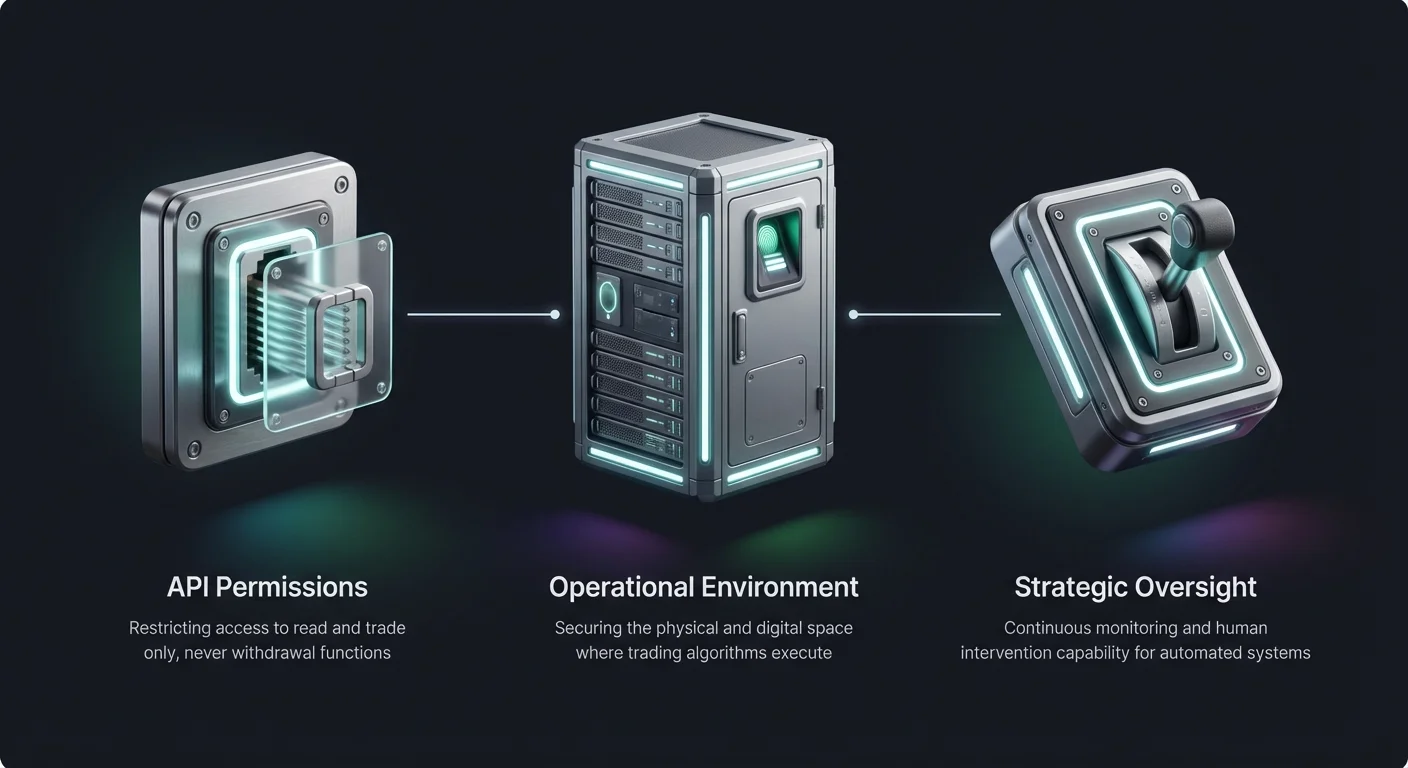
At the core of most trading bot architectures is the Application Programming Interface, or API. This is the bridge that allows your software to communicate with a cryptocurrency exchange. The API key acts as a username, while the API secret functions as a password. Protecting these credentials is the single most critical aspect of bot security. If a malicious actor gains access to these keys, they can potentially execute trades or withdraw funds without your direct login credentials.
The first rule of API management is the principle of least privilege. When generating keys on an exchange, you are typically presented with several permission options. These usually include "Read," "Trade," and "Withdraw." For a trading bot to function, it requires "Read" access to monitor market data and account balances. It also needs "Trade" access to place buy and sell orders. It rarely, if ever, needs "Withdraw" access.
Never enable withdrawal permissions for a trading bot API. There is almost no scenario where an automated algorithm should have the authority to move funds off the exchange. By leaving this permission disabled, you ensure that even if the keys are compromised, the attacker cannot transfer your assets to their own wallet. They might be able to execute nuisance trades, but the capital remains within the exchange's ecosystem, giving you time to intervene.
IP Whitelisting and key Restrictions
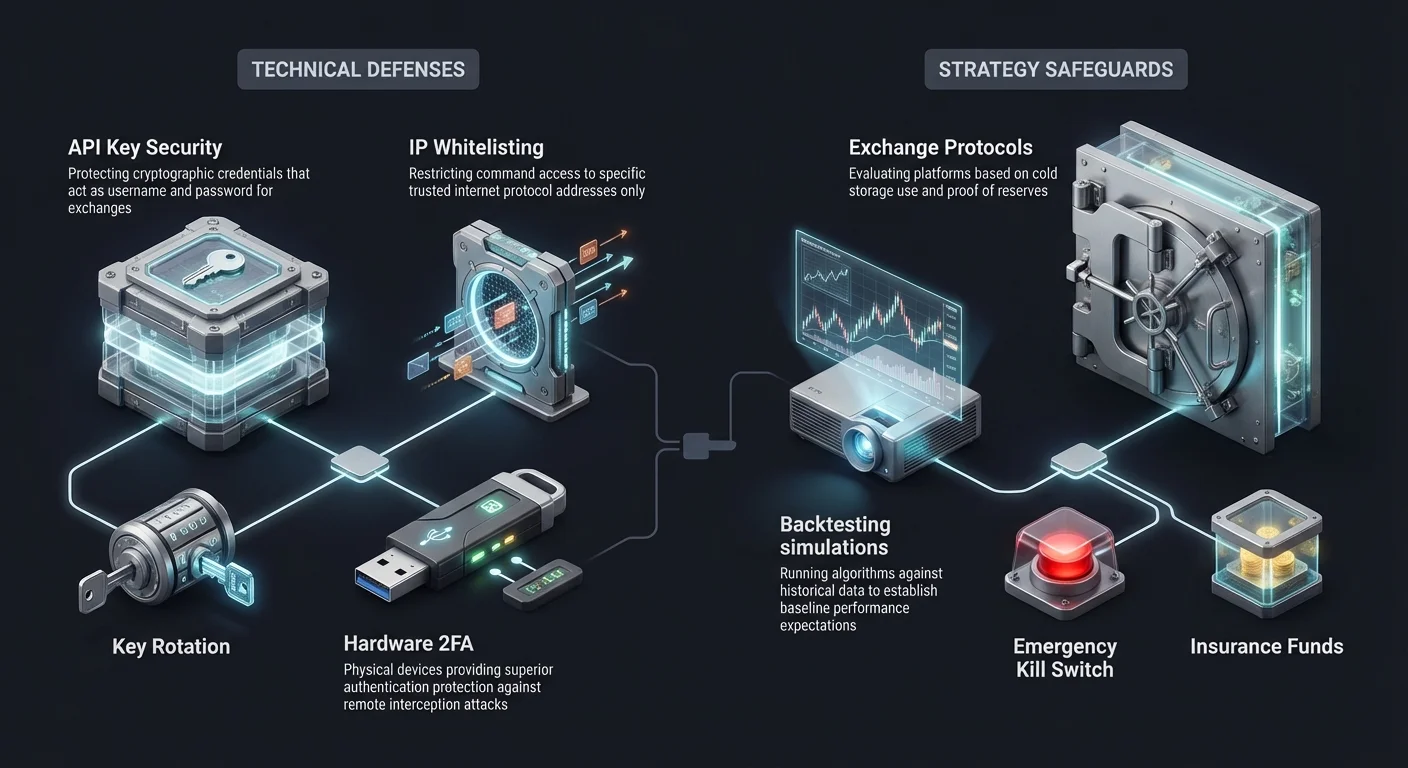
Restricting access to your API keys adds a powerful layer of defense. Most reputable exchanges offer IP whitelisting for API keys. This feature ensures that the exchange will only accept commands from a specific Internet Protocol (IP) address. If a request using your API keys originates from an unknown IP address, the exchange automatically rejects it. This renders stolen keys useless to a hacker unless they also control the specific device or server hosting the bot.
For traders running bots on a home computer, IP whitelisting can be challenging if the internet service provider assigns dynamic IP addresses that change frequently. In such cases, using a Virtual Private Network (VPN) with a static IP or hosting the bot on a Virtual Private Server (VPS) can provide a stable address for whitelisting. This setup ensures that the connection channel remains exclusive and secure.
Key rotation is another vital practice. Just as you update passwords periodically, you should regenerate API keys at regular intervals. This limits the window of opportunity for an attacker if a key has been silently compromised. If a bot platform or your own server suffers a security breach, old keys that have been rotated out will be invalid, protecting your account from unauthorized access.
| Security Measure | Function | Importance Level |
|---|---|---|
| Disable Withdrawals | Prevents funds from leaving the exchange | Critical |
| IP Whitelisting | Restricts access to specific locations | High |
| Key Rotation | Changes credentials periodically | Medium |
Operational Security for Bot Traders
While API security protects the connection, operational security (OpSec) protects the environment where the bot resides. Many traders run bots on personal computers, cloud servers, or third-party platforms. Each environment carries distinct risks. If you run a bot on a personal device, that machine becomes a high-value target for malware and keyloggers.
Securing a personal trading device requires rigorous hygiene. This includes keeping the operating system and antivirus software fully updated. It also involves avoiding risky behaviors such as downloading unverified software or clicking on suspicious links. A dedicated machine for trading, separate from the computer used for general browsing and gaming, significantly reduces the attack surface.
Cloud-based trading requires different considerations. When using a VPS or a third-party bot platform, you are trusting a remote server with your strategy and potentially your API secrets. It is crucial to enable Two-Factor Authentication (2FA) on any account associated with your trading infrastructure. This includes the login for the VPS provider, the bot platform, and the exchange itself.
Hardware keys (like YubiKeys) offer superior protection compared to SMS-based 2FA. SMS messages can be intercepted through SIM swapping attacks, where a hacker convinces a mobile carrier to transfer your phone number to their device. Authenticator apps or hardware keys generate codes locally or require physical presence, eliminating the risk of remote interception.
Assessing Exchange Security Measures
The security of a trading bot is inextricably linked to the security of the exchange it trades on. No matter how secure your bot is, if the exchange is compromised, your funds are at risk. Evaluating an exchange's security protocols is a mandatory step before connecting any automated system. Centralized exchanges (CEX) manage custody of your funds, meaning you must trust their internal security practices.
Look for exchanges that employ cold storage for the vast majority of their digital assets. Cold storage involves keeping private keys offline, disconnected from the internet, making them inaccessible to remote hackers. Top-tier exchanges typically keep 95% or more of user funds in cold storage, keeping only a small fraction in "hot wallets" to facilitate immediate liquidity for active trading.
Proof of Reserves (PoR) has become a standard expectation for transparent exchanges. This cryptographic verification allows users to confirm that the exchange actually holds the assets it claims to possess. While not a direct security feature against hacking, it protects against insolvency risk and internal mismanagement. A solvent exchange is less likely to halt withdrawals or collapse during market volatility.
Insurance funds are another critical feature. Reputable exchanges often maintain a dedicated fund to cover user losses in the event of a breach or technical failure on their end. While this does not guarantee a full refund in a catastrophic event, it provides a layer of financial buffer. Checking the history of an exchange regarding hacks and their response to security incidents provides insight into their reliability.
Decentralized Exchange Risks
Decentralized Exchanges (DEXs) offer an alternative to the custodial model of CEXs. In a DEX environment, users trade directly from their wallets via smart contracts. This eliminates the risk of an exchange operator stealing funds or losing them to a hack of the central wallet. However, DEX trading introduces smart contract risk.
Bots operating on DEXs interact directly with code on the blockchain. If the smart contract governing the liquidity pool or the swap mechanism contains a vulnerability/bug, it can be exploited. In such cases, funds approved for trading with that contract could be drained. This is distinct from CEX risks where the threat is usually account takeover or platform breach.
When using bots on a DEX, users must grant "token approval" to the smart contract. This permission allows the contract to spend tokens on the user's behalf. A common risk management oversight is granting "infinite approval," which allows the contract to spend an unlimited amount of tokens. If the contract is malicious or exploited, the wallet can be fully emptied. Revoking or limiting token approvals is a necessary maintenance task for DEX bot traders.
Strategy Risk and Market Volatility
Beyond technical security, the trading strategy itself acts as a source of risk. A bot is simply a set of instructions. If those instructions are flawed, the bot will efficiently execute a losing strategy. Market volatility is the primary adversary here. Cryptocurrency markets are known for rapid price swings, which can trigger unexpected behavior in automated systems.
Flash crashes, where the price of an asset drops significantly and recovers within minutes, can devastate certain strategies. For example, a bot programmed to sell when the price drops by 5% (a stop-loss) might exit a position at the bottom of a flash crash, locking in a loss just before the market rebounds. Conversely, a bot without a stop-loss might hold onto a crashing asset all the way to zero.
Overfitting is a common pitfall in strategy development. This occurs when a trader configures a bot based perfectly on past market data. While the bot performs flawlessly in backtests, it may fail in live trading because market conditions constantly evolve. A strategy that worked during a bull run in 2021 may be disastrous in a sideways market in 2025.
Grid Trading Risks
Grid trading is a popular strategy that profits from the fluctuation of price within a specific range. The bot places a web of buy and sell orders at set intervals. As the price moves up and down, the bot captures small profits. This strategy excels in sideways or "ranging" markets where the price oscillates without a strong trend. However, it carries specific risks that must be managed.
The primary risk in grid trading is a breakout from the grid range. If the price drops below the lowest buy order, the bot ceases to function and leaves the trader holding a bag of deprecating assets. This is similar to "impermanent loss" in liquidity provision. The trader accumulates the asset as its value falls, potentially resulting in a total value lower than if they had simply held stablecoins.
Conversely, if the price rises above the highest sell order, the bot will have sold all its positions. While this results in profit, the trader misses out on the continued upside potential. The risk here is "opportunity cost." To manage grid risks, traders use "stop-loss" orders below the grid to prevent deep losses during a market crash and "take-profit" levels to secure gains before a trend reversal.
Arbitrage Bot Vulnerabilities
Arbitrage involves buying an asset on one exchange where the price is low and selling it on another where the price is high. It is often perceived as a low-risk strategy because it capitalizes on price inefficiencies rather than market direction. However, execution risk in arbitrage is significant. The window of opportunity for these trades is often measured in seconds or milliseconds.
Latency is the enemy of arbitrage. If the bot receives price data with a slight delay, or if the trade execution lags, the price gap may close before the transaction is complete. This can result in "slippage," where the final execution price is worse than expected, turning a profitable trade into a loss. Network connectivity and exchange API speeds are critical variables.
Transfer times between exchanges also pose a risk for cross-exchange arbitrage. If a strategy requires moving funds from Exchange A to Exchange B to rebalance, a delay in the blockchain network or the exchange's processing can leave capital stuck in transit. during this time, market prices may shift drastically, negating the arbitrage opportunity and exposing the funds to volatility.
Fee structures must be meticulously calculated. Arbitrage relies on thin margins. Trading fees, withdrawal fees, and network gas fees can easily consume the entire profit of a trade. A bot that does not accurately account for dynamic fee structures may execute thousands of trades that bleed capital rather than accumulate it.
Copy Trading Risks and Dependency
Copy trading allows users to automate their portfolio by mirroring the moves of experienced traders. While this removes the need to develop a personal strategy, it introduces dependency risk. The follower relies entirely on the competence and emotional stability of the signal provider. If the lead trader tilts or makes a catastrophic error, the follower's bot instantly replicates that mistake.
Latency issues can also affect copy trading. By the time the leader's trade is broadcast, processed by the platform, and executed in the follower's account, the price may have moved. This is particularly damaging in fast-moving markets or with scalping strategies where entry price is everything. The follower often gets a worse entry price than the leader, leading to lower returns or losses over time.
Risk mismatch is another danger. A lead trader with a large portfolio might take risks that are mathematically sound for their capital size but ruinous for a smaller account. For instance, a leader might endure a 20% drawdown because they have reserves to cover it. A follower with a smaller margin balance might face liquidation at that same level. Followers must adjust position sizing and leverage to match their own risk tolerance, not just the leader's.
Backtesting and Paper Trading
Before deploying real capital, rigorously testing a bot is a fundamental risk management step. Backtesting involves running the bot's algorithm against historical market data to see how it would have performed. This provides a baseline for expected returns and drawdowns. However, historical performance is never a guarantee of future results.
Paper trading, or forward testing, offers a more realistic simulation. In this mode, the bot runs on live market data but uses virtual funds. This allows the trader to observe how the bot handles real-time latency, order book depth, and fee calculations without financial risk. It helps identify technical bugs or logic errors that backtesting might miss due to idealized data.
Traders should allocate a significant period to paper trading—often weeks or months—to ensure the bot performs consistently across different market conditions (e.g., weekends vs. weekdays, high volatility vs. low volatility). Jumping straight into live trading with a new script is a violation of basic risk management principles.
Monitoring and Human Oversight
Automation does not imply abandonment. "Set it and forget it" is a dangerous mindset in crypto trading. Continuous monitoring is required to ensure the bot is operating correctly and that the underlying strategy remains valid. Technical failures, such as API disconnections or server crashes, require immediate human intervention to resolve.
Traders should establish a routine for checking bot performance. This might involve daily reviews of trade logs, profit/loss statements, and error reports. Many modern bot platforms offer mobile notifications or email alerts for significant events, such as a filled order or a steep drawdown. Enabling these alerts allows for faster reaction times.
An "emergency kill switch" is a vital component of any automated setup. This is a mechanism to instantly stop all bot activity and cancel open orders. In the event of a flash crash, a hack, or a malfunction where the bot starts spamming orders, the trader must be able to pull the plug immediately. Knowing exactly how to shut down the system under pressure is a key part of operational readiness.
Diversification in Automated Trading
Diversification is a cornerstone of investment theory and applies equally to bot trading. Relying on a single bot running a single strategy on a single pair creates a single point of failure. If that specific market turns unfavorable or the strategy breaks, the entire portfolio suffers. Spreading risk across different vectors stabilizes long-term performance.
Strategy diversification involves running different types of bots simultaneously. For example, a trader might run a grid bot on a stable pair like BTC/USDT to harvest volatility, while running a trend-following bot on ETH/USDT to capture upside moves. If the market trends strongly, the grid bot might pause or lose efficiency, but the trend bot compensates. If the market ranges, the grid bot generates profit while the trend bot remains idle.
Asset diversification reduces exposure to the idiosyncratic risk of specific coins. Running bots on a basket of top-tier assets (like Bitcoin, Ethereum, and major Layer 1 tokens) protects against the failure of any single project. However, traders must be wary of correlation. Since the crypto market often moves in unison, diversifying across highly correlated assets provides less protection than diversifying across different strategies.
Regulatory and Compliance Risks
The regulatory landscape for cryptocurrency is evolving efficiently. Changes in laws can impact the viability of certain trading bots. For instance, if a jurisdiction bans the trading of privacy coins or restricts leverage, a bot programmed to trade those assets may face legal hurdles or exchange-enforced blocks.
Compliance also extends to tax reporting. High-frequency trading bots can generate tens of thousands of transactions in a single year. Calculating the capital gains and losses for each trade manually is impossible. Traders must ensure they have robust tax software capable of ingesting the massive data logs generated by their bots. Failure to accurately report automated trading activity can lead to significant fines and legal trouble.
Know Your Customer (KYC) requirements on exchanges can also pose a risk if an account is suddenly flagged for re-verification. If an exchange freezes an account for a compliance check while a bot is active, the trader may be unable to close losing positions. Ensuring all KYC documentation is up to date and using reputable exchanges with clear compliance policies mitigates this operational risk.
Conclusion
Security and risk management for crypto trading bots is a multi-faceted discipline that merges cybersecurity with financial prudence. It begins with the secure handling of API keys, ensuring permissions are restricted and access is whitelisted. It extends to the choice of exchange, prioritizing platforms with proven track records, cold storage protocols, and insurance funds. Operational security protects the physical and digital environment where the trading algorithms live.
Beyond technical defenses, managing the inherent risks of automated strategies is crucial. Whether using grid, arbitrage, or copy trading bots, understanding the specific vulnerabilities of each method allows traders to set appropriate safeguards. Regular monitoring, rigorous backtesting, and the ability to intervene manually prevent minor errors from becoming major catastrophes. Automation is a tool for execution, not a replacement for strategic oversight.
Effective bot trading requires treating security not as a feature, but as the foundation of every strategy.