Entering the world of cryptocurrency trading requires more than just capital and a strategy. The fundamental step involves selecting the venue where transactions occur. This decision dictates the security of your assets, the fees you pay, and the tools available for execution.
A trading platform acts as the bridge between your digital wallet and the broader market. It is the infrastructure that facilitates the exchange of value. For beginners, this choice often determines the entire user experience and the safety of their initial investment.
Understanding the mechanics behind these platforms is essential. You must comprehend how they match buyers and sellers and how they handle custody of funds. The distinction between centralized and decentralized models creates vastly different responsibilities for the trader.
Security remains the paramount concern in this selection process. A platform might offer advanced charting or low fees, but those features matter little if the underlying infrastructure is vulnerable. Traders must prioritize protecting their capital above all else.
The Centralized Exchange Model
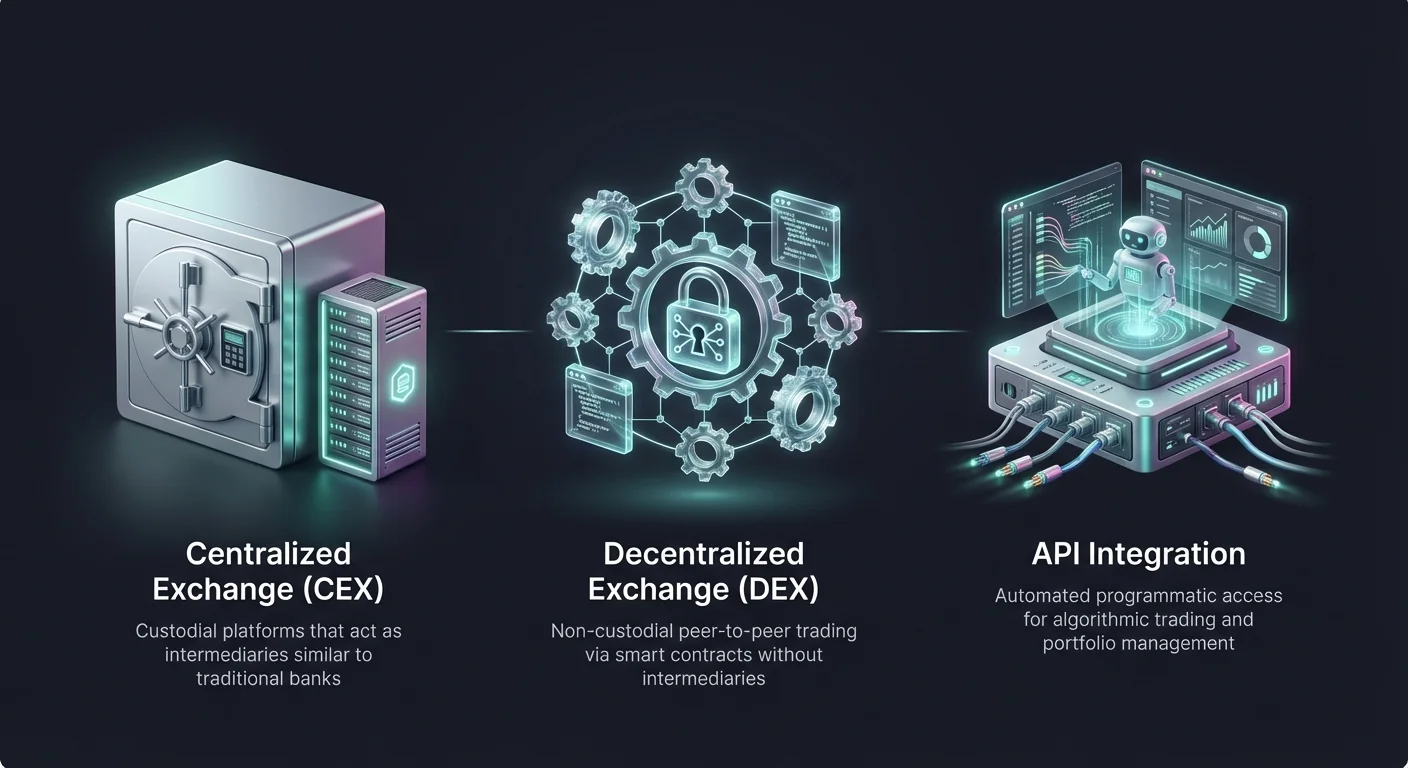
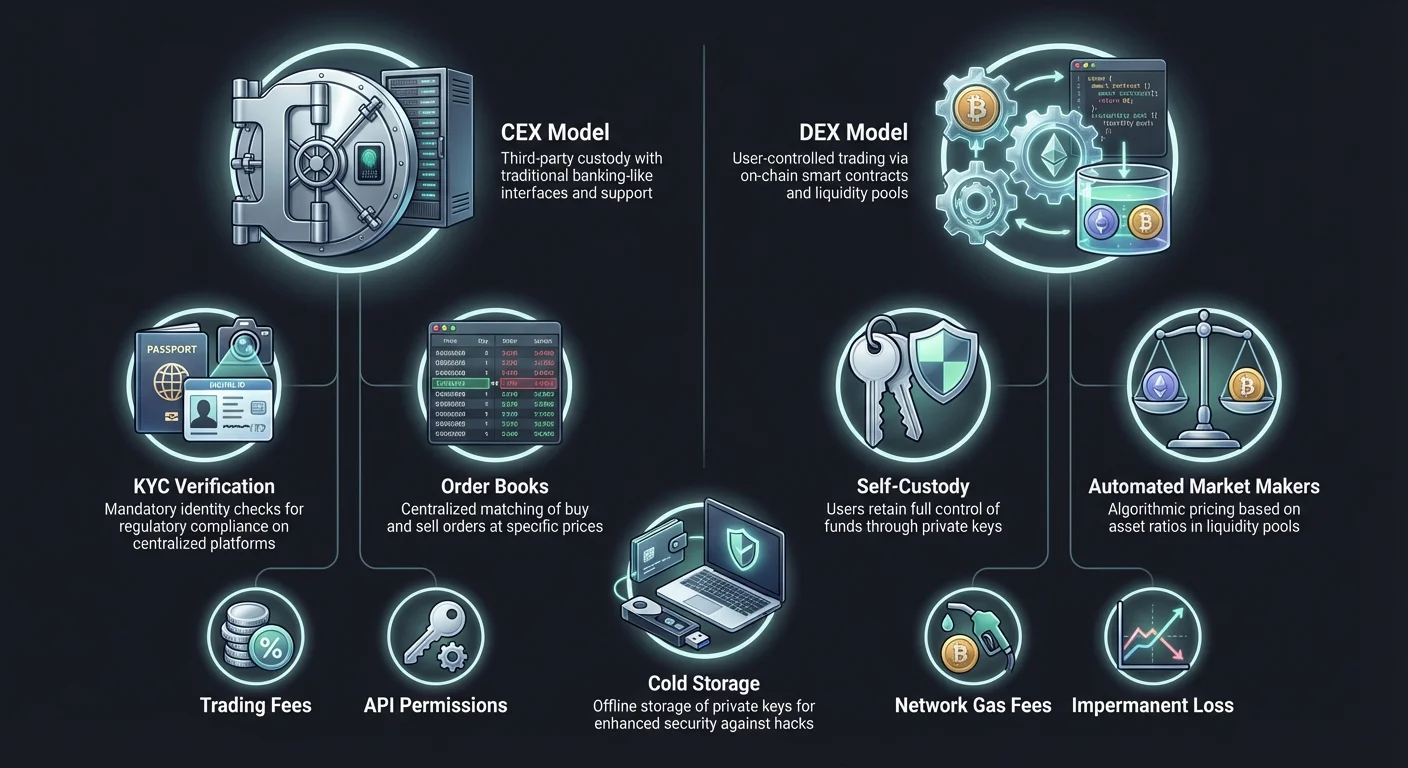
A centralized exchange (CEX) operates as a traditional business. It functions similarly to a stock brokerage or a bank. The platform is owned by a private company that manages the infrastructure and facilitates trades between users.
When you use a CEX, you are trusting a third party with your funds. You deposit fiat currency or cryptocurrency into a wallet controlled by the exchange. The exchange then holds these assets in custody while you trade.
This custodial model offers convenience. If you lose your password, the exchange can help you recover your account. They generally offer customer support and user-friendly interfaces that mimic traditional banking apps.
However, the custodial nature introduces risk. Since the exchange holds the private keys to the wallets, your funds are only as safe as the exchange's security measures. History includes several instances of exchanges facing insolvency or security breaches.
Regulatory Compliance and Identity Verification
Centralized exchanges must adhere to the laws of the jurisdictions in which they operate. This compliance creates a structured environment that often requires users to prove their identity. This process is known as Know Your Customer (KYC).
Regulatory bodies impose these AML/KYC requirements to prevent money laundering, terror financing, and tax evasion. A compliant exchange cannot allow anonymous trading. Users must complete a registration process before accessing full trading features.
The verification process typically involves uploading government-issued identification. This might be a passport or a driver's license. Some platforms require a selfie with the ID to prove physical possession of the document.
"Lite" verification might allow small trades with just an email address. However, withdrawing significant funds usually triggers stricter ID requirements. Traders concerned with privacy often find these requirements intrusive, but they are standard for compliant, banked exchanges.
Order Books and Market Makers
Centralized platforms use an order book model to determine prices. This is a digital list of buy and sell orders organized by price level. The exchange's engine matches a buyer willing to pay a certain price with a seller asking for that amount.
Users who place orders that do not fill immediately are called "makers." They add liquidity to the order book. Users who accept existing orders are called "takers," as they remove liquidity from the book.
Market makers play a crucial role in this ecosystem. These are entities or individuals who place both buy and sell orders to ensure there is always someone to trade with. They help maintain a stable market price and reduce the gap between buying and selling rates.
The Decentralized Alternative
Decentralized exchanges (DEXs) offer a fundamental shift in how trading occurs. Unlike their centralized counterparts, DEXs operate without a central authority or company managing the transactions. They run on code known as smart contracts.
The defining feature of a DEX is self-custody. You do not deposit funds into an exchange account. Instead, you trade directly from your own private wallet. You retain full control of your private keys throughout the entire process.
This model eliminates the risk of an exchange freezing your funds or going bankrupt. There is no registration process and no identity verification. Anyone with an internet connection and a compatible wallet can participate.
However, this freedom comes with responsibility. If you lose access to your wallet or make a mistake in a transaction, there is no customer support to assist you. The code executes exactly as written, for better or worse.
Automated Market Makers
Most modern DEXs do not use order books. Instead, they utilize a system called an Automated Market Maker (AMM). This innovation allows for decentralized trading without the need for traditional market makers.
AMMs rely on liquidity pools. These are smart contracts where users deposit pairs of tokens. For example, a pool might contain equal values of Ethereum and a stablecoin.
Pricing is determined algorithmically. A constant formula adjusts the price based on the ratio of assets in the pool. As users buy one asset from the pool, its supply decreases, and its price rises relative to the other asset.
Connecting via Web3 Wallets
Connecting to a DEX requires a Web3-enabled wallet rather than a username and password. This connection allows the website to view your public address and request approval for transactions. The site never sees your private key.
The connection process is usually instant. You click "Connect Wallet," approve the connection in your browser extension or mobile app, and you are ready to trade. This is a frictionless experience compared to the multi-step signup of centralized platforms.
However, users must remain vigilant against phishing sites. Malicious websites can mimic legitimate DEXs. If you connect your wallet to a scam site and approve a malicious contract, the attackers can drain your funds.
The Role of Application Programming Interfaces
For advanced traders, the graphical user interface is often insufficient. They require speed and automation. This is where Application Programming Interfaces (APIs) become critical.
An API allows two pieces of software to talk to each other. In trading, it allows a user's custom software or a third-party bot to communicate directly with the exchange's matching engine.
This connection bypasses the visual website. It enables algorithmic trading, where computer programs execute trades based on predefined criteria. This occurs much faster than a human could click a mouse.
Many professional traders use APIs to connect their accounts to portfolio management dashboards. This aggregates data from multiple exchanges into a single view. It simplifies tracking performance across a diverse portfolio.
Managing API Security Permissions
Connecting via API introduces a new vector of security risk. When you generate an API key on an exchange, you are creating a digital credential that grants access to your account. If these keys are stolen, an attacker can control your funds.
Exchanges mitigate this by offering granular permission settings. When creating a key, you can define exactly what it is allowed to do. The most basic level is "Read-Only," which allows the software to see balances but not move them.
The next level permits "Spot Trading." This allows the software to place buy and sell orders. This is necessary for trading bots but carries the risk of an attacker making bad trades to drain value.
The most dangerous permission is "Withdrawal." You should almost never grant withdrawal permissions to an API key. If a hacker acquires a key with withdrawal access, they can instantly transfer your entire balance to their own wallet.
Liquidity and Trade Execution
Liquidity is the lifeblood of any trading platform. It refers to how easily an asset can be bought or sold without causing a drastic change in its price. High liquidity is essential for efficient trading.
In a liquid market, you can sell a large amount of Bitcoin without crashing the price. In an illiquid market, even a small sell order might push the price down significantly. This creates a phenomenon known as slippage.
Slippage is the difference between the expected price of a trade and the price at which it actually executes. It occurs most frequently on DEXs or smaller centralized exchanges with thin order books.
Day traders must prioritize platforms with deep liquidity. High volume indicates that many buyers and sellers are active. This ensures that market orders fill instantly and at predictable prices.
Fee Structures and Cost Analysis
Every platform charges for its services, but the structures vary. Understanding these costs is vital for profitability. High fees can eat away at the margins of a successful trading strategy.
Centralized exchanges typically charge trading fees based on your monthly volume. They often use a maker-taker model. Makers pay lower fees because they provide liquidity, while takers pay higher fees for removing it.
Withdrawal fees are another cost to consider. Most exchanges charge a flat fee to move crypto off their platform. This fee covers the network cost but often includes a profit margin for the exchange.
On decentralized exchanges, you pay network gas fees rather than platform trading fees. On a congested network like Ethereum, a single swap can cost significantly more than a trade on a centralized platform.
| Feature | Centralized Exchange (CEX) | Decentralized Exchange (DEX) |
|---|---|---|
| Custody | Exchange holds funds | Self-custody (You hold funds) |
| ID Checks | Mandatory (KYC/AML) | None (Anonymous) |
| Fees | Trading % + Withdrawal fee | Network Gas fees |
Volatility and Risk Management
Cryptocurrency markets are notoriously volatile. Prices can swing dramatically in short periods. Your platform choice impacts your ability to manage this volatility.
During periods of extreme market stress, centralized exchanges may experience downtime. High traffic can overwhelm their servers. This prevents traders from logging in to adjust positions or panic sell.
DEXs generally remain operational as long as the underlying blockchain is running. However, network congestion can make transactions prohibitively expensive or slow to confirm during these times.
Risk management tools are integrated into most platforms. Stop-loss orders are essential for protecting capital. These orders automatically sell an asset if its price drops to a certain level.
Leveraging Advanced Order Types
Basic buying and selling are known as "market orders." You accept the current best price available. While fast, this offers no price protection.
Limit orders allow you to set a specific price at which you are willing to buy or sell. The trade will only execute if the market reaches your price. This is crucial for disciplined trading strategies.
Margin trading introduces borrowed funds to increase position size. This is available on many CEXs and some advanced DEXs. While it amplifies potential profits, it also magnifies losses.
Liquidation is a risk specific to margin trading. If the market moves against your leveraged position, the exchange will automatically close your trade to recover the borrowed funds. You can lose your entire collateral.
Security Hygiene for Traders
Regardless of the platform, personal security habits are the final line of defense. Using strong, unique passwords for every exchange account is a mandatory baseline. Password managers can help generate and store these securely.
Two-factor authentication (2FA) should be enabled on every account. SMS verification is better than nothing, but it is vulnerable to SIM swapping attacks. App-based authenticators or hardware security keys offer superior protection.
Phishing remains a primary threat. Attackers create fake emails or websites that look identical to real ones. Always bookmark your exchange's official URL and never click on suspicious links in emails or social media.
For substantial holdings, cold storage is recommended. This involves moving assets off the exchange and into a hardware wallet. These devices keep private keys offline, immune to remote hacks.
Understanding Impermanent Loss
For those participating in DEX liquidity pools, a unique risk exists called impermanent loss. This occurs when the price of your deposited tokens changes compared to when you deposited them.
Because the AMM algorithm constantly rebalances the ratio of tokens, you may end up with less of the appreciating asset. Often, simply holding the tokens in a wallet would have resulted in a higher value than providing liquidity.
The loss is considered "impermanent" because it disappears if the prices return to their original ratio. However, if you withdraw your funds while the prices are different, the loss becomes permanent.
Stablecoin pairs are often used to mitigate this risk. Since stablecoins are pegged to a value, their prices rarely diverge. This drastically reduces the likelihood of impermanent loss for liquidity providers.
The Future of Hybrid Models
The industry is seeing a convergence of features. Centralized exchanges are integrating Web3 wallets and decentralized products. Conversely, DEXs are improving their user interfaces to match the ease of use of CEXs.
"Banked" exchanges are bridging the gap between fiat and crypto. They allow direct bank transfers and credit card purchases. This fiat on-ramp is a critical feature for new entrants who do not yet own cryptocurrency.
Aggregators are simplifying the DEX experience. These tools scan multiple exchanges to find the best price and lowest fees for a trade. They handle the complex routing behind the scenes.
As technology evolves, we may see more hybrid approaches. These aims to offer the security of self-custody with the speed and liquidity of centralized matching engines.
Conclusion
Selecting a trading platform is a foundational step that dictates your security, costs, and capabilities in the crypto market. Centralized exchanges offer a familiar, bank-like experience with customer support and fiat integration, but they require trusting a third party with your assets. Decentralized exchanges provide autonomy and privacy through code and smart contracts, yet they demand a higher level of technical responsibility from the user.
The connection method you choose—whether a simple login, a Web3 wallet injection, or an API integration—carries its own set of risks and operational requirements. Security must remain the constant priority across all interactions. By utilizing tools like 2FA, cold storage, and restricted API permissions, traders can mitigate the inherent risks of the digital asset landscape while leveraging the powerful technologies available to them.
Your platform choice is not just about fees; it is a decision about how much responsibility you are willing to take for your own financial sovereignty.