
The world of venture capital (VC)—the engine that funds the world’s most ambitious startups—is rapidly evolving. For decades, venture investing was strictly a club reserved for large institutional players, university endowments, and a select few high-net-worth individuals. Crypto, however, is fundamentally democratizing access to private deals through innovative structures like investment syndicates and Decentralized Autonomous Organizations (DAOs).
While these new models offer unprecedented speed and accessibility, they also introduce complex legal and regulatory challenges, particularly when dealing with the requirement for investors to be "accredited." Understanding how decentralized fundraising models operate while navigating global securities laws is crucial for any sophisticated investor looking to enter this space.
This guide provides an overview of crypto syndicates and DAO venture funds, focusing specifically on the critical compliance hurdles necessary to operate legally and effectively in the realm of decentralized private capital.
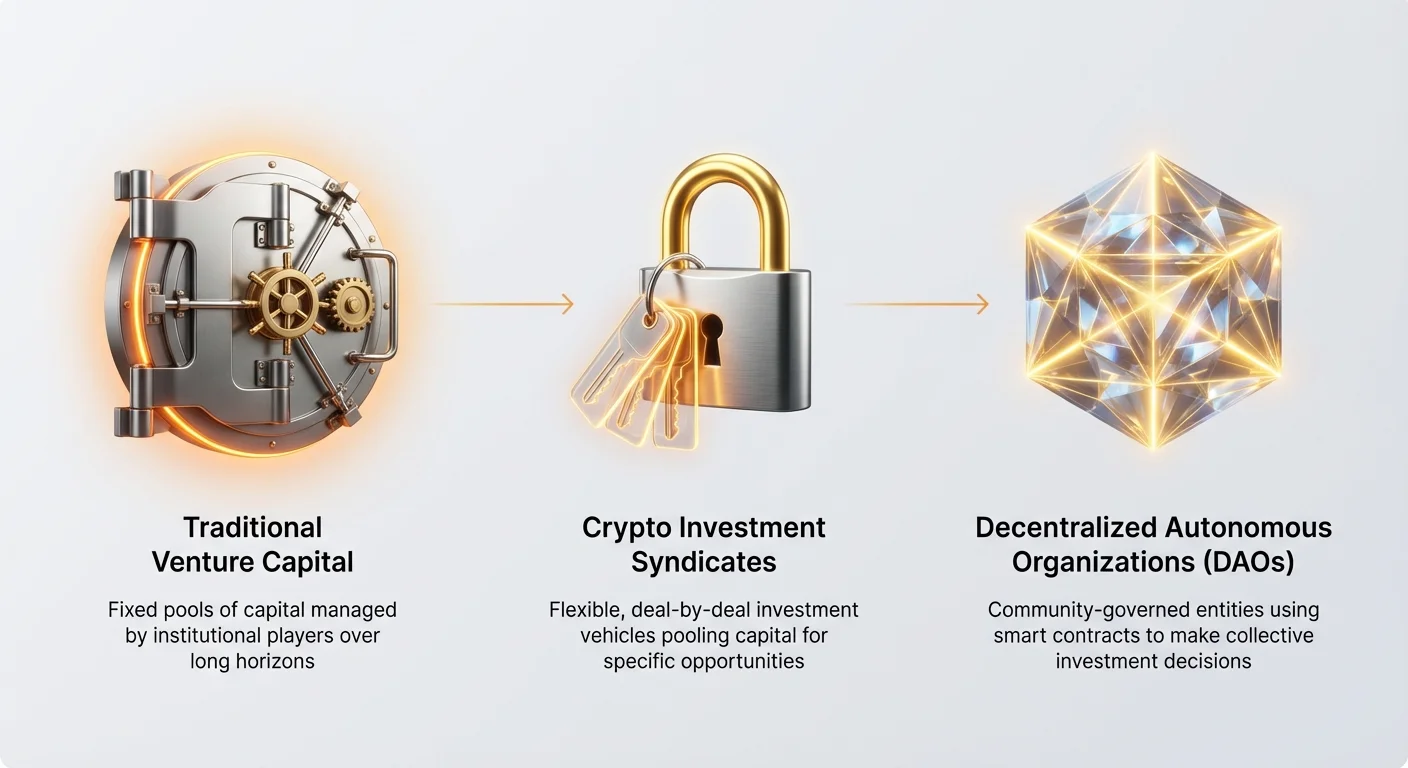
The Evolution of Venture Capital: From Funds to Syndicates
Traditional VC funds raise a fixed pool of capital over several years and invest it at their discretion. Investment syndicates offer a more flexible, deal-by-deal approach, allowing sophisticated investors to participate only in the specific companies they believe in.
What is a Crypto Investment Syndicate?
A syndicate, in the context of crypto venture investing, is a temporary, pooled vehicle designed to invest in a single, specific private company or token sale.
Typically, a syndicate is managed by a "lead investor" or "syndicate head"—often a well-connected individual or firm—who finds the deal, conducts due diligence, and negotiates the terms. The syndicate head then opens the deal to a network of smaller investors (known as Limited Partners, or LPs) who pool their capital for that specific investment.
To facilitate this pooling, the syndicate usually wraps the transaction in a legal entity called a Special Purpose Vehicle (SPV). This SPV holds the investment and distributes future returns. In the crypto space, these SPVs might be tokenized, meaning the investors receive a proportional token representing their ownership interest in the SPV, making the carried interest and ownership trackable on-chain.
Key Benefits of Syndicated Investing
Syndicates lower the traditional barriers to entry for high-quality private deals.
- Access to Premium Deals: The best startups often limit access to capital raises. Syndicates allow smaller accredited investors to gain exposure to deals they would never access alone, piggybacking on the reputation and network of the lead investor.
- Flexibility: Unlike a traditional 10-year closed fund commitment, syndicate investors only commit capital when a specific deal is presented.
- Diversification: Investors can allocate smaller amounts across numerous high-conviction deals, diversifying their portfolio against the binary nature of startup investing (where most companies fail, but a few generate massive returns).
Decentralized Autonomous Organizations (DAOs) as Venture Investors
The most radical change to fundraising comes from DAOs, which utilize blockchain technology to create transparent, community-governed treasuries capable of making large-scale investment decisions. When a DAO focuses its treasury on acquiring equity or tokens in early-stage projects, it is functioning as a DAO venture investing vehicle.
The Mechanics of DAO Venture Funding
In a DAO venture model, the capital is not managed by a small group of general partners but by the collective community holding the DAO’s governance token.
- Capital Pooling: Investors contribute crypto assets (ETH, USDC, etc.) to the DAO’s decentralized smart contract treasury.
- Proposal Submission: A community member or internal investment committee identifies a potential investment target (e.g., a new DeFi protocol). They submit a formal proposal to the DAO outlining the terms, valuation, and thesis.
- On-Chain Voting: DAO members vote on the proposal using their governance tokens. If the proposal reaches the required quorum and threshold, the smart contract automatically executes the investment, transferring funds from the treasury to the target company.
This process is highly transparent and resistant to single points of failure, but it introduces significant friction in speed and compliance.
Governance Challenges in DAO Investing
While democratic, DAO venture investing struggles with the demands of traditional startup deals:
- Speed of Execution: Startup deals often close quickly. A DAO’s multi-day or multi-week voting process can cause it to miss competitive investment rounds.
- Anonymity vs. KYC: Traditional equity investment requires the identity of the investor (the DAO, or the entity representing the DAO) to be disclosed and verified. This clashes with the pseudonymity often preferred by DAO participants.
- Liability and Structure: If a DAO is deemed an unregistered general partnership or fund in a major jurisdiction (like the U.S.), the individual token holders could potentially face personal liability for the DAO’s actions. Establishing a legally compliant "off-chain wrapper" (like an LLC or Foundation) is often necessary to shield members and interface with traditional legal contracts.
Navigating the Regulatory Landscape: The Role of the Accredited Investor
The primary hurdle for both syndicates and DAOs is satisfying securities regulations designed to protect the general public from risky, non-transparent investments. In most jurisdictions, high-risk private placements are restricted to individuals deemed financially sophisticated enough to absorb potential losses: the accredited investor.
Defining the Accredited Investor
In the U.S., the Securities and Exchange Commission (SEC) defines an accredited investor based on strict financial criteria, intended to ensure the individual has a high level of financial literacy and wealth.
To qualify as an accredited investor, an individual must generally meet one of the following criteria:
- Income Test: Earned income exceeding $200,000 in each of the two most recent years (or $300,000 jointly with a spouse) and having a reasonable expectation of reaching the same income level in the current year.
- Net Worth Test: A net worth exceeding $1 million, either individually or jointly with a spouse (excluding the value of the primary residence).
The core purpose of this definition is straightforward: since private deals do not offer the extensive public disclosures mandated for publicly traded stocks, regulators limit participation to those who can afford professional advice and are capable of performing complex due diligence.
Regulation D (Reg D) and Private Placements
For U.S.-based crypto investment syndicates and funds, compliance largely revolves around Regulation D of the Securities Act of 1933. Reg D provides several exemptions that allow companies to raise capital without registering the offering with the SEC, provided they meet specific rules:
- Rule 506(b): Allows the syndicate to raise an unlimited amount of capital from an unlimited number of accredited investors. However, this exemption prohibits "general solicitation" (public advertising). The syndicate manager must already have a pre-existing relationship with the investors.
- Rule 506(c): Allows for general solicitation (public advertising of the deal). However, this rule requires the syndicate manager to take "reasonable steps to verify" that all purchasers are accredited investors.
The enforcement of this verification requirement is where decentralized funding models run into friction. Simply having a decentralized token pool does not eliminate the need for the syndicate manager (or the DAO’s legal wrapper) to collect personal information (KYC/AML) and verify the investor’s financial status before accepting funds.
Global Compliance and Regulation S
Crypto investment syndicates rarely restrict their offerings to a single country. For international fundraising, Regulation S becomes critical.
Regulation S governs offers and sales of securities that occur outside the United States. If a syndicate strictly limits the offering to non-U.S. persons and ensures the transaction takes place offshore, the offering is generally exempt from U.S. registration requirements.
For decentralized models, this means:
- Geolocation Blocking: Implementing technical controls (like IP address blocking or wallet-based verification) to prevent U.S. persons from participating in the offering.
- Affirmative Representation: Requiring all investors, regardless of location, to formally attest that they are not U.S. persons or are otherwise qualified under Regulation S.
However, if a DAO or syndicate fails to adequately block U.S. participation, they risk subjecting the entire offering to U.S. securities laws, potentially resulting in severe penalties for offering unregistered securities.
Operationalizing Crypto Syndication: On-Chain vs. Off-Chain Compliance
The tension between regulatory reality and decentralized ideals is most evident in the operational structure of crypto investment syndicates. The structure defines how the syndicate collects capital, verifies identity, and distributes returns.
Off-Chain Syndicates: The Hybrid Model
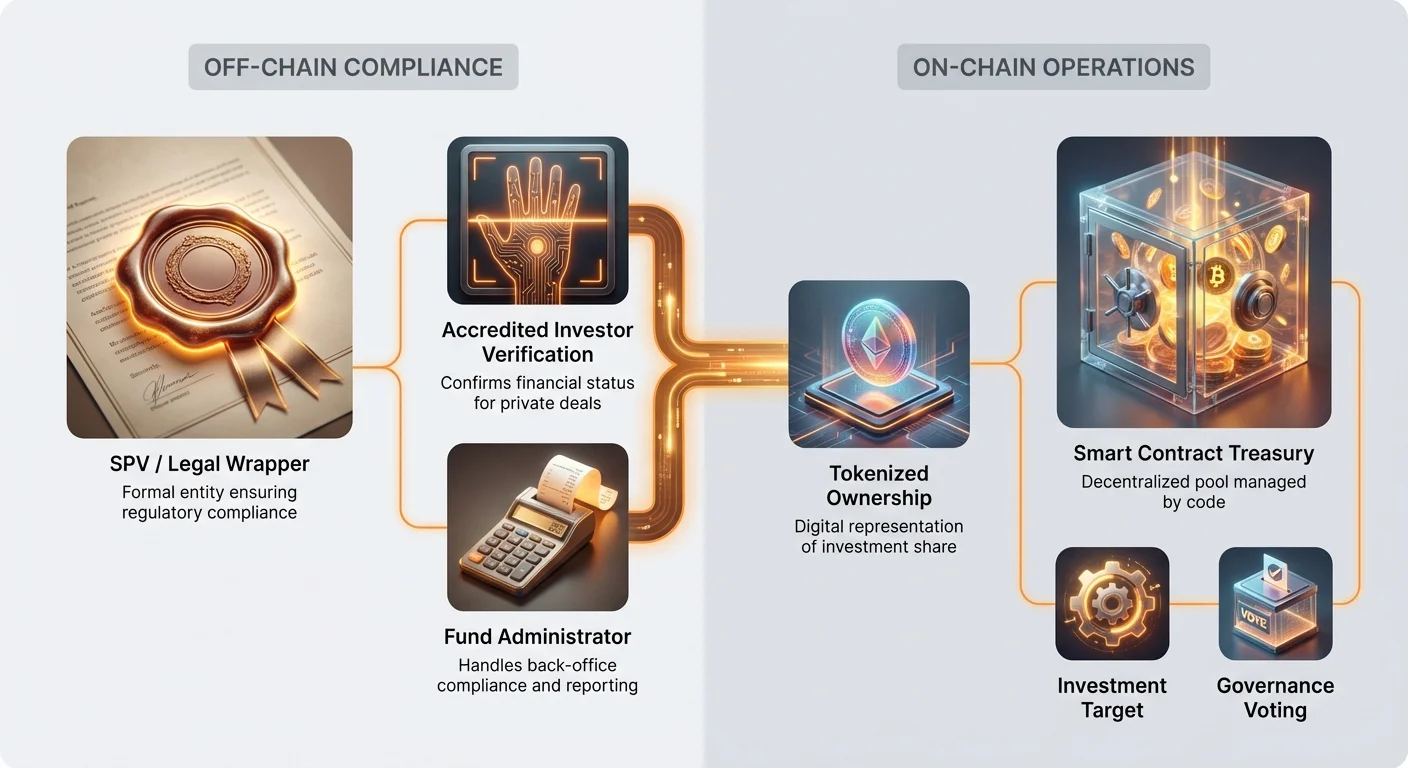
Most professional, legally compliant crypto syndicates operate using a hybrid model: the legal structure is off-chain, but the underlying assets and transactions are often managed on-chain.
Structure components:
- The Legal Wrapper: A formal legal entity (SPV, LLC, Cayman Foundation, etc.) is established in a favorable jurisdiction. This entity is the legal signatory on the investment documents.
- Fund Administrator: A trusted third party (an administrator) handles the back-office compliance, including verifying the accredited status of every LP, processing KYC/AML checks, and managing tax reporting.
- Tokenized Ownership: While the compliance is handled off-chain, the SPV might issue a token to LPs representing their pro-rata share of the investment. This token simplifies the tracking of ownership and the future distribution of carried interest (the fund manager’s share of profits).
This hybrid approach ensures full compliance with Reg D/S while leveraging blockchain efficiency for transparent tracking and easier secondary transfer potential (provided regulatory restrictions on transferability are met).
On-Chain Syndicates: Regulatory Friction
A purely on-chain syndicate attempts to automate the entire fundraising process via smart contracts without requiring centralized intermediaries for verification. This model faces substantial regulatory friction:
- Verifying Wallet Owners: How does a smart contract independently verify that the anonymous wallet sending capital belongs to a legally verified accredited investor who is not a sanctioned person? Without a mechanism to link the public wallet address to a verified, real-world identity, the syndicate cannot meet the basic requirements of KYC/AML and Reg D.
- Enforcement: Traditional venture investments involve legal contracts (SAFTs, SAFE notes, Equity agreements). If the investment goes wrong, enforcement and dispute resolution rely on the legal jurisdiction of the SPV. A purely on-chain pool lacks the centralized legal nexus required for enforcement.
Tip: Any decentralized fundraising vehicle that requires participants to verify their identity and accreditation status using a trusted third-party service (often called a 'token gating service' or 'KYC provider') is demonstrating a commitment to compliance, even if the capital pooling is decentralized.
Key Compliance Risks for Decentralized Funds
The consequences of failing to meet regulatory obligations are severe, impacting both the fund manager and the investors.
- Unregistered Securities Offering: The greatest risk is that regulators classify the syndicate’s investment opportunity (the tokens or partnership interests) as an illegal, unregistered security offering.
- Anti-Money Laundering (AML) Violations: If a fund fails to perform adequate KYC/AML on its investors, it risks facilitating illicit financial activity, resulting in massive fines and potential criminal prosecution.
- Commingling of Assets: Funds must strictly separate the operating capital of the management entity from the investment capital of the LPs. Decentralized pools that poorly manage their smart contract treasury can create risks of commingling, leading to accounting and legal nightmares.
Practical Steps for Participating in a Crypto Syndicate
For accredited investors considering entering the decentralized venture space, thorough due diligence and a clear understanding of the operational structure are paramount.
Due Diligence Beyond the Whitepaper
When evaluating a syndicate, you are not just vetting the underlying startup; you are vetting the syndicate manager (or the DAO’s investment committee) and their operational integrity.
- Vetting the Deal Sponsor/GP: Look at the lead investor’s track record. How many previous deals have they sourced? What is their relationship with the underlying startup? High-quality deals are often oversubscribed; the lead needs significant influence to secure allocation.
- Checking the Legal Infrastructure: Ask specific questions about their compliance structure. Do they use an SPV? Which jurisdiction is it in? Which third-party administrator handles KYC/AML verification? A refusal to discuss compliance is a major red flag.
Understanding Fund Economics and Liquidity
Even in a decentralized structure, the fundamental economics of venture investing apply.
- Fees and Carried Interest: Understand the fee structure (e.g., a 2% management fee and 20% carried interest is standard). Ensure the smart contract clearly dictates how and when these fees are calculated and distributed.
- Investment Horizon: Venture investing is illiquid. Even if you hold a tokenized interest in an SPV, the underlying asset is equity in a private company that may not be liquid for 5 to 10 years. Do not invest capital you need access to quickly.
- Tax Implications: The process of investing, receiving tokens, and eventually selling them all trigger complex tax events. Due to the rapid and often complicated nature of decentralized transactions, working with a crypto-specialized tax professional is essential.
Conclusion
Decentralized fundraising models—from organized crypto investment syndicates utilizing legal wrappers to fully autonomous DAO venture investing—are fundamentally transforming capital formation. They offer unparalleled access and transparency, shifting power from traditional funds to nimble networks of accredited investors.
However, the regulatory obligations established by global securities laws, particularly the requirement to verify accredited status and enforce KYC/AML, remain inflexible. The future of successful decentralized capital formation lies not in circumventing these rules, but in building hybrid, compliant structures that marry the efficiency of on-chain operations with the legal rigor of established financial regulations. For accredited investors, these hybrid models offer the best path to safely and legally accessing the highest-growth opportunities in the crypto ecosystem.