
When the cryptocurrency market first emerged, tax compliance was often an afterthought. However, as digital assets matured into trillion-dollar global economies, tax authorities worldwide recognized the immense potential for revenue and the corresponding need for regulation. Today, tax compliance for digital assets is not just about reporting a few individual trades; it is a complex, multijurisdictional challenge, particularly for institutions, global funds, and high-net-worth individuals operating across borders.
Navigating this environment requires understanding how different countries categorize crypto, how international tax agreements apply, and—crucially—how global frameworks like the OECD's Crypto-Asset Reporting Framework (CARF) are reshaping transparency. For institutional players managing significant capital across multiple jurisdictions, this transition demands enterprise-grade solutions and a proactive understanding of global regulatory standards.
This guide provides a high-level overview of the complexities involved in multijurisdictional crypto tax compliance, focusing on the sophisticated regulatory requirements that govern international digital asset management.

The Foundations of Crypto Taxation: Assets, Events, and Residency
Before delving into complex cross-border reporting, it is essential to establish the fundamental tax principles that apply to digital assets, as these foundational decisions dictate all subsequent compliance obligations.
Defining Cryptocurrencies for Tax Purposes
One of the greatest challenges in global crypto tax is the lack of a universal definition. Tax authorities generally classify digital assets in one of two ways, and this classification dramatically impacts reporting:
- Property or Asset: The vast majority of major economies (including the U.S., UK, Canada, and Australia) classify cryptocurrencies like Bitcoin and Ethereum as property (similar to stocks or real estate).
- Implication: When property is exchanged, it triggers a capital gains or capital losses event. If you hold the asset for a long period, you may qualify for favorable long-term capital gains rates.
- Currency or Means of Payment: A few smaller jurisdictions may classify certain stablecoins or digital assets as currency.
- Implication: Exchange or use of currency typically does not trigger a taxable event, simplifying transactional reporting but potentially complicating foreign currency rules.
For institutional investors, the classification of complex assets like tokenized securities, NFTs, and DeFi derivatives further complicates matters, requiring detailed legal analysis in each jurisdiction they operate within.
Identifying Taxable Events
A taxable event occurs when a specific action results in a realized gain or loss, or when income is generated. While the specifics vary globally, the following activities are almost universally considered taxable:
- Selling Crypto for Fiat: The most straightforward taxable event, resulting in a capital gain or loss calculated by subtracting the cost basis (what you paid) from the sales price.
- Trading Crypto for Crypto (Bartering): If you trade Bitcoin for Ethereum, you must calculate the gain or loss on the Bitcoin at the time of the trade, using the fair market value (FMV) of the Ethereum received.
- Using Crypto for Goods and Services: If you pay for a service using Bitcoin, you realize a capital gain or loss on the Bitcoin used, as if you had sold it for fiat immediately before the purchase.
- Receiving Crypto as Compensation: If a business or individual is paid in crypto for work performed, the FMV of the crypto at the time of receipt is considered ordinary income.
The Critical Role of Tax Residency
In a multijurisdictional context, tax residency is the single most important factor determining which country has the primary right to tax a digital asset holder.
- Individuals: Residency is usually determined by physical presence (the number of days spent in a country) or "center of vital interests" (where family, assets, and business ties are located).
- Corporations and Funds: Residency is often based on the place of incorporation, the jurisdiction where the fund is physically managed, or where the "Effective Place of Management" (EPOM) is situated.
For global funds that incorporate in tax-favorable jurisdictions (like the Cayman Islands or Luxembourg) but whose investment decisions are made in New York or London, careful planning is necessary to ensure the entity is reporting to the correct tax authorities under the relevant treaty agreements. Conflicting claims of residency can lead to complex and costly double taxation disputes.
Navigating International Information Sharing Frameworks
The biggest shift in global crypto tax compliance since 2020 has been the institutionalization of transparency through multilateral agreements. Governments are no longer relying solely on self-reporting; they are building global infrastructure to ensure that financial institutions and crypto service providers automatically share data across borders.
The OECD's Crypto-Asset Reporting Framework (CARF)
The Organization for Economic Co-operation and Development (OECD), which coordinates tax policy among 38 developed nations, created the Crypto-Asset Reporting Framework (CARF) specifically to address the global regulatory gap posed by digital assets.
What is CARF?
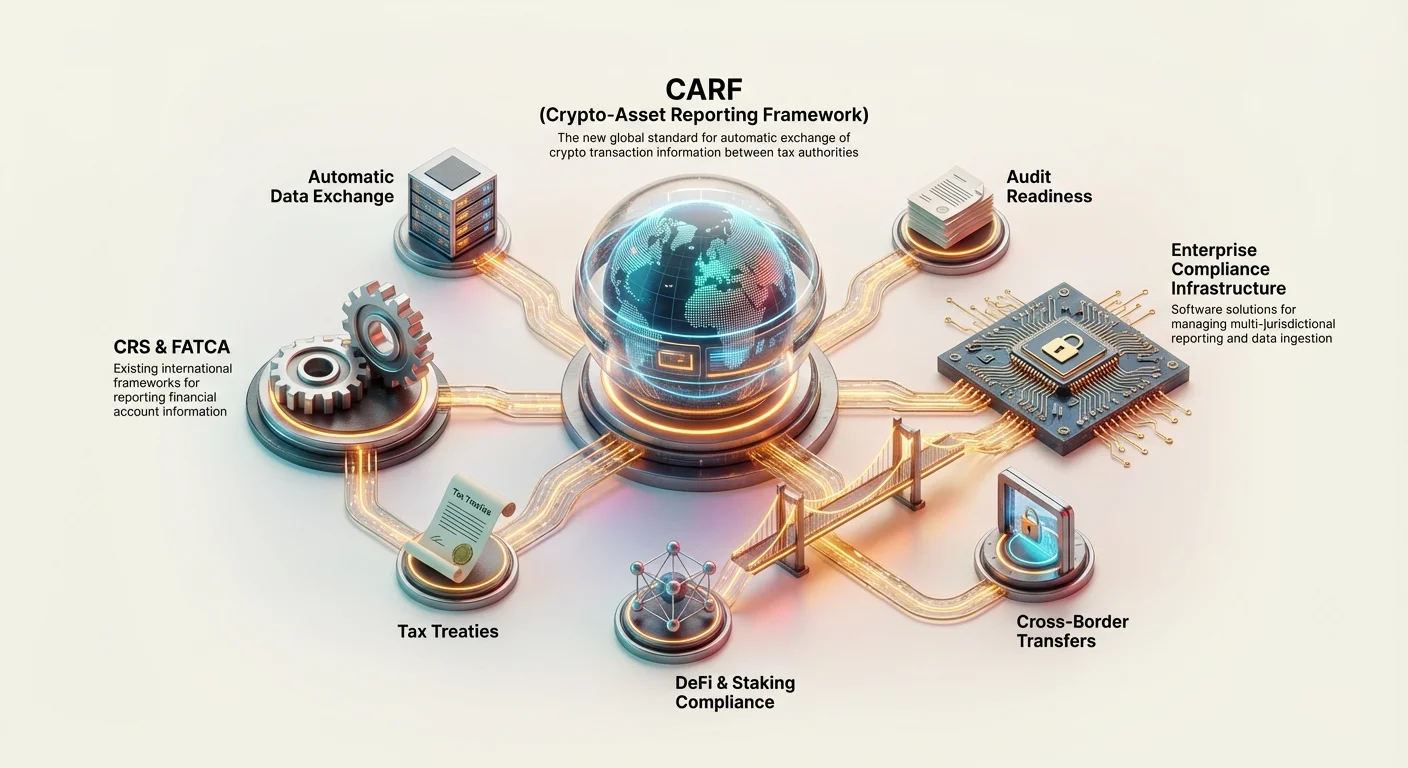
CARF mandates that all "Crypto-Asset Service Providers" (CASPs)—which include centralized exchanges, brokers, certain DeFi platforms, and other intermediaries—collect and report information on crypto transactions to their local tax authorities. These authorities then automatically exchange that information with the tax jurisdictions where the user resides.
Who Reports Under CARF?
CARF defines reporting entities broadly, targeting any intermediary facilitating exchanges between crypto and fiat, or between one crypto asset and another. This includes:
- Centralized Exchanges (CEXs): These are the primary targets, requiring them to report all trading activity.
- Certain Wallet Providers: Those that offer exchange services.
- DeFi Entities: Platforms that can exercise control or influence over the underlying assets (though pure, decentralized software protocols are more complex to categorize).
- Brokers and Market Makers: Entities facilitating large over-the-counter (OTC) trades.
What Data is Exchanged?
The information exchanged under CARF is comprehensive, ensuring tax authorities can reconstruct a taxpayer’s investment activity:
- Identifying Information: Name, address, date of birth, and Tax Identification Number (TIN) of the user.
- Reporting Period Activity: Total value of exchanges between relevant crypto assets, total value of crypto-for-fiat exchanges, and any transfers to non-CARF compliant wallets.
- Asset Specifics: Details on the types of crypto assets held and transacted.
For global funds, CARF is an existential compliance issue. If a fund utilizes a CARF-compliant CASP, that CASP is obligated to report the fund’s activity to the jurisdiction where the fund's investors or managers reside, ensuring full visibility into international crypto holdings.
Legacy Frameworks: FATCA and CRS Implications
While CARF is specific to digital assets, it builds upon and interacts with existing international information-sharing agreements established long before Bitcoin existed.
FATCA (Foreign Account Tax Compliance Act)
The U.S. enacted FATCA to combat tax evasion by U.S. citizens holding assets in non-U.S. financial institutions.
- Relevance to Crypto: FATCA requires non-U.S. Foreign Financial Institutions (FFIs) to report the holdings and income of U.S. taxpayers. While many crypto exchanges initially avoided FFI status, the increasing regulation and institutionalization mean that large, global exchanges are often deemed FFIs, compelling them to identify and report on their U.S. client base to the IRS.
CRS (Common Reporting Standard)
The CRS is the global equivalent of FATCA, adopted by over 100 jurisdictions (excluding the U.S. for many purposes). It mandates the automatic exchange of financial account information between participating countries.
- CRS and Digital Assets: Initially, CRS focused on traditional bank accounts, stocks, and bonds. However, as the CARF standard is implemented, it essentially acts as the digital asset extension of the CRS. Once adopted, CARF information will flow through the existing multilateral conventions established by the CRS, ensuring seamless data exchange on crypto holdings between compliant nations.
For institutional reporting, the challenge is ensuring that all assets—traditional securities, derivatives, and crypto—are correctly categorized and reported under both CRS (for traditional assets) and CARF (for digital assets) simultaneously, based on the location of the ultimate beneficial owner.
Advanced Transactions: Staking, DeFi, and Cross-Border Complexity
Institutional strategies often involve highly sophisticated transactions, such as yield generation in Decentralized Finance (DeFi) or large-scale cross-border transfers. These areas introduce novel regulatory ambiguities that must be addressed across multiple jurisdictions.
Tax Treatment of Passive Income (Staking and Lending Rewards)
Passive income generated from holding crypto, such as staking rewards (securing a Proof-of-Stake network) or lending income (providing assets to a DeFi protocol), has varied tax treatment globally.
When is Income Recognized?
This is the primary point of contention:
- Receipt as Ordinary Income: The standard view in many countries (including the U.S.) is that staking rewards are recognized as ordinary income upon receipt, based on the fair market value at that moment.
- Creation as a Capital Asset: Some arguments suggest that staking rewards should only be viewed as income upon sale, treating the creation of the reward similar to the creation of a commodity. While this view has gained some traction in specific court cases, the majority approach remains treating it as income upon receipt.
Institutional Implications
For global funds, this difference is crucial for income statement reporting. If a fund stakes $100 million in Ethereum and earns 5% yield, determining when that 5% is booked as income (at the moment of minting vs. the moment of realization) affects timing, valuation, and local tax liabilities. Furthermore, the fund must track the cost basis of every individual reward coin received, as each reward becomes a separate capital asset when sold later.
Challenges in Decentralized Finance (DeFi) Reporting
DeFi protocols—such as decentralized exchanges (DEXs), liquidity pools, and lending platforms—present significant headaches for multijurisdictional reporting because they often lack a central controlling entity subject to a specific regulatory body.
- Lack of Reporting Entity: Unlike a centralized exchange, a smart contract is not required to submit a CARF report. This shifts the full burden of transaction tracking and compliance directly onto the institutional user.
- Token Complexity: DeFi involves using numerous tokens (LP tokens, governance tokens, wrapped assets) and executing multi-step transactions (e.g., providing liquidity, yielding LP tokens, staking LP tokens for governance rewards). Each step is potentially a distinct taxable event that requires FMV calculation in the fund's base currency.
- Jurisdictional Nexus: If an institution interacts with a DeFi protocol hosted in the cloud, governed by anonymous users across the globe, determining which country has the right to tax the activity requires complex "nexus" analysis.
For large institutions, compliance often necessitates employing dedicated, expensive enterprise software that can decode complex smart contract interactions and apply appropriate accounting methodologies (like FIFO, LIFO, or specific identification) across dozens of subsidiary ledgers.
Managing Cross-Border Crypto Transfers and Remittance Rules
Cross-border transfers occur whenever an asset moves between a fund’s custody location and an exchange located in a different jurisdiction, or when a fund distributes returns to investors globally.
- Transfer Fees and Basis: While simple crypto transfers between a fund's own wallets are not typically taxable, the gas or network fees paid for those transfers are generally deductible expenses, which must be tracked and denominated correctly across borders.
- Remittance Rules: Many countries operate on a remittance basis of taxation, meaning that foreign income is only taxed when it is brought back ("remitted") into the home country.
- Example: A fund based in Country A earns crypto profits via an offshore exchange. If Country A uses a remittance basis, the profit might not be taxed until the fund converts the crypto to fiat and brings the fiat back to Country A. However, this is rapidly changing as jurisdictions adopt CARF, aiming to tax income regardless of physical remittance.
- Anti-Money Laundering (AML) and KYC: Large cross-border transfers, particularly those involving non-custodial or peer-to-peer (P2P) platforms, can trigger stringent AML/KYC checks required by local financial intelligence units (FIUs). Funds must ensure that all large movements adhere to the "Travel Rule" (FATF requirement) if the transfers go through regulated CASPs.
Strategic Compliance for Global Funds and Institutions
For institutional managers, compliance is not merely about calculating gains; it is about structuring operations, selecting technology, and interpreting treaties to minimize risk and ensure regulatory adherence globally.
Implementing Enterprise-Grade Compliance Infrastructure
The scale of institutional trading (potentially thousands of transactions per day across multiple assets and jurisdictions) makes manual calculation impossible and standard retail tax software insufficient.
Requirements for Institutional Software:
- Multi-Jurisdictional Logic: The software must support simultaneous reporting rules for multiple tax jurisdictions (e.g., U.S. GAAP for financial reporting, IFRS for certain foreign entities, and local tax rules for income calculations).
- Robust Data Ingestion: Ability to integrate via secure APIs with dozens of centralized exchanges, prime brokers, custodians, and custom DeFi smart contracts. It must handle massive volumes of granular transaction data.
- Audit Trail and Cost Basis Flexibility: Providing immutable records of every trade and allowing for sophisticated cost basis methods (like segregation of assets for specific investors or subsidiaries) that meet the high scrutiny of regulatory audits.
- Integration with Corporate ERP: Seamless synchronization with the fund's Enterprise Resource Planning (ERP) and general ledger (GL) systems to facilitate real-time financial reporting and compliance oversight.
Choosing the right technology firm—one specializing in institutional crypto accounting—is a critical, strategic decision that drives both efficiency and compliance accuracy.
Understanding Tax Treaties and Preventing Double Taxation
The primary mechanism for resolving conflicts arising from multijurisdictional activity is the network of bilateral tax treaties signed between countries.
How Treaties Apply to Crypto
Tax treaties define which country has the primary taxing right over specific types of income (e.g., business profits, capital gains, interest, royalties). While many treaties predate crypto, tax authorities generally interpret digital assets under existing categories:
- Permanent Establishment (PE) Rules: Treaties often define "business profits" based on whether a firm has a PE in a foreign country. For crypto funds, the definition of a digital PE (e.g., a server or network node) is an evolving legal topic, but usually, the human decision-makers (the fund managers) establish the PE.
- Relief via Tax Credits: If two countries both claim the right to tax the same income (e.g., Country A taxes the fund's profits, and Country B taxes the investor's share), the treaty typically requires one country (usually the investor's home country) to offer a foreign tax credit (FTC) to offset the taxes already paid abroad.
Effective fund structuring involves strategic use of treaties to minimize tax leakage and maximize after-tax returns for investors. This necessitates proving residency and ensuring all activities fall within the definitions stipulated by the relevant treaty.
Best Practices for Audit Readiness and Documentation
Given the novelty and complexity of digital assets, global tax authorities are initiating detailed audits of major market players. Institutional compliance must be structured with immediate audit readiness in mind.
Key Documentation Requirements:
- Detailed Cost Basis Records: Every transaction must be linked to its original cost, including associated fees. For high-volume traders, this often involves maintaining millions of transaction records.
- Valuation Methodology Documentation: Clear, consistent, and justifiable documentation explaining how fair market value (FMV) was determined for non-fiat transactions (e.g., crypto-to-crypto trades, DeFi rewards) and how pricing was sourced (e.g., using time-stamped centralized exchange data).
- KYC/AML Records: Comprehensive proof that the fund and its service providers have complied with all required Know-Your-Customer (KYC) and Anti-Money Laundering (AML) standards for all large transfers.
- Legal Opinions on Classification: Written legal analyses confirming the tax classification (property vs. income) of novel assets or complex DeFi interactions within the relevant jurisdictions. Regulators often demand these legal foundations to support the fund's tax position.
By maintaining robust, structured records, global funds can significantly reduce the risk of penalties and protracted legal battles when facing scrutiny from multiple national tax agencies simultaneously.
Conclusion: Adapting to the Age of Global Transparency
The era of anonymous, lightly taxed crypto activity is over, especially for institutional players. The global implementation of global regulatory frameworks signals a decisive move toward seamless, automatic sharing of digital asset data between tax jurisdictions worldwide.
For new investors and aspiring fund managers, understanding multijurisdictional tax compliance is no longer an optional accounting task—it is a core component of risk management and strategic operation. Success in the global digital asset landscape hinges on anticipating these regulatory shifts, implementing cutting-edge enterprise software, and leveraging expert counsel to navigate the constantly evolving terrain of international tax law. Proactive compliance is the only way to safeguard capital and ensure sustainable participation in the decentralized economy.