
Navigating the cryptocurrency market requires understanding the fundamental differences between available trading platforms. Two primary models dominate the landscape: centralized exchanges (CEXs) and decentralized exchanges (DEXs). Each offers a distinct approach to handling digital assets, prioritizing different aspects of the user experience. Centralized platforms focus on functionality, speed, and ease of use, mimicking traditional financial institutions. They act as intermediaries that facilitate trades, manage custody, and provide customer support.
In contrast, decentralized exchanges prioritize autonomy and direct peer-to-peer interaction. These platforms operate without a central authority, relying on code and smart contracts to execute trades. The choice between these models often comes down to a trader's specific needs regarding security, convenience, and control. While centralized entities provide a familiar interface for traditional investors, decentralized alternatives offer a window into the future of permissionless finance.
Understanding the mechanics behind these platforms is essential for any market participant. The trading venue dictates not only the fees and available assets but also the security risks involved. As the industry matures, the line between functionality and decentralization continues to define the evolution of crypto market infrastructure. This review explores top centralized platforms while contrasting their operational models with decentralized counterparts.
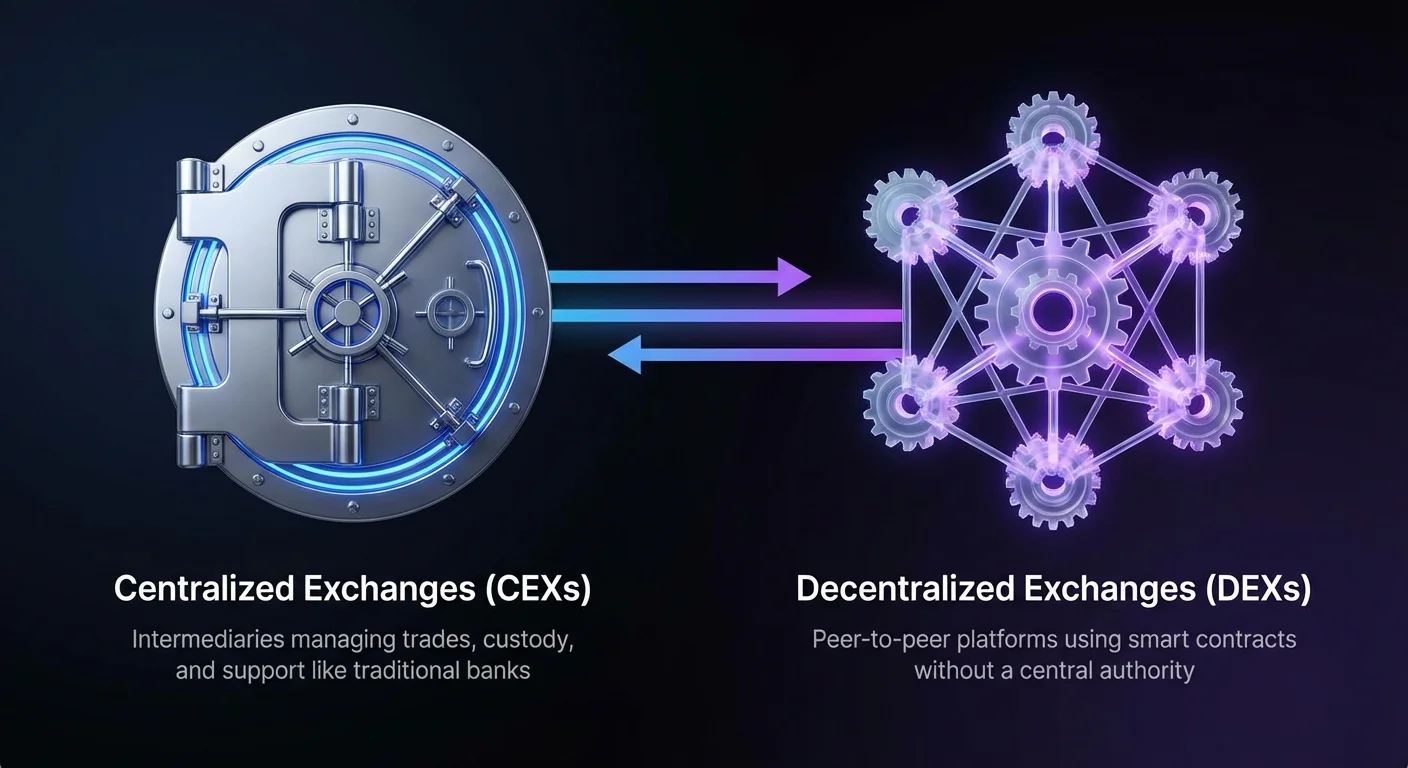
The Centralized Exchange Model
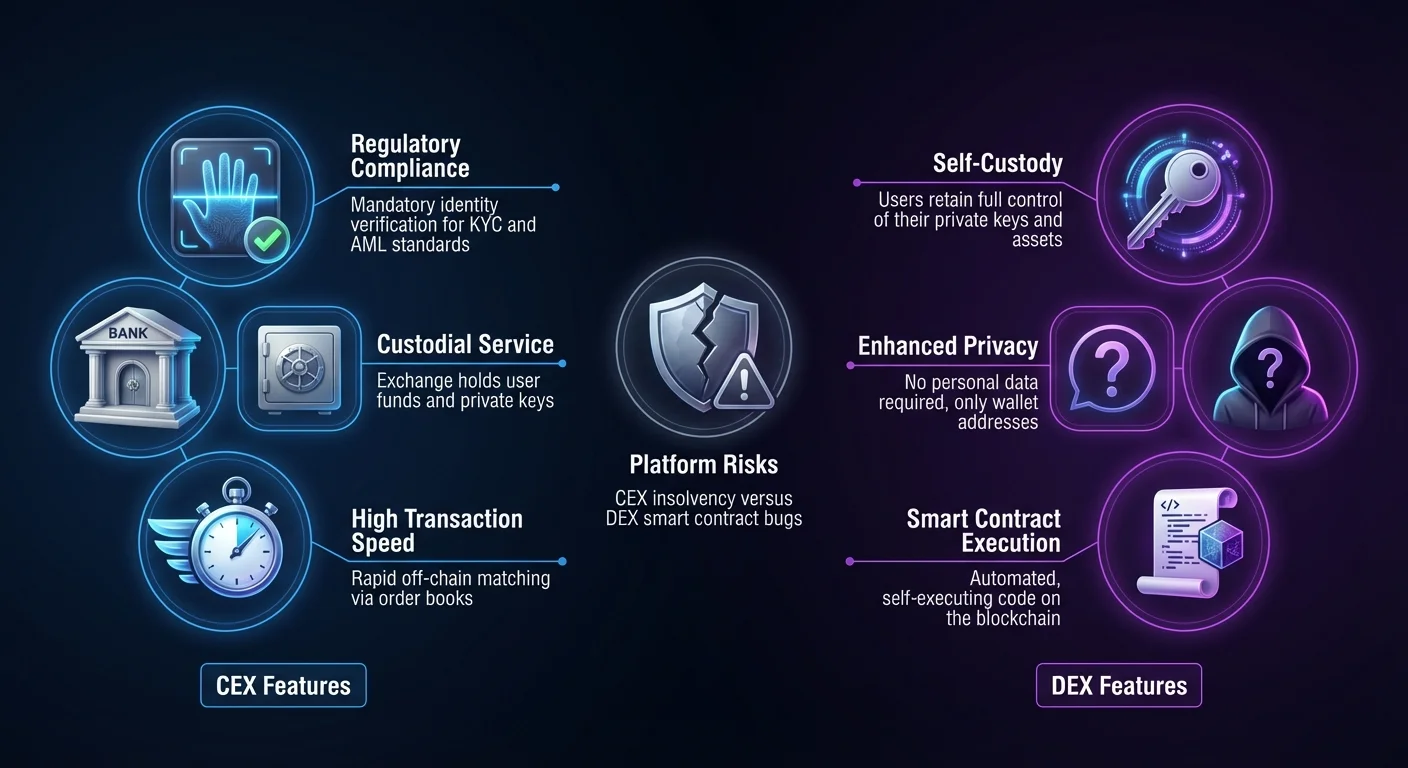
Centralized exchanges function as the primary gateway for most users entering the cryptocurrency space. These platforms are businesses owned and operated by private companies. They are subject to the laws and regulations of the jurisdictions in which they operate. When a user creates an account on a CEX, they typically must provide personal identification to comply with Know Your Customer (KYC) and Anti-Money Laundering (AML) standards. This verification process aligns crypto trading with traditional banking standards.
The core functionality of a centralized exchange relies on an order book system. This digital ledger records all buy and sell orders for specific assets. The exchange acts as a trusted middleman, matching buyers with sellers based on price and volume. When a match is found, the exchange executes the trade and updates the internal balances of the users involved. This process is highly efficient, allowing for rapid transaction speeds and high liquidity.
Custody and Control
A defining characteristic of centralized exchanges is the custody of funds. When users deposit cryptocurrency into a CEX, they are effectively transferring control of those assets to the exchange. The platform holds the private keys to the digital wallets, acting as a custodian. Users trust the exchange to secure these funds and honor withdrawal requests. This arrangement offers convenience, as users do not need to manage complex security measures personally.
However, this custodial model introduces specific risks. If the exchange faces insolvency or security breaches, user funds can be jeopardized. History contains several examples of exchanges failing to protect user deposits. Consequently, many experienced traders advocate for keeping only active trading capital on centralized platforms. Long-term holdings are often safer in self-custodial wallets where the user retains full control.
Interface and Usability
Centralized exchanges invest heavily in user interface (UI) and user experience (UX) design. Their goal is to make trading as intuitive as possible for beginners and professionals alike. These platforms often feature clear dashboards, easy-to-read charts, and simple buttons for buying and selling. They bridge the gap between complex blockchain technology and everyday financial applications.
Support services are another major advantage of the centralized model. Because these are managed businesses, they typically offer customer support teams to assist with account issues, password resets, and transaction inquiries. This safety net is reassuring for newcomers who may be unfamiliar with the technical nuances of blockchain transactions. The combination of polished interfaces and human support creates a high-functionality environment.
The Decentralized Alternative
Decentralized exchanges operate on a fundamentally different philosophy. They facilitate peer-to-peer transactions without the need for a trusted third party or intermediary. A DEX is not run by a single company but operates through smart contracts on a blockchain. These are self-executing programs that automatically enforce the rules of the trade.
Because there is no central authority, DEXs are generally permissionless. Anyone with a crypto wallet and an internet connection can access the platform. There are no sign-up forms, no identity verification processes, and no geographical restrictions. This openness aligns with the core tenets of cryptocurrency, increasing economic freedom and accessibility for individuals globally.
Automated Market Makers
Most modern DEXs utilize a system known as an Automated Market Maker (AMM). Unlike the order book model used by centralized competitors, AMMs rely on liquidity pools. A liquidity pool is a collection of tokens locked in a smart contract. Traders do not trade against other individuals directly; instead, they trade against the pool.
The price of assets in an AMM is determined algorithmically. A mathematical formula balances the ratio of assets in the pool to set the exchange rate. This innovation solved early liquidity problems in decentralized finance. It allows trading to occur at any time, provided there are sufficient funds in the pool. This system removes the need for traditional market makers to manually facilitate trades.
Self-Custody and Privacy
The most significant advantage of a DEX is the preservation of self-custody. Users trade directly from their personal crypto wallets. Funds are never transferred to the exchange's control. The smart contract executes the swap and immediately settles the assets back into the user's wallet. This eliminates the risk of an exchange freezing funds or mismanaging deposits.
Privacy is another critical benefit. Since there is no registration process, users do not need to divulge sensitive personal information. Trading activity is visible on the blockchain, but it is linked only to a wallet address, not a real-world identity. This protects users from data breaches that frequently affect centralized platforms where personal data is stored on central servers.
Coinbase: The Benchmark for Accessibility
Coinbase is widely recognized as a cornerstone of the cryptocurrency exchange market. Established in 2012, it has built a reputation for being one of the most user-friendly platforms available. Its design philosophy centers on simplicity, making it an ideal starting point for individuals new to digital assets. The onboarding process is streamlined, guiding users through account creation and verification with minimal friction.
The platform supports a vast array of cryptocurrencies, offering access to hundreds of assets. This extensive selection allows users to diversify their portfolios easily within a single interface. Coinbase also provides educational resources that reward users for learning about different cryptocurrencies. This "learn-to-earn" model incentivizes education, helping to bridge the knowledge gap for beginners.
Security is a paramount concern for Coinbase. The exchange employs robust measures to protect user funds, including two-factor authentication (2FA) and cold storage for the majority of assets. Cold storage involves keeping private keys offline, significantly reducing the risk of online theft. Furthermore, as a publicly traded company, Coinbase operates with a level of transparency and regulatory scrutiny that few competitors can match.
Kraken: Security and Advanced Tools
Kraken stands out as a platform that balances accessibility with advanced trading features. Launched in 2011, it is one of the longest-running exchanges in the industry. This longevity has contributed to its reputation for reliability and security. Kraken has consistently maintained a strong security posture, employing advanced encryption and strict surveillance protocols to safeguard assets.
For traders seeking more than simple buy and sell options, Kraken offers a suite of complex financial products. The platform supports margin trading and advanced futures strategies, allowing users to leverage their positions. These tools enable sophisticated strategies for managing risk and capitalizing on market volatility. Additionally, Kraken provides staking services, allowing users to earn rewards on their holdings by participating in network validation.
The interface caters to a broad spectrum of users. Beginners can navigate the basic buying options, while experienced traders can utilize the advanced charting and order types. This versatility makes Kraken a suitable choice for users as they progress from novice to expert levels. The platform’s commitment to high liquidity also ensures that trades are executed efficiently, even for large volumes.
Gemini: Compliance and Institutional Trust
Gemini distinguishes itself through an unwavering commitment to regulatory compliance and security certifications. Founded in 2014, the exchange has prioritized operating within strict legal frameworks. It is regulated by the New York Department of Financial Services (NYDFS), a distinction that carries significant weight in the financial world. This adherence to regulation appeals to institutional investors and safety-conscious individuals.
The platform has achieved SOC 1 Type 2 and SOC 2 Type 2 certifications. These independent audits verify that the exchange maintains rigorous controls over financial reporting and data security. Gemini operates as a full-reserve exchange, meaning all customer assets are backed one-to-one. This transparency is designed to build trust in an industry that often faces skepticism regarding solvency.
Gemini offers a specialized interface known as ActiveTrader for more experienced users. This platform features advanced charting tools and multiple order types, capable of executing trades in microseconds. Despite these professional features, Gemini maintains an accessible entry point for casual investors, with no account minimums required to get started. This dual approach serves a diverse client base effectively.
Bitget: Innovation in Social Trading
Bitget has carved a niche in the market by focusing on social trading features, specifically copy trading. This functionality allows users to replicate the strategies of experienced traders automatically. Beginners can browse the profiles of top-performing investors, view their track records, and choose to mirror their trades. This system democratizes access to professional trading strategies.
The platform ensures high liquidity to support these activities. Fast transaction speeds are essential for copy trading, as delays can result in price discrepancies between the master trader and the follower. Bitget’s infrastructure is designed to handle high volumes of rapid transactions, ensuring that copy trades are executed promptly. This technical capability underpins the social trading experience.
In addition to social features, Bitget provides a secure environment for asset management. The exchange utilizes multi-signature wallets and advanced encryption standards. The user interface remains intuitive despite the complex backend operations, allowing users to manage their accounts and monitor copy trading performance easily. This blend of social interaction and technical robustness defines Bitget’s position in the market.
BTCC: The Veteran of Futures Trading
BTCC is one of the oldest exchanges in the cryptocurrency ecosystem, with a history dating back to 2011. Its longevity serves as a testament to its adaptability and reliability. The platform has a strong focus on futures trading, offering innovative solutions for derivative markets. Users can engage in contract trading with various order types, including limit, market, and stop orders.
A key feature of BTCC is its offering of futures contracts without expiration dates. This allows traders to hold positions for as long as they deem necessary, providing greater flexibility in strategy execution. The platform also integrates Bitcoin mining solutions, bridging the gap between asset production and trading. This comprehensive approach attracts a dedicated base of miners and traders.
Despite being a veteran platform, BTCC maintains modern security standards. It employs cold wallet storage to protect user funds from online vulnerabilities. The exchange also offers mobile applications that replicate the full functionality of the web interface. This ensures that traders can manage their positions and monitor the markets from anywhere, a crucial requirement for futures trading.
Comparing Functionality vs. Autonomy
The choice between using a centralized exchange like those reviewed above and a decentralized alternative involves weighing functionality against autonomy. Centralized exchanges excel in speed and convenience. Their order book systems provide high liquidity and rapid execution, which is vital for day trading and high-frequency strategies. They also offer fiat on-ramps, making it easy to convert local currency into crypto.
Decentralized exchanges, while offering superior privacy and control, often face challenges with user experience. The process of connecting a wallet, managing gas fees, and navigating AMM interfaces can be daunting for newcomers. Furthermore, trading on a DEX requires users to be fully responsible for their security. Losing a private key or interacting with a malicious smart contract results in irreversible loss.
Liquidity Dynamics
Liquidity manifests differently in these two environments. On a centralized exchange, market makers and institutional players provide deep order books. This results in tight spreads, meaning the difference between the buying and selling price is minimal. High liquidity ensures that large orders do not significantly impact the asset's price.
On a DEX, liquidity is crowdsourced through liquidity pools. While popular pairs on major DEXs can rival centralized liquidity, less popular tokens may suffer from high slippage. Slippage occurs when the final execution price differs from the expected price due to insufficient liquidity. Traders must be aware of these dynamics when choosing where to execute larger trades.
The Technology of Trust
The fundamental difference between CEXs and DEXs lies in the technology of trust. Centralized exchanges ask users to trust the company. Users rely on the exchange's internal database to record their balances accurately. They trust the security team to prevent hacks and the management team to maintain solvency. This model mirrors the traditional banking system.
Decentralized exchanges replace institutional trust with code. Transactions are recorded directly on the public blockchain, providing immutable proof of ownership. The rules of the exchange are open-source and visible to anyone who can read the code. This transparency reduces the risk of internal manipulation but shifts the burden of verification to the user.
| Feature | Centralized Exchange (CEX) | Decentralized Exchange (DEX) |
|---|---|---|
| Custody | Exchange holds keys | User holds keys |
| Privacy | KYC required | Anonymous / Pseudonymous |
| Speed | High (Off-chain matching) | Variable (On-chain consensus) |
Risk Management Considerations
Regardless of the platform chosen, risk management is essential. Centralized exchanges carry the risk of platform failure or regulatory shutdowns. Users mitigate this by diversifying across multiple exchanges and withdrawing profits to private wallets. Security features like two-factor authentication are non-negotiable requirements for protecting centralized accounts.
Decentralized exchanges introduce smart contract risk. If the code governing the liquidity pool contains a bug or vulnerability, hackers can exploit it to drain funds. Additionally, liquidity providers on DEXs face "impermanent loss," a phenomenon where the value of deposited assets diverges from holding them simply in a wallet. Understanding these distinct risk profiles is crucial for asset protection.
Conclusion
The landscape of cryptocurrency exchanges offers a spectrum of choices ranging from highly functional, centralized platforms to autonomous, decentralized protocols. Exchanges like Coinbase, Kraken, and Gemini provide a secure, user-friendly entry point with robust support and regulatory compliance. They prioritize ease of use and speed, making them suitable for most everyday traders and institutional investors.
Conversely, the decentralized model offers a compelling alternative for those prioritizing privacy and self-custody. While the learning curve is steeper, the ability to trade without intermediaries aligns with the foundational ethos of cryptocurrency. Ultimately, the decision rests on the individual's comfort with technical responsibility versus their need for convenience and support.
The best strategy often involves utilizing both models to balance operational efficiency with long-term asset security.