
When entering the world of cryptocurrency, the first challenge isn’t learning how to trade—it’s learning how to secure your assets. Unlike traditional banking, where the bank handles all security and recovery, digital asset security falls largely upon the user. This critical decision about who holds the private keys is known as the custody model.
Understanding custody is the single most important step in building self-sovereignty in the digital economy. Your choice of custody model determines your level of control, your exposure to risk, and even the legal nature of your ownership. Do you prefer the convenience and familiarity of a centralized platform, or the absolute control and responsibility of holding the keys yourself?
This guide breaks down the spectrum of crypto custody models, from full self-sovereignty to shared security solutions, establishing the necessary context for understanding advanced features like Multi-Party Computation (MPC) and Multisignature wallets.
The Foundation: Understanding Key Ownership
Before exploring custody models, we must define the central component of crypto security: the private key.
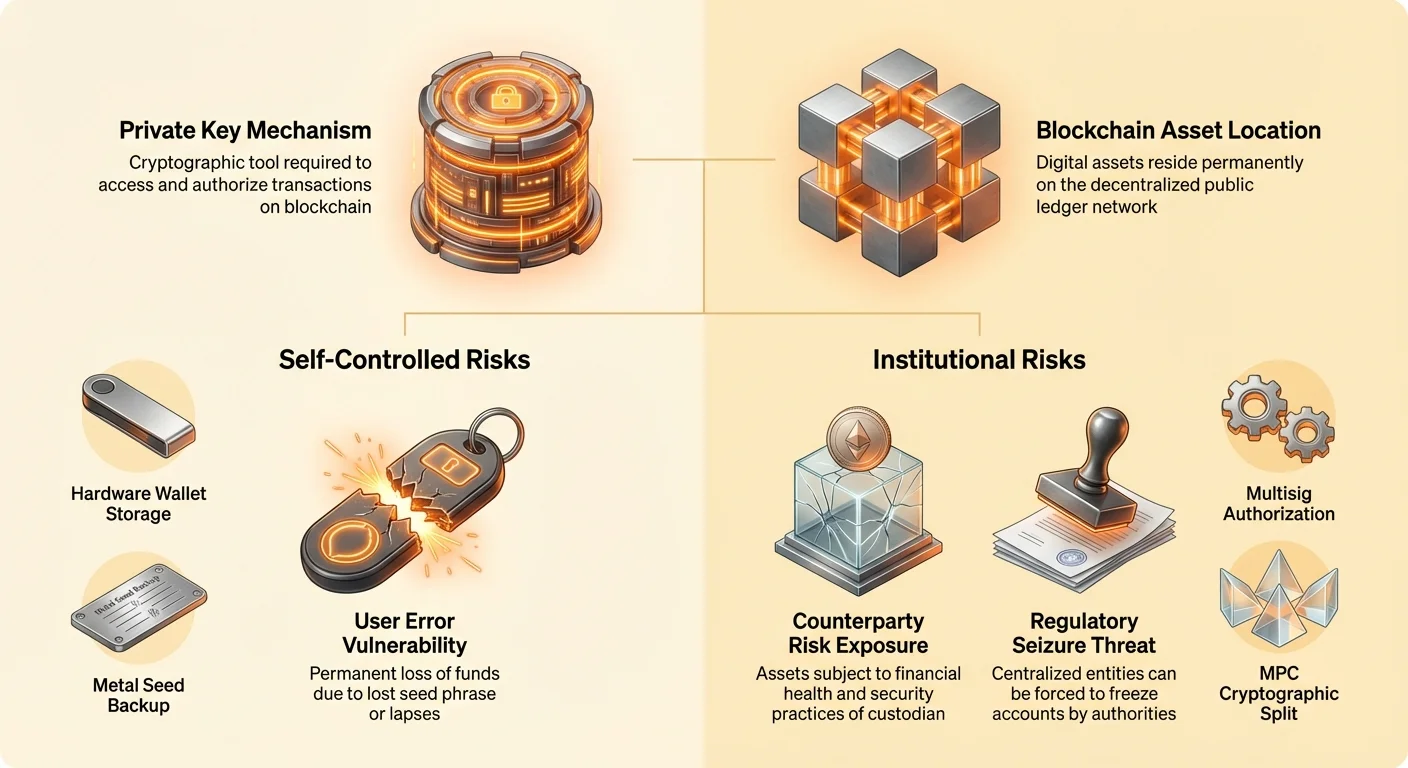
A cryptocurrency wallet doesn't actually store Bitcoin or Ethereum; it stores the mathematical keys required to access and authorize transactions on the blockchain. Your crypto assets always reside on the decentralized ledger (the blockchain). The private key is the secret password that proves you are the legitimate owner and allows you to move those assets.
The Role of the Seed Phrase
The private key is a complex string of letters and numbers. Because this is cumbersome, most modern wallets use a seed phrase (also called a recovery phrase or mnemonic phrase)—a sequence of 12 or 24 common words. This phrase is the master key from which all your private keys can be generated.
Custody is simply the management and security of this seed phrase.
If a third party (like an exchange) controls your seed phrase, they have custody. If only you know and control the seed phrase, you have self-custody.
Form Factor vs. Custody Model
It is vital to distinguish between a wallet’s form factor (the physical device or software type) and its custody model (who holds the key).
- Form Factor: Where the software resides (e.g., Hardware, Mobile App, Desktop application).
- Custody Model: Who controls the private key that unlocks the funds (e.g., You, a Centralized Exchange, or a combination of parties).
A mobile wallet app, for example, can be configured for either self-custody or full custody, depending on where the keys are stored.
Model 1: Full Sovereignty (Non-Custodial / Self-Custody)
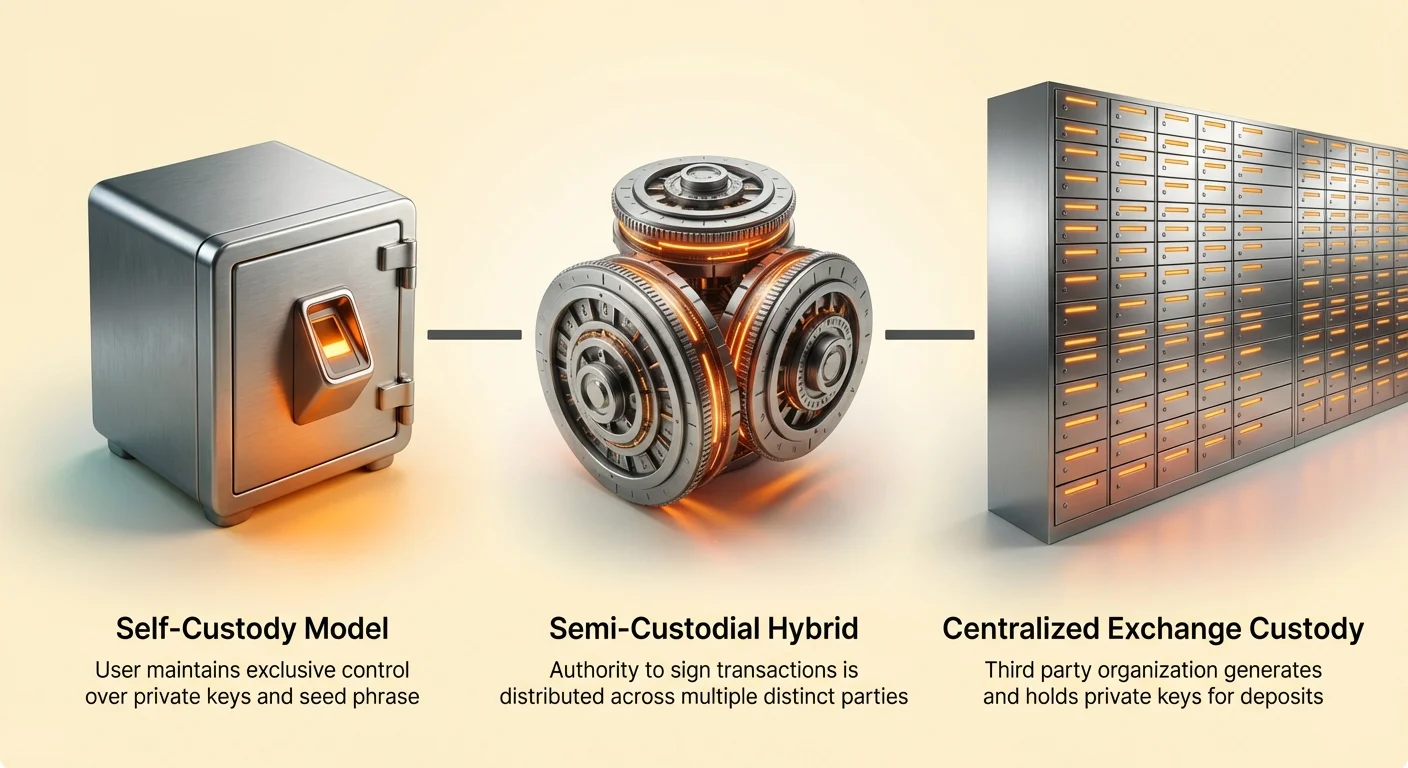
In a non-custodial or self-custody model, the user maintains exclusive control over their private keys and seed phrase.
Definition and Mechanism
Self-custody means you are the sole entity responsible for storing, backing up, and protecting your private key. The wallet software merely provides the interface for viewing your balance and creating transaction signatures.
Because no third party ever handles your private key, your funds cannot be frozen, seized, or censored by any government or company. This arrangement offers maximum financial freedom and is the truest expression of the decentralized ethos.
Advantages and Disadvantages
| Feature | Advantage | Disadvantage |
|---|---|---|
| Control | Absolute control; funds are censorship-resistant. | Absolute responsibility; if you lose the seed phrase, the funds are lost forever. |
| Security | Eliminates counterparty risk (risk that the custodian fails). | Vulnerable to physical theft or malware on the user’s device. |
| Privacy | Transactions are linked only to your blockchain address, not a KYC’d identity. | Complex setup for newcomers; requires careful backup procedures. |
Practical Examples of Self-Custody
- Hardware Wallets (Cold Storage): These physical devices (like Trezor or Ledger) store the private key entirely offline, isolated from internet-connected devices. This is considered the gold standard for long-term storage of large amounts of crypto.
- Software Wallets (Hot Storage): Mobile and desktop apps where the key is generated and stored locally on your device. While highly convenient for everyday transactions, the key remains on an internet-connected device, making them less secure than hardware wallets.
Model 2: Centralized Convenience (Full Custody / CEX Wallets)
A full custodial model is the most familiar to users coming from traditional finance. It involves entrusting your assets to a third-party organization, typically a Centralized Exchange (CEX).
Definition and Mechanism
When you deposit funds into an account on a major exchange (like Coinbase, Binance, or Kraken), the exchange generates and holds the private keys associated with your deposit. The balance displayed in your account is simply an entry in the exchange’s internal database.
You do not transact directly on the blockchain; you request the exchange to debit your internal balance. The exchange executes the actual blockchain transaction using its own pool of keys.
The Convenience of Centralization
Custodial services are incredibly popular because they offer unparalleled convenience and risk mitigation for the user’s personal mistakes.
- Easy Recovery: If you forget your password, the CEX can verify your identity and restore access to your account balance, just like a bank.
- Ease of Access: Seamless integration for buying, selling, and trading, often with instant settlements on the platform.
- Insurance and Security: Large exchanges employ vast security teams and often hold substantial insurance policies to protect against major hacks of their central holdings.
The Critical Drawback: Counterparty Risk
The main drawback of custodial wallets is encapsulated in the crypto maxim: "Not Your Keys, Not Your Coin."
When the CEX holds the keys, you face counterparty risk. This means your assets are subject to the financial health, security practices, and regulatory environment of the custodian. If the exchange is hacked, becomes insolvent (goes bankrupt), or decides to freeze your account for regulatory reasons, you may lose access to your funds entirely. This risk was painfully illustrated by major exchange failures in the past.
Legal Implications of CEX Custody
The legal status of your assets in a CEX is crucial. When you deposit assets:
- Self-Custody: You hold the legal title to the cryptographic private key. The asset is yours unequivocally.
- CEX Custody: You typically hold an unsecured creditor claim against the exchange for the value of your assets. You own an account balance, but the exchange owns the underlying blockchain asset. If the company enters bankruptcy, retrieving your funds can become a lengthy and uncertain legal process.
Model 3: The Middle Ground (Semi-Custody and Hybrid Models)
As the crypto industry matured, new models emerged to bridge the gap between absolute self-sovereignty and absolute convenience. These "semi-custodial" models involve distributing the private key or the authority to sign transactions across multiple parties, mitigating single points of failure.
Shared Control with Multisignature (Multisig) Wallets
A Multisig wallet is a self-custody solution built directly into the blockchain protocol (e.g., Bitcoin or Ethereum). It requires multiple distinct private keys to authorize a single transaction.
Mechanism: A Multisig wallet is typically defined as M-of-N, meaning $M$ signatures out of a possible $N$ keys are required. For example, a 2-of-3 Multisig setup requires any two of the three key holders to approve a transaction.
Custody Application:
- A company might use 3-of-5 Multisig, requiring a majority of board members to approve fund transfers.
- An individual might use 2-of-3, holding one key on a hardware wallet, one on a mobile device, and depositing the third key with a trusted legal firm for recovery purposes. In this scenario, no single party (including the third-party custodian) can move the funds unilaterally.
Multisig distributes risk, ensuring that compromise of a single key doesor loss of a single key doesn't doom the funds.
Distributed Key Sharing with Multi-Party Computation (MPC)
Multi-Party Computation (MPC) wallets represent a modern cryptographic technique that offers a strong alternative to traditional self-custody, often deployed by institutional custodians and certain next-generation wallet providers.
Mechanism: In MPC, the private key is never created or stored in one place. Instead, it is cryptographically divided into "key shares" that are distributed among several independent parties (e.g., the user, the wallet provider, and a security partner). When a transaction is needed, the key shares communicate with each other to cryptographically sign the transaction without ever reconstructing the original key.
Custody Application:
- MPC offers a "self-custodial feel" because the user typically holds at least one key share, ensuring the service provider cannot move funds without the user's participation.
- It improves security by removing the single point of failure (the 12/24-word seed phrase). If a hacker gets one share, it is useless without the others.
- It allows for easier account recovery mechanisms managed by the provider, mitigating the risk of users losing their key shares while retaining the benefits of shared control.
Key Distinction: While Multisig requires M full private keys to sign, MPC requires M key shares to cooperate and create a single signature.
Hybrid Custody in Decentralized Finance (DeFi)
Decentralized applications (DApps) often rely on smart contracts that require the user to self-custody their assets (using a non-custodial wallet like MetaMask). However, the applications themselves introduce a different type of semi-custody risk.
When you deposit assets into a DeFi protocol (e.g., a lending pool), you retain the private key, but the assets are locked in a smart contract. You control the ability to interact with the contract, but the contract’s rules (which are controlled by its developers) dictate how the assets are managed. This is a hybrid risk profile: key custody is non-custodial, but asset management custody is outsourced to code.
Legal Ownership and Risk Mitigation
The choice of custody model must align directly with the legal reality of your situation and your personal risk assessment.
Defining Legal Title vs. Control
In crypto, control is ownership. If you possess the private key and can authorize transactions, the assets are, in the legal sense, yours.
| Custody Model | Who Holds the Private Key? | Legal Status of Assets | Core Risk Exposure |
|---|---|---|---|
| Self-Custody | User (Solely) | Direct ownership; assets are on the blockchain. | User error (loss of key) and device security compromise. |
| Full Custody (CEX) | Centralized Exchange | Account claim against the institution. | Counterparty failure (bankruptcy/insolvency) and regulatory seizure. |
| Semi-Custody (MPC/Multisig) | Distributed (Shared) | Direct ownership; assets are on the blockchain, secured by multiple keys/shares. | Complex setup, difficulty coordinating key holders, reliance on providers for recovery. |
The Critical Risks of Each Model
When choosing a model, consider which type of catastrophic failure you are best equipped to handle:
1. Insolvency Risk (CEX Risk)
If you hold crypto on an exchange and that exchange goes bankrupt, your funds may be used to pay off the exchange’s other debts, depending on the jurisdiction and how the exchange segregates client funds. This risk is zero in self-custody.
2. Sovereignty and Censorship Risk (CEX Risk)
If your assets are on a CEX, a government subpoena or regulatory action can force the exchange to freeze your account. For users requiring absolute financial privacy or living under unstable regimes, this risk is unacceptable, making self-custody the only viable option.
3. Human Error Risk (Self-Custody Risk)
The primary risk of self-custody is the loss of the seed phrase or the security lapse that allows a hacker access to your offline backup. There is no password reset button, no customer service line, and no legal recourse if you lose your keys.
A Framework for Choosing Your Model
Your custody strategy should be dynamic, tailored to the quantity and purpose of your funds:
| Fund Purpose | Recommended Custody Model | Primary Security Method |
|---|---|---|
| Trading and Short-Term Liquidity (Small amounts) | Full Custody (CEX) | Exchange’s institutional security and FDIC/insurance policies. |
| Long-Term Savings/Inheritance (Large amounts) | Self-Custody (Hardware Wallet) | Offline storage (cold storage) and physical security of the seed phrase. |
| Institutional Treasury/Shared Funds (High value) | Semi-Custody (Multisig or MPC) | Distribution of key control and cryptographic proofs. |
| Active DeFi & NFT Interaction (Medium amounts) | Self-Custody (Mobile/Desktop Wallet) | Password protection and limited exposure of the connected device. |
Actionable Tip: Adopt the "Wallet Pyramid"
A common best practice is to adopt a tiered strategy:
- Base Layer (Cold Storage): The majority of your holdings (your “HODL stack”) should be in self-custody via a hardware wallet, secured offline.
- Middle Layer (Active Funds): A moderate amount used for regular payments or interacting with DeFi, secured in a self-custodial mobile wallet.
- Top Layer (Liquidity): The smallest amount of capital, held on an exchange for quick trading or off-ramping to fiat currency.
Conclusion
The crypto economy offers a fundamental choice: outsource your security for convenience (custodial) or own your security for sovereignty (non-custodial).
As a newcomer, starting with a reputable centralized exchange (CEX) provides a necessary training wheel period, allowing you to learn market dynamics without the immediate, high-stakes pressure of key management. However, as your portfolio grows and your comfort level increases, migrating to a self-custody solution—ideally a hardware wallet—becomes essential for long-term security.
For those requiring institutional grade security, shared responsibility, or easy recovery without forfeiting control entirely, semi-custodial technologies like Multisig and MPC offer compelling pathways. Ultimately, the best custody model is the one you understand completely and are prepared to defend, ensuring that you—and only you—maintain control over your financial future.