
When most people receive money, they deposit it into a bank account. This is a model of trust; you trust the bank to hold your funds safely, manage the accounts, and execute transfers on your behalf. In return for this convenience, you forfeit ultimate, immediate control over those assets.
Cryptocurrency, however, was born from a desire to fundamentally change this dynamic. It allows individuals to become their own bank—a concept known as self-custody.
Self-custody is more than just a security feature; it is the philosophical core of decentralized finance. It means taking personal, direct control of your digital assets, bypassing traditional third-party intermediaries like exchanges or centralized financial institutions. This shift grants unparalleled sovereignty, but it also demands uncompromising responsibility.
Before you choose a wallet, analyze security trade-offs, or begin transacting, it is crucial to understand why self-custody matters, what it entails, and the inherent risks and rewards that come with being the sole protector of your wealth. This guide sets the intellectual stage, defining the tools of ownership and exploring the continuum between convenience and absolute control.
The Foundation of Ownership: Keys and Addresses
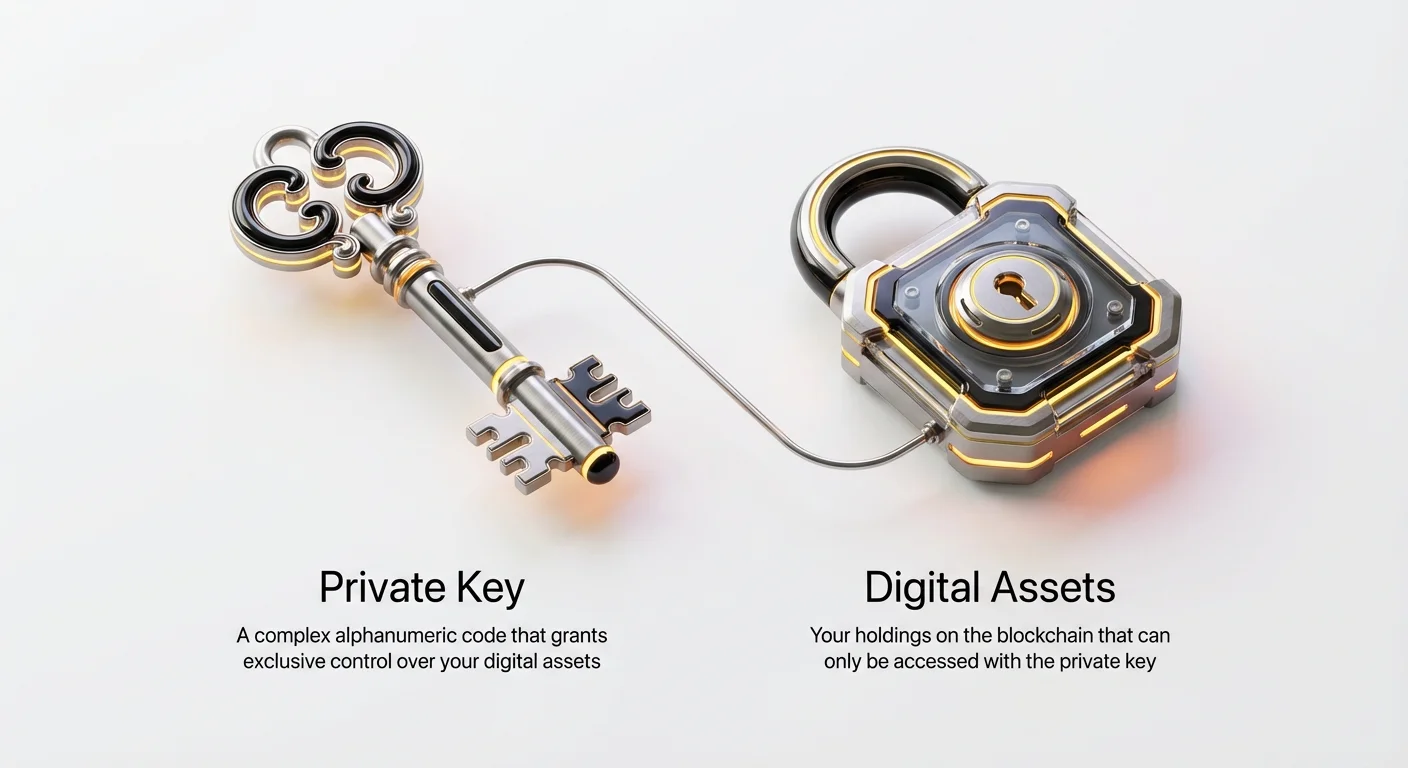
In the digital world of crypto, ownership isn't determined by a name on a ledger held by a bank; it is determined by possession of a mathematical secret. To truly grasp self-custody, you must first understand the relationship between the private key and the public address.
Think of the blockchain—whether it’s Bitcoin, Ethereum, or Solana—as a massive, public ledger detailing who owns what. Your public address is where everyone sees your assets listed, but only your private key can authorize moving them.
The Private Key: Your Digital Signature
The private key is the single, most important component in cryptocurrency. It is a long, complex string of alphanumeric characters, essentially a master password that proves ownership of the funds associated with a specific public address.
- Function: The private key is used to digitally sign (authorize) transactions. When you want to send crypto, your wallet uses your private key to create a mathematical proof (the signature) that confirms you, and only you, approved the transfer.
- Secrecy is Everything: If someone else obtains your private key, they gain immediate and irreversible control over your assets. They can spend your funds without your knowledge or permission, and because crypto transactions are permanent and censorship-resistant, there is no one to call to reverse the theft. This key must never be shared.
The Public Address: Your Digital Mailbox
The public address is derived mathematically from your private key. It is the visible destination where others can send you cryptocurrency.
- Function: This is the equivalent of your email address or your bank account number. You can share your public address freely and openly, as it poses no security risk. It simply allows others to locate you on the blockchain network and deposit funds.
- One-Way Link: While anyone can send crypto to your public address, only the corresponding private key can unlock those funds and move them elsewhere.
The Seed Phrase (Mnemonic Phrase): The Master Backup
Since private keys are long, complex, and impossible for humans to memorize, most modern self-custody wallets utilize a seed phrase (also called a recovery phrase or mnemonic phrase).
The seed phrase is a sequence of 12, 18, or 24 common words (e.g., "apple, tree, run, jump, satellite, blue..."). This sequence acts as a human-readable master key.
- Ultimate Control: This one phrase is capable of mathematically regenerating all of your individual private keys and, consequently, all of your associated public addresses.
- Loss Prevention: If your physical hardware wallet breaks, your computer crashes, or your mobile wallet app is deleted, the seed phrase is the only way to restore access to your funds on a new device.
- Security Priority: Protecting the seed phrase is the absolute highest security priority in crypto self-custody. Anyone who possesses it controls your entire crypto portfolio.
The Core Philosophy: "Not Your Keys, Not Your Coin"
The phrase "Not your keys, not your coin" is the central mantra of self-custody. It clearly articulates the difference between true ownership on a decentralized network and the traditional ownership model where a third party mediates access to your assets.
When you use a major centralized crypto exchange (like Coinbase or Binance) or another custodial service, you are delegating custody. You have an account with the exchange, and the exchange maintains the private keys linked to the funds displayed in your balance. They effectively act as a bank.
The Centralized Risk Model (Why Banks Work Differently)
In traditional banking, your deposited funds are technically liabilities of the bank, and your account is insured (e.g., FDIC in the US, up to $250,000). If the bank fails or is robbed, the government or insurance mechanism steps in to make you whole.
In centralized crypto exchanges, this safety net often does not exist for the underlying assets. While many exchanges hold insurance for operational failures or hot wallet hacks, they do not guarantee the solvency of the entire institution.
When you leave crypto on an exchange:
- You do not have the private key. You cannot move the funds without permission from the exchange.
- The exchange acts as a central point of failure. If the exchange is hacked, goes bankrupt, or freezes accounts due to regulatory pressure, your access to funds can be instantly cut off.
The Risk of Third-Party Failure
The history of cryptocurrency is littered with cautionary tales that underscore the critical need for self-custody. These events typically fall into two categories: external hacking and internal mismanagement or fraud.
For example, the collapse of major centralized exchanges has resulted in billions of dollars of user funds becoming inaccessible or lost forever, as victims had relinquished control of their private keys to the failing institution.
Self-custody eliminates this specific counterparty risk. By holding your own keys, you remove the necessity of trusting a third party to be honest, competent, or solvent. Your risk profile shifts entirely from institutional failure to personal security discipline.
Mapping the Custody Continuum (Convenience vs. Control)
The decision of where to store your crypto is a crucial trade-off between convenience (easy access, password recovery, simple interface) and control (absolute sovereignty, maximum security, no third-party dependence).
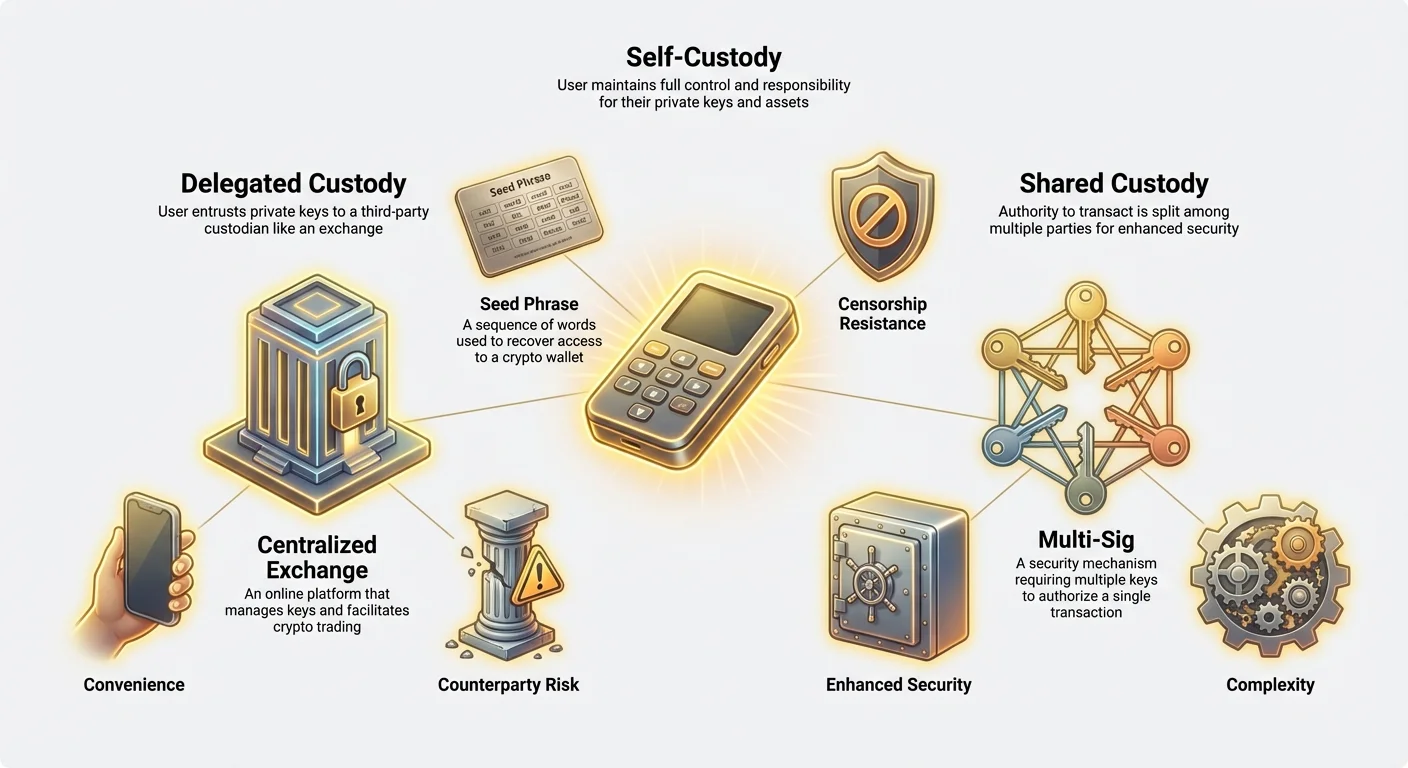
We can categorize crypto storage solutions along a continuum based on who controls the private keys required to sign transactions. Understanding this spectrum is essential for choosing the right tools for your specific needs, risk tolerance, and portfolio size.
Self-Sovereign Custody (Full Control, High Responsibility)
In the self-sovereign model, the user (you) is the only party who holds the private key or the seed phrase. This model guarantees maximum autonomy but requires the highest level of personal security discipline.
Characteristics:
- Key Holder: User (You).
- Examples: Hardware wallets (Ledger, Trezor), non-custodial software wallets (e.g., Exodus, MetaMask).
- Pros: Censorship resistance, elimination of counterparty risk, maximum security potential.
- Cons: No recovery option if the seed phrase is lost; high barrier to entry for beginners; high cognitive load required for key management.
If you lose your keys in this model, no one can help you recover the funds—they are permanently lost on the blockchain.
Delegated Custody (The Exchange Model)
Delegated custody is the most common entry point for new users, offering the highest convenience but the lowest sovereignty. Here, you delegate the responsibility of holding the private key to a trusted financial institution or platform.
Characteristics:
- Key Holder: The Centralized Exchange or Custodian.
- Examples: Coinbase, Binance, centralized payment processors.
- Pros: Easy to use, familiar interface, password recovery available, simplified trading and tax reporting.
- Cons: Subject to exchange insolvency, regulatory seizure, and platform downtime; you cannot control transaction speed or network fees directly; you rely completely on the custodian's security protocols.
Shared Custody (Multi-Sig and the Future)
Shared custody models attempt to find a middle ground by splitting the authority to transact between multiple parties or entities. This is often achieved using multi-signature (Multi-Sig) technology, which requires two or more private keys to authorize a single transaction.
Characteristics:
- Key Holder: A predetermined combination of parties (e.g., 2 out of 3, where the parties could be you, a backup device, and a professional custodian).
- Examples: Certain institutional custody solutions, advanced decentralized autonomous organizations (DAOs), and specialized wallets designed for families or businesses.
- Pros: Enhanced security (a single compromised key is not enough to steal funds); built-in redundancy (if one key is lost, the others can still recover/transact); combines trust and security.
- Cons: Requires coordination; highly complex setup; higher transaction fees due to increased data size.
Shared custody is often viewed as the optimal model for large institutions or individuals seeking high security without relying entirely on a single point of failure (personal hardware or a centralized third party).
Sovereignty and Decentralization: The Why of Self-Custody
The philosophical motivation for self-custody is rooted in the concepts that gave rise to Bitcoin and the crypto movement: financial autonomy, decentralization, and censorship resistance. Self-custody is the practical act of asserting these principles.
Financial Autonomy and Censorship Resistance
Traditional finance operates within jurisdictional borders and regulatory frameworks. Banks must comply with government mandates, including freezing or seizing assets deemed illegal or suspicious. While this system offers consumer protections, it also means your financial life is ultimately controlled by others.
Decentralization, facilitated by self-custody, fundamentally alters this power dynamic.
- Autonomy: When you hold your private keys, no bank, government, or external authority can prevent you from accessing, sending, or using your funds, provided the underlying decentralized network is operational. You are the sole authority over your wealth.
- Censorship Resistance: Self-custody is the technological defense against financial censorship. If funds are held on an exchange, the exchange can be ordered to block transactions. If funds are held in a self-custody wallet, the only entity that can sign the transaction is the key holder—you.
This is particularly vital for people living in regions with unstable banking systems, high inflation, or authoritarian governments. For them, self-custody is not an optional security feature—it is a lifeline of financial freedom.
The Cost of Convenience: Trade-offs in Security
The primary argument against self-custody for beginners is the high responsibility required. Losing your seed phrase means losing your money, irrevocably. In a custodial environment, forgetting your password is an inconvenience; in a self-custodial environment, it is financial oblivion.
The philosophy dictates that the loss of convenience is a necessary trade-off for true control.
| Feature | Self-Custody (Control) | Delegated Custody (Convenience) |
|---|---|---|
| Key Holder | You | Third-party Custodian |
| Recovery Mechanism | Seed Phrase (must be secured offline) | Customer Service/Password Reset |
| Counterparty Risk | Zero (Only personal risk) | High (Risk of exchange collapse/hack) |
| Censorship Risk | Zero (Only physical interference) | High (Risk of asset freeze/seizure) |
For long-term investors holding significant wealth, the risk of a single, catastrophic third-party failure often outweighs the inconvenience of rigorous personal security measures.
Preparing for Self-Custody: Responsibility and Best Practices
Embracing self-custody is a transition from being a consumer reliant on safety nets to becoming a responsible financial sovereign. This transition requires a fundamental change in security habits.
The Unforgiving Nature of Private Keys
The first rule of self-custody is recognizing that the blockchain network is inherently neutral and unforgiving. It does not distinguish between a hacker, a legitimate owner, or an accidental error. It simply executes whatever transaction is correctly signed by the private key.
There is no "undo" button. If you send funds to the wrong address, or if a hacker steals your seed phrase, those funds are instantly gone and non-recoverable.
Key Responsibilities:
- Impenetrable Storage: Your seed phrase should be stored offline, physically, in multiple secure locations. This might involve engraving it on metal plates, laminating it, or using fireproof vaults. Never store it electronically (photos, emails, cloud storage).
- Air-Gapped Access: For significant holdings, private keys should ideally be kept "air-gapped"—meaning they exist only on a device (like a hardware wallet) that is never connected to the internet.
- Treat it Like Cash (or Better): If someone gained access to the physical location of your keys, they would have immediate access to your entire digital portfolio. Treat your seed phrase with the same level of security you would use for large amounts of physical cash or gold.
Actionable Tip: Start Small and Test Your Recovery
Before entrusting a significant amount of capital to self-custody, beginners should follow a measured, responsible approach:
- Get Comfortable with the Tools: Download a non-custodial wallet and transfer a small, negligible amount of cryptocurrency (e.g., $10-$20).
- Practice the Backup: Carefully write down the seed phrase. Double-check every word for accuracy.
- Test the Recovery: Crucially, simulate a disaster. Delete the wallet app or disconnect the hardware device. Re-install the wallet on a different device (or the same one) and attempt to recover the funds using only the written seed phrase.
- Confirm the Funds Appear: If the funds appear successfully, you know your backup process is sound. Only then should you consider moving larger amounts into that self-custody solution.
Self-custody is not a one-time setup; it is an ongoing process of key management, security maintenance, and continuous education. By taking these initial steps, you graduate from being a simple crypto holder to a sophisticated manager of digital assets, fully aligned with the founding principles of decentralization.
Conclusion
The decision to adopt self-custody is the most fundamental choice any participant in the crypto ecosystem will make. It represents a philosophical commitment to financial sovereignty, asserting that individuals should have direct, unfettered access to their own wealth.
While the convenience of centralized exchanges is undeniable—especially for trading and short-term holdings—true participation in the decentralized economy requires accepting the full weight of personal responsibility. Self-custody demands vigilance, discipline, and meticulous key management, but in return, it offers the ultimate prize: absolute control over your financial destiny, free from the failures and whims of third-party intermediaries.
As you continue through the process of selecting wallets and analyzing security trade-offs, remember that every choice you make along the custody continuum shifts the balance between convenience and control. Understanding the power and necessity of the private key is the essential first step toward becoming truly sovereign in the world of digital assets.