
Bitcoin scaling remains one of the most critical topics in the cryptocurrency sector. As the network grows, the limitation of seven transactions per second on the base layer becomes a bottleneck for global adoption. The Lightning Network represents the primary Layer-2 solution designed to address this hurdle.
This protocol operates on top of the main blockchain to facilitate faster and cheaper transfers. While the initial version of the Lightning Network established the proof of concept for payment channels, the ecosystem is evolving into a more mature phase.
This evolution is driven by protocol upgrades like Taproot and a deeper understanding of liquidity dynamics. It moves beyond simple peer-to-peer payments into complex routing structures and potential smart contract applications.
Analyzing the current state of this technology requires a look at adoption metrics and technical risks. We must also consider how recent advancements in Bitcoin's code allow for greater efficiency. The transition from a theoretical scaling solution to a robust financial rail involves solving distinct challenges regarding liquidity and security.
The Evolution of State Channels
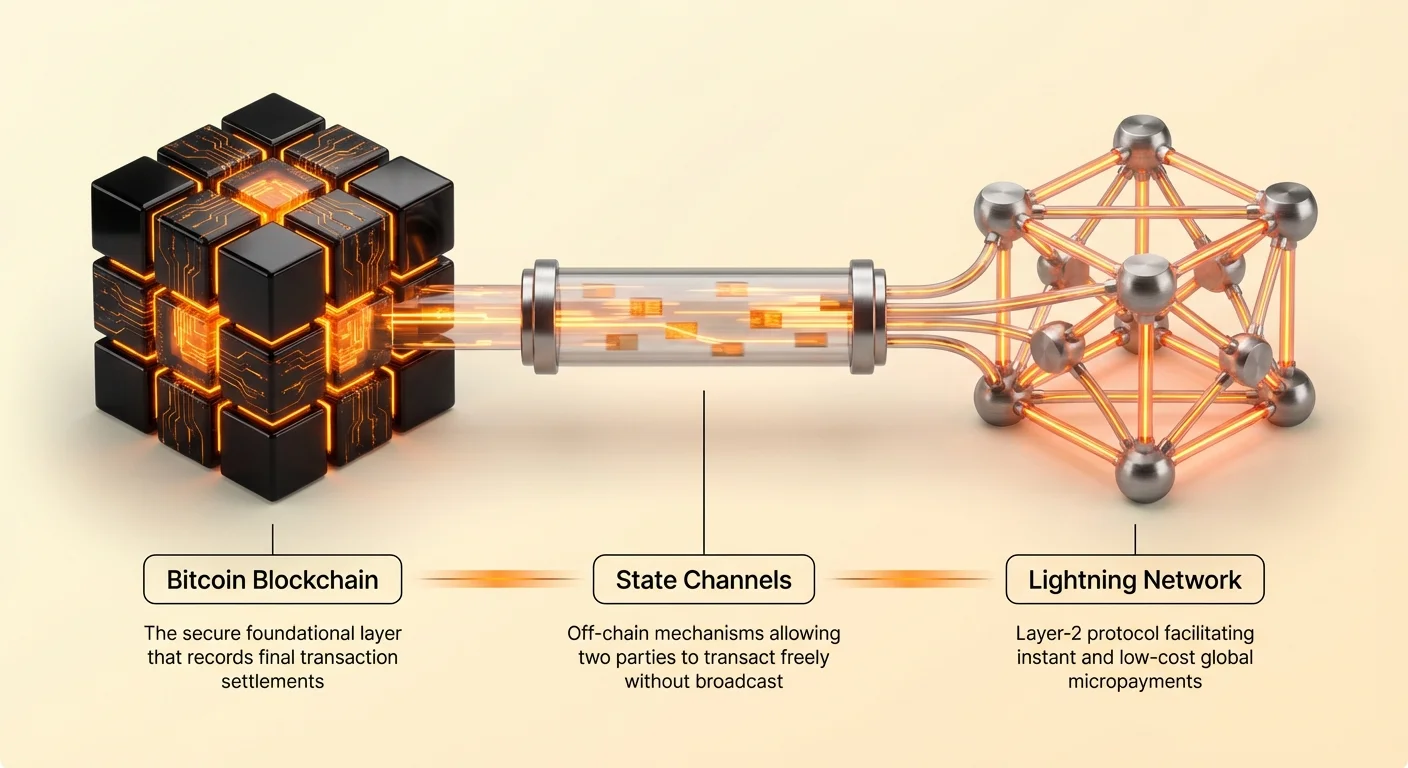
The core mechanism powering the Lightning Network is the state channel. This technology allows two parties to conduct numerous transactions without recording every single one on the main blockchain. To understand the network's potential, one must grasp how these channels maintain security while operating off-chain.
To initiate a channel, two parties lock a specific amount of Bitcoin into a multi-signature address. This is an address that requires authorization from multiple people to sign a transaction. This initial funding transaction is recorded on the Bitcoin mainnet, serving as the anchor for the channel's security.
Once the channel is open, the participants can transact an unlimited number of times. They exchange signed transaction data that updates their respective balances within the channel's current state. These updates happen instantly and do not touch the main blockchain.
This process avoids the ten-minute block time and the fees associated with on-chain miners. It effectively turns Bitcoin into a medium for micro-transactions. The final settlement only occurs when the parties decide to close the channel.
At that point, they broadcast the final state to the Bitcoin blockchain. The network then distributes the funds according to the latest balance agreement. This architecture shifts the burden of data storage away from the public ledger, preserving block space for high-value settlements.
The Impact of SegWit on Scalability
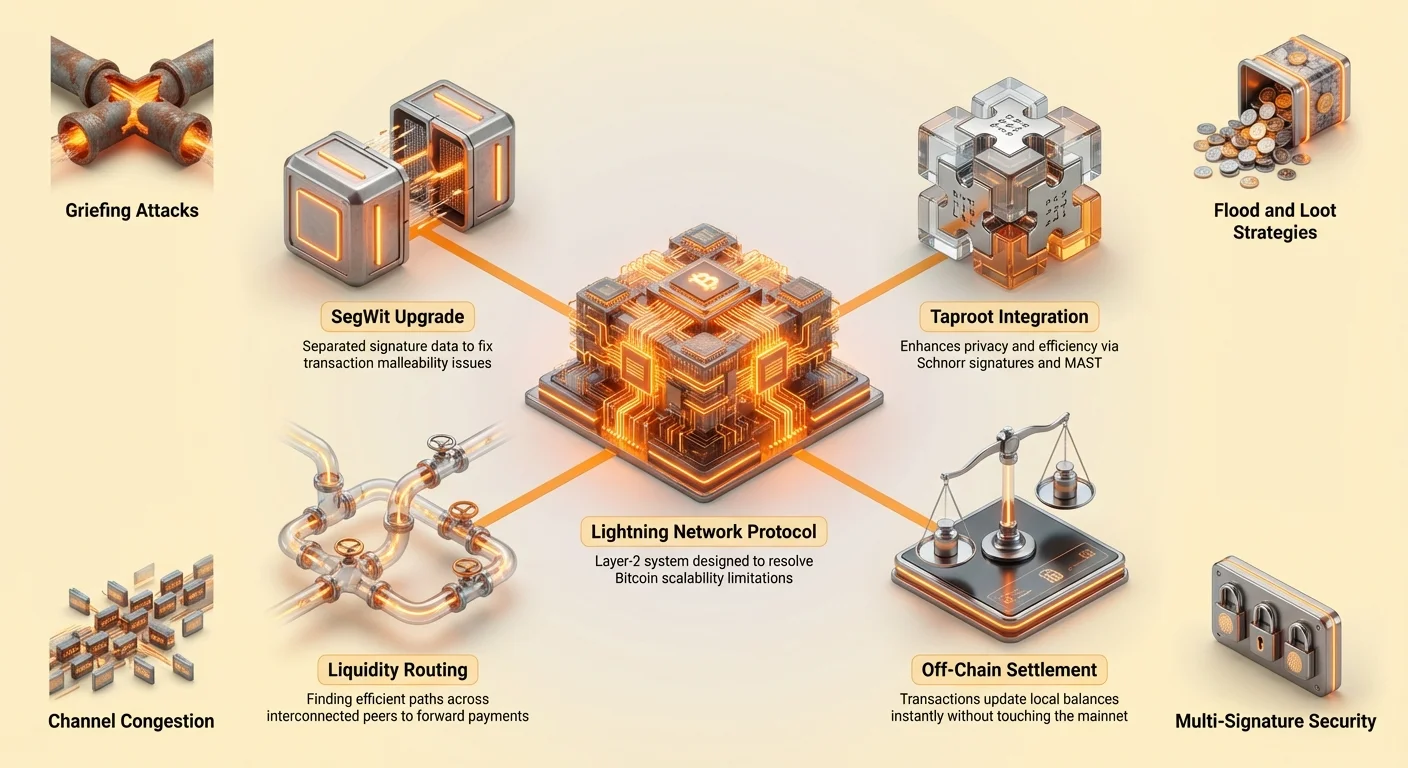
The implementation of Segregated Witness (SegWit) was a pivotal moment for Bitcoin scaling. Before this upgrade, transaction malleability was a significant issue that hindered the development of second-layer solutions. SegWit separated signature data from transaction data, which fixed the malleability bug and paved the way for secure payment channels.
By removing signature data from the main part of the transaction block, SegWit also increased the effective block size. This allowed for more transactions to fit into a single block. While this was a Layer-1 upgrade, its primary long-term value was enabling protocols like the Lightning Network to function reliably.
Without the malleability fix provided by SegWit, creating the refund transactions necessary for Lightning channels would have been risky. If a transaction ID could be altered before confirmation, it could render the safety mechanisms of a payment channel useless. SegWit ensured that transaction IDs remained consistent.
This stability allowed developers to build the complex web of revocable transactions that define the Lightning Network today. It serves as the technical foundation upon which modern liquidity routing is built.
Adoption Metrics and Locked Value
When evaluating the success of the Lightning Network, Total Value Locked (TVL) is a common metric. As of early 2024, the network held approximately 5,000 BTC in capacity. This figure represents the liquidity available for routing payments across the globe. While this is a significant amount of capital, it pales in comparison to other off-chain solutions.
For context, Wrapped Bitcoin (WBTC) on Ethereum holds over 150,000 BTC. This disparity highlights a distinct preference in the market for decentralized finance (DeFi) utility over pure payment velocity. WBTC allows Bitcoin holders to use their assets in lending protocols and decentralized exchanges, generating yield that the Lightning Network does not natively offer.
The slow growth of Lightning capacity compared to tokenized Bitcoin on other chains suggests that demand for payments is currently lower than the demand for yield. However, capacity is not the only metric that matters. Node count and channel connectivity are equally important for a healthy routing network.
A highly concentrated network with a few large nodes introduces centralization risks. A dispersed network with thousands of smaller nodes offers better censorship resistance but may suffer from routing failures. The current adoption phase focuses on balancing these two factors to ensure reliability.
Liquidity Management Challenges
Liquidity is the lifeblood of the Lightning Network, but managing it is complex. A payment channel is like a tube with a fixed amount of water (Bitcoin) inside. If Alice sends 1 BTC to Bob, the water moves to Bob's side. The total capacity remains the same, but the distribution changes.
This dynamic creates the problem of inbound capacity. If a merchant receives many payments, their side of the channel fills up. Eventually, they cannot receive any more funds until they spend some Bitcoin to push the balance back to the other side.
New users often struggle with this concept. They open a channel to receive a payment, only to realize they first need to spend funds or lease inbound liquidity from a provider. This friction impedes the user experience and complicates merchant adoption.
Comparison of Bitcoin Scaling Solutions
Understanding where the Lightning Network fits requires comparing it to other scaling methods. The following table outlines key differences between Lightning and other popular off-chain or sidechain solutions.
| Feature | Lightning Network | Liquid Network | Wrapped Bitcoin (WBTC) |
|---|---|---|---|
| Architecture | State Channels | Federated Sidechain | ERC-20 Token |
| Settlement | Peer-to-Peer | Federation Consensus | Ethereum Mainnet |
| Speed | Instant | ~2 Minutes | ~12 Seconds (Eth blocks) |
| Custody | Non-Custodial | Federated Custody | Centralized Custodian |
| Primary Use | Micro-payments | Asset Issuance/Trading | DeFi Collateral |
Security Vulnerabilities in Payment Channels
The Lightning Network introduces unique attack vectors that do not exist on the main Bitcoin blockchain. Because transactions occur off-chain and rely on time-locks, bad actors can attempt to exploit these mechanics. These vulnerabilities are currently the subject of intense research and mitigation efforts by developers.
Griefing Attacks
Griefing attacks are designed to disrupt the network rather than steal funds directly. In this scenario, an attacker initiates a payment that routes through multiple channels. However, they refuse to finalize the transaction on the receiving end.
This action locks up the liquidity along the entire route. The honest nodes involved in the path cannot use those funds for other transactions until the time-lock expires. While the attacker does not gain money, they degrade the network's efficiency.
If executed at scale, this could paralyze specific hubs or routes. It forces node operators to be cautious about who they peer with. Currently, there is no cost to failed payments, which makes griefing cheap to execute.
Flood and Loot Strategies
A more dangerous vulnerability is the "flood and loot" attack. This involves an attacker forcing many victims to close their channels simultaneously. The goal is to congest the Bitcoin mempool, which is the holding area for unconfirmed transactions.
If the main blockchain is congested, legitimate closing transactions may not confirm in time. Lightning channels rely on specific time windows to penalize cheating attempts. If a node cannot get their penalty transaction confirmed before the deadline, the attacker can steal funds.
This attack relies on the limited throughput of Bitcoin's base layer. It highlights the critical dependency Layer-2 solutions have on the underlying blockchain's capacity to process settlements during emergencies.
Pinning and Time-Dilation
Pinning attacks involve tricking a node into accepting a transaction that cannot be confirmed or replaced. An attacker might broadcast a transaction with a low fee that sits in the mempool, preventing the honest node from closing the channel properly.
Time-dilation is a sophisticated attack where a hacker isolates a node from the rest of the network. By delaying the delivery of block headers, the attacker tricks the victim into thinking they have more time to react than they actually do.
This distortion of time can cause the victim to miss critical deadlines for claiming funds or penalizing cheaters. Solving these issues often requires changes to both the Lightning protocol and Bitcoin Core software.
Advancements in Routing Logic
The Lightning Network relies on the theory of six degrees of separation. A user does not need a direct channel with everyone they wish to pay. They only need a path of interconnected peers to route the funds. Finding this path efficiently is a complex computer science problem.
Routing nodes charge small fees to forward these payments. This creates a marketplace for liquidity. Nodes that are well-connected and maintain balanced channels can earn a return on their Bitcoin. However, calculating the best route involves balancing speed, low fees, and reliability.
Modern implementations utilize onion routing. This privacy feature ensures that a node only knows the immediate predecessor and the immediate successor in the path. It does not know the original sender or the final recipient.
This structure enhances privacy but complicates the detection of routing failures. If a payment fails halfway through, the sender must try a different path. Improvements in pathfinding algorithms are essential for making the user experience seamless.
The Role of Taproot in Privacy and Efficiency
The activation of Taproot in November 2021 brought significant upgrades to Bitcoin that directly benefit the Lightning Network. Taproot introduced Schnorr signatures, a cryptographic scheme that allows for signature aggregation. This is vital for multi-signature transactions, which are the backbone of payment channels.
With Schnorr signatures, a multi-sig transaction looks identical to a standard single-sig transaction on the blockchain. This improves privacy by making it difficult for outside observers to distinguish between a Lightning channel open and a regular payment.
Furthermore, Taproot enables Merkelized Abstract Syntax Trees (MAST). This technology allows for complex spending conditions to be scripted without revealing the entire script on the blockchain. Only the condition that is met needs to be revealed.
For the Lightning Network, this means complex channel structures or cooperative closes can be executed more cheaply. It reduces the data footprint on the blockchain, lowering the cost of opening and closing channels. This efficiency is crucial for onboarding users who may have smaller balances.
Custodial vs. Non-Custodial Dilemmas
For the Lightning Network to reach mass adoption, the user interface must be simple. However, simplicity often comes at the cost of sovereignty. Running a Lightning node requires technical expertise. Operators must manage channel balances, watchtowers, and uptime.
This complexity has led to the rise of custodial Lightning wallets. These services manage the channels and liquidity on behalf of the user. While this provides a smooth, bank-like experience, it reintroduces trust into a trustless system.
If the custodial provider fails or is shut down, the user loses access to their funds. This mirrors the risks associated with centralized exchanges. The community is currently divided between promoting easy-to-use custodial solutions and developing better tools for self-custody.
Non-custodial wallets are improving, but they often face the inbound liquidity issues mentioned earlier. Hybrid models are emerging that attempt to automate channel management without taking full custody of the private keys.
Smart Contracts and Programmability
While Bitcoin is often criticized for lacking the programmable flexibility of Ethereum, Layer-2 solutions are changing this narrative. The Lightning Network allows for the development of decentralized applications (dApps) that utilize Bitcoin for micropayments.
Developers are exploring ways to build sophisticated financial contracts on top of Lightning. This includes Discrete Log Contracts (DLCs), which enable oracle-based betting and derivatives without on-chain footprint.
These advancements bring smart contract utility to Bitcoin without bloating the base layer. It allows users to execute agreements that are enforceable by the blockchain but settled instantly off-chain. This creates a unique niche for high-frequency, low-trust commerce.
Interaction with Sidechains and Rollups
The Lightning Network does not exist in a vacuum. It operates alongside other scaling solutions like sidechains and newer concepts like rollups. Sidechains, such as the Liquid Network, offer different trade-offs regarding speed and trust.
Liquid uses a federated consensus model, which is faster than Bitcoin but more centralized. It supports advanced asset issuance and confidential transactions. Lightning can interoperate with sidechains through atomic swaps.
This allows a user to move value between the high-speed Lightning Network and the feature-rich sidechain environment without trusting a third-party exchange. Rollups, a technology borrowed from the Ethereum ecosystem, are also being explored for Bitcoin.
Sovereign rollups on Bitcoin would use the blockchain for data availability while executing transactions off-chain. This could potentially offer higher throughput than Lightning for certain use cases, creating a multi-layered scaling ecosystem.
Future Potential with Taproot Assets
A major development on the horizon is the ability to issue assets on the Bitcoin blockchain that can be transferred via the Lightning Network. This protocol, often referred to as Taproot Assets, leverages the privacy and efficiency of the Taproot upgrade.
It allows users to mint stablecoins or other tokens on Bitcoin and route them through Lightning channels. This could transform the network into a multi-asset rail. Imagine sending a stablecoin instantly with near-zero fees, secured by Bitcoin's proof-of-work.
This functionality competes directly with high-throughput blockchains like Solana or Ethereum Layer-2s. By bringing stablecoins to Lightning, Bitcoin becomes a viable competitor for global forex and remittance markets, vastly expanding its utility beyond a store of value.
Conclusion
The transition to a mature Lightning Network involves navigating a landscape of technical trade-offs and adoption hurdles. While the liquidity metrics currently lag behind Ethereum-based DeFi, the focus on sustainable, non-custodial scaling remains the network's defining characteristic. The integration of Taproot and the potential for multi-asset routing suggest a robust future for this Layer-2 protocol.
Risks such as pinning attacks and channel congestion are serious, but the open-source nature of Bitcoin development ensures these vectors are continuously analyzed. The tension between custodial convenience and sovereign security will likely drive the next generation of wallet software. As the ecosystem expands, the interplay between Lightning, sidechains, and base-layer upgrades will determine Bitcoin's role in the future of digital finance.
True scaling is achieved when complex technology becomes invisible to the user while maintaining decentralized security.