
For years, the conversation surrounding the world's leading digital asset has been dominated by a single, contentious topic: energy consumption. Critics often portray the network as an environmental disaster, citing total electricity usage figures that rival mid-sized nations. While these statistics generate sensational headlines, they often lack the necessary context to provide a complete picture. To truly understand the impact of this decentralized financial system, one must look beyond the raw numbers and examine the nuances of power generation, grid dynamics, and the utility provided.
The narrative is slowly shifting from one of wastefulness to one of grid efficiency and renewable synergy. Energy researchers and industry experts are beginning to highlight how mining operations can actually support the transition to green energy rather than hinder it. By functioning as a flexible load that can be turned on or off instantly, miners offer a unique solution to some of the most persistent problems in modern energy infrastructure.
Understanding this complex relationship requires a deep dive into the mechanics of the network. We must analyze how consensus is achieved, where the energy actually comes from, and what value is derived from this expenditure. The story is not black and white. It is a nuanced tale of technology, economics, and the future of energy distribution.
The Mechanics of Consensus
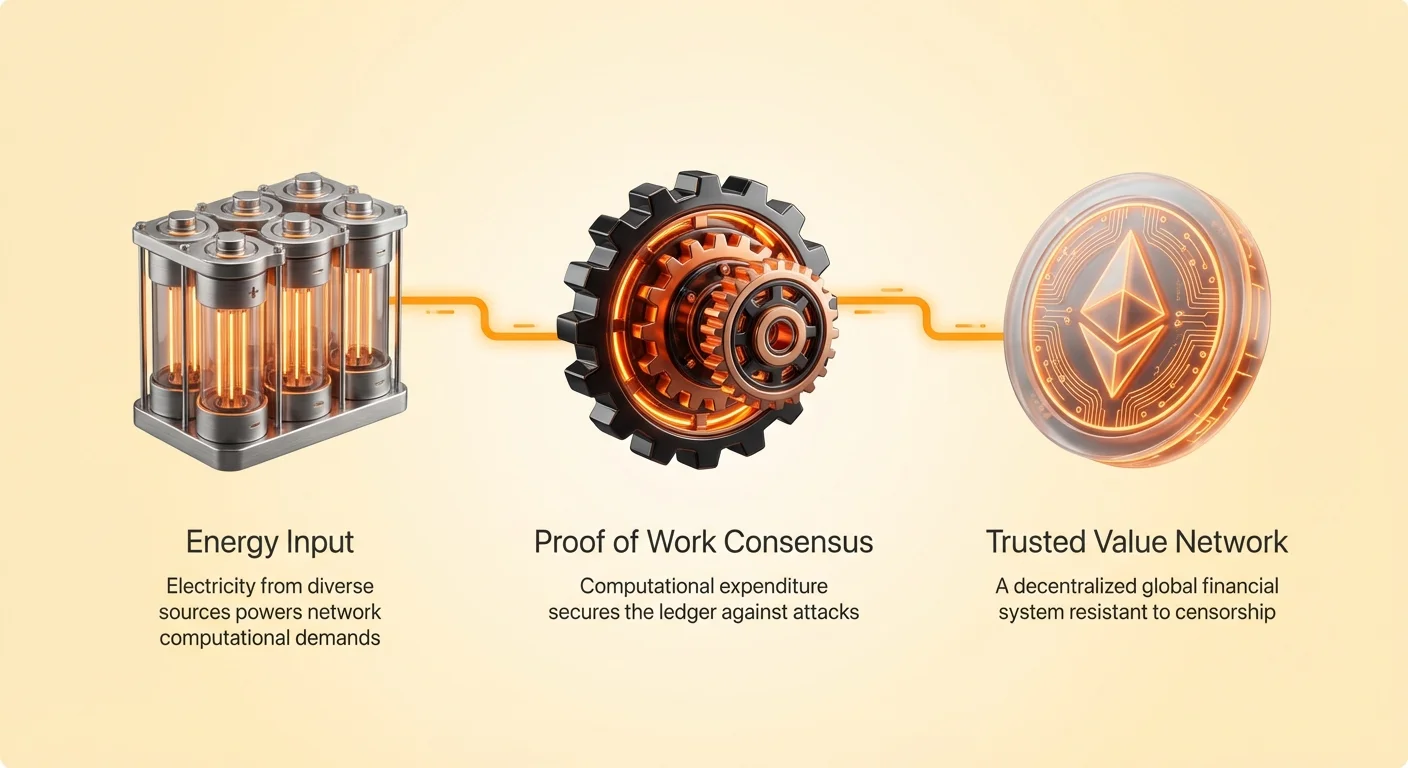
To grasp why the network consumes energy, one must first understand the mechanism known as Proof of Work (PoW). This is the consensus algorithm that secures the ledger and ensures that no central authority is needed to process transactions. In a traditional banking system, a centralized entity like a bank or government validates records. They use servers, office buildings, and employees to maintain trust.
In a decentralized system, there is no central gatekeeper. Instead, thousands of computers, known as miners, compete to solve complex mathematical puzzles. The first miner to solve the puzzle gets the right to add a new block of transactions to the blockchain. This process requires significant computational power, which in turn requires electricity.
This energy expenditure is not a bug; it is a feature. The cost of electricity acts as a barrier to entry for bad actors. To attack the network or alter the ledger, an attacker would need to amass a majority of the computing power. This would require a staggering amount of hardware and electricity, making such an attack economically unfeasible. The energy consumed is essentially the cost of securing a global, censorship-resistant monetary network.
Security vs. Waste
Critics often label this energy use as "wasteful" because the mathematical calculations do not serve a direct purpose outside of securing the network. However, this perspective overlooks the fundamental value of security. Just as physical vaults, armored trucks, and security guards consume resources to protect physical cash and gold, electricity is consumed to protect digital value.
The "work" performed by miners provides a mathematical guarantee of immutability. Once a transaction is confirmed and buried under subsequent blocks, it becomes nearly impossible to reverse. This finality is what allows the asset to function as a trustless store of value. Without the energy-intensive Proof of Work, the network would be vulnerable to spam, denial-of-service attacks, and fraudulent history rewriting.
Furthermore, the protocol includes an automatic difficulty adjustment. As more miners join the network, the puzzles become harder to solve. If miners leave, the puzzles become easier. This ensures that blocks are produced at a consistent 10-minute interval, regardless of how much energy is being thrown at the network. It is a self-regulating system designed for stability and longevity.
Quantifying the Consumption
When discussing energy usage, it is crucial to distinguish between large numbers and relative impact. Estimates suggest that the Bitcoin network consumes approximately 71.86 Terawatt-hours (TWh) per year. Standing alone, this figure seems immense. It is comparable to the annual electricity consumption of countries like Austria or Colombia. However, when placed in a global context, the perspective shifts.
Data from the Cambridge Bitcoin Electricity Consumption Index (CBECI) indicates that this consumption represents only about 0.37% of the world's total electricity usage. While not insignificant, it is far from the planet-eating monster often depicted in media reports. It is a sliver of global demand, comparable to the energy used by holiday lights or always-on household appliances in the United States alone.
Comparisons are essential for human comprehension. For instance, the amount of energy wasted in the United States electrical grid due to transmission and distribution losses is immense. The Bitcoin network could theoretically be powered entirely by just 35% of these losses. This highlights that the issue is often not a lack of energy generation, but rather inefficiencies in how energy is distributed and utilized.
The Internet Analogy
Fears of exponential energy growth are not new to technology. In the late 1990s and early 2000s, similar concerns were raised about the Internet. Predictions claimed that the growth of data traffic would result in the Internet consuming a catastrophic portion of the world's electricity. A famous 2017 article even predicted that mining would consume all the world's energy by 2020.
Obviously, this did not happen. The Internet grew, but so did the efficiency of data centers and transmission networks. Energy consumption did not scale linearly with adoption. The same principle applies to mining hardware. The industry is fiercely competitive, driving constant innovation in semiconductor efficiency.
Modern mining rigs are orders of magnitude more efficient than their predecessors. They can perform significantly more calculations per watt of electricity. As the block reward for miners decreases over time due to halving events, the economic pressure to use the most efficient hardware and the cheapest electricity increases. This natural economic incentive acts as a brake on unchecked energy consumption growth.
Distinguishing Electricity from Energy
A common error in environmental analysis is confusing electricity consumption with total energy consumption. Electricity is just one form of energy. Many industries rely heavily on direct fossil fuel combustion, which does not show up in electricity statistics. The agricultural and transportation sectors, for example, consume vast amounts of hydrocarbon energy directly.
Comparing a digital mining industry that runs strictly on electricity to industries that burn fuel directly is an apples-to-ranges comparison. As the electrical grid itself becomes greener, the digital asset network becomes greener automatically. If a miner plugs into a grid powered by wind or solar, their carbon footprint drops near zero.
This creates a unique trajectory for the industry. Unlike combustion-engine vehicles that will always emit carbon, a mining rig is agnostic to its power source. It simply needs electrons. As global energy infrastructure decarbonizes, the network's environmental impact diminishes in tandem, without requiring any changes to the protocol itself.
The Renewable Energy Synergy
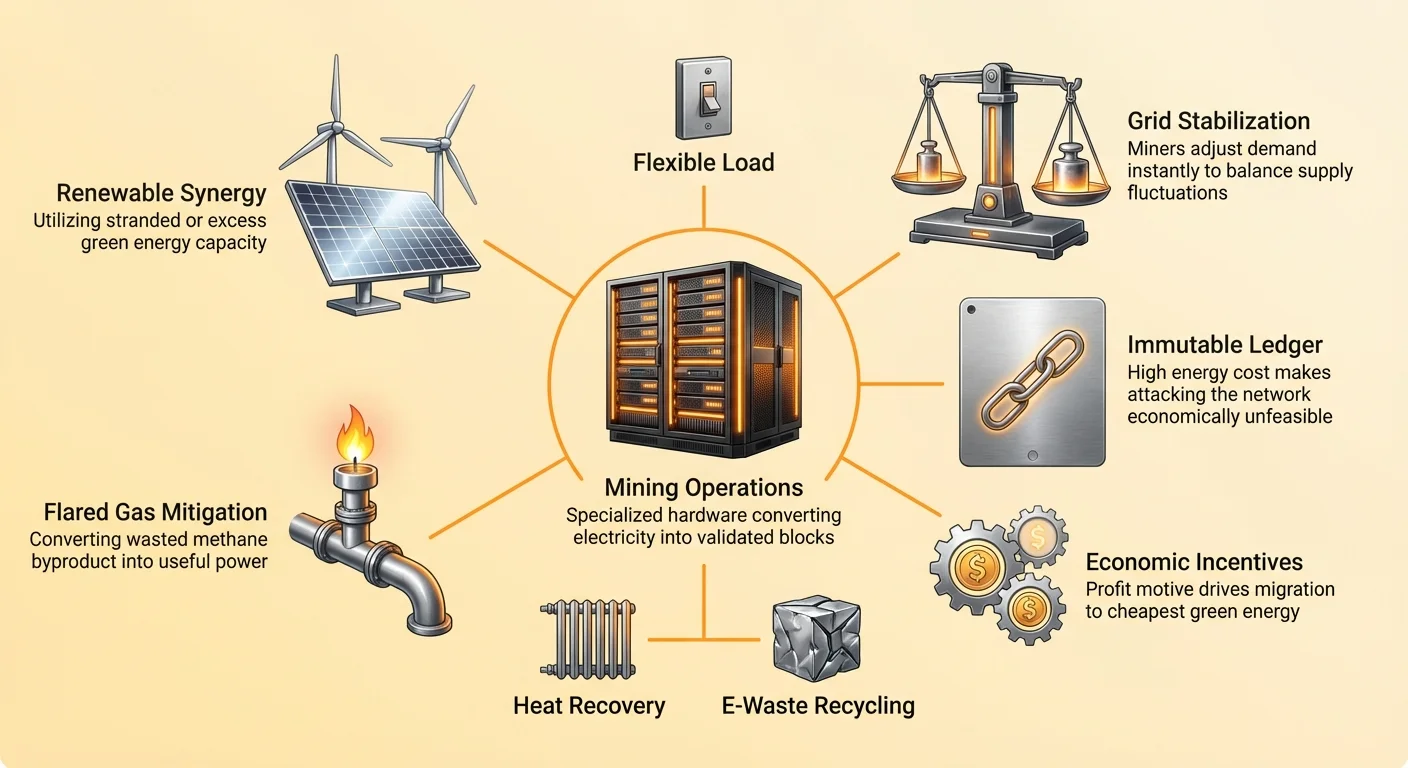
Miners are nomadic by nature. They do not need to be near cities or customers. They only require an internet connection and a power source. This geographic flexibility allows them to seek out the cheapest electricity available on the planet. In the energy market, the cheapest power is often renewable power that is generated in remote locations.
Hydroelectric dams, for example, often produce constant power regardless of demand. If a dam is built in a remote region with a small local population, much of that generating capacity goes to waste. The water must be spilled without generating electricity, or the electricity is lost in transmission over long distances. Miners can set up operations directly at the source.
By purchasing this excess power, miners provide revenue to renewable energy projects that might otherwise be economically unviable. This additional income stream can subsidize the construction of new green energy infrastructure. Reports estimate that a significant portion of mining energy comes from renewables, with figures ranging between 39% and 73% depending on the study.
Stabilizing the Grid
Renewable energy sources like wind and solar are intermittent. The wind does not always blow, and the sun does not always shine. Conversely, these sources sometimes produce more energy than the grid can handle, leading to negative pricing or curtailment (shutting off the generators). This instability is a major challenge for modern power grids.
Miners act as a "controllable load." They can switch their machines on or off in seconds. During periods of peak demand, such as a heatwave when everyone runs air conditioning, miners can shut down to free up power for households. During periods of low demand and high renewable generation, they can spin up to consume the excess.
This demand response capability makes the grid more resilient. It provides a financial incentive to build over-capacity of renewable generation, knowing there is always a buyer of last resort. This symbiosis suggests that rather than being a parasite on the grid, the industry serves as a battery-like buffer that improves overall efficiency.
The Flared Gas Solution
One of the most promising environmental applications of mining involves the oil and gas industry. When companies drill for oil, they often hit pockets of natural gas. If there is no pipeline infrastructure to transport this gas, it is often burned off, or "flared," into the atmosphere. This process releases carbon dioxide and methane, a potent greenhouse gas.
Bitcoin miners are increasingly deploying mobile shipping containers filled with mining rigs to these oil fields. Instead of flaring the gas, the companies route it into generators to produce electricity on-site. This electricity then powers the mining rigs.
This process significantly reduces methane emissions. It turns a wasted, polluting byproduct into economic value. The revenue generated can even fund further emission-reduction technologies. This is a concrete example of how the profit motive inherent in the network drives tangible environmental benefits that other industries cannot replicate.
Comparative Environmental Impact
To fairly judge the environmental cost of the network, one must compare it to the alternatives. The traditional banking system and the gold industry are the primary analogues. Both systems require massive amounts of energy and resources to function, yet they rarely face the same scrutiny regarding their carbon footprints.
The gold industry is notoriously destructive. It involves open-pit mining, deforestation, and the displacement of massive amounts of soil. It uses toxic chemicals like cyanide and mercury to separate the metal from the ore. The energy required to dig, transport, crush, and refine gold is immense, and the physical environmental degradation is permanent.
In contrast, digital mining leaves no physical scar on the earth. It involves no chemicals and no direct pollution at the site of operation. Once the hardware is manufactured, the only ongoing input is electricity. If that electricity is green, the operation is clean.
The Cost of Fiat Systems
Comparing digital currency to the fiat banking system is more complex but revealing. The fiat system requires a vast physical infrastructure. This includes tens of thousands of bank branches, corporate skyscrapers, call centers, and server farms. It also includes the fleet of armored trucks and the daily commute of millions of bank employees.
All of these components consume energy and emit carbon. The construction of buildings requires concrete and steel. The transportation of employees and cash burns gasoline. The Bitcoin network replaces much of this settlement and clearing infrastructure with software.
While the banking system supports more transactions per second, the base layer of Bitcoin functions more like a central bank settlement layer. When viewed through this lens, the efficiency of replacing global physical infrastructure with code becomes apparent. The network achieves global settlement with a fraction of the physical resources required by the legacy financial system.
| Feature | Gold Mining | Fiat Banking | Bitcoin Mining |
|---|---|---|---|
| Primary Energy Source | Diesel/Fossil Fuels | Mixed (Grid + Transport) | Electricity |
| Physical Impact | Deforestation/Chemicals | Urban Construction | Minimal (Data Centers) |
| Waste Product | Toxic Sludge/Rock | Paper/Plastic/Emissions | Heat |
Electronic Waste Concerns
Critiques regarding electronic waste (e-waste) are valid but often lack context. Mining hardware, specifically Application-Specific Integrated Circuits (ASICs), becomes obsolete over time. When these machines are no longer efficient, they are discarded. This generates e-waste, similar to discarded smartphones and laptops.
However, the lifespan of mining hardware is increasing. In the early days, machines became obsolete in months. Now, hardware remains competitive for years. Furthermore, the metal and components in these machines are highly recyclable. The industry is also seeing the emergence of secondary markets where older machines are sent to areas with ultra-cheap power, extending their lifecycle.
The Ethical Dimension
The debate often moves from physics to ethics. Critics argue that even if the energy is renewable, using it for "fake internet money" is a waste. This argument relies on a subjective judgment of what is valuable. It assumes that the network provides no social good and therefore deserves zero energy.
We do not apply this logic to other industries. We do not question the energy used by the video game industry, Christmas lights, or clothes dryers. We accept that people value these things, and therefore the energy use is justified. The question is not "is it a lot of energy?" but rather "is the utility worth the cost?"
For millions of people, the answer is yes. For the unbanked populations in developing nations, the network offers a first access to global financial tools. For citizens living under authoritarian regimes with collapsing currencies, it offers a lifeline to preserve their wealth. The value of a censorship-resistant, seizure-immune store of value is immense for those who need it most.
The Hospital Analogy
To illustrate the ethics of resource consumption, consider the example of hospitals. Hospitals are environmentally demanding. They consume massive amounts of electricity and generate significant medical waste, including single-use plastics. Yet, society does not label hospitals as "bad." We accept the environmental cost because the service provided—saving lives—is deemed essential.
While digital currency does not perform surgery, it provides financial sovereignty. For a refugee fleeing a war zone, the ability to carry their life savings in a memorized password is a form of survival. For a family sending remittances without losing 20% to predatory middlemen, it is economic empowerment.
If one accepts that economic freedom and property rights are public goods, then the energy consumed to secure them is justifiable. The moral calculation changes depending on one's privilege and access to stable traditional banking. For those outside the system, the energy cost is a small price to pay for inclusion.
Future Efficiency Trends
The industry is not standing still. Innovation is driving efficiency at a rapid pace. Beyond hardware improvements, miners are exploring new ways to utilize the heat generated by their machines. Mining rigs produce significant amounts of thermal energy. Innovative projects are now capturing this heat for productive use.
Greenhouses are being heated by mining operations, allowing for year-round food production in cold climates. District heating systems are piping waste heat from miners into homes and offices. In these setups, the electricity is used twice: once to secure the financial network and once to provide thermal comfort. This effectively halves the carbon footprint of the operation.
Immersion cooling is another technological leap. By submerging miners in non-conductive liquid, cooling fans are eliminated. This reduces electricity consumption for cooling by up to 95% and extends the life of the hardware. These innovations suggest a future where mining is integrated into industrial and residential heating systems, becoming an invisible, efficiency-boosting component of the built environment.
Economic Incentives for Green Growth
The profit motive is the strongest driver of the green transition in mining. Solar and wind are now the cheapest forms of energy generation in history. Miners are rational economic actors. They are relentlessly hunting for the lowest bottom line. This aligns their incentives perfectly with the environmental goals of society.
As carbon taxes and regulations increase the cost of fossil fuel energy, the mining industry will migrate even faster toward renewables. No other industry is as mobile or as sensitive to power costs. This makes miners the natural pioneers of new energy frontiers. They will go where the green energy is abundant and underutilized.
This dynamic creates a positive feedback loop. More mining revenue for green projects leads to more green infrastructure. More green infrastructure leads to a cleaner grid. A cleaner grid reduces the carbon footprint of every transaction. The market forces are pushing the industry toward sustainability faster than any government mandate could.
Conclusion
The story of mining and energy is far more complex than simple consumption statistics suggest. It is a narrative of technological evolution, grid stabilization, and economic incentives aligning with environmental goals. While the network consumes a significant amount of electricity, it does so to secure a global, decentralized financial system that offers unique value to millions. The comparison to traditional industries reveals that digital mining is often cleaner, more efficient, and less physically destructive than the alternatives.
As the industry matures, the integration with renewable energy sources will likely deepen. Miners will continue to act as a catalyst for green energy projects, monetizing wasted resources and stabilizing volatile grids. The conversation is moving away from alarmism toward a pragmatic understanding of how this technology fits into a sustainable future. The energy expended is not a waste; it is an investment in a secure, open, and immutable monetary network.
Bitcoin's energy consumption serves as a security budget that incentivizes renewable generation and enables global financial freedom.