
Entering the world of cryptocurrency trading often focuses heavily on price action, market trends, and asset selection. However, one of the most critical determinants of long-term profitability is the cost of doing business on the platforms themselves. Every transaction, transfer, and conversion incurs a cost. These expenses can silently erode profits if not properly understood and managed.
New traders frequently overlook the complex fee structures employed by modern exchanges. What appears to be a negligible percentage on a single trade can compound significantly over hundreds of transactions. Understanding the economic model of these platforms is the first step toward financial efficiency. It requires dissecting the fine print of user agreements and fee schedules.
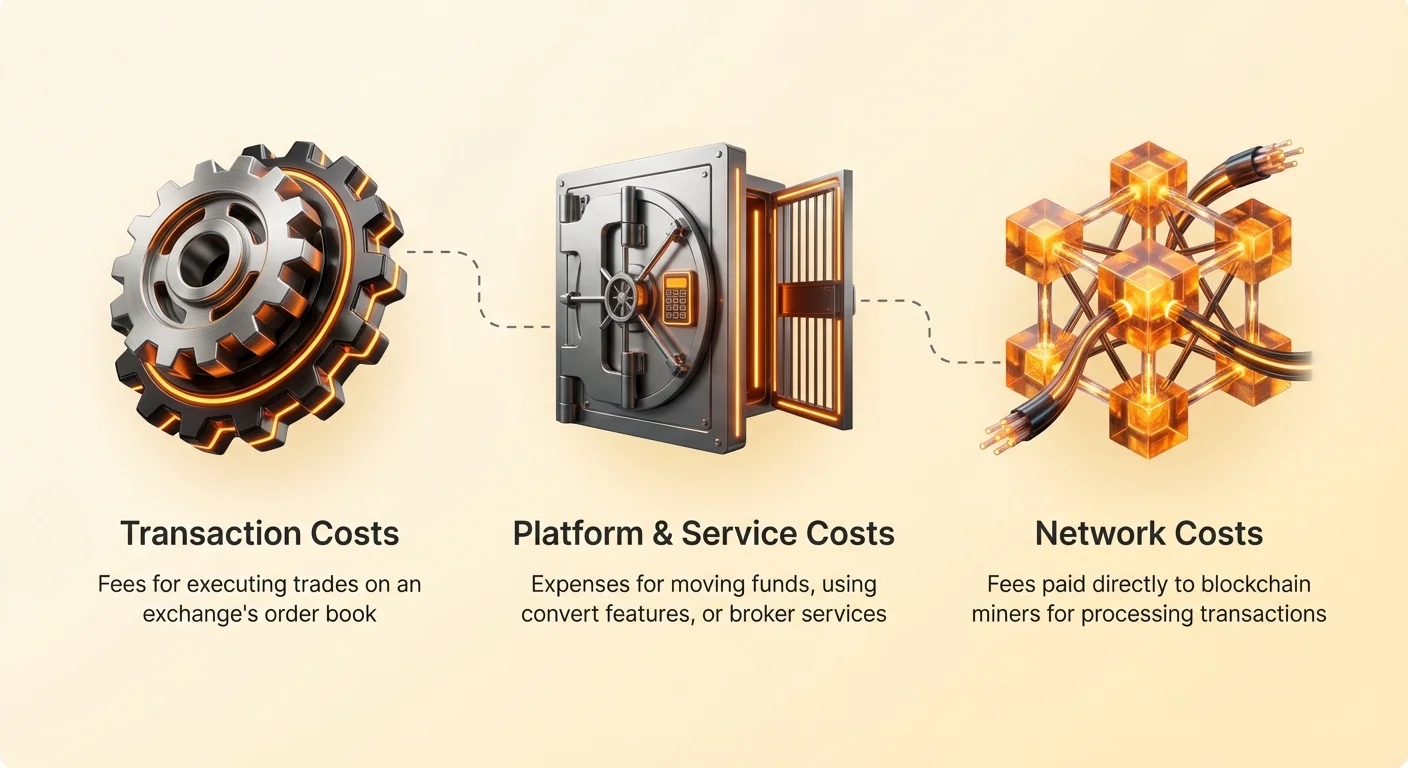
The landscape of digital asset platforms is diverse. It ranges from centralized order-book exchanges to decentralized protocols and user-friendly brokerages. Each type of venue operates on a distinct revenue model. Some charge upfront commissions, while others hide their costs within the asset price itself.
Navigating this terrain requires a clear understanding of technical terms like "maker," "taker," and "spread." It also involves recognizing the external costs imposed by blockchain networks, such as miner fees, which are often passed on to the user. This analysis aims to deconstruct these costs to provide a clear picture of the financial reality of crypto trading.
The Economic Model of Exchanges
Cryptocurrency exchanges are businesses that require significant capital to operate. They must maintain robust security infrastructure, server capacity, customer support teams, and legal compliance departments. To cover these operational overheads and generate profit, they employ various revenue streams that directly impact the user.
The primary revenue source for most platforms is the trading fee. This is typically calculated as a percentage of the total transaction volume. Unlike traditional stock brokerages that have largely moved to zero-commission models, the crypto industry largely retains per-trade fees due to the fragmented and volatile nature of the market.
Another significant revenue stream is the "spread." This is particularly common among brokerage-style platforms that simplify the trading experience for beginners. The spread represents the difference between the buying price and the selling price of an asset at any given moment.
In a spread-based model, the platform essentially buys the asset at a lower price and sells it to the user at a slightly higher price. The user pays "zero fees" in the traditional sense, but they are purchasing the asset at a premium compared to the raw market rate. This markup constitutes the platform's profit margin.
Distinguishing Trading Venues
To analyze costs effectively, one must distinguish between the different types of trading venues. Centralized Exchanges (CEX) operate like traditional stock markets. They utilize an order book where buyers and sellers list their prices. The exchange acts as the middleman, matching these orders and taking a cut from both sides.
Brokerage platforms often function differently. They may act as the counterparty to your trade or route your order to other exchanges. Because they prioritize ease of use and speed over granular control, they often charge higher overall costs. These costs are usually embedded in the price spread rather than displayed as a line-item commission.
Decentralized Exchanges (DEX) operate on code and smart contracts without a central authority. While they remove the corporate middleman, they introduce network costs. Users must pay "gas" fees to the blockchain network for every interaction, which is a critical part of mastering gas fees. In times of high network congestion, these fees can sometimes exceed the value of the trade itself.
Understanding the Order Book
The central mechanism of most professional trading platforms is the order book. This is a real-time, dynamic list of buy and sell orders organized by price level. Understanding the order book is a prerequisite to understanding the "Maker vs. Taker" fee model, which is the industry standard for active trading.
The order book reflects the market's immediate supply and demand. On one side are the "bids," which are buy orders from people wanting to purchase the cryptocurrency. On the other side are the "asks," which are sell orders from those looking to offload their assets.
When a trader places an order that matches an existing order on the book, the trade executes immediately. This removes liquidity from the book. Conversely, when a trader places an order at a price that is not yet available, that order sits on the book waiting for someone else to take it. This adds liquidity.
The Concept of Liquidity
Liquidity refers to the ease with which an asset can be bought or sold without affecting its stable price. A liquid market has many buyers and sellers, allowing for large transactions to occur with minimal price slippage. Exchanges are desperate for liquidity because it attracts more traders.
To incentivize traders to provide this liquidity, exchanges developed the maker-taker fee model. They effectively reward users who add orders to the book (makers) with lower fees. Simultaneously, they charge a premium to users who take orders off the book (takers).
This economic incentive aligns the goals of the trader with the health of the exchange. Traders who are patient and willing to wait for their price get a discount. Traders who demand immediate execution pay for that privilege. This structure helps maintain a thick order book, stabilizing prices.
The Role of Market Makers
Professional market makers are entities or individuals who specialize in providing liquidity. They constantly place both buy and sell orders at various price points. By doing so, they ensure that there is always a counterparty available for retail traders who want to buy or sell instantly.
Exchanges rely heavily on these market makers to ensure smooth operations. Without them, the gap between the highest buy price and the lowest sell price—known as the bid-ask spread—would be very wide. A wide spread makes trading inefficient and costly for regular users.
Because of their vital role, high-volume market makers often negotiate extremely low fees. In some cases, they may even receive rebates, meaning the exchange pays them to trade. For the average retail trader, becoming a "maker" simply means using Limit orders rather than Market orders to access lower fee tiers.
Deconstructing Maker Fees
A "Maker" is a market participant who provides liquidity to the order book. You become a maker when you place an order that does not fill immediately. For example, if Bitcoin is trading at $50,000, and you place a Limit order to buy at $49,500, your order goes onto the book.
You are effectively saying, "I am willing to buy Bitcoin at this specific price." Until the market price drops to $49,500 and someone decides to sell to you, your order remains open. You have "made" a new option for other traders. You have added depth to the market.
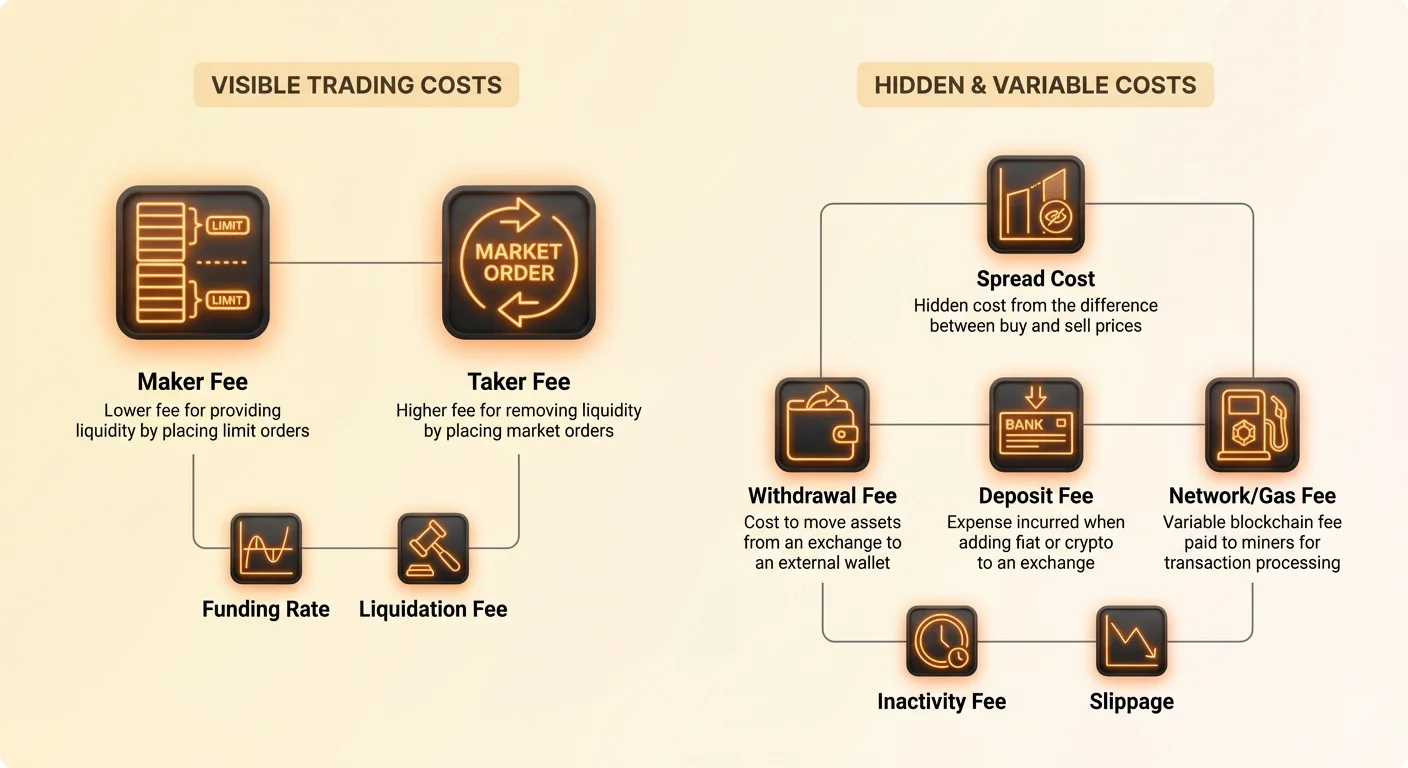
Because you are helping the exchange by thickening their order book, you are charged the Maker fee. This fee is almost universally lower than the Taker fee. On some platforms, the Maker fee can be as low as 0.01% or even 0%.
Strategic Implications of Maker Orders
Using Maker orders is a primary strategy for cost-conscious traders. It requires patience and a strict adherence to price targets. By refusing to pay the current market price and instead setting a specific entry or exit point, the trader reduces their transaction costs significantly.
However, the risk of being a Maker is non-execution. If the market price never reaches your limit order, the trade will not happen. You might miss a major price move because you were trying to save a fraction of a percentage in fees. This is the trade-off between cost efficiency and opportunity cost.
Another aspect is that Maker orders are passive. You cannot force them to execute. You are at the mercy of the market moving toward your price. In fast-moving volatile markets, chasing the price with Limit orders can result in repeatedly missing the entry as the price runs away.
Calculating Maker Costs
To calculate the cost of a Maker trade, you multiply the total value of the transaction by the Maker fee percentage. If you are buying $1,000 worth of Ethereum and the Maker fee is 0.10%, the fee is $1.00. This amount is usually deducted from the currency you are receiving.
If you are buying Ethereum, you will receive $1,000 worth of ETH minus the $1.00 equivalent in ETH. If you are selling, the fee is deducted from the fiat or stablecoin you receive. It is crucial to account for this deduction when calculating precise profit and loss targets.
Over thousands of trades, the difference between a 0.10% Maker fee and a 0.50% standard fee is massive. It can determine whether a high-frequency trading strategy is viable or if it will slowly bleed the account dry through friction costs.
Deconstructing Taker Fees
A "Taker" is a market participant who removes liquidity from the order book. You become a Taker when you place an order that matches immediately with an existing order on the book. This is most commonly associated with "Market" orders, which is a key factor in optimizing crypto trade execution.
If Bitcoin is trading at $50,000 and you enter a Market Buy order, the exchange engine immediately matches you with the cheapest available Sell order on the book. You are "taking" that liquidity away. You demand immediate execution and are willing to pay the current asking price.
Because you are reducing the depth of the order book, the exchange charges you a higher premium. Taker fees are generally higher than Maker fees, sometimes by a significant margin. Standard Taker fees on major exchanges often hover around 0.10% to 0.60%.
The Cost of Immediacy
The Taker fee is essentially the price of speed. When news breaks or the market begins a rapid ascent, traders do not want to wait for a Limit order to fill. They want to get in or out immediately. The Taker fee is the premium paid for that certainty of execution.
In panic selling scenarios, Taker fees become a secondary concern. If the market is crashing, paying an extra 0.2% to exit a position instantly is often better than waiting for a Limit order that might never fill as the price plummets. In this context, the Taker fee acts as insurance for liquidity access.
However, for routine trading, relying solely on Market orders is a bad habit. It maximizes the friction on every trade. New traders often default to Market orders because they are simple and instant, unaware that they are consistently paying the highest possible rate on the platform.
Comparing Fee Tiers
| Activity | Order Type | Fee Level | Impact on Liquidity |
|---|---|---|---|
| Maker | Limit Order | Low | Adds Liquidity |
| Taker | Market Order | High | Removes Liquidity |
| Taker | Stop Loss | High | Removes Liquidity |
Stop-loss orders generally execute as Market orders once the trigger price is hit. This means that protective stops, while necessary for risk management, will almost always incur Taker fees. This is an unavoidable cost of protecting capital.
Some advanced traders use "Stop Limit" orders to try and incur Maker fees even on exits. However, this carries the risk that the Limit price is skipped over during a sharp crash, leaving the position open. The Taker fee is the cost of guaranteeing the exit.
The Mechanics of Spread Fees
While Maker and Taker fees are transparent and listed on fee schedules, spread fees are often opaque. Brokerage platforms and "convert" features on major exchanges frequently utilize spreads. A spread is the gap between the buy and sell price quoted by the platform, often constituting the hidden costs.
If the global market price of a token is $100, a broker might quote you a buy price of $101 and a sell price of $99. That $1 difference on either side is the spread. You are not charged a separate "transaction fee," so the platform claims the trade is free.
In reality, you have paid a 1% fee by purchasing above market value. This cost is realized immediately; as soon as you buy the asset, you are technically at a loss until the price rises enough to cover the spread. This is a stealth cost that confuses many beginners.
Comparing Spreads vs. Commissions
Transparent commission-based exchanges (Maker/Taker models) are generally cheaper than spread-based brokers. A 0.5% Taker fee is visible and calculable. A variable spread that widens during volatility can cost a trader 1% to 3% without them realizing it until the trade executes.
Spreads fluctuate based on market volatility. During quiet periods, spreads may be tight and competitive. During a market crash or a massive pump, spreads often widen significantly. Brokers do this to protect themselves from rapid price changes while they execute the order on the backend.
Traders must compare the "all-in" cost. This means calculating the price deviation from the spot market index plus any commissions. Often, the "free" trade on a broker is significantly more expensive than the commission-based trade on a professional exchange.
Hidden Costs in Conversions
Many exchanges offer a simple "Convert" button that allows users to swap one crypto for another instantly. This feature almost always uses a spread model, even if the exchange uses Maker/Taker fees on its pro trading interface.
The convenience of a one-click swap comes at a premium. The exchange acts as the counterparty or routes the trade through an instant settlement system that demands a spread. Users looking to save money should avoid "Convert" features and instead use the Spot market pairs.
For example, converting BTC directly to ETH might incur a 1% spread. Selling BTC for USD (Maker fee) and then buying ETH with USD (Maker fee) might cost 0.2% total. The extra steps require more effort but result in significant savings.
Withdrawal Fees: The Exit Tax
Once trading profits are secured, moving funds off an exchange introduces a new set of costs. Withdrawal fees are charged when a user transfers cryptocurrency from their exchange wallet to an external private wallet or another platform. These fees can be surprisingly high.
Withdrawal fees generally consist of two parts, though they are often bundled into a single flat rate. The first part is the network fee, which the exchange pays to miners or validators to process the transaction on the blockchain. The second part is a processing fee retained by the exchange.
Exchanges often set a flat fee for withdrawals regardless of the transaction size. For example, withdrawing Bitcoin might cost 0.0005 BTC whether you are moving $100 or $100,000. This flat-rate structure disproportionately affects small traders.
Network Variable Costs
Different blockchains have vastly different cost structures. Withdrawing Bitcoin or Ethereum can be expensive due to high demand for block space. During bull markets, simple transfers can cost $20 to $50 in network fees.
In contrast, newer Layer 1 blockchains often have negligible fees. Networks like Solana, Litecoin, or Ripple (XRP) often cost pennies to transact. Smart traders often convert their funds into a low-fee cryptocurrency before withdrawing to move value between exchanges cheaply.
However, this strategy triggers taxable events and exposure to price volatility during the transfer. It is a balancing act between paying the high withdrawal fee of a major asset versus the friction and tax implications of converting assets for transport.
Exchange Processing Markups
Exchanges often charge more than the actual network cost. If the Bitcoin network fee is currently $5, the exchange might still charge the fixed 0.0005 BTC (approx $25) fee. The difference is pure profit for the platform.
Some user-friendly platforms offer "free withdrawals" up to a certain limit. In these cases, the exchange absorbs the network cost as a marketing expense. This is common in competitive markets or for VIP users who generate high trading volumes.
It is vital to check the withdrawal fee schedule before depositing. Some platforms have low trading fees but exorbitant withdrawal fees. They lure traders in with cheap execution and then trap the funds with high exit costs, forcing users to keep assets on the platform.
Deposit Methods and Costs
Getting money into the crypto ecosystem is the first financial hurdle. The method chosen to deposit fiat currency (USD, EUR, etc.) greatly influences the initial cost basis. There are usually three main channels: bank transfers, card payments, and third-party processors.
Bank transfers (ACH, SEPA, Wire) are typically the slowest but cheapest method. Many exchanges allow domestic bank transfers for free or for a very nominal fee. The downside is the waiting period, which can range from a few hours to several business days.
Credit and debit card purchases are instant but expensive. Payment networks (Visa/Mastercard) charge the exchange a processing fee, which is passed on to the user. Additionally, the exchange adds a convenience fee. Total fees for card deposits often range from 3% to 5%.
Third-Party Processors
Platforms often integrate with payment processors like PayPal, Simplex, or Banxa. These services provide a bridge for users who cannot use direct bank transfers. While convenient, they are often the most expensive option available.
Fees for these services can climb upwards of 5% to 10%. Using a third-party processor forces the trader to start with a significant immediate loss. To break even, the asset must appreciate by more than the deposit fee, placing the trader at a disadvantage from day one.
Some exchanges have direct integrations with electronic wallets that offer lower fees. However, the general rule remains: the faster and more convenient the deposit method, the higher the fee. Planning ahead and using slow bank transfers is the most capital-efficient method.
Volume-Based Fee Tiers
Crypto exchanges operate on economies of scale. They want to encourage high-volume trading because it deepens liquidity and generates consistent revenue. To achieve this, almost all professional exchanges use a tiered fee structure.
The standard fees (e.g., 0.50%) apply to entry-level users. As a user's 30-day trading volume increases, they move up the VIP tiers. Each tier unlocks a lower Maker and Taker fee. Institutional traders moving millions of dollars often pay near-zero fees.
For the average retail trader, reaching the higher tiers is difficult. However, even moving from the first to the second tier can result in a 10% to 20% fee reduction. It is worth checking the threshold for the next tier; sometimes a few extra trades can push a user into a cheaper bracket for the following month.
Native Token Discounts
Many centralized exchanges have issued their own utility tokens. Examples include Binance Coin (BNB), KuCoin Token (KCS), and others. These tokens serve various functions within the exchange ecosystem, but their primary utility is fee reduction.
Holding the native token in your exchange wallet often qualifies you for a fee discount, typically around 25%. Alternatively, users can opt to pay their trading fees using the token rather than the asset being traded. This prevents "dust" (tiny, unusable amounts of crypto) from accumulating and lowers the cost.
Using native tokens for discounts is one of the easiest ways to immediately lower trading costs. However, it exposes the trader to the price volatility of the exchange token itself. If the token crashes, the loss in capital value may outweigh the savings in trading fees.
Centralized vs. Decentralized Cost Structures
The choice between a Centralized Exchange (CEX) and a Decentralized Exchange (DEX) represents a fundamental shift in cost structure. A CEX charges for the service of matching orders and custody. A DEX charges for the use of the blockchain network and liquidity incentives.
On a CEX, the fee is predictable. It is a percentage of the trade. On a DEX, the fee includes the liquidity provider fee (usually 0.3%) plus the blockchain gas fee. The gas fee is flat relative to the trade size but variable relative to network demand.
For small trades ($100), a DEX is often economically unviable on expensive chains like Ethereum. A $50 gas fee on a $100 trade is a 50% loss. For large trades ($100,000), the flat gas fee is negligible, and the control over assets becomes the primary value proposition.
Slippage on DEXs
DEXs rely on Automated Market Makers (AMMs) rather than traditional order books. In an AMM, the price is determined by a formula based on the ratio of assets in a pool. Large trades can significantly unbalance the pool, causing the price to shift against the trader during the transaction.
This phenomenon is called slippage. While it exists on CEXs, it is often more pronounced on DEXs with low liquidity. Traders can set a "slippage tolerance," but setting it too low might cause the transaction to fail (wasting the gas fee), while setting it too high results in a poor entry price.
Aggregators help mitigate this by splitting the trade across multiple liquidity pools to find the best average price. However, slippage remains a hidden cost on decentralized platforms that must be factored into the break-even analysis.
The Price of Security
There is often a correlation between the cost of an exchange and its security standards. "Premium" exchanges that charge higher fees often invest heavily in regulatory compliance, insurance policies, and cold storage infrastructure.
Budget exchanges with rock-bottom fees may cut corners on customer support or security protocols. They might lack insurance funds to reimburse users in the event of a hack. In this sense, higher fees can be viewed as a premium for safety and reliability.
Regulatory compliance also carries a cost. Exchanges licensed in strict jurisdictions (like New York or Europe) face high auditing and legal costs. These are inevitably passed down to the user through fees. Users trading on unregulated offshore platforms pay less but accept higher counterparty risk.
Insurance Funds
Some top-tier exchanges maintain a dedicated insurance fund (SAFU funds, etc.). A portion of trading fees goes into this reserve. If the exchange is breached or if margin traders are liquidated beyond their collateral, the fund covers the loss.
This mechanism protects the integrity of the platform and user deposits. While it contributes to a fee structure that might be slightly higher than a bare-bones competitor, it provides a safety net that is invaluable during black swan events or systemic failures.
Impact of Leverage on Costs
Trading with leverage (margin or futures) introduces a new layer of costs: the funding rate. In perpetual futures contracts, the price is tethered to the spot price via funding payments.
If the majority of traders are Long (betting price will go up), they must pay a fee to the Shorts. If the majority are Short, they pay the Longs. This funding fee is charged periodically, often every 8 hours.
While the rate is usually small (e.g., 0.01%), it can spike massively during volatile trends. Holding a leveraged position open for weeks can result in funding fees that eat up a significant portion of the margin. Additionally, borrowing funds for margin trading incurs daily interest rates.
Liquidation Fees
The most severe cost in leverage trading is the liquidation fee. If a position moves against the trader and the margin is depleted, the exchange forcibly closes the position. This process incurs a liquidation penalty, which is significantly higher than a standard trading fee.
This penalty feeds into the insurance fund. It is designed to discourage reckless leverage and cover the risk that the position's value drops below zero before it can be closed. Avoiding liquidation is not just about preserving capital; it is about avoiding these punitive exit fees.
Strategies to Minimize Trading Costs
Reducing fees is the most reliable way to improve a trading edge. The market is unpredictable, but fees are constant. The first strategy is to always utilize Limit orders (Maker) whenever the urgency of the trade permits. This requires patience and planning but yields immediate savings.
The second strategy is to batch transactions. Instead of making five small deposits or withdrawals, accumulate funds and move them in a single transaction. This is particularly effective for mitigating flat-rate withdrawal fees.
Third, traders should optimize their deposit methods. Linking a bank account for ACH transfers takes time to set up but saves 3% to 5% on every deposit compared to using a card. This patience effectively guarantees a better starting position for every trade.
Fee Rebates and Referral Programs
Many exchanges offer referral programs where inviting new users grants a percentage of their trading fees as a commission. Conversely, signing up through a referral link often grants a discount on your own fees for a set period.
Some high-volume traders can negotiate fee rebates. In this scenario, the Maker fee becomes negative. The exchange pays the trader for every Limit order that gets filled. This transforms trading from a cost center into a potential revenue stream, although it requires substantial capital and volume.
Hidden Fees and Pitfalls
Beyond standard trading costs, users must be vigilant regarding inactivity fees. Some platforms charge a monthly maintenance fee if the account remains dormant for a specific period, usually 12 months. This slowly drains small balances left on forgotten exchanges.
Another pitfall is the "minimum trade amount" or "dust" issue. If an exchange has a high minimum trade size, users may end up with small fractions of cryptocurrency that they cannot sell or withdraw. This residual value is effectively lost unless the user deposits more funds to cross the threshold.
Finally, be aware of premium subscription models. Some exchanges offer "Pro" or "Gold" memberships that promise lower fees or better data. Traders must calculate if their trading volume justifies the monthly subscription cost. For casual investors, the subscription often exceeds the potential fee savings.
Conclusion
The landscape of cryptocurrency platform costs is multifaceted and often deceptive. While the headline trading fee is the most visible expense, it is merely the tip of the iceberg. Costs permeate every stage of the investment lifecycle, from the initial fiat deposit to the final withdrawal of assets. Spreads, network fees, funding rates, and premium markups all chip away at potential returns.
Successful trading requires a holistic view of these expenses. A platform with low trading fees might have exorbitant withdrawal costs. A user-friendly broker might offer free trades but hide a 2% spread. Understanding the distinction between Maker and Taker orders allows traders to align their execution strategy with the most efficient fee tier. Furthermore, recognizing the trade-offs between the convenience of centralized platforms and the autonomy of decentralized protocols helps in selecting the right venue for specific trade sizes.
Ultimately, fee optimization is a form of risk management. By minimizing the friction costs of trading, investors lower their break-even point and increase their margin for error. In a market characterized by extreme volatility, controlling the controllable variables—specifically the cost of doing business—is a hallmark of a disciplined and professional approach to cryptocurrency investing.
Every dollar saved in fees is a dollar of pure profit that does not require the market to move in your favor.