
Bitcoin has long been celebrated as the ultimate store of value, often described as digital gold. Its primary value proposition relies on security, decentralization, and immutability. To maintain these properties, the network has historically employed a limited scripting language that restricts complexity. This conservative design choice prevents the types of vulnerabilities often seen in more complex blockchain networks. However, as the ecosystem evolves, the demand for greater functionality on the base layer has grown. Developers and users alike are seeking ways to expand Bitcoin's utility without compromising its foundational security.
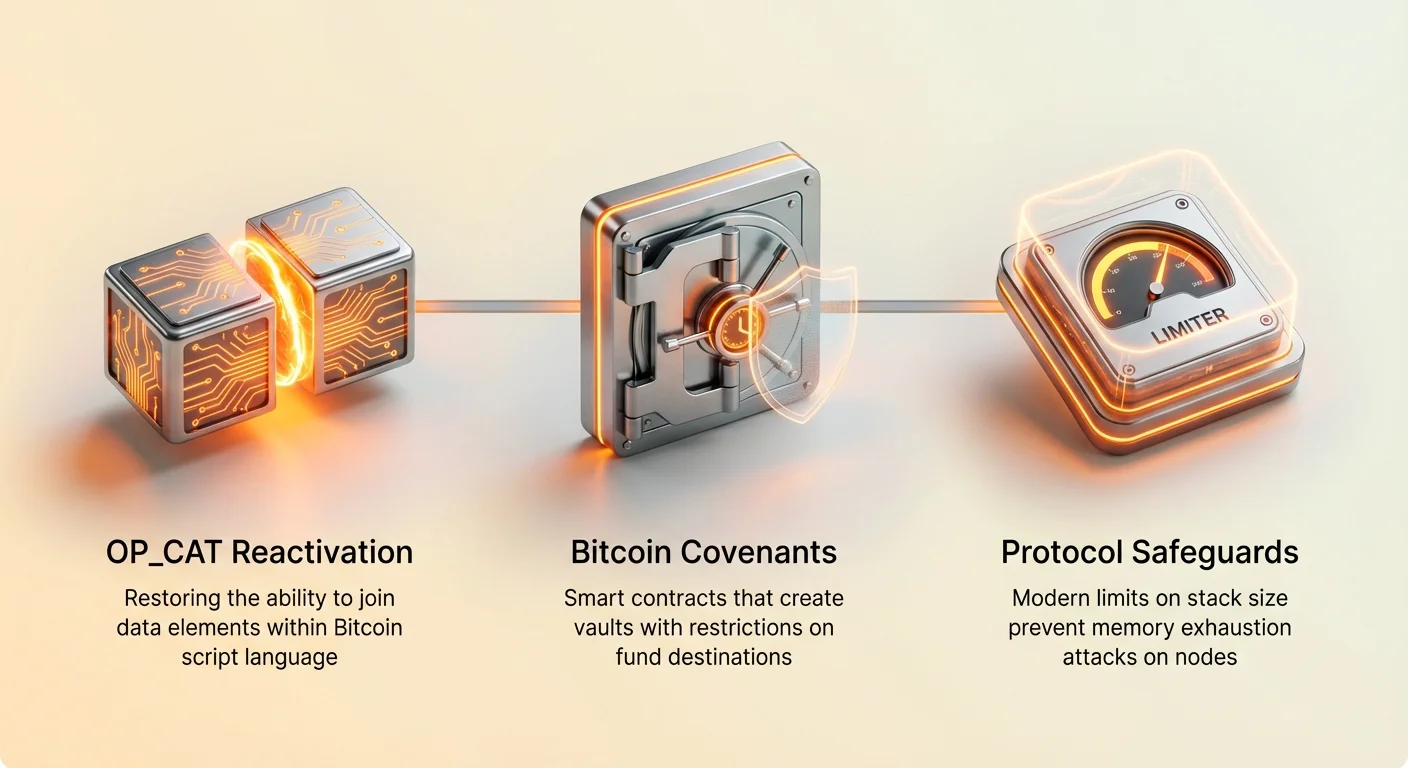
The conversation surrounding Bitcoin's evolution has recently centered on the reintroduction of a specific command known as OP_CAT. This opcode, which stands for "concatenate," was part of the original Bitcoin software but was disabled by Satoshi Nakamoto in 2010. The primary concern at the time was the potential for memory usage exploits. Today, proponents argue that the landscape has changed. With modern safeguards and a deeper understanding of the protocol, many believe OP_CAT can be safely reactivated.
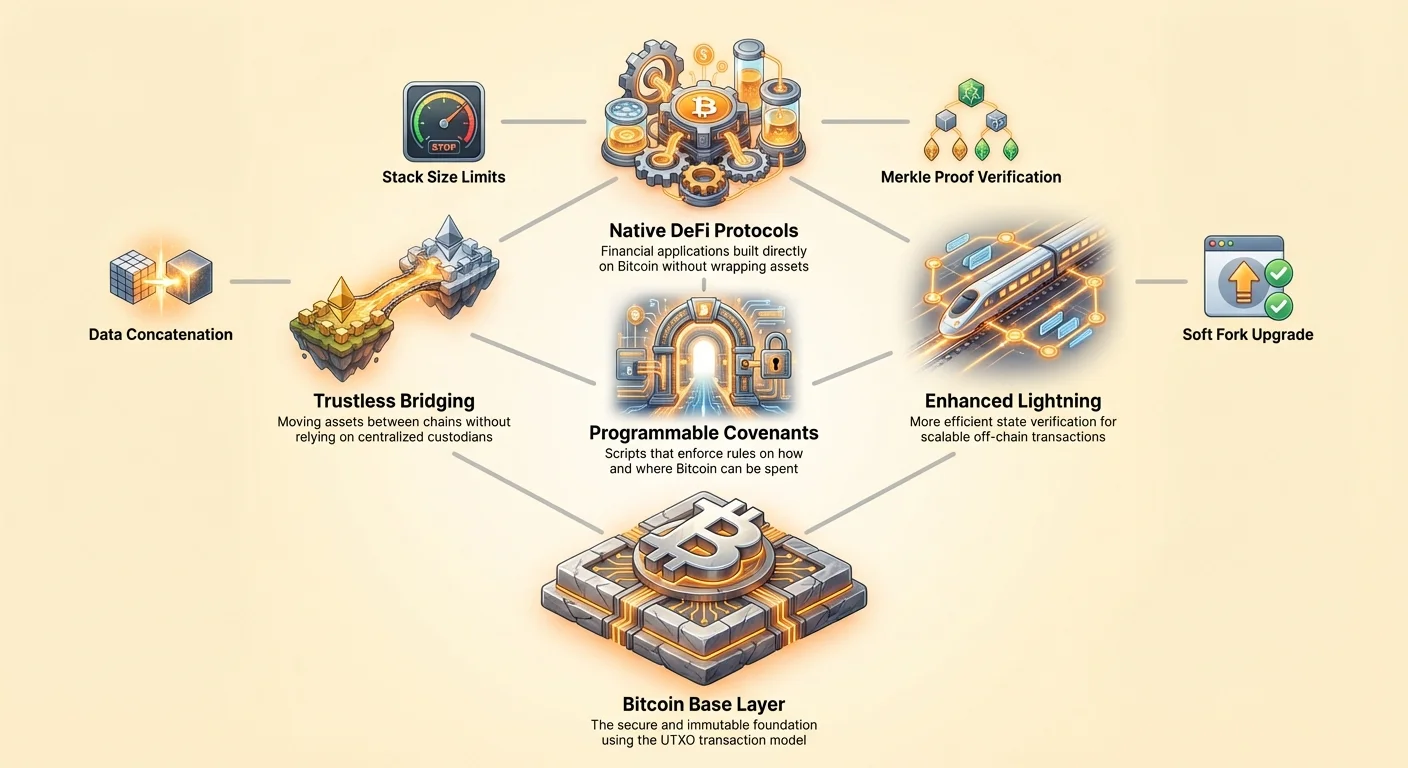
Re-enabling this function could unlock a new era of development for the network. It promises to bridge the gap between Bitcoin's robust security and the flexible smart contract capabilities found on other platforms. By allowing script components to be joined together during execution, OP_CAT enables complex data verification that was previously impossible. This shift could facilitate true decentralized finance (DeFi) applications, trustless bridging, and advanced scaling solutions directly on the world's most secure blockchain.
Understanding Bitcoin Scripting and Opcodes
Bitcoin does not use a standard programming language like Python or C++. Instead, it utilizes a stack-based language known as Script. This language processes data in a linear, Last-In-First-Out (LIFO) queue. When a transaction is validated, the network executes a series of commands, or "opcodes," to determine if the conditions for spending funds have been met. These opcodes are low-level instructions that define specific operations, such as adding numbers, hashing data, or checking digital signatures.
The Limitations of the Current System
The current set of available opcodes is intentionally restricted. While this limitation reduces the attack surface of the network, it also creates significant hurdles for developers. Building complex applications requires workarounds that are often inefficient or simply impossible. For instance, the inability to combine two pieces of data on the stack means that contracts cannot easily verify the relationship between different data elements. This restriction forces developers to rely on off-chain coordination or trusted intermediaries for complex financial operations.
The Function of Concatenation
OP_CAT provides a specific utility that is currently missing: the ability to take two items from the stack, join them together, and push the combined result back onto the stack. While this sounds like a trivial operation, it is a fundamental building block for computation. In the context of cryptography and verification, being able to construct data dynamically allows the script to verify Merkle proofs. This capability is essential for checking that a specific piece of data belongs to a larger dataset without revealing the entire dataset.
The Resurrection of OP_CAT
The debate over OP_CAT is not merely technical; it is a discussion about the philosophical direction of Bitcoin. When Satoshi Nakamoto disabled several opcodes in 2010, the network was in its infancy. The potential for a "memory explosion" attack, where a script loops and creates exponentially larger data strings, was a valid threat. However, the modern proposal to reinstate OP_CAT includes strict limits on the size of the stack elements. These safeguards ensure that the operation cannot be abused to crash nodes or bloat the blockchain.
Reintroducing this opcode would require a soft fork, a backward-compatible upgrade to the network. This path is similar to previous upgrades like SegWit and Taproot. The proposal must go through the rigorous Bitcoin Improvement Proposal (BIP) process, where it is drafted, peer-reviewed, and debated. Only after achieving rough consensus among developers, miners, and the economic majority can it be activated. This careful governance process ensures that the change is safe and desired by the community.
Enabling Bitcoin Covenants
One of the most transformative possibilities enabled by OP_CAT is the creation of covenants. In the current Bitcoin protocol, a script generally only controls the conditions under which funds can be spent. It does not control where those funds go once the signature is provided. Once you unlock the coins with your private key, you can send them anywhere. Covenants change this dynamic by allowing a transaction to place restrictions on the destination of the funds.
How Covenants Work
A covenant essentially lets a user create a "vault" on the blockchain. For example, a user could secure their funds in a script that stipulates the coins can only be sent to a specific whitelist of addresses. Alternatively, they could create a time-locked vault where a thief might be able to initiate a withdrawal, but the rightful owner has a 24-hour window to "cancel" the theft and sweep the funds to a recovery wallet. This functionality drastically improves self-custody security without needing a third-party custodian.
Recursive Smart Contracts
Beyond simple vaults, covenants allow for recursive scripts. These are scripts that can verify their own structure or the structure of the transaction spending them. This capability allows the state of a contract to be carried over to the next transaction. This is the foundational logic required for building stateful smart contracts on Bitcoin, similar to those seen on Ethereum, but implemented in a way that aligns with Bitcoin’s Unspent Transaction Output (UTXO) model.
Enhancing Layer-2 Solutions
Layer-2 scaling solutions like the Lightning Network have already revolutionized Bitcoin transaction speeds and costs. However, they still face technical friction points. Managing channel states and ensuring fair closures can be complex. OP_CAT could streamline these processes by enabling more efficient state verification mechanisms. By allowing the script to verify aggregated data, the storage requirements for Lightning nodes could be reduced, making the network more decentralized and accessible.
Furthermore, OP_CAT is instrumental for advanced scaling concepts like "Eltoo." This proposed update to the Lightning Network would simplify channel management by removing the need to store old states to prevent cheating. While Eltoo has often been associated with a different opcode proposal (SIGHASH_ANYPREVOUT), the functional capabilities introduced by OP_CAT offer alternative pathways to achieve similar efficiency gains. It provides the cryptographic primitives needed to build more robust off-chain protocols that settle securely on the main chain.
Revolutionizing Bridging and Sidechains
The integration of Bitcoin with other blockchain networks has historically relied on centralized intermediaries. Bridges, which move assets between chains, are frequently the most vulnerable points in the crypto ecosystem. The introduction of OP_CAT could fundamentally alter this architecture by enabling trust-minimized or "trustless" bridging mechanisms.
The Trust Problem in Bridging
Currently, when users move Bitcoin to a sidechain or another network (like Ethereum via WBTC), they typically lock their coins with a custodian. This custodian issues a wrapped token on the destination chain. The security of this system depends entirely on the honesty and competence of the custodian. If the custodian is compromised or acts maliciously, the backing Bitcoin is lost. This centralization risk is contrary to the ethos of Bitcoin.
Decentralized Pegs with OP_CAT
With OP_CAT, scripts can verify proofs generated by a sidechain. This capability allows for the creation of a decentralized two-way peg. A smart contract on the main Bitcoin chain could verify that an event happened on the sidechain without needing a trusted third party to attest to it. This would allow users to deposit funds into a bridge contract that is governed purely by code. If the sidechain attempts to steal the funds, the main chain script could theoretically detect the invalid state and prevent the theft.
Bitcoin DeFi and Tokenization
Decentralized Finance (DeFi) attempts to replicate traditional financial services—such as lending, borrowing, and trading—without intermediaries. While DeFi has flourished on other chains, Bitcoin's participation has been limited by its scripting constraints. OP_CAT acts as a catalyst for a native Bitcoin DeFi ecosystem that does not require wrapping coins or leaving the network security perimeter.
Decentralized Exchanges (DEXs)
Building a Decentralized Exchange (DEX) directly on Bitcoin is challenging because of the difficulty in managing complex order books and automated market makers (AMMs) with simple scripts. OP_CAT facilitates the creation of atomic swaps and more sophisticated order matching systems. By enabling scripts to parse and verify complex data structures, developers can build protocols where trades are executed trustlessly. This reduces reliance on centralized exchanges and enhances user privacy.
Tokenized Real-World Assets
The ability to issue digital assets representing real-world value (like stocks, bonds, or stablecoins) directly on Bitcoin is highly sought after. While protocols like Ordinals have introduced digital artifacts, they rely heavily on off-chain indexers to track ownership. OP_CAT allows for on-chain validation of token transfers. Scripts could enforce rules regarding who can hold a token or how it can be transferred, making the tokenization of regulated assets more feasible and secure on the Bitcoin blockchain.
Security Considerations and Risks
Implementing any change to Bitcoin's consensus rules involves risk. The primary concern with OP_CAT remains the potential for resource exhaustion. If a script allows a user to concatenate data repeatedly in a loop, a small input could balloon into a massive amount of data that nodes must process and store. This could theoretically lead to Denial of Service (DoS) attacks against the network.
Mitigating Technical Risks
To address these concerns, the modern proposal for OP_CAT includes strict limitations. The size of any stack element resulting from a concatenation operation is capped, typically at 520 bytes. This limit prevents the exponential growth of data that Satoshi originally feared. Furthermore, the operation cost (in terms of block weight) would be adjusted to accurately reflect the computational resources required, ensuring that attackers cannot spam the network cheaply.
The Challenge of Consensus
Technical safety is only half the battle. The social consensus required to activate a soft fork is high. Bitcoin governance is deliberately slow and conservative. Stakeholders, including miners, developers, and economic nodes, must agree that the benefits outweigh the complexity risks. There is often resistance to any change that expands the scripting language, as some purists believe Bitcoin should remain solely a monetary network and leave complex computation to other layers.
Comparing Smart Contract Capabilities
It is helpful to contextualize what OP_CAT brings to Bitcoin by comparing it to other smart contract environments. Bitcoin with OP_CAT does not become Ethereum; it retains its distinct UTXO-based architecture. The table below highlights the key differences and the middle ground that OP_CAT attempts to occupy.
| Feature | Current Bitcoin | Bitcoin with OP_CAT | Ethereum (EVM) |
|---|---|---|---|
| State Model | Stateless (UTXO) | Semi-Stateful (Covenants) | Stateful (Accounts) |
| Turing Completeness | No | No (but closer functional parity) | Yes |
| Verification | Simple Signatures | Merkle Proofs & Introspection | Full Computation |
Bitcoin with OP_CAT remains non-Turing complete, meaning it cannot run infinite loops or solve every computable problem. This is a feature, not a bug, as it preserves the predictability and auditability of the blockchain. However, it gains the ability to perform "introspection"—checking transaction details within the script—which bridges the gap between simple payments and programmable money.
The Path to Activation
The process of upgrading Bitcoin is decentralized and rigorous. It begins with the drafting of a Bitcoin Improvement Proposal (BIP). For OP_CAT, this involves specifying the exact technical behavior of the opcode, the resource limits, and the deployment method. Once the BIP is assigned a number, it undergoes scrutiny on developer mailing lists and in technical forums.
Developers must write the code for the reference implementation (Bitcoin Core) and create extensive test networks (testnets) to ensure the upgrade does not break existing consensus rules. If the technical community reaches "rough consensus," the upgrade is packaged into a software release. Finally, the network must signal support. This historically involves miners flagging their readiness in the blocks they mine. If a sufficient threshold is reached, the upgrade locks in and activates after a waiting period. This lengthy path ensures that Bitcoin remains stable and that no single entity can force changes upon the network.
Conclusion
The case for OP_CAT is rooted in the desire to unlock Bitcoin's latent potential without sacrificing its core principles. By restoring the ability to concatenate data within the scripting language, developers can build safer vaults, trust-minimized bridges, and efficient scaling solutions. This single opcode serves as a keystone for a variety of advanced features, from covenants to decentralized finance protocols, all secured by the most robust proof-of-work network in existence.
While the risks of protocol changes are never zero, the proposed safeguards for OP_CAT address the historical concerns that led to its removal. The conservative evolution of Bitcoin ensures that features are only added when they offer significant utility and safety. As the digital asset landscape matures, the ability to perform complex verification on-chain may well be the necessary step to ensure Bitcoin remains not just a store of value, but the foundational layer of the decentralized economy.
OP_CAT is a simple code update that could safely unlock powerful smart contracts and decentralized finance directly on Bitcoin.