
Ethereum is widely recognized as a decentralized, open-source blockchain platform that introduced smart contract functionality to the world. While Bitcoin established the concept of decentralized digital currency, Ethereum expanded this vision to create a programmable foundation for a new internet. Often described as the "world's computer," it serves not merely as a digital ledger for tracking payments but as a shared computing platform. This infrastructure allows developers to build applications that run exactly as programmed without any possibility of downtime, censorship, or third-party interference.
The network distinguishes itself through its ability to manage state and logic, not just balances. Unlike a traditional shared supercomputer that might perform complex calculations like mapping stars, Ethereum acts as a platform for verifying and executing agreements. Its resources are allocated through market forces, meaning anyone willing to pay the required fees can access the network's processing power. This open access democratizes the ability to create and use financial tools, removing the gatekeepers found in traditional Web 2.0 systems.
The Genesis of Programmable Blockchains
The concept of Ethereum was first proposed in late 2013 by Vitalik Buterin, a Russian-Canadian programmer. His vision was to create a "Turing-complete" blockchain. In computing terms, this means a system capable of running any type of application or solving any computational problem, given enough time and resources. This was a significant departure from Bitcoin, which was designed primarily as a decentralized ledger for managing programmable money. The goal was to build a platform where the rules of interaction could be defined by code rather than by central authorities.
Formal development began in early 2014 through EthSuisse, a company based in Switzerland. The founding team included notable figures such as Charles Hoskinson and Gavin Wood, though the group evolved significantly over time. The project officially launched its mainnet in July 2015. This launch marked the transition from theoretical whitepapers to a live, functioning network that would eventually host thousands of decentralized applications.
The Initial Distribution and Funding
To fund the development of this ambitious protocol, the team conducted a crowdsale in July and August of 2014. During this period, participants exchanged Bitcoin for Ether (ETH), the network's native cryptocurrency. The sale raised approximately 31,000 Bitcoin, which was worth around $18 million at the time. The initial supply began with about 72 million ETH.
Eighty-three percent of this initial supply was distributed to the crowdsale participants. The cost per ETH during this sale averaged around $0.30. The remaining portion of the initial supply was allocated to early contributors and the Ethereum Foundation. This non-profit organization was tasked with overseeing the development and promotion of the network. This distribution method was crucial for bootstrapping the network's security and development resources, though it created an initial concentration of wealth that has dispersed over time as the ecosystem has grown.
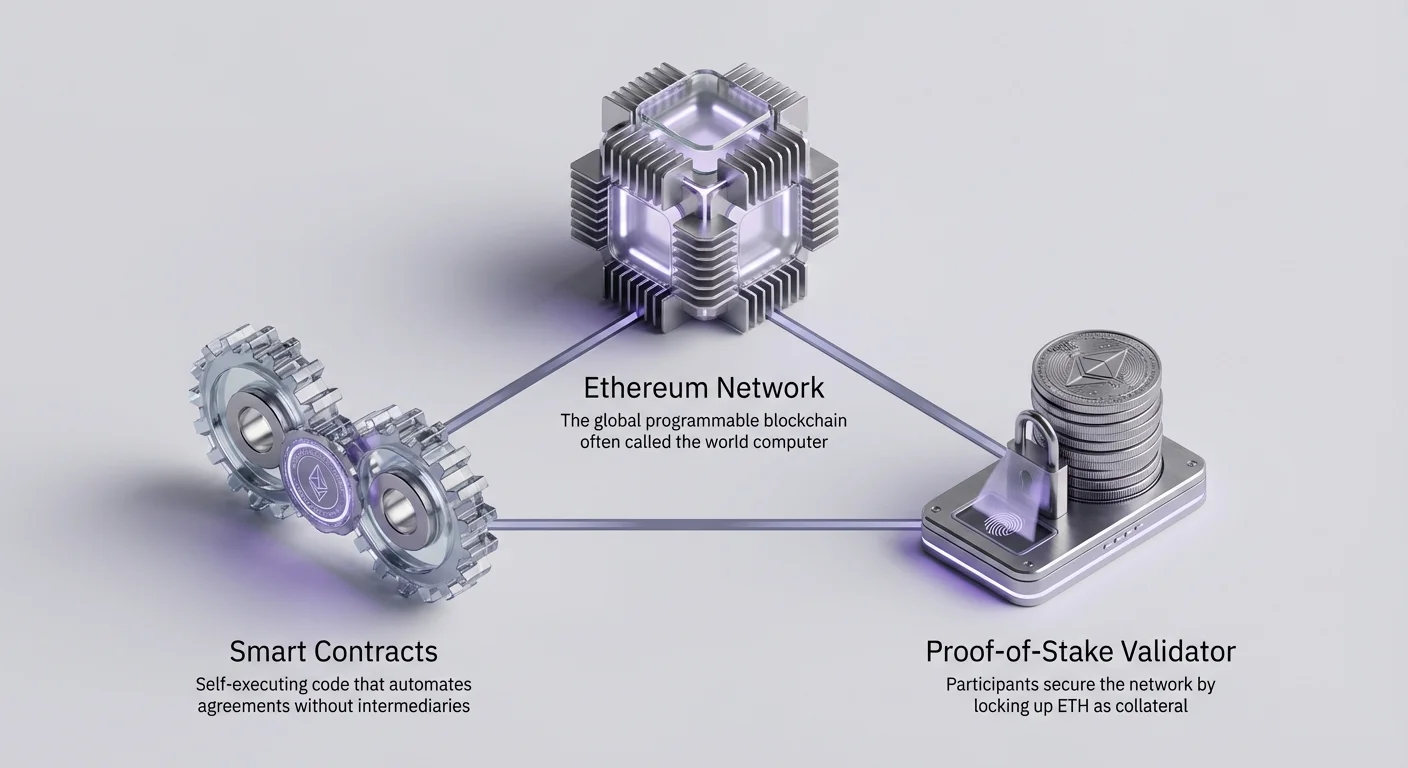
The Engine Room: Ethereum Virtual Machine (EVM)
At the heart of the network lies the Ethereum Virtual Machine (EVM). This is the runtime environment for smart contracts. It is a sandboxed virtual machine, meaning it is completely isolated from the rest of the network. Code running inside the EVM cannot harm the underlying protocol or access files on the host computer. This isolation is critical for security, ensuring that even if a smart contract contains malicious code or bugs, it cannot crash the entire blockchain or compromise the consensus mechanism.
The EVM executes smart contracts by interpreting bytecode. When a developer writes a program in a high-level language, it is compiled into this bytecode, which the machine can read and execute. Every node in the network runs an instance of the EVM, allowing them to agree on the execution of the same instructions. This redundancy ensures that the "state" of the computer is updated uniformly across the globe.
Because the EVM is Turing-complete, it can theoretically execute any calculation. However, to prevent infinite loops or programs that consume excessive resources, every operation requires a fee known as "gas." Gas measures the computational effort required to execute specific operations. This mechanism prevents network abuse and compensates the participants who validate transactions and secure the ledger.
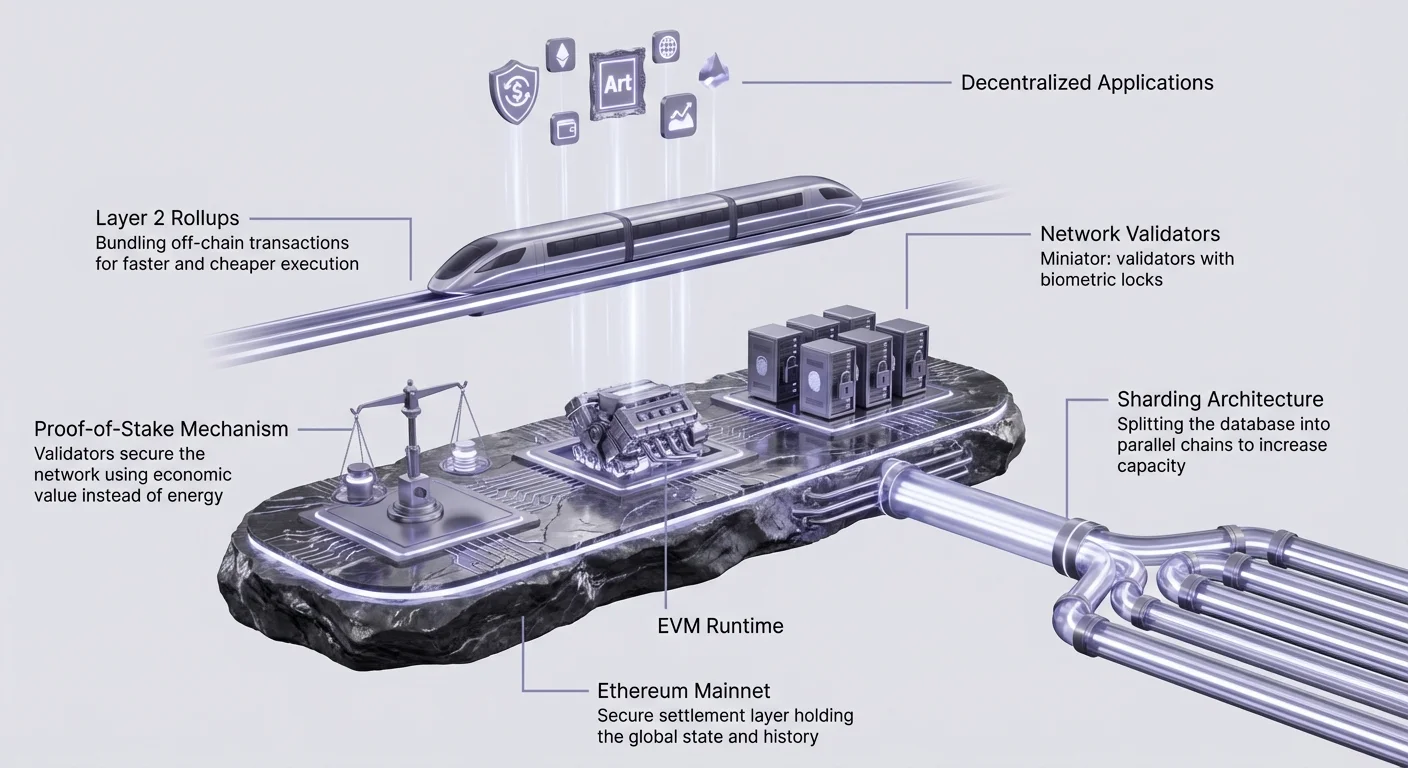
Smart Contracts: The Architecture of Trust
A smart contract is essentially a computer program stored on the blockchain. It contains a set of rules and logic that execute automatically when specific conditions are met. Unlike traditional legal contracts that require intermediaries like lawyers or notaries to enforce, smart contracts rely on cryptographic code. Once deployed to the network, these contracts are immutable, meaning their code cannot be altered by anyone, including the original creator. This immutability provides a high degree of assurance to all participants that the terms of the agreement will be honored.
Code as Law
The primary innovation of smart contracts is the creation of "trustless" environments. In this context, trustless does not mean the system is untrustworthy. Rather, it means users do not need to trust a specific person or institution to behave correctly. They only need to trust the code, which is open-source and verifiable by anyone. For example, a smart contract can hold funds in escrow and release them only when a digital receipt is verified.
This eliminates the need for a third party to hold the money. The code acts as the unbiased arbiter. If the pre-defined conditions are met, the action executes. If they are not, it does not. This binary, deterministic nature removes ambiguity and potential for human error or corruption. It fundamentally changes how agreements are structured, moving from a reputation-based system to a verification-based system.
Automating Agreements and Token Sales
Smart contracts have enabled entirely new forms of economic coordination. One of the most common early use cases was the Token Sale or Initial Coin Offering (ICO). Projects could use a smart contract to automatically distribute new digital tokens to anyone who sent ETH to a specific address. The contract handled the accounting, distribution, and pricing without a centralized stock exchange or bank.
Beyond fundraising, these contracts facilitate complex automated actions like Airdrops. An airdrop involves sending free tokens to users who meet certain criteria, such as using a specific application or holding a certain asset. The smart contract can query the blockchain's history, identify eligible wallets, and distribute the rewards instantly. This capability allows for automated, transparent marketing and community-building initiatives that would be logistically impossible in traditional finance.
The Scalability Bottleneck and the Trilemma
Despite its revolutionary capabilities, Ethereum faces significant hurdles regarding scalability. In its legacy form, the network could process approximately 15 to 30 transactions per second. This throughput is vastly lower than centralized payment processors, which can handle thousands. As the network grew in popularity, demand for block space exceeded supply. This congestion led to high gas fees, making it expensive for average users to interact with decentralized applications.
This challenge is often framed as the "Blockchain Trilemma." The theory posits that a blockchain can only optimize for two of three qualities: decentralization, security, and scalability. Ethereum initially prioritized decentralization and security. Its original consensus mechanism required every node to process every transaction, ensuring extreme security but limiting speed. To address this, the network embarked on a multi-year roadmap to evolve its underlying architecture without sacrificing its core values.
The Evolution to Proof-of-Stake
The most significant milestone in Ethereum's evolution was the transition from Proof-of-Work (PoW) to Proof-of-Stake (PoS). This upgrade, often referred to as "The Merge," fundamentally changed how the network reaches consensus. Under the old PoW model, similar to Bitcoin, miners used massive amounts of computational power and energy to solve complex mathematical puzzles. This process secured the network but was resource-intensive and limited in scalability.
The Environmental and Economic Shift
The move to Proof-of-Stake eliminated the need for energy-hungry mining rigs. Instead of miners, the network now relies on "validators." These participants are chosen to create new blocks based on the amount of cryptocurrency they hold and act as collateral. This is known as "staking." By staking ETH, validators demonstrate their commitment to the network's honesty.
This shift drastically reduced the network's energy consumption, making it more environmentally sustainable. It also altered the economic model. The issuance of new ETH dropped significantly, and the security model moved from physical energy cost to economic value at risk. If a validator acts maliciously, their staked ETH can be "slashed," or destroyed, providing a strong financial incentive to follow the rules.
Staking and Network Security
In the PoS system, security is derived from the total value staked in the network. To attack the chain, an entity would need to control a majority of the staked ETH, which would be prohibitively expensive. This democratization of security allows more users to participate in network maintenance. While running a mining farm requires specialized hardware and cheap electricity, staking can be done via a standard computer or through staking pools.
Validators earn rewards for processing transactions and proposing new blocks. This system aligns the incentives of the token holders with the health of the network. The transition also paved the way for future scalability upgrades that were not possible under Proof-of-Work. It effectively set the stage for sharding and other throughput enhancements that define the next phase of the roadmap.
The Future of Throughput: Sharding
With Proof-of-Stake successfully implemented, the roadmap focuses on increasing capacity through a technique called sharding. In a traditional blockchain, every node must store and process the entire history of the network. This provides redundancy but creates a bottleneck. Sharding proposes splitting the database into smaller, manageable pieces called "shards."
Each shard operates like a separate lane on a highway. Instead of all traffic moving in a single lane, traffic is distributed across roughly 64 new chains. This parallel processing capability means the network can handle many more transactions simultaneously. Validators will only need to verify data for the specific shard they are assigned to, rather than the entire network.
This architecture significantly reduces the hardware requirements for running a node. By lowering the barrier to entry, sharding helps maintain decentralization even as the network scales to handle global demand. However, implementing sharding is technically complex. It requires careful coordination to ensure that data on one shard is secure and can communicate with data on other shards. This complexity is why sharding is being rolled out in phases, following the successful stabilization of Proof-of-Stake.
Scaling Layers: The Rise of L2s
While sharding addresses scalability at the base layer (Layer 1), the immediate solution for congestion has come from Layer 2 (L2) scaling solutions. L2s are separate networks that operate on top of the main Ethereum blockchain. They handle the heavy lifting of transaction processing off-chain and then settle the final results on the mainnet. This approach benefits from the security of Ethereum while offering much faster speeds and lower costs.
The Role of Rollups
The most promising L2 technology is known as "rollups." Rollups bundle or "roll up" hundreds of transactions into a single batch. This batch is then compressed and submitted to the main Ethereum network as a single transaction. By splitting the transaction fee among hundreds of users, the cost per user drops dramatically.
There are the two main types of rollups. Optimistic rollups assume transactions are valid by default and only run computations if someone challenges a transaction. Zero-Knowledge (ZK) rollups use complex cryptography to prove the validity of a batch of transactions without revealing the underlying data. Both technologies are currently live and processing billions of dollars in value, effectively acting as the high-speed express lanes for the Ethereum ecosystem.
Sidechains and Compatibility
Alongside rollups, other EVM-compatible blockchains have emerged to support the ecosystem. Networks like the BNB Smart Chain, Polygon, and Avalanche use the same standards as Ethereum, allowing developers to easily port their applications. While some of these operate as sidechains with their own consensus mechanisms, they contribute to the broader scaling landscape.
These platforms often make different trade-offs regarding centralization and speed. For instance, Polygon acts as a scaling framework that uses a combination of technologies to enhance throughput. These interconnected networks create a multi-chain future where users can move assets between layers depending on their needs for speed, security, or cost. The Ethereum mainnet increasingly serves as the secure settlement layer for this web of high-performance chains.
The Web3 Ecosystem
The evolution of Ethereum's infrastructure is driven by the needs of the applications built upon it. These decentralized applications (dApps) cover a wide range of sectors. The most prominent category is Decentralized Finance (DeFi). DeFi protocols recreate traditional financial systems—borrowing, lending, and trading—without banks. Smart contracts manage liquidity pools and interest rates automatically, providing open access to financial services for anyone with an internet connection.
Another major sector is Non-Fungible Tokens (NFTs). NFTs represent unique digital ownership of assets like art, music, or virtual real estate. Unlike fungible tokens such as ETH or Bitcoin, which are interchangeable, each NFT has a unique identifier. This technology has revolutionized digital provenance and created new economies for creators and collectors.
Decentralized Autonomous Organizations (DAOs) represent a new structure for human coordination. These are organizations governed by code and member voting rather than a central CEO or board. Decisions regarding treasury management or project direction are made through transparent, on-chain proposals. This structure relies heavily on the "credible neutrality" of the Ethereum platform, ensuring that the rules of the organization cannot be arbitrarily changed by a single powerful actor.
Below is a comparison of the two leading assets in the space:
| Feature | Bitcoin | Ethereum |
|---|---|---|
| Primary Purpose | Store of value, digital money | Platform for decentralized apps |
| Consensus Model | Proof-of-Work (PoW) | Proof-of-Stake (PoS) |
| Throughput | ~7 transactions per second | ~30 TPS (Scalable via L2s) |
| Smart Contracts | Limited functionality | Turing-complete, extensive |
| Supply Policy | Hard cap of 21 million | No hard cap, dynamic issuance |
Conclusion
The journey of Ethereum from a whitepaper in 2013 to a global settlement layer has been defined by continuous adaptation. It began as a proof-of-concept for a world computer, relying on energy-intensive mining to secure its early blocks. Over the years, it has successfully navigated the complex transition to Proof-of-Stake, fundamentally altering its economic and environmental footprint while maintaining uptime.
Looking forward, the roadmap is clear but ambitious. The combination of sharding and Layer 2 solutions aims to solve the scalability trilemma, eventually allowing the network to process thousands of transactions per second. This evolution is necessary to support complex Web3 applications like decentralized social media and global finance. As the infrastructure matures, the focus shifts from simple speculation to genuine utility, powered by a neutral, decentralized, and increasingly efficient platform.
Ethereum is evolving from a single shared computer into a vast, interconnected network of secure, high-speed layers.