
Decentralized finance has fundamentally altered how individuals interact with capital, effectively removing the intermediaries that have controlled economic systems for centuries. By utilizing decentralized networks like Ethereum, financial products are no longer managed by banks or brokerages but are instead governed by code. This shift democratizes access to borrowing, lending, and trading. However, the removal of centralized oversight introduces a complex array of risks that every participant must navigate independently.
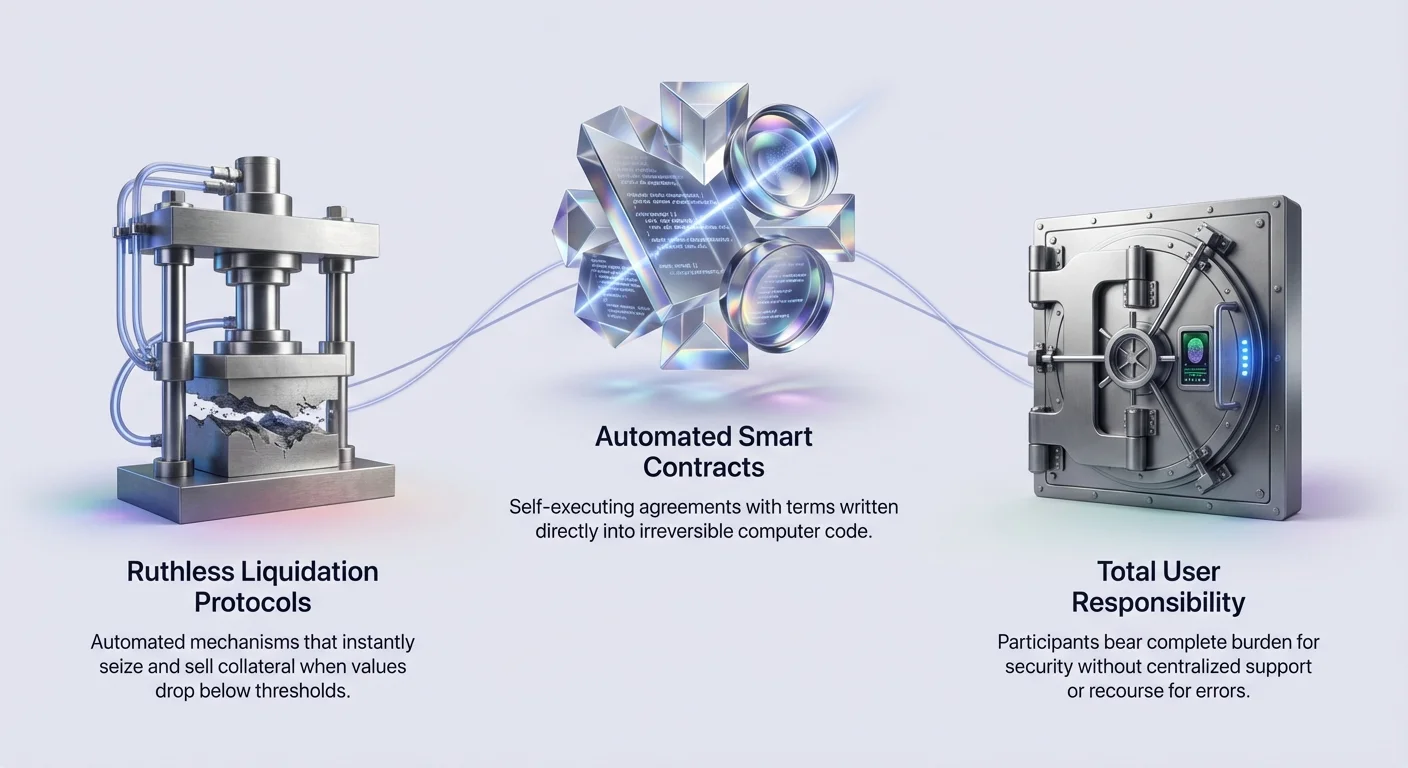
The absence of a central authority means there is no customer support hotline to call when a transaction goes wrong or funds go missing. In this ecosystem, responsibility falls entirely on the user. Understanding the mechanics of these risks is the only way to participate safely. The potential for high yields is often directly correlated with the level of danger involved. Therefore, a robust risk management framework is not optional; it is a requirement for survival in the decentralized economy.
The Double-Edged Sword of Automation
The core innovation of this financial sector is the smart contract. These are self-executing agreements where the terms are directly written into lines of computer code. This automation allows for efficiency that traditional finance cannot match. Interest payments are distributed automatically, and trades are settled instantly without a clearinghouse. This reduces overhead costs and potentially increases the returns available to participants.
However, this deterministic nature creates a rigid environment where errors are unforgiving. If a user interacts with a contract incorrectly, or if the contract itself contains a logic error, the outcome is irreversible. In traditional banking, a fraudulent transaction might be reversed, or a system error might be manually corrected by an administrator. In decentralized protocols, the code is the final authority. If the code allows an exploit, that exploit is valid within the system's logic, regardless of the developer's original intent.
The Transparency Paradox
One of the primary arguments for decentralized systems is transparency. Most protocols operate on open-source software, meaning the code is visible to anyone with an internet connection. In theory, this allows the community to verify the security and functionality of an application before depositing funds. This stands in stark contrast to the "black box" nature of traditional financial institutions.
Yet, this openness also provides a blueprint for attackers. Hackers can analyze the codebase of a lending protocol or exchange to identify vulnerabilities that developers missed. While the community eventually patches these holes, new protocols are often most vulnerable in their early stages. The longer a protocol exists without incident, the more "battle-tested" it becomes. However, the initial period of deployment remains a high-risk phase where transparency aids both the auditor and the attacker equally.
Smart Contract Vulnerabilities and Audits
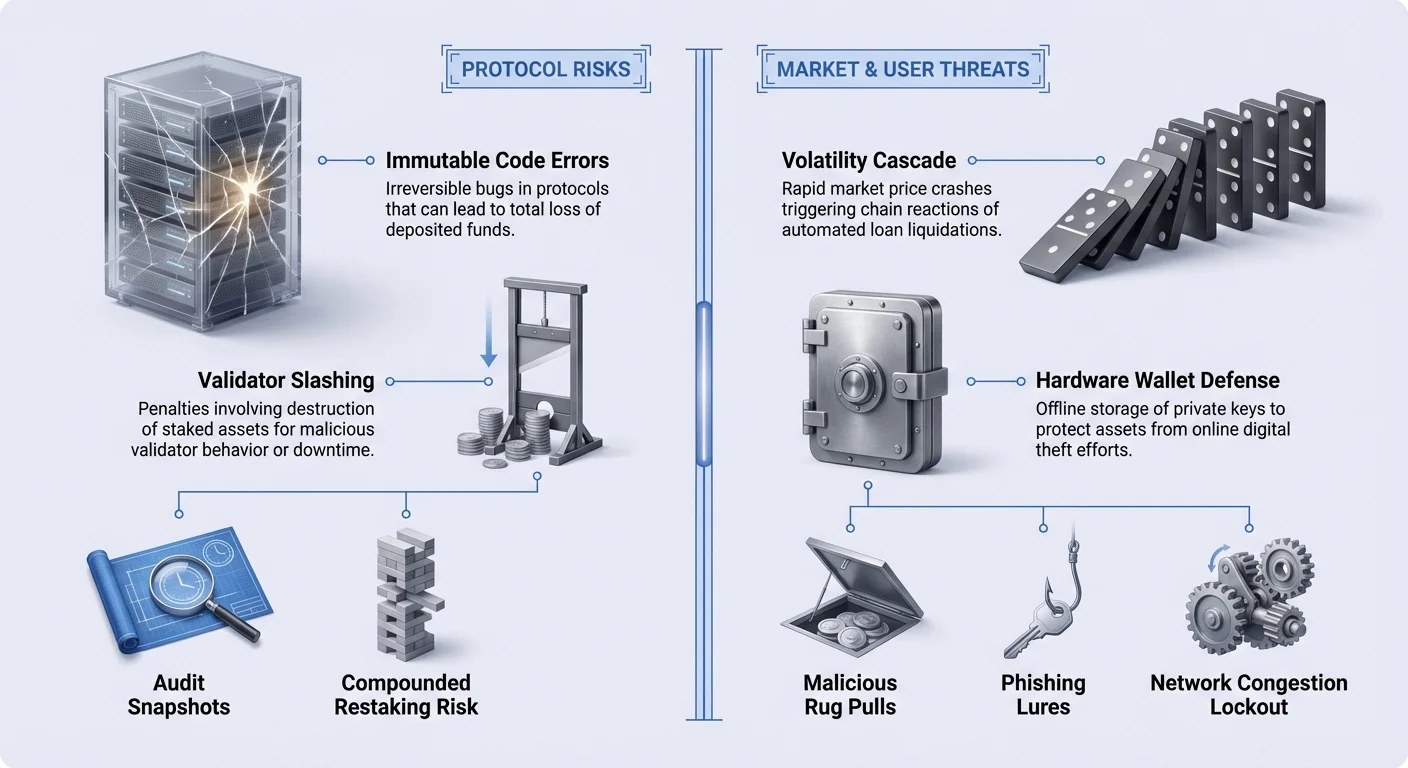
The foundation of any decentralized application is its code. When developers deploy a financial product, they are essentially releasing a complex software program that holds real value. Human error is an unavoidable part of software development. In most industries, a software bug results in a glitch or a crash. In this sector, a bug results in the total loss of user funds.
Audits serve as the primary defense against these catastrophic failures. A smart contract audit involves a third-party security firm reviewing the code to identify security flaws, inefficiencies, and logic errors. These firms attempt to break the contract in a controlled environment to ensure it can withstand attacks in the wild. Reputable projects will almost always undergo multiple audits from different firms to ensure redundancy.
Limitations of Security Audits
It is crucial to understand that an audit is not a guarantee of safety. It is merely a snapshot of the code at a specific point in time. An audit confirms that the specific version of the code reviewed did not contain obvious vulnerabilities found by that specific team. It does not predict how the contract will interact with other complex protocols or how it might handle unforeseen market conditions.
Furthermore, developers often upgrade or modify contracts after an initial audit. If these changes are not re-audited, they can introduce new vulnerabilities into a previously secure system. Users must verify that the current version of the application they are using matches the audited version. Blind trust in a "verified" badge without checking the dates and scope of the report can lead to false confidence.
The Risks of Malicious Design
Not all code risks stem from accidental bugs. Some dangers are intentional features designed by malicious developers. A "rug pull" occurs when the creators of a project structure the smart contracts to allow them to withdraw user funds or mint infinite tokens to dump on the market. These are not exploits in the traditional sense; they are functions that execute exactly as written.
In these scenarios, the code is working perfectly, but the intent is theft. Auditors can sometimes flag centralized privileges that allow for such behavior, such as a function that lets an admin drain the liquidity pool. However, if a user does not read the audit report or if the project was never audited, they remain exposed. This highlights why interacting with anonymous teams or unverified contracts carries immense danger regardless of the platform's popularity.
The Mechanics of Liquidation
Lending and borrowing are among the most popular use cases in the decentralized ecosystem. Unlike traditional loans that rely on credit scores and legal enforcement, decentralized loans rely on collateral. To borrow assets, a user must deposit a different asset of greater value. This over-collateralization ensures that the lender is always protected, even if the borrower disappears.
The mechanism that protects the protocol is called liquidation. If the value of the borrower's collateral drops below a certain threshold, the smart contract automatically sells the collateral to repay the loan. This process is ruthless and automated. There are no margin calls via phone or grace periods to deposit more funds. The moment the math dictates the loan is unsafe, the assets are seized and sold.
Collateralization Ratios
The safety of a loan is defined by the collateralization ratio. For example, a protocol might require a user to deposit $200 worth of Ethereum (ETH) to borrow $100 worth of stablecoins. This is a 2:1 ratio. This buffer protects the protocol against price fluctuations. If the value of ETH drops significantly, the ratio tightens.
If the value of the collateral falls to a point where it barely covers the loan value plus penalties, the liquidation triggers. Users must actively monitor these ratios. A healthy margin today can vanish tomorrow during a flash crash. Managing this ratio is the primary responsibility of any borrower in the space. Failing to add collateral or repay part of the loan in time results in the permanent loss of the deposited asset.
The Cost of Automation
Liquidation is not free. When a position is liquidated, the protocol typically charges a penalty fee on top of the loan repayment. This fee rewards the "liquidators"—bots or users who identify under-collateralized loans and execute the transaction to balance the books. This means a borrower not only loses their position but also loses a percentage of their remaining equity.
This system ensures the solvency of the lending pool but punishes the individual borrower heavily. It is a system designed to protect the collective liquidity at the expense of the individual's risky position. Users who engage in leverage must understand that the protocol prioritizes its own survival over the preservation of their specific assets.
Market Volatility Impacts
Market volatility is the external force that triggers the internal mechanisms of risk. Cryptocurrency markets are notoriously volatile, with double-digit percentage moves occurring within hours. This volatility directly impacts the health of smart contract-based loans and trading positions. A sudden market crash can trigger a cascade of liquidations across the network, depressing prices further and causing more liquidations in a feedback loop.
During these events, network congestion often spikes. As prices crash, users rush to deposit collateral or sell assets, while trading bots rush to liquidate positions. This surge in activity clogs the blockchain, causing transaction fees to skyrocket and confirmation times to slow down. A borrower might try to save their position by depositing more funds, only to find their transaction stuck in a queue while their assets are liquidated.
This inability to act during a crisis is a distinct risk of decentralized systems. In a centralized exchange, the internal database might handle the load, or the exchange might halt trading. On a blockchain, the network simply processes transactions for the highest bidder. If a user cannot afford the exorbitant gas fees during a crash, they are effectively locked out of risk management exactly when they need it most.
To mitigate this, users often utilize stablecoins. By borrowing against stable assets or holding reserves in tokens pegged to fiat currencies, users can reduce their exposure to price swings. However, even stablecoins carry risks if they lose their peg. The interplay between asset volatility, network congestion, and protocol parameters creates a dynamic threat environment that requires constant vigilance.
Staking and Restaking Risks
Staking allows users to earn passive income by locking up their assets to support the operation of a blockchain network. In Proof of Stake (PoS) systems, validators commit capital to ensure they act honestly while verifying transactions. If a validator acts maliciously or fails to maintain uptime, the network penalizes them through a process called slashing.
Slashing involves the destruction or confiscation of a portion of the staked tokens. For users who delegate their tokens to a third-party validator, this risk is passed down. If the chosen validator behaves poorly, the user loses money. This creates a due diligence requirement: users must not only trust the protocol but also the specific competence of the node operator they select.
The Dangers of Lock-Up Periods
Many staking protocols impose lock-up periods during which assets cannot be moved. This illiquidity is a significant risk factor. If the market price of the staked asset crashes, the user is unable to sell to stop the loss until the unlocking period expires.
Liquid staking attempts to solve this by issuing a receipt token that represents the staked asset. This token can be traded while the underlying asset earns rewards. However, this introduces a new layer of de-pegging risk. If the market loses confidence in the liquid staking protocol, the receipt token may trade at a discount to the underlying asset, resulting in losses for holders who need to exit quickly.
Complexity in Restaking
Restaking is a newer evolution that allows the same staked capital to secure multiple protocols simultaneously. While this increases potential rewards, it exponentially increases risk. This concept, often involving Actively Validated Services (AVSs), means a user's assets are subject to the slashing conditions of multiple networks at once.
If a user restakes their ETH to secure an oracle network and a bridge, a failure in either service could result in a slashing event. This is known as compounded risk. The complexity of managing slashing conditions across different services makes it difficult for average users to accurately assess their exposure. Furthermore, restaking can lead to centralization if too much control consolidates around a few dominant liquid restaking providers.
| Feature | Standard Staking | Restaking |
|---|---|---|
| Reward Source | Single Network | Multiple Protocols |
| Slashing Risk | Single set of rules | Cumulative/Multiple rules |
| Complexity | Low to Medium | High |
Malicious Actors and Scams
Beyond technical failures and market mechanics, the human element of fraud remains prevalent. The anonymity provided by blockchain networks protects privacy but also shields scammers. Phishing is a common attack vector where bad actors create websites that look identical to legitimate decentralized applications (DApps).
A user might search for a popular exchange, click a sponsored link, and land on a fraudulent site. When they connect their wallet, they are not signing a transaction to trade; they are signing a permission giving the attacker access to their funds. Unlike a bank login, a compromised wallet signature can drain all approved assets instantly. Verifying URLs and checking for security certificates is a daily hygiene practice required for Avoiding Scams and Phishing Attacks.
Social engineering also plays a major role. Scammers may pose as support staff in Discord channels or Telegram groups, offering to "sync" wallets or fix transaction errors. Legitimate decentralized protocols never have support staff that ask for private keys or seed phrases. The decentralized nature of the space means that anyone asking for direct access to a wallet is almost certainly a malicious actor.
Risk Mitigation and Insurance
To survive in this environment, users must adopt a defensive mindset. Diversification is the first line of defense. Spreading capital across different protocols, assets, and blockchains reduces the impact of any single failure. If one lending platform is exploited, funds in another remains safe.
Insurance protocols have emerged to offer on-chain protection. These decentralized insurance providers allow users to pay premiums to cover their deposits against smart contract bugs or exchange hacks. While this adds a cost to the investment, it provides a safety net that is otherwise absent. However, these insurance claims are often decided by a vote of community members, adding a layer of governance risk to the payout process.
Self-custody practices are also paramount. Using hardware wallets keeps private keys offline, protecting them from digital theft. Understanding the difference between a "hot wallet" connected to the internet and a "cold wallet" used for long-term storage is essential. Regularly revoking smart contract permissions that are no longer needed prevents old, forgotten connections from becoming vulnerabilities in the future.
Conclusion
The decentralized finance landscape offers unprecedented control over personal wealth, but this freedom is inextricably linked to responsibility. The risks range from the technical rigidity of smart contracts and the ruthless mathematics of liquidation to the volatile nature of market prices and the persistent threat of malicious actors. Mechanisms like audits and insurance provide layers of protection, yet they are not infallible solutions.
Success in this ecosystem requires more than just capital; it demands continuous education and a proactive approach to security. Participants must scrutinize the code they interact with, monitor the health of their collateralized positions, and remain vigilant against social engineering. By understanding the compounding risks of advanced strategies like restaking and maintaining strict digital hygiene, users can navigate these decentralized markets effectively.
True ownership of assets means accepting total responsibility for their security; never invest more than you can afford to lose.