
Decentralized finance has fundamentally shifted how individuals interact with financial markets. Unlike traditional banking systems or centralized exchanges where a single entity facilitates trades and holds custody of assets, decentralized protocols operate through peer-to-peer networks. This structure removes the need for intermediaries but introduces a new requirement for market functionality. In this ecosystem, the users themselves act as the bank. They provide the capital necessary for trading to occur.
This participation is not merely a passive activity but a foundational element of how decentralized exchanges function. By supplying assets to these platforms, users ensure that markets remain active and liquid. In return for facilitating this environment, protocols offer incentives. These incentives create a circular economy where liquidity providers earn fees from traders. This establishes a cooperative financial model that contrasts sharply with the profit-hoarding models of traditional institutions.
Understanding the mechanics of this system is essential for anyone looking to participate in modern crypto markets. It involves grasping concepts like liquidity pools, smart contracts, and yield farming. These mechanisms allow capital to work efficiently, generating returns through transaction fees and additional protocol rewards. The process transforms idle assets into productive capital that supports the broader ecosystem's health and stability.
The Foundation of Decentralized Market Liquidity
The Role of the Liquidity Provider
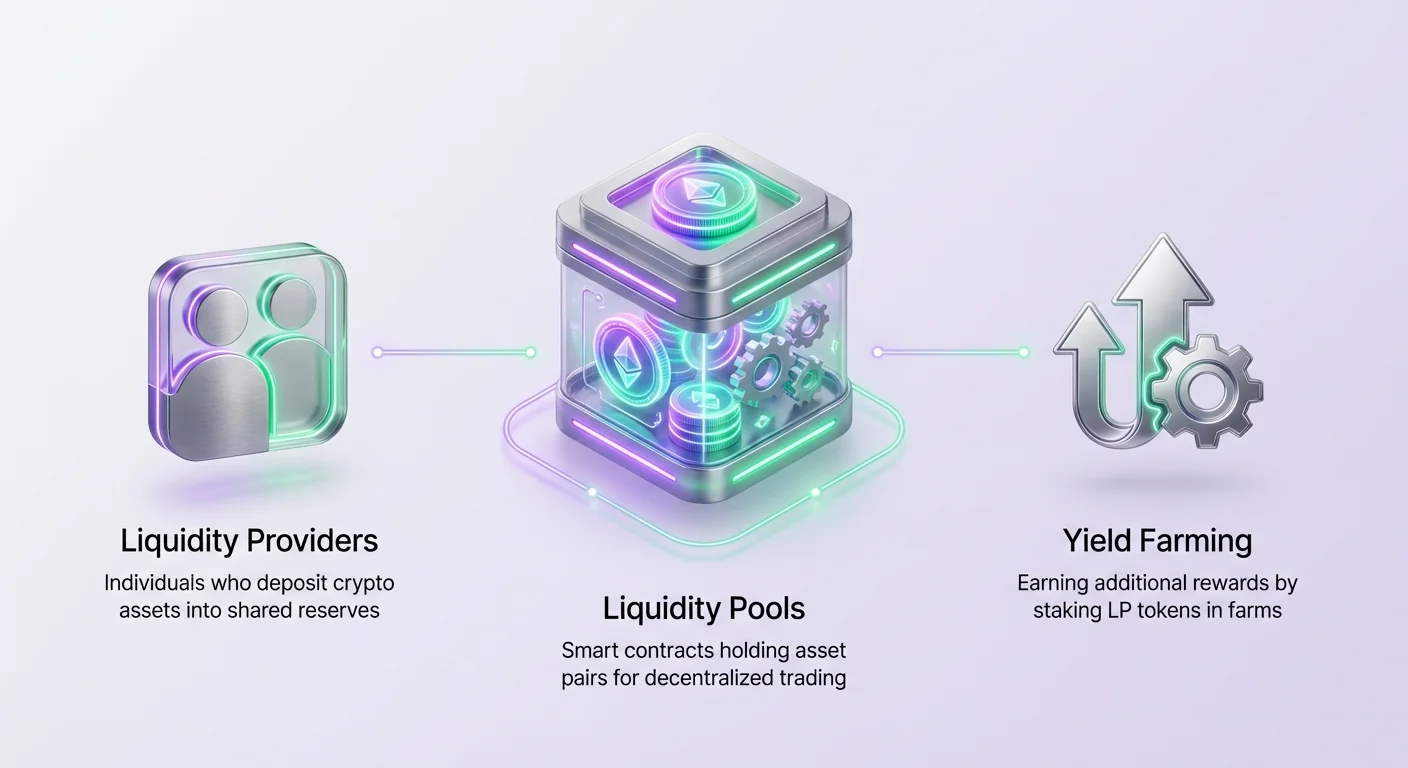
In a decentralized exchange environment, trading is made possible strictly by the contributions of liquidity providers. These are individuals who deposit their cryptocurrency assets into shared reserves known as liquidity pools. Without these pools, a decentralized exchange cannot function. There is no order book managed by a central authority matching buyers and sellers. Instead, traders swap tokens directly against the funds held in these smart contracts.
When a user adds liquidity, they are essentially strengthening the market. They ensure that other users can buy or sell assets without causing drastic price fluctuations. This role is critical because the depth of a market directly correlates to its stability. A market with few assets in the pool is volatile and inefficient, while a deep pool offers a smooth trading experience. The protocol rewards this service by distributing a portion of the trading fees collected from swappers directly to the liquidity providers.
Understanding Trading Pairs and Pools
Every trade on a decentralized exchange occurs within a specific trading pair. Each pair has its own dedicated liquidity pool. For instance, a popular trading pair might consist of a native ecosystem token and a wrapped version of a major network asset, such as Ethereum. This pool acts as a standalone reservoir of value that balances the two assets against each other.
The technical architecture generally follows a consistent pattern across most platforms. A smart contract is programmed to accept deposits of specific crypto assets. These contracts usually enforce strict ratio requirements to maintain market equilibrium. Most commonly, a liquidity provider must deposit an equal value of both assets in the pair. If one Ethereum is worth 1,600 USDC, the provider must deposit 1 ETH and 1,600 USDC simultaneously. This 50/50 value split is crucial for the automated pricing mechanisms that govern the pool.
The Mechanics of Smart Contracts
The entire process is governed by smart contracts, which are self-executing codes on the blockchain. When a user deposits funds into a pool, the smart contract takes custody of those assets and manages the trade logic. It does not require human intervention to approve trades or calculate fees. This automation ensures that the system is permissionless and trustless.
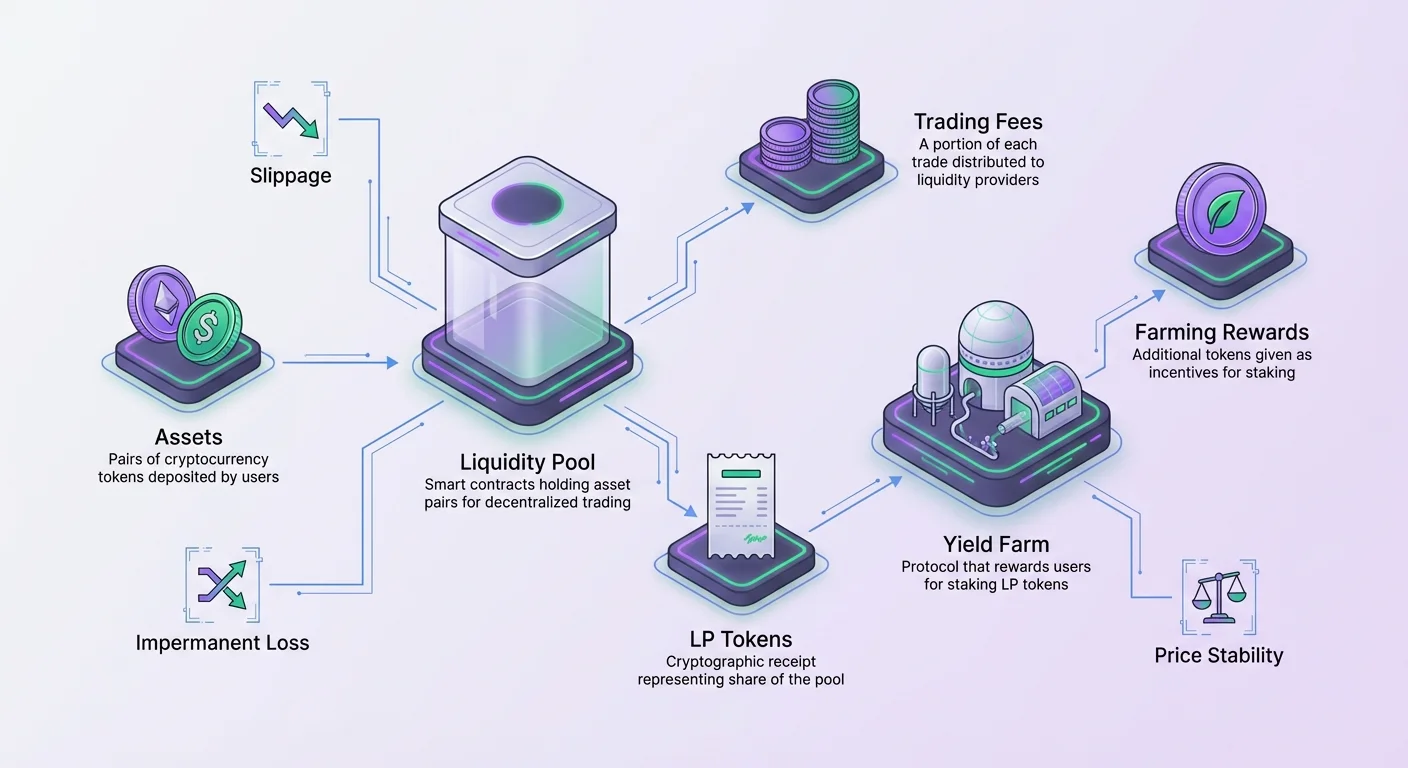
Upon depositing funds, the smart contract issues a digital receipt to the user. This receipt is critical for tracking ownership of the pool's reserves. The assets deposited may not be locked, meaning the user can usually withdraw them at any time. However, the ratio of assets returned upon withdrawal might differ from the ratio deposited due to trading activity in the pool. The smart contract handles these calculations seamlessly, ensuring that the total value remains mathematically consistent with the pool's state.
The Critical Importance of Market Depth
Consequences of Low Liquidity
Liquidity is arguably the most vital metric for determining the health of any financial market. In the context of crypto, it specifically refers to how easily an asset can be converted into another asset without affecting its stable price. When a trading pair suffers from low liquidity, even relatively small trades can have an outsized impact on the market price.
For example, imagine a scenario where a user wants to swap a specific amount of Ethereum for USDC. If the pool is shallow, buying that Ethereum removes a significant percentage of the available supply from the contract. This scarcity immediately drives up the price for that specific transaction. The next person attempting a similar trade would face an even higher price. This volatility makes the market unreliable for serious traders and discourages volume, creating a negative feedback loop.
Slippage and Price Accuracy
Low liquidity directly contributes to a phenomenon known as slippage. Slippage occurs when the price at which a trade is finally executed differs from the price the user expected when they initiated the transaction. In a liquid market, slippage is negligible because the pool is deep enough to absorb the order without shifting the balance. In an illiquid market, the price shifts during the transaction itself.
Furthermore, the lower the liquidity in a pair, the less likely the displayed value of the assets is accurate compared to the broader market. Arbitrageurs rely on deep liquidity to align prices across different exchanges. Without sufficient funds in the pool, the local price on the DEX can drift away from the global average. This makes the market practically unusable for users who need fair pricing. DEXs combat this by aggressively incentivizing users to add liquidity through fee sharing.
| Factor | High Liquidity Environment | Low Liquidity Environment |
|---|---|---|
| Price Stability | Prices remain stable during large trades. | Prices swing wildly with small trades. |
| Execution Speed | Trades execute near instant market rates. | High slippage and failed transactions. |
| User Experience | Reliable and predictable costs. | Unpredictable costs and poor value. |
Navigating Liquidity Provider (LP) Tokens
The Receipt of Ownership
When a user successfully deposits the required pair of assets into a liquidity pool, the protocol must provide proof of that deposit. This proof comes in the form of a Liquidity Pool (LP) token. These tokens function as a cryptographic receipt. They represent the user's specific share of the total liquidity in that pool.
It is important to understand that the user no longer holds the original tokens in their wallet in their raw form. Instead, they hold the LP tokens. These LP tokens are the key to unlocking and retrieving the original capital. Without the LP token, the smart contract cannot verify who owns the funds in the pool. Therefore, safeguarding these tokens is just as important as safeguarding the underlying cryptocurrency.
Proportional Rewards and Fees
The LP token dictates the distribution of trading fees. DEXs typically charge a small percentage on every swap facilitated by the protocol. For example, a standard fee might be 0.25% of the trading volume. This revenue is not kept by the exchange developers but is distributed to the pool's liquidity providers.
The distribution is strictly proportional. If a user provides 10% of the total liquidity in a specific pool, they hold LP tokens representing a 10% share. Consequently, they are entitled to 10% of all the transaction fees generated by that specific pool. If the pool processes $100,000 in volume, and the total fees are $250, the user with a 10% share would earn $25. This reward accumulates automatically within the position.
Managing and Exiting Positions
LP tokens are dynamic instruments. As fees accumulate in the pool, they are added to the total liquidity reserves. This means the value of the entire pool grows over time, assuming trading volume is consistent. When a user decides to exit their position, they "burn" or redeem their LP tokens back to the smart contract.
The smart contract then calculates the user's current share of the pool. Because fees have been added to the pile, the amount of crypto assets returned to the user will typically be higher than the amount deposited. However, the ratio between the two assets may have shifted. The user receives the principal deposit plus their share of the accrued fees, finalizing the liquidity provision cycle.
Fundamentals of Yield Farming Mechanics
Layering Incentives on Liquidity
Yield farming is a practice that builds upon the foundation of liquidity provision. While earning trading fees is the primary incentive for LPs, decentralized exchanges often need to attract even more capital to ensure smooth operations. To achieve this, they introduce a secondary layer of rewards known as farming.
In this system, the LP tokens described previously serve a dual purpose. Not only do they act as a receipt for the liquidity position, but they can also be deposited into a separate smart contract known as a "farm." By depositing LP tokens into a farm, the user actively puts their receipt to work. This process is the core definition of yield farming in this context: utilizing liquidity artifacts to earn additional protocol incentives.
How Farms Operate
Farms are essentially collections of smart contracts designed to distribute rewards over time. When a user stakes their LP tokens into a farm, they are effectively locking that proof of liquidity within the protocol's farming contract. While the tokens are in the farm, the user continues to earn the underlying trading fees from the liquidity pool, but they also begin to accrue farming rewards.
These rewards are typically paid out in the native token of the decentralized exchange. The goal is to align the interests of the users with the growth of the platform. By offering these extra tokens, the DEX encourages users to keep their liquidity in the pool for longer periods. This sustained liquidity creates a better trading environment, which attracts more volume, generating more fees, and theoretically supporting the ecosystem's value.
Farming vs. Simple Pooling
It is crucial to distinguish between simple liquidity provision and yield farming. A user who only deposits assets into a pool holds LP tokens in their wallet. They earn trading fees, but they do not earn farming rewards. To participate in farming, the user must take the extra step of interacting with the farming contract and depositing those LP tokens.
This additional step often requires a separate transaction fee on the blockchain. However, the potential upside is significantly higher because the user gains access to the Annual Percentage Yield (APY) offered by the farm. This APY is generated from the platform's token supply rather than just the trading volume, providing a more consistent stream of returns even if trading activity temporarily slows down.
Reward Systems and APY Dynamics
Source of Farming Rewards
Farming rewards do not appear out of thin air. They are generally allocated from the project's total token supply. The developers or the decentralized governance organization sets aside a specific percentage of tokens to be distributed as incentives. For example, a project might allocate 35% of its total supply to be released over several years specifically to reward liquidity providers.
These tokens are released linearly or on a block-by-block basis. The rate of release is determined by the protocol's emission schedule. This schedule ensures that rewards are distributed fairly over time rather than being exhausted immediately. The smart contract divides the released tokens among all the farmers currently staking in the pool based on their share of the farm.
Understanding Dynamic APY
The Annual Percentage Yield (APY) in yield farming is rarely fixed. It is a dynamic figure that changes based on two main factors: the price of the reward token and the total value of assets locked in the farm. If the price of the reward token rises, the APY value effectively increases because the rewards being paid out are worth more.
Conversely, the APY is heavily influenced by participation. If a farm offers a high APY, it attracts more users. As more people deposit their LP tokens into the farm, the fixed amount of rewards being released per block must be shared among a larger number of participants. This dilutes the rewards for everyone, causing the APY to decrease. Therefore, APY is a self-correcting metric that balances supply and demand for liquidity.
Sustainable vs. Unsustainable Yields
In the competitive landscape of DeFi, some platforms offer astronomical APYs, sometimes exceeding 1,000%, to attract immediate attention. While tempting, these rates are often unsustainable. If a protocol prints and distributes its native token too aggressively, the market becomes flooded with supply.
If the recipients of these rewards decide to sell them immediately to realize profits, the price of the token can collapse. This phenomenon drives away liquidity providers, leaving the DEX with no volume and a worthless token. Sustainable ecosystems focus on balanced rewards that incentivize long-term participation rather than short-term speculation. A moderate, consistent APY is often a sign of a healthier economic model than a flash-in-the-pan four-digit return.
The Ecosystem of Incentives
Native Token Distribution
The distribution of native tokens through farming is a strategic mechanism for decentralization. By rewarding users who contribute value (liquidity) to the network, the protocol places ownership of the platform into the hands of its most active participants. This contrasts with selling tokens primarily to venture capitalists or insiders.
This distribution method fosters a sense of community ownership. Users who hold the earned tokens may eventually gain voting rights or other utility within the ecosystem. In this way, yield farming acts as both a marketing tool to attract capital and a governance distribution mechanism to decentralize control.
Combating Mercenary Liquidity
One of the biggest challenges for DEXs is "mercenary liquidity." These are participants who have no loyalty to the platform and purely chase the highest available APY. They move their capital from farm to farm, extracting rewards and dumping tokens, then leaving as soon as the yield drops.
To combat this, platforms design incentives that reward longevity. Some protocols might implement vesting schedules where rewards are locked for a period, or they might offer loyalty bonuses. However, many modern DEXs, such as the Verse DEX, opt for a model that balances attractive opening APYs with a clear, long-term emission schedule. This approach aims to convert mercenary capital into sticky liquidity by proving the platform's utility and reliability over time.
Managing Distribution Periods
Farming rewards are often organized into distribution periods. These can be set at weekly or monthly intervals. The DEX operators project an APY for the upcoming period based on assumptions about how much liquidity will be present.
If fewer people participate than expected, the actual yield for those who do participate will be higher than projected. If participation surges, the yield drops. This fluctuation is normal. Users must actively monitor these periods. While some farms allow users to claim rewards at any time without unlocking their principal, knowing when a distribution period ends or changes is vital for managing expectations regarding returns.
| Term | Definition | Impact on User |
|---|---|---|
| Mercenary Capital | Users chasing short-term high yields. | Can cause price volatility for reward tokens. |
| Distribution Period | The specific timeframe for reward releases. | Determines the schedule of earnings. |
| Token Emission | The rate at which new tokens are created. | Affects the long-term value of rewards. |
Requirements for DeFi Participation
Essential Tools for Access
Participating in liquidity provision and yield farming requires a specific set of digital tools. The barrier to entry is relatively low, but the technical requirements are non-negotiable. First and foremost, a user needs a digital wallet, often referred to as a Web3 wallet.
The most secure option is a self-custodial wallet. Self-custody means the user holds the private keys to the wallet, giving them full and exclusive control over the assets inside. Unlike a custodial account on a centralized exchange, where a third party manages the funds, a self-custodial wallet connects directly to the blockchain. This direct connection is required to interact with the smart contracts that power DEXs and farms.
The Necessity of Native Currency
Inside the wallet, the user must hold cryptocurrency. However, it is not enough to simply hold the assets they wish to invest. They must also hold a sufficient amount of the blockchain's native currency to pay for transaction fees. These fees, often called "gas," pay for the computational power required to execute changes on the network.
For example, if a user is farming on the Ethereum network, they must hold ETH to pay for the deposit, the approval of the smart contract, and the eventual withdrawal. If they are on a different chain, like Polygon or Bitcoin Cash, they would need MATIC or BCH respectively. Running out of native currency can leave assets stuck in a contract until the wallet is topped up, so maintaining a buffer for fees is a critical management practice.
Choosing the Right Exchange
The final requirement is selecting a reputable decentralized exchange. Not all DEXs are created equal. Users should look for platforms with sufficient trading volume, as volume drives the fee revenue that creates the base yield.
Additionally, security audits are paramount. Since users are interacting with smart contracts, they need assurance that the code has been reviewed by professional security firms to prevent hacks or exploits. A reputable DEX will transparently display its analytics, showing the depth of its pools and the history of its volume, allowing users to make informed decisions before depositing their capital.
Managing Risks in Liquidity Provision
Price Divergence and Ratios
When providing liquidity, users must understand that they are effectively acting as automated market makers. The smart contract is programmed to always offer a price, regardless of what is happening in the broader market. This mechanism relies on the ratio of assets in the pool.
If the external market price of one asset changes drastically, traders will use the pool to swap assets until the pool's internal price matches the market. This rebalancing changes the ratio of tokens the liquidity provider owns. The provider will end up holding more of the asset that is dropping in value and less of the asset that is rising. This is a fundamental mechanic of how AMMs (Automated Market Makers) maintain equilibrium.
Implicit Costs of Providing Liquidity
This shifting ratio leads to a concept often referred to as impermanent loss, though the source material focuses on the mechanics of value accuracy. Essentially, if the value of the assets inside the pool diverges significantly from the time of deposit, the total value of the user's withdrawal might be less than if they had simply held the two assets separately in a wallet.
The trading fees earned and the farming rewards collected are designed to offset this potential downside. Successful liquidity management involves calculating whether the combined APY from fees and farming is sufficient to cover the risks associated with price volatility. In stable pairs (like two stablecoins), this risk is minimal. In volatile pairs, the rewards must be higher to justify the exposure.
Step-by-Step Workflow for Farming
Acquiring the Assets
The journey begins with acquiring the necessary crypto assets. The user must calculate the 50/50 split required for the target pool. If the goal is to enter a VERSE-ETH farm, the user needs an equivalent value of VERSE tokens and ETH. This often involves performing a swap on the DEX first to get the correct balances.
Once the assets are in the wallet, the user navigates to the "Pools" section of the DEX. Here, they initiate the deposit transaction. The protocol will ask for permission to access the tokens, followed by a confirmation to deposit them. Upon success, the wallet balance of the raw assets decreases, and the LP token balance appears.
Activating the Farm
With LP tokens in hand, the user moves to the "Farms" interface. This section displays available farming contracts. The user locates the farm that matches their LP tokens (e.g., the VERSE-ETH Farm).
The process requires another set of transactions. First, the user approves the farming contract to spend their LP tokens. Second, they execute the deposit function. Once this transaction clears on the blockchain, the LP tokens are moved from the user's wallet into the farm's smart contract. The interface will immediately begin updating to show "Pending Rewards," indicating that the farming process is live and generating yield.
Claiming and Exiting
Managing the position involves deciding when to claim rewards. Some platforms require users to withdraw their LP tokens to get the rewards, but many modern interfaces allow for a distinct "Claim" action. This harvests the accrued tokens and sends them to the wallet without disrupting the underlying principal in the farm.
When the user decides to stop farming, the process is reversed. They withdraw the LP tokens from the farm, then go back to the Pool interface to "remove liquidity." This burns the LP tokens and returns the original asset pair—plus accrued trading fees—back to the user's self-custodial wallet, completing the investment cycle.
Conclusion
The evolution of decentralized finance has democratized access to market-making strategies that were once the exclusive domain of large financial institutions. By leveraging smart contracts and liquidity pools, individual users can put their assets to work, earning a passive income stream through trading fees and farming rewards. This system relies heavily on the active participation of liquidity providers who facilitate the seamless exchange of tokens in a permissionless environment.
However, participating in these protocols requires a clear understanding of the underlying mechanics. From the 50/50 ratio requirements of liquidity pools to the dynamic nature of APY in yield farms, users must navigate a landscape that rewards technical literacy and risk management. The combination of trading fees and farming incentives creates a powerful revenue model, but it is one that demands attention to market conditions and the sustainability of the reward tokens being issued.
Ultimately, yield farming and liquidity provision represent a cooperative approach to finance. By aligning the incentives of the exchange, the token project, and the individual user, DeFi creates a self-sustaining ecosystem. Success in this space depends on choosing reputable platforms, maintaining self-custody of assets, and consistently managing expectations regarding risks and rewards.
Providing liquidity and yield farming allows you to earn passive income on your crypto assets by facilitating decentralized trading.