
The Ethereum network represents one of the most significant experiments in distributed computing history. Since its inception, it has aimed to serve as a world computer that is open to all. However, achieving this vision requires overcoming substantial technical hurdles. The roadmap for Ethereum is not a simple straight line but a series of interconnected upgrades designed to improve specific aspects of the system.
These upgrades are often categorized into distinct phases that rhyme: The Merge, The Surge, The Scourge, The Verge, The Purge, and The Splurge. Each phase addresses a critical component of the network's architecture. The goal is to solve the complex problems associated with decentralized networks while maintaining security.
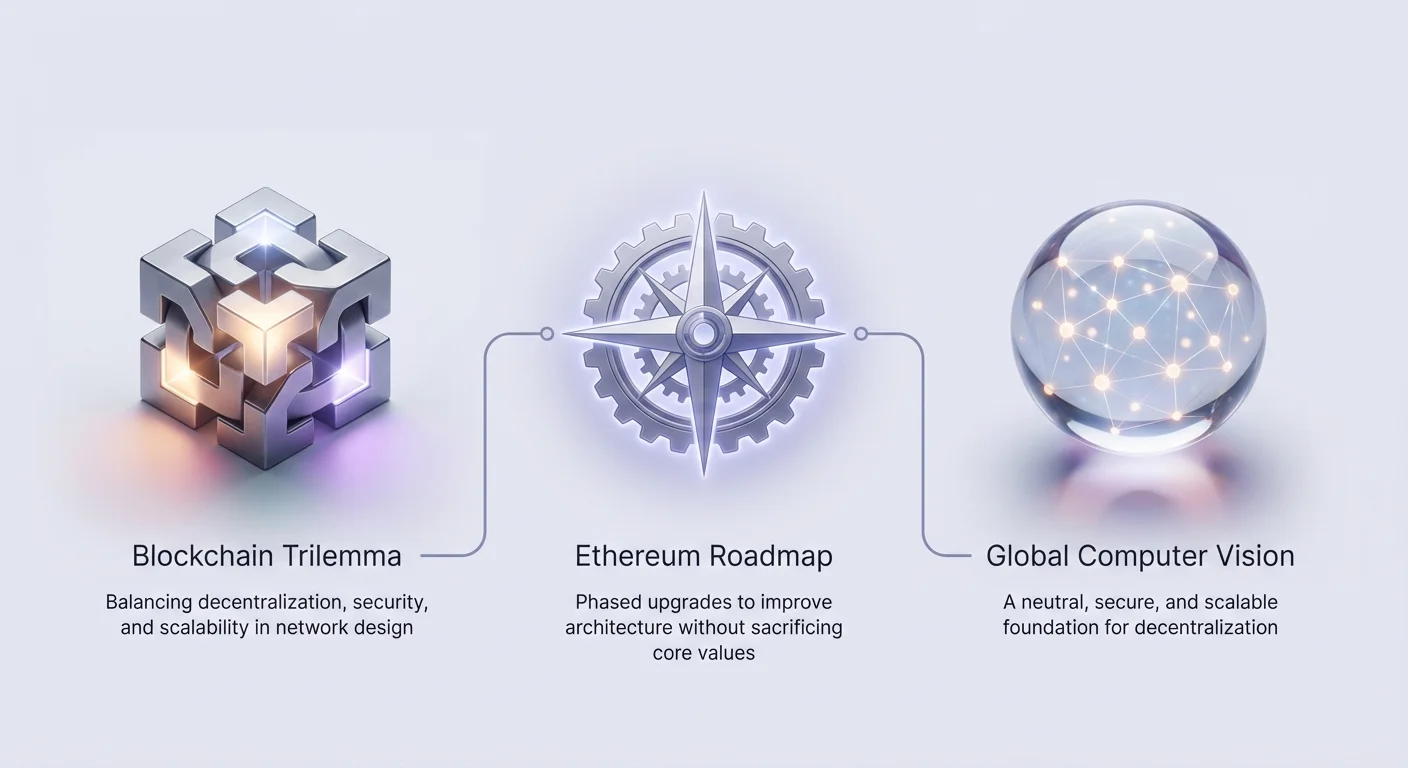
Central to this evolution is the concept of the "blockchain trilemma." This theory suggests that a decentralized network can only optimize for two of three primary features: decentralization, security, and scalability. Ethereum originally prioritized security and decentralization, which often resulted in network congestion and high fees during periods of high demand.
The roadmap is an attempt to solve this trilemma. By implementing these upgrades, the network aims to become scalable enough to handle global demand without sacrificing its core values. The transition involves fundamental changes to both the economic and technical structure of the blockchain.
The Foundation: Understanding The Merge
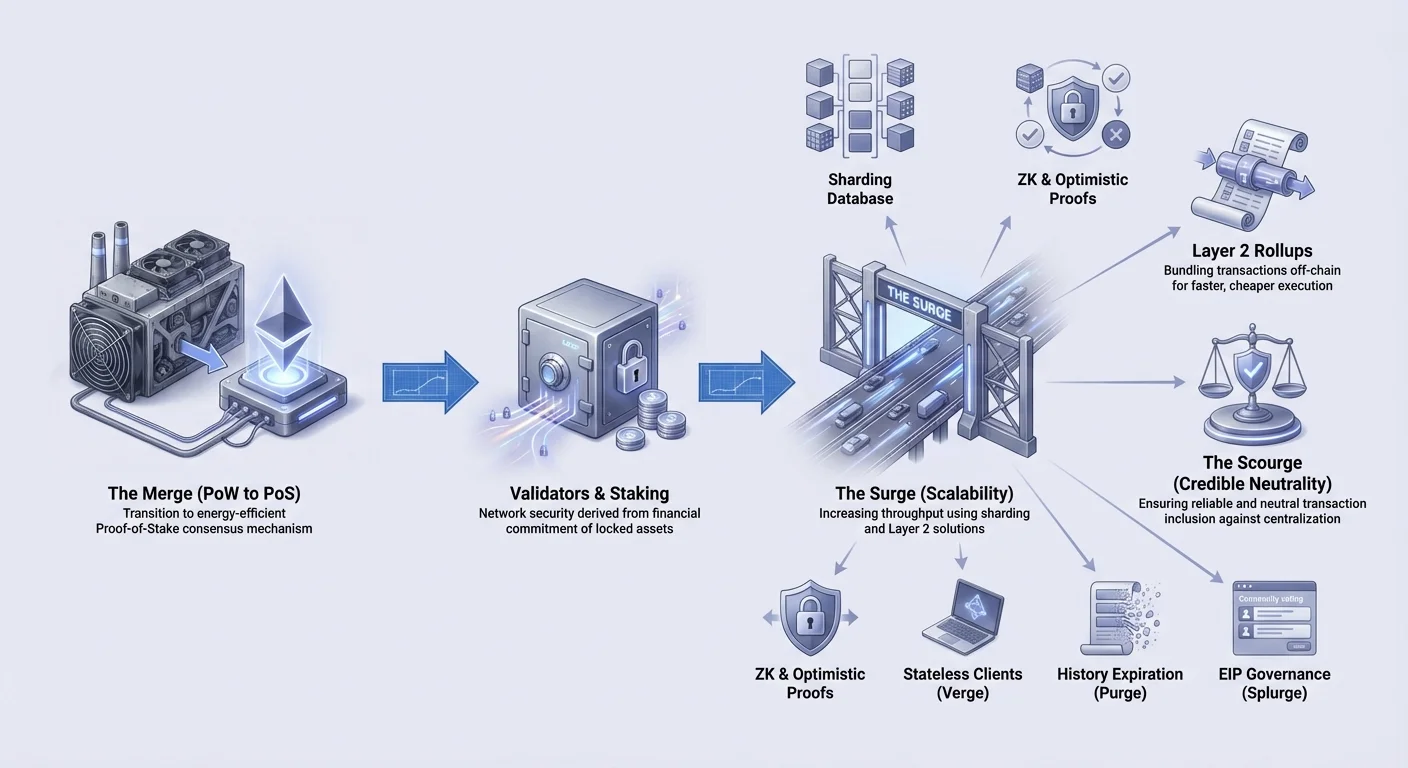
The most significant upgrade in Ethereum's history was known as The Merge. Completed in September 2022, this event marked the transition from the original Proof-of-Work (PoW) consensus mechanism to Proof-of-Stake (PoS). This shift was necessary to reduce the network's energy consumption and lay the groundwork for future scalability upgrades.
Before The Merge, Ethereum relied on miners to secure the network. These participants operated energy-intensive hardware to solve complex mathematical puzzles. This system, while secure, consumed vast amounts of electricity. The transition to Proof-of-Stake replaced miners with validators, who secure the network by locking up capital rather than burning energy.
Mechanics of Proof-of-Stake
In the Proof-of-Stake system, network security is derived from financial commitment rather than computational power. Participants, known as validators, stake their cryptocurrency by sending it to a specific smart contract. This staked asset acts as a security deposit or collateral that guarantees their honest behavior.
The protocol selects validators at random to propose new blocks. Once a validator proposes a block, other validators verify the data to ensure it adheres to the network rules. If the block is valid, it is added to the chain, and the validators are rewarded with newly minted cryptocurrency and transaction fees. This system aligns the financial incentives of the operators with the health of the network.
Benefits and Security Improvements
The primary advantage of this transition was the dramatic reduction in energy usage. Estimates suggest that the switch to Proof-of-Stake reduced Ethereum's energy consumption by over 99 percent. This removed a major barrier to institutional adoption and environmental sustainability.
Beyond energy efficiency, the new system introduced distinct security properties. In a Proof-of-Work system, attacking the network requires 51 percent of the hashing power. In Proof-of-Stake, an attacker would need to acquire a majority of the staked assets. This creates a high economic barrier to malicious behavior. Additionally, the protocol includes a mechanism called slashing. If a validator acts maliciously or violates protocol rules, their staked assets can be forfeited entirely or in part.
The Surge: Achieving Massive Scalability
With the consensus mechanism updated, the focus shifts to "The Surge." This phase targets scalability. The objective is to increase the transaction throughput of the network to support thousands of transactions per second. The primary technologies driving this phase are sharding and Layer 2 scaling solutions.
Scalability is critical because the main network, or Layer 1, has a limited capacity. It can typically process only a specific number of transactions per day. When demand exceeds this capacity, users compete to have their transactions included in the next block. This competition drives up gas fees, pricing out smaller users and limiting the utility of decentralized applications.
The Role of Sharding
Sharding is a technique designed to partition the network's database into smaller, more manageable pieces called shards. In a traditional blockchain, every node must process and store every transaction. This requirement ensures security but severely limits speed. Sharding changes this dynamic by distributing the data processing responsibility.
Under a sharded system, validators are assigned to specific shards. Each shard operates somewhat like a separate blockchain with its own state and transaction history. However, unlike independent blockchains, shards communicate and coordinate through the main chain. This allows the network to process many blocks simultaneously rather than consecutively. The initial implementation of sharding focuses on data availability, which enhances the efficiency of Layer 2 rollups.
Layer 2 Solutions and Rollups
Layer 2 solutions are protocols built on top of the Ethereum mainnet. They handle transaction execution off-chain while relying on the main network for security and final settlement. By moving the heavy lifting away from Layer 1, these solutions offer faster speeds and significantly lower costs.
Rollups are currently the most promising Layer 2 technology. They work by bundling hundreds of transactions into a single batch. This batch is processed on the second layer, and only the compressed data is posted back to the main Ethereum blockchain. There are two primary types of rollups: Optimistic rollups and Zero-Knowledge (ZK) rollups.
| Rollup Type | Validation Method | Pros | Cons |
|---|---|---|---|
| Optimistic | Assumes validity by default | EVM compatible, easier to build | Long withdrawal times (7 days) |
| ZK Rollup | Mathematical validity proof | Instant finality, high security | High computational cost, complex |
Optimistic Versus Zero-Knowledge
Optimistic rollups assume that transactions are valid by default. They do not perform computation on the main chain unless someone challenges a transaction. If a challenge occurs, the network verifies the data. This method is compatible with existing Ethereum smart contracts but requires a withdrawal delay to allow time for challenges.
Zero-Knowledge rollups take a different approach. They generate a cryptographic proof that verifies the validity of the transaction batch. This proof is submitted to the main chain. Since the validity is mathematically proven upfront, there is no need for a challenge period. This allows for faster withdrawals. However, the technology is more complex to implement and requires significant computational resources to generate the proofs.
The Scourge: Ensuring Credible Neutrality
As the network scales, new risks emerge regarding centralization and censorship. "The Scourge" refers to the roadmap items dedicated to ensuring reliable and neutral transaction inclusion. This phase addresses the concern that sophisticated actors might gain too much control over the network.
A core principle of Ethereum governance is "credible neutrality." This means the mechanism should not discriminate for or against any specific people. The design must treat everyone fairly. However, economic forces in a Proof-of-Stake system can lead to centralization. Critics argue that because larger stakeholders earn more rewards, the "rich get richer." This concentration of wealth could theoretically lead to a concentration of power.
Addressing Validator Centralization
The barrier to entry for becoming a validator can influence the network's decentralization. If running a validator node requires expensive hardware or massive amounts of ETH, only wealthy entities can participate. This reduces the diversity of the network.
Furthermore, the rise of specialized services like liquid staking pools has led to large amounts of stake being controlled by a few entities. While these services make staking accessible to users with less capital, they introduce a potential point of failure. If a single entity controls a large percentage of the network's stake, they could potentially influence governance or transaction ordering.
To combat this, the roadmap includes upgrades to ensure that block production remains distributed. The goal is to separate the role of building blocks from the role of proposing them. This separation helps prevent any single validator from censoring transactions or extracting excessive value from users.
The Verge and The Purge: Managing Data and History
The long-term health of the blockchain depends on its ability to remain accessible to independent operators. "The Verge" and "The Purge" focus on efficiency, specifically regarding node operation and historical data management.
For a blockchain to be truly decentralized, individuals must be able to verify the ledger themselves. This is done by running a "node." A node is a computer that runs the Ethereum software and validates transactions. If the hardware requirements for running a node become too high, fewer people will do it. This leads to reliance on centralized service providers like Infura, which creates vulnerability.
The Verge: Reducing Verification Costs
The Verge aims to introduce "stateless clients" or Verkle trees. Currently, verifying a block requires access to a large portion of the blockchain's state. As the network grows, this state becomes larger, requiring more RAM and faster SSDs.
The upgrades in this phase will allow nodes to verify blocks without storing the entire state of the network on their hard drives. By reducing the data requirements, it becomes feasible for users to run nodes on consumer-grade hardware, such as mobile phones or basic laptops. This lowers the barrier to entry and increases the resilience of the network.
The Purge: Eliminating Historical Bloat
The Ethereum blockchain carries the weight of its entire history. The Purge involves cleaning up old network history to simplify the protocol. Currently, running a full archival node requires downloading terabytes of data. This history includes every transaction ever executed since the genesis block.
While maintaining a complete history is important for auditing, it is not strictly necessary for validating new transactions. The Purge seeks to implement mechanisms where nodes can expire old history. This means nodes would stop storing data that is older than a certain timeframe, such as one year.
This reduction in storage requirements prevents the network from becoming too heavy. It ensures that new nodes can sync with the network quickly. By managing the accumulation of technical debt, the protocol remains agile and easier to maintain for developers and users alike.
The Splurge: Governance and Future Polish
The final category, "The Splurge," acts as a catch-all for necessary but miscellaneous upgrades. These are the improvements that fix minor issues, improve the user experience, and refine the economic model. It also encompasses the ongoing evolution of Ethereum's governance.
Ethereum is not a static protocol. It requires constant changes to fix bugs and respond to market conditions. This evolution is managed through Ethereum Improvement Proposals (EIPs). Individuals or teams draft proposals, which are then debated by the community. This process relies on "rough consensus" among stakeholders, including miners, node operators, and developers.
Economic Improvements and EIP-1559
One major example of an economic upgrade that fits this category is EIP-1559. Implemented before The Merge, this upgrade overhauled the fee market. It introduced a base fee that is burned (destroyed) with every transaction. This change made transaction fees more predictable for users.
Upgrades like these are crucial for the long-term sustainability of the asset. By burning ETH, the protocol introduces a deflationary pressure that counters the issuance of new tokens to validators. Future "Splurge" upgrades may focus on Account Abstraction, which would make managing crypto wallets as easy as using a traditional banking app.
The Challenge of Decentralized Governance
Governance in a decentralized system is inherently political. Unlike a private company, there is no CEO to make unilateral decisions. Changes must be adopted voluntarily by the thousands of independent nodes running the software.
This process can be slow and contentious. For example, the community must balance progressivism (making rapid changes to improve the network) with conservatism (maintaining stability and minimizing risk). The Ethereum culture has generally favored a progressive approach to solve the trilemma. However, ensuring that these changes reflect the values of the broader community requires constant vigilance and active participation from all stakeholders.
Conclusion
The roadmap from The Merge to The Splurge represents a comprehensive plan to mature the Ethereum network. By transitioning to Proof-of-Stake, the protocol solved its energy consumption issues. Through sharding and Layer 2 rollups, it aims to solve the scalability crisis that has historically plagued high-demand blockchains.
Simultaneously, the focus on node efficiency and historical data management ensures that the network remains decentralized. Lowering the hardware barriers for validators and node operators protects the system from centralized control. While the technology is complex, the ultimate goal is simple: to build a neutral, secure, and scalable foundation for the digital future.
Ethereum’s upgrades aim to create a fast, secure global computer that anyone can use and verify efficiently.