
The world of digital assets has matured far beyond simple HODLing (holding onto assets long-term). Today, institutions, corporate treasuries, and high-net-worth individuals (HNWIs) view cryptocurrencies not just as volatile speculation, but as an asset class capable of generating meaningful, passive income.
However, deploying large-scale capital—millions or even billions of dollars—into yield strategies is fundamentally different from a retail investor allocating a few thousand dollars. For large digital asset holders, the calculation changes entirely: liquidity, counterparty risk, and regulatory compliance become paramount concerns, often outweighing the pursuit of the highest possible percentage yield.
This comprehensive guide is designed for those seeking to understand the sophisticated strategies employed by professional capital managers to generate income from vast digital asset reserves. We will contrast the familiar structure of Centralized Finance (CeFi) with the complex, yet powerful, potential of Decentralized Finance (DeFi), specifically examining the trade-offs necessary when dealing with institutional-scale liquidity and risk management.
Foundational Concepts: Understanding Crypto Yield
Generating yield in the crypto ecosystem means actively putting assets to work rather than letting them sit idle in a wallet. While the mechanics can be intricate, the outcomes generally fall into two broad categories: earning transaction fees or earning interest/rewards for securing a network.
Staking vs. Lending: The Core Difference
Institutional yield strategies often begin by differentiating between staking and lending, as the risk profiles and required infrastructure are vastly different.
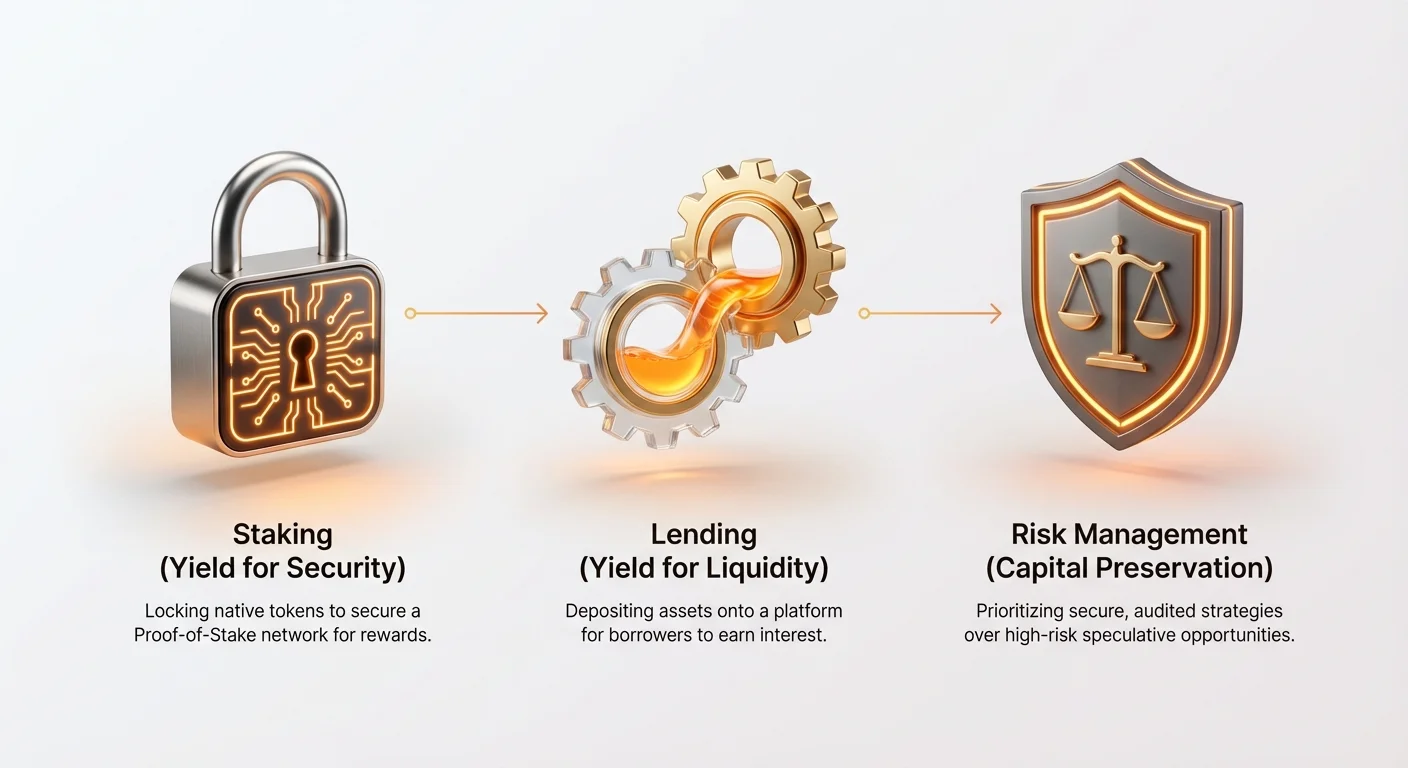
1. Staking (Yield for Security): Staking is the process of locking up native network tokens (like Ethereum's ETH or Solana's SOL) to help secure a Proof-of-Stake blockchain. In return for validating transactions and maintaining network integrity, the staker receives newly minted tokens as a reward.
- Risk Profile: Primarily protocol risk (slashing—the penalty for validator misbehavior) and technical risk (running secure node infrastructure).
- Liquidity: Often low. Many PoS networks require tokens to be locked up for a period (unbonding), which can take days or weeks, making immediate withdrawal impossible.
2. Lending (Yield for Liquidity): Lending involves depositing assets onto a platform (either CeFi or DeFi) to be borrowed by others, usually traders or businesses. The depositor earns interest paid by the borrowers.
- Risk Profile: Primarily counterparty risk (if lending through CeFi) or smart contract risk (if lending through DeFi).
- Liquidity: Generally high, especially in DeFi lending protocols, where assets can often be withdrawn instantly (assuming sufficient liquidity remains in the pool).
The Yield Spectrum: Risk vs. Reward
For institutional players, high yields are treated with extreme caution. The yield spectrum maps directly to the underlying risk:
| Yield Strategy | Typical Yield Source | Institutional Risk Consideration |
|---|---|---|
| Simple CeFi Lending | Interest paid by borrowers/exchange | Counterparty default (solvency risk) |
| Native Protocol Staking | Network block rewards | Lock-up periods, slashing penalties |
| Liquid Staking Tokens (LSTs) | Staking rewards + trading fees | Smart contract risk, depeg risk |
| Liquidity Provision (LPs) | Trading fees + token incentives | Impermanent Loss (IL), incentive decay |
The institutional imperative is to generate maximum yield without assuming catastrophic risk that could jeopardize the entire principal. This means prioritizing secure, audited, and compliant strategies over speculative, high-APR farming opportunities.
Centralized Finance (CeFi) Strategies for Institutional Staking
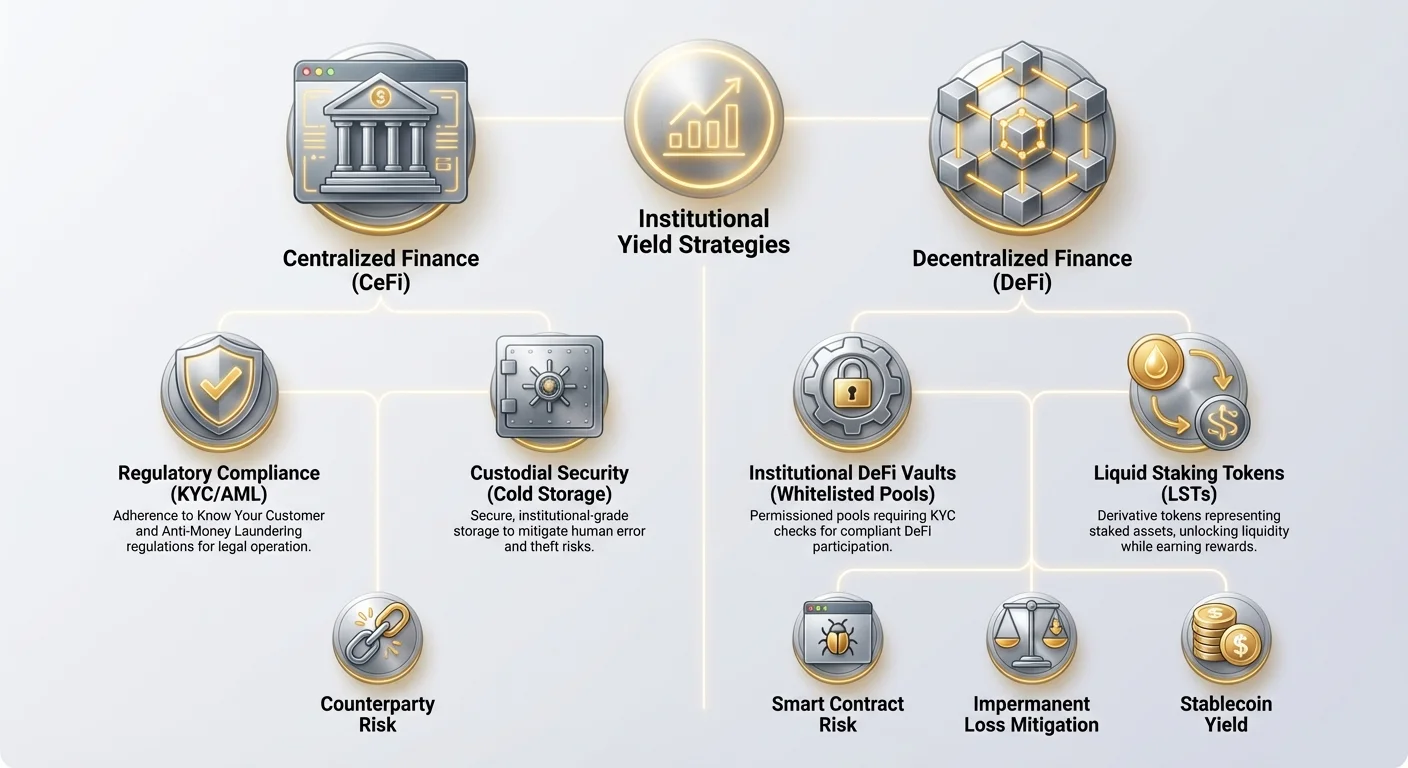
CeFi strategies rely on trusted, regulated intermediaries—like exchanges, prime brokers, or custodians—to manage the staking and lending process. For large capital, CeFi offers familiar risk management structures that are appealing to legal and compliance teams.
Benefits: Security and Compliance Oversight (KYC/AML)
The main advantage of CeFi platforms for institutional capital is the established framework for security and compliance.
- Regulatory Compliance: CeFi platforms adhere to Know Your Customer (KYC) and Anti-Money Laundering (AML) regulations. This is mandatory for funds, corporate treasuries, and traditional financial institutions (TradFi) looking to interact with digital assets.
- Custodial Security: Institutions often cannot, or will not, manage private keys themselves. CeFi providers offer secure, institutional-grade cold storage custody solutions, mitigating the risk of human error or theft related to key management.
- Simplified Reporting: Institutions deal with complex multijurisdictional tax and accounting requirements. Leading CeFi platforms provide integrated reporting tools that consolidate transactions, calculate gains and losses, and streamline the necessary paperwork for tax compliance, a critical feature for professional fund management.
Trade-Offs: Counterparty Risk and Lock-Up Periods
While compliance is a major win, CeFi introduces a single point of failure: the platform itself.
Counterparty Risk: When assets are deposited on a CeFi exchange for staking or lending, the institution forfeits direct control over the private keys. The funds are held "on-balance-sheet" by the CeFi provider. If the provider mismanages assets, experiences a hack, or becomes insolvent, the institution may lose its principal entirely. This "not your keys, not your crypto" axiom is the greatest vulnerability in CeFi, especially for massive amounts of capital.
Illiquidity Risk: Many CeFi staking products mirror the underlying network's lock-up requirements. If an institution needs to withdraw capital quickly—perhaps to meet redemptions or manage risk—they may be subject to mandated unbonding periods of up to 21 or more days, severely restricting financial agility.
Prime Brokerage and Custodial Solutions
Sophisticated large holders often use specialized prime brokers or dedicated institutional custodians (like Coinbase Custody or Anchorage Digital) rather than retail-facing exchanges for staking.
These solutions act as a compliant bridge, offering:
- Segregated Accounts: Assets are often held in separate accounts, reducing exposure to the broker’s own operational insolvency risk.
- Off-Chain Settlement: Prime brokers can often facilitate large transactions off-chain, reducing network fees and execution time.
- Managed Staking Infrastructure: The custodian or broker takes on the technical burden of running highly secure validator nodes, mitigating the slashing risk and infrastructure overhead for the institution. The custodian ensures geographic and jurisdictional diversification of the validator nodes to minimize regulatory risk exposure.
Decentralized Finance (DeFi) for Large Capital Deployment
DeFi strategies offer the powerful appeal of removing the central counterparty, dramatically reducing the risk of a centralized exchange defaulting. However, utilizing DeFi at an institutional scale requires navigating a much higher level of technical and smart contract risk.
Institutional DeFi Vaults and Whitelisting
The permissionless nature of early DeFi posed regulatory hurdles for institutions bound by strict KYC/AML mandates. To bridge this gap, specialized institutional DeFi protocols have emerged.
These protocols (sometimes called "permissioned DeFi" or "institutional pools") require all participants—both lenders and borrowers—to pass stringent KYC checks conducted by third-party verification services.
How they function:
- Whitelisting: An institutional fund must be whitelisted, proving its identity and regulatory standing.
- Segregated Pools: Funds are deposited into pools that are inaccessible to non-whitelisted retail users.
- Compliance Wrapper: The protocol structure provides regulatory certainty, allowing institutions to generate yield from lending and borrowing while remaining compliant with their organizational mandates.
For large capital, these specialized vaults are crucial, as they allow participation in DeFi mechanics (transparency, automation) without violating KYC/AML requirements.
Liquid Staking: Optimizing Liquidity while Earning Yield
One of the most complex yet high-impact strategies for large Ethereum and other PoS token holders is the use of Liquid Staking Tokens (LSTs), also known as staking derivatives.
The Problem LSTs Solve: Native staking locks up capital. For an institution holding hundreds of thousands of ETH, having that capital locked for weeks is unacceptable.
The LST Solution: When an institution stakes ETH through a liquid staking protocol (e.g., Lido or Rocket Pool), they receive a derivative token (like stETH or rETH).
- The Original ETH is locked and earning staking rewards.
- The LST (e.g., stETH) is liquid and tradeable.
The LST represents the claim on the staked asset plus accumulated rewards. This token can then be used elsewhere in DeFi (e.g., as collateral for loans, or deposited into a liquidity pool to earn additional trading fees), effectively allowing the institution to stack yields (earning staking rewards + DeFi interest).
Liquid Staking Risk Profile (The Institutional View)
While LSTs unlock liquidity, they introduce a distinct set of risks that must be carefully managed at scale:
- Smart Contract Risk: If the underlying LST protocol's smart contract is exploited, the entire staked principal could be lost.
- Depeg Risk: The LST (e.g., stETH) is pegged to the value of the underlying asset (ETH). If market confidence in the LST issuer falters, or if there is major technical failure, the LST could "depeg" (trade below the value of ETH). For institutions managing hundreds of millions, a 5% depeg event represents a catastrophic loss in market value, even if the underlying principal is theoretically recoverable later.
Analyzing and Mitigating Smart Contract Risk
For any institutional deployment into DeFi, smart contract auditability is the number one priority. Due diligence involves:
- Independent security audits by multiple, reputable firms.
- Formal verification of critical contract logic.
- Clear documentation outlining bug bounty programs and emergency shutoff procedures.
- Deep analysis using due diligence frameworks to score protocol maturity.
- Code Audits: Ensuring the protocol has been rigorously audited by multiple, reputable third-party security firms (e.g., CertiK, Trail of Bits).
- Bug Bounties: Verifying the protocol maintains active bug bounty programs to incentivize white-hat hackers to find flaws before malicious actors do.
- Insurance and Cover: For large deployments, institutions often seek insurance coverage (available through providers like Nexus Mutual) to mitigate losses specifically resulting from smart contract failure. While coverage limits can be low compared to total institutional allocation, they provide an essential layer of risk transfer.
Advanced Yield Techniques and Risk Management
Beyond simple staking and lending, large holders engage in more complex, yield-optimized strategies that prioritize capital preservation over speculative returns.
Impermanent Loss Mitigation for Liquidity Providers (LPs)
Providing liquidity (LPing) to Automated Market Makers (AMMs) is a core DeFi yield strategy. LPs earn a share of the transaction fees generated by traders who use the pool. However, LPs face a unique risk known as Impermanent Loss (IL).
IL occurs when the price ratio of the two assets in a pool changes after the deposit. If Asset A increases dramatically in value compared to Asset B, the LP effectively sells some of the appreciated asset to maintain the pool ratio, resulting in fewer tokens than if they had simply held the assets (HODLed).
Mitigation Strategies for Large Capital:
- Stablecoin Pools: The most common mitigation strategy is focusing capital on pools containing two assets that are designed to maintain a 1:1 parity (e.g., USDC/USDT, DAI/USDC). Since the price ratio is intended to remain constant, the risk of IL is negligible, allowing the institution to capture high trading fees with minimal volatility risk.
- Hedging Strategies (Delta Neutral): Sophisticated funds may employ delta-neutral strategies. They provide liquidity to a volatile pool (e.g., ETH/BTC) to earn fees, but simultaneously open offsetting short positions in traditional derivatives markets or perpetual futures markets. If the price of ETH drops (causing IL), the short position gains value, essentially "hedging" the loss exposure in the LP position. This requires significant financial sophistication and access to regulated derivative markets.
Treasury Management Yield Strategies (Focus on Stablecoins)
Corporate treasuries and asset managers holding large reserves of fiat-backed stablecoins (USDC, USDT) require yield solutions that are highly liquid and extremely low-risk, as capital preservation is the absolute priority.
Yield generation for stablecoin treasuries usually focuses on the following:
- Institutional Lending Platforms: Lending stablecoins on highly audited, institutional-grade platforms (both CeFi and permissioned DeFi) to earn predictable interest rates.
- Tokenized Treasury Bills/RWAs: Deploying stablecoins into emerging Real World Asset (RWA) protocols that tokenize US Treasury bills or commercial paper. This provides a low-risk, traditionally regulated interest rate (often 4-5%) while maintaining the capital on-chain, ready for deployment. This strategy is extremely popular with risk-averse institutions seeking to maintain custody and high liquidity.
- Yield Aggregation with Risk Caps: Utilizing automated yield optimizers that intelligently distribute stablecoins across various protocols to find the best risk-adjusted rate. Critically, institutional aggregators are configured with explicit risk parameters (e.g., "Do not invest in any protocol less than one year old" or "Cap allocation to any single smart contract at $X million").
Compliance and Accounting Challenges of DeFi Yield
One of the greatest operational burdens for large digital asset managers is the complexity of tracking and reporting yield events, especially across DeFi platforms.
Taxable Events: Nearly every form of yield is a taxable event. Staking rewards are often treated as ordinary income upon receipt. Interest and trading fees are usually treated similarly. For institutions operating globally, calculating the cost basis and fiat value of these intermittent, tiny accruals across hundreds of transactions requires specialized, automated crypto tax software platforms.
Jurisdictional Complexity: If a fund operates across multiple legal entities in different countries, the classification of DeFi activities (is an LP position a loan? Is staking an operational activity?) varies widely, requiring specialist legal counsel and often necessitating the use of specific legal entity structures (as discussed in Crypto Fund Structuring). The lack of centralized reporting or 1099-equivalent forms from DeFi protocols necessitates robust internal accounting infrastructure.
Best Practices for Institutional Yield Portfolio Management
Deploying capital at scale requires discipline, robust security procedures, and continuous risk assessment, moving far beyond the opportunistic strategies often employed by retail investors.
Due Diligence and Vendor Selection
The quality of institutional yield depends heavily on the partnerships selected. This applies to both CeFi custodians and DeFi protocol choices.
1. Custody and Security: Large holders must prioritize security above all else. This means choosing custodians that offer multi-signature technology, geographically dispersed vaulting, and independent third-party attestations (e.g., SOC 2 reports). Any strategy that forces the institution to directly interact with a smart contract using a hot wallet should be viewed with extreme skepticism.
2. Audit Trails and Reporting: Before selecting a staking provider or DeFi protocol, management must ensure that all activity is programmatically readable and exportable via APIs. The ability to reconcile daily or weekly transactions instantly is crucial for compliance, accounting, and operational risk management. Lack of a clean audit trail is a sufficient reason to dismiss a yield opportunity, regardless of the potential APR.
Diversification and Sizing Bets
The scale of institutional capital demands calculated diversification to avoid concentration risk.
1. Protocol Diversification: Never allocate the entire staking principal to a single validator or a single LST issuer. Spreading staked assets across multiple trusted LST providers and even native node infrastructure minimizes the impact of a single smart contract failure or slashing event.
2. Yield Diversification: A well-managed institutional portfolio should allocate capital across different yield buckets to balance liquidity, risk, and return:
- Safe/Liquid (50-70%): Stablecoin lending on whitelisted DeFi pools or RWA tokenization platforms. Focus: Capital preservation.
- Core Staking (20-40%): ETH, Solana, or other PoS staking via major institutional custodians or established LST protocols. Focus: Network-native yield.
- Opportunistic/Tactical (0-10%): Smaller allocations to higher-risk, higher-reward strategies (e.g., new liquid staking derivatives, short-term incentive pools). Focus: Alpha generation, but with strict loss limits.
By adhering to strict sizing limits, institutional managers ensure that even if the highest-risk strategy fails completely, the overall impact on the fund’s principal remains minimal.
Conclusion
The evolution of crypto yield generation has created immense opportunities for institutional capital, transitioning digital assets from a speculative gamble into a functional, income-generating asset class. However, achieving successful yield at scale requires a nuanced understanding of risk far beyond that of a typical retail investor.
For the large digital asset holder, the primary focus shifts from maximizing APR to ensuring regulatory compliance, mitigating systemic counterparty risk (in CeFi), and eliminating smart contract risk (in DeFi). By utilizing specialized institutional vaults, carefully selecting liquid staking solutions, and employing sophisticated hedging techniques to protect against impermanent loss, professional fund managers can build resilient portfolios that generate substantial, risk-adjusted passive income in the decentralized economy.