
Ethereum has established itself as the cornerstone of decentralized finance and the broader Web3 ecosystem. It serves as the settlement layer for billions of dollars in value and hosts thousands of decentralized applications. However, this immense popularity has created significant challenges regarding network capacity. As more users flock to the network, the demand for block space exceeds the available supply. This bottleneck results in network congestion and skyrocketing transaction fees that often price out everyday users.
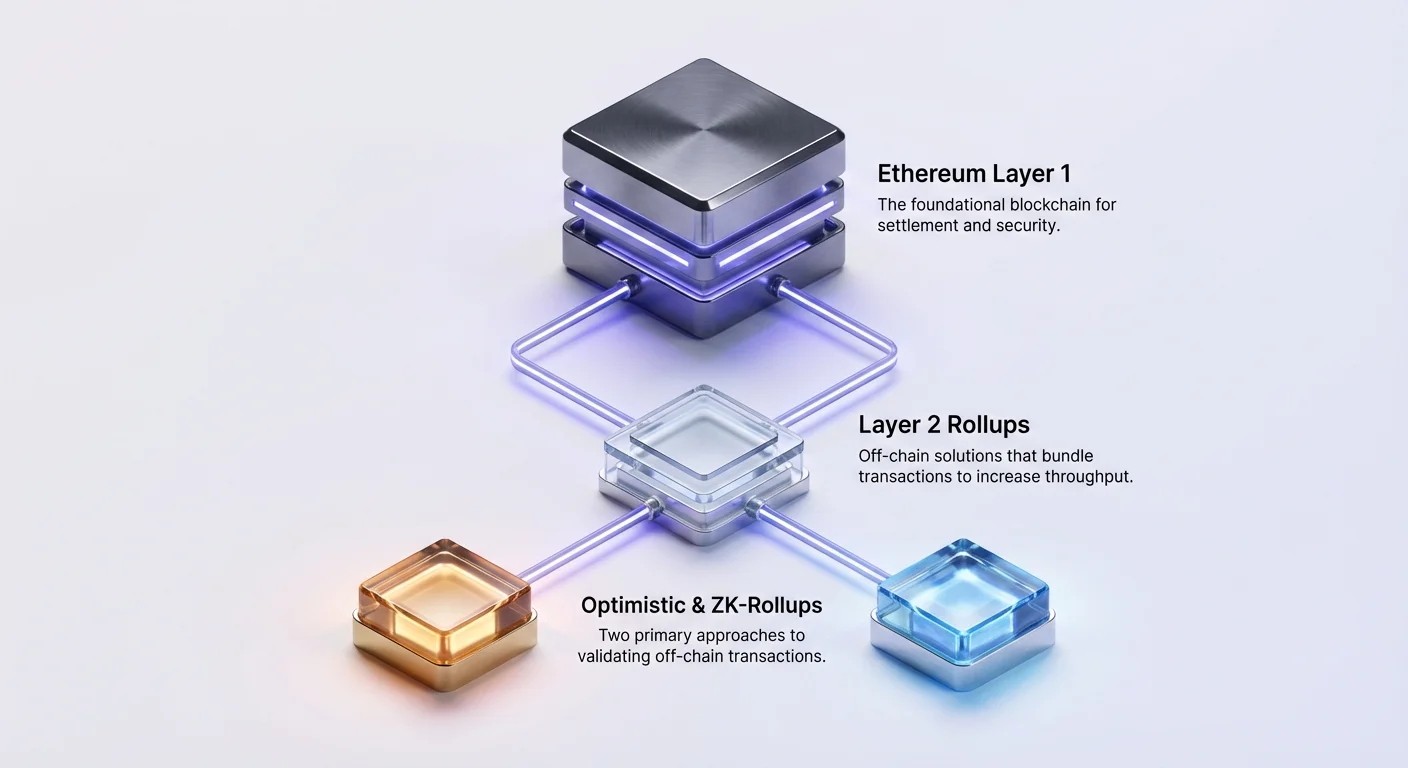
The community has long recognized that the main Ethereum blockchain, often referred to as Layer 1, cannot handle the world's transaction volume alone. The network regularly processes over a million transactions daily, yet this is insufficient to meet global demand. To address this, developers have built solutions that sit on top of the mainnet. These are collectively known as Layer 2 scaling solutions. They aim to increase transaction throughput without compromising the robust security that makes Ethereum valuable.
Among the various scaling approaches, rollups have emerged as the most promising technology for the long-term future of the network. Rollups process transactions outside the main Ethereum chain but post transaction data back to it. This approach reduces the burden on the main network while ensuring that data remains accessible and secure. Within this category, two primary contenders have risen to the forefront: Optimistic Rollups and Zero-Knowledge (ZK) Rollups.
The Scalability Challenge and Layer 2
To understand why rollups are necessary, one must first grasp the limitations inherent in blockchain design. This is often described as the "blockchain trilemma." The concept suggests that a decentralized network can only optimize for two of three primary features at once: decentralization, security, and scalability. Ethereum has historically prioritized decentralization and security. This choice means that scalability on the base layer is naturally limited.
The Cost of Congestion
When the network becomes busy, the mechanism for including transactions in a block resembles an auction. Users essentially bid against each other to have their transactions processed by validators. This leads to volatile gas prices. During periods of high demand, performing a simple token swap or interacting with a decentralized application can cost exorbitant amounts. This friction limits the growth of the ecosystem and prevents widespread adoption of decentralized applications (DApps).
Moving Execution Off-Chain
Layer 2 solutions address this by moving the heavy lifting off the main Ethereum chain. Instead of every node on the main network processing every single calculation, the execution happens on a secondary layer. The Layer 2 network handles the computation and storage of state changes. It then periodically submits a summary or proof of these transactions to the Ethereum mainnet. This anchors the Layer 2 state to Layer 1, leveraging Ethereum's security without its congestion.
Types of Scaling Solutions
While rollups are the focus, other solutions exist. Channels, similar to Bitcoin's Lightning Network, allow users to transact endlessly off-chain and only settle the final balance on-chain. Plasma creates child chains that use the main chain for trust arbitration. Independent sidechains run parallel to Ethereum with their own consensus mechanisms. However, rollups have gained favor because they keep data on-chain, providing higher security guarantees than sidechains or Plasma.
How Rollups Function
Rollups derive their name from the process of "rolling up" or bundling hundreds or thousands of transactions into a single batch. Instead of submitting each transaction individually to the Ethereum mainnet, the rollup operator submits a compressed batch of data. This significantly reduces the data footprint on Layer 1. By splitting the transaction fees of the submission across many users, the cost per user drops dramatically.
The critical difference between the two major types of rollups lies in how they prove to the main network that the off-chain transactions are valid. The mainnet needs a way to ensure that the data being submitted is correct and that no one is processing invalid transactions or stealing funds. Optimistic Rollups and ZK-Rollups take two fundamentally different philosophical and technical approaches to this verification process.
Optimistic Rollups: The Presumption of Innocence
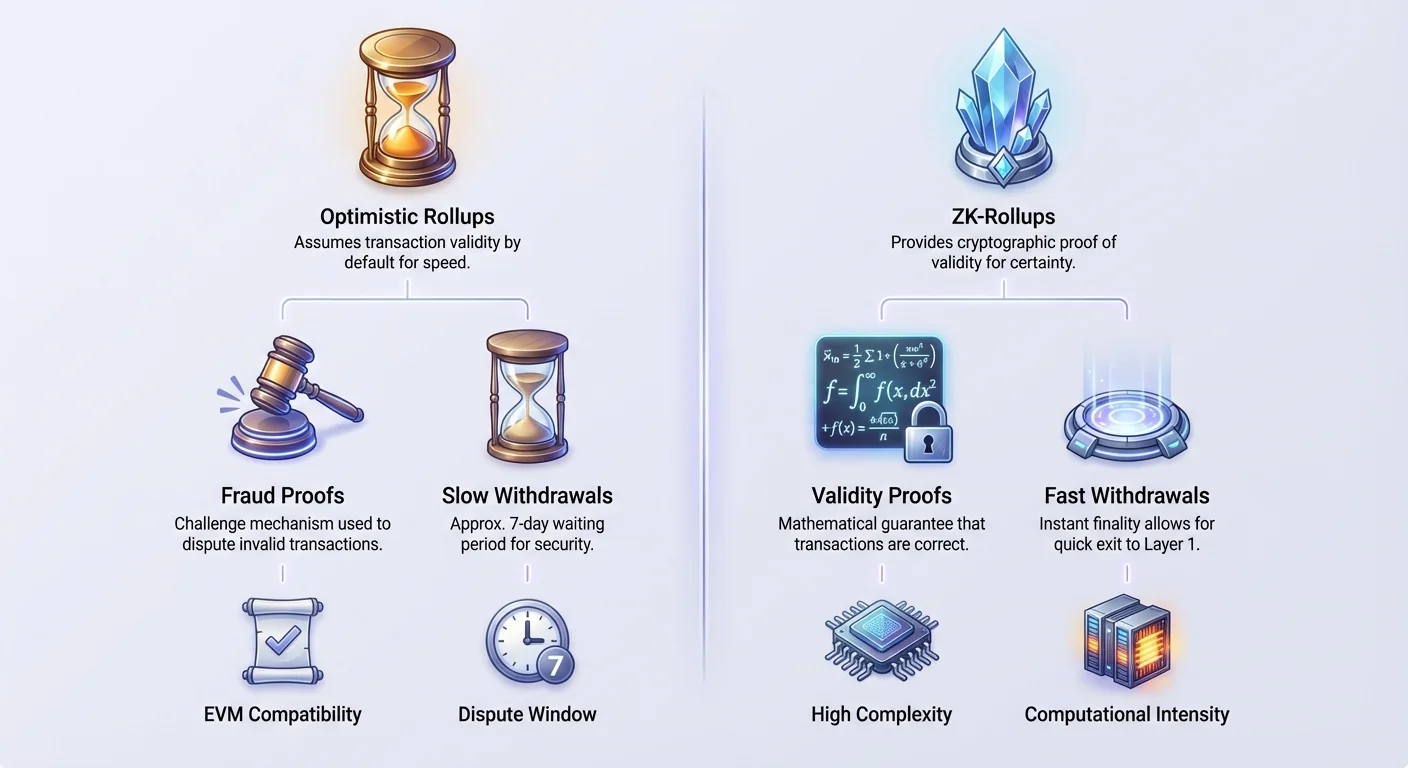
Optimistic Rollups operate on a principle similar to "innocent until proven guilty." When a batch of transactions is submitted to the Ethereum mainnet, the system automatically assumes that the transactions are valid. It does not perform immediate heavy computation to check every signature or state change. This "optimistic" assumption allows for significant improvements in speed and throughput because the overhead of constant verification is removed.
The Fraud Proof Mechanism
To ensure security, Optimistic Rollups utilize a mechanism known as a fraud proof. While the system assumes validity by default, there is a specific window of time after submission known as the challenge period. During this window, which typically lasts around seven days, other participants in the network can dispute the validity of a transaction batch. If someone identifies malicious activity or an invalid calculation, they can submit a proof to the mainnet challenging the batch.
If a challenge is verified as correct, the invalid transaction batch is rolled back. The malicious actor who submitted the bad batch is penalized, often by losing the funds they bonded or "staked" to participate as a validator. This "carrot and stick" approach incentivizes honest behavior. Participants know that if they try to cheat, they will likely be caught and financially punished during the challenge window.
Compatibility and Development
One of the primary advantages of Optimistic Rollups is their complexity level regarding implementation. They rely on standard cryptographic technology that is well-understood in the industry. Because they do not require complex new mathematical proofs for every batch, they are easier to build. More importantly, they offer high compatibility with the Ethereum Virtual Machine (EVM).
This EVM compatibility means that developers can port their existing decentralized applications from Ethereum Layer 1 to an Optimistic Rollup with minimal changes. Smart contracts written for the mainnet generally work seamlessly on these Layer 2s. This has allowed for rapid adoption, as major DeFi protocols and projects can scale their operations without rewriting their codebases.
The Withdrawal Bottleneck
The reliance on a challenge period introduces a significant user experience drawback. Because the network must wait to see if a fraud proof is submitted, moving assets from Layer 2 back to Layer 1 is not instant. Users typically have to wait for the dispute period to end, which can take a week or more. While third-party liquidity providers can offer faster exits for a fee, the native bridge retains this delay to ensure security.
ZK-Rollups: Mathematical Certainty
Zero-Knowledge (ZK) Rollups take the opposite approach. Instead of assuming transactions are valid, they provide explicit proof that they are. Every time a batch of transactions is bundled, the Layer 2 operator generates a cryptographic proof, specifically a Zero-Knowledge Proof (SNARK or STARK). This proof is submitted to the Ethereum mainnet along with the transaction data.
Validity Proofs
The proof serves as a mathematical guarantee that the transactions in the batch were executed correctly according to the rules of the protocol. The Ethereum mainnet verifies this proof. If the proof checks out, the state update is finalized immediately. There is no need to trust the operator or wait for someone to challenge the data. The mathematics ensures that an invalid state transition cannot be generated in the first place.
Instant Finality
Because the validity is verified instantly upon submission to Layer 1, ZK-Rollups do not require a challenge period. Once the batch is accepted, the funds are secure and the state is final. This solves the withdrawal delay problem inherent in Optimistic Rollups. Users can withdraw their funds from Layer 2 to Layer 1 as soon as the proof is verified, without a multi-day waiting period. This offers a superior user experience for transferring assets between layers.
Computational Intensity
The downside of ZK-Rollups is the immense computational power required to generate the validity proofs. Creating a Zero-Knowledge proof is a complex and resource-intensive task. This high computational overhead can limit the throughput of the rollup itself or increase the costs of generating blocks. However, as hardware improves and the underlying cryptographic technology matures, these costs are decreasing.
Technical Complexity
ZK-Rollups rely on newer, more complex cryptographic primitives compared to Optimistic Rollups. Implementing them is significantly more difficult. Furthermore, creating a ZK-Rollup that is fully compatible with the Ethereum Virtual Machine has historically been a major engineering challenge. While progress is being made, general-purpose computation on ZK-Rollups has lagged behind the easy compatibility offered by Optimistic solutions.
Comparing the Trade-offs
Both rollup types offer distinct advantages depending on the needs of the application and the user. They both sit securely on top of Ethereum, deriving their security from the mainnet, but their operational mechanics lead to different strengths and weaknesses.
| Feature | Optimistic Rollups | ZK-Rollups |
|---|---|---|
| Validation Method | Fraud Proofs (Dispute model) | Validity Proofs (Math verification) |
| Withdrawal Time | Slow (approx. 7 days) | Fast (minutes to hours) |
| Complexity | Lower (Standard cryptography) | High (New cryptographic tech) |
Security Considerations
Optimistic Rollups rely on at least one honest actor watching the chain to submit a fraud proof if something goes wrong. In contrast, ZK-Rollups rely on mathematics; the mainnet smart contract simply rejects any batch that lacks a valid proof. While both are considered highly secure compared to sidechains, ZK-Rollups theoretically offer a stronger security guarantee because they do not depend on game-theoretic incentives or active watchers to catch fraud.
Throughput Potential
ZK-Rollups also have an edge in data efficiency. Because the validity proof itself confirms the correctness of the changes, ZK-Rollups technically need to post less data to the main chain than Optimistic Rollups. Optimistic solutions must publish enough data to allow anyone to replay the transaction and verify it during a challenge. This slight difference means ZK-Rollups could theoretically achieve higher throughput in the long run.
The Future Ecosystem
The competition between these technologies is not a zero-sum game. They may coexist for years, serving different niches. However, the consensus among many researchers is that ZK-Rollups represent the long-term future of Ethereum scaling. The immediate benefits of Optimistic Rollups—ease of deployment and EVM compatibility—have allowed them to gain an early lead in adoption. Projects like Polygon have utilized Optimistic technology to provide immediate relief for congestion.
Hybrid Approaches
Interestingly, the lines may blur. Some platforms, like Polygon, have explored integrating ZK technology into their roadmaps despite starting with other frameworks. The ecosystem is likely to see hybrid solutions or a gradual migration where Optimistic implementations upgrade to ZK proofs as the technology becomes more accessible and EVM-compatible.
The Role of Sharding
Both types of rollups will benefit from the future upgrades to Ethereum, specifically sharding. Sharding splits the network into smaller pieces to process more data. For rollups, the primary benefit is increased data availability. Since rollups need to post transaction data to Layer 1, the amount of space available on the mainnet limits them. Sharding will vastly increase the data capacity of Ethereum, allowing rollups to process exponentially more transactions at lower fees.
Developer Adoption
For now, developers choose based on current maturity. DApps requiring full EVM support today often default to Optimistic Rollups. However, as "zkEVM" (EVM-compatible ZK-Rollups) technology matures, the barrier to entry for the validity-proof model will vanish. Once the complexity costs drop, the advantages of instant withdrawals and mathematical security will likely drive a shift toward ZK solutions.
Conclusion
Scaling Ethereum is essential for the network to fulfill its potential as a global financial substrate. Layer 2 solutions have moved beyond theoretical concepts to become vital parts of the infrastructure. Optimistic Rollups currently provide a pragmatic, working solution that alleviates congestion using standard technology and game theory. They offer developers an easy path to scale existing applications, albeit with the trade-off of delayed withdrawals.
ZK-Rollups offer a more technically sophisticated solution that promises instant finality and rigorous security through validity proofs. While they face hurdles regarding computational cost and implementation complexity, they resolve the withdrawal bottlenecks that plague optimistic models. As cryptographic research advances, ZK-Rollups are poised to become the standard for high-performance blockchain scaling.
The choice between them currently depends on the need for immediate compatibility versus long-term efficiency.