
The world of cryptocurrency and blockchain technology promises a future defined by autonomy, transparency, and trustlessness. Yet, achieving this vision requires solving one of the most fundamental challenges in computer science and engineering: the Decentralization Trilemma.
This concept, often credited to Ethereum co-founder Vitalik Buterin, posits that a decentralized ledger system can only effectively achieve two of three core properties—Decentralization, Security, and Scalability—at any given time. Engineers building blockchains are constantly forced to make difficult design choices, sacrificing some degree of one pillar to maximize the efficiency of the other two.
Understanding the Trilemma is not just academic; it is the critical lens through which we analyze every major blockchain project. It explains why some networks are incredibly secure but slow, while others are lightning-fast but rely on fewer participants. This foundational analysis sets the context for all advanced solutions—from consensus mechanism upgrades to complex Layer 2 architectures—by anchoring them in the central conflict of decentralized infrastructure.
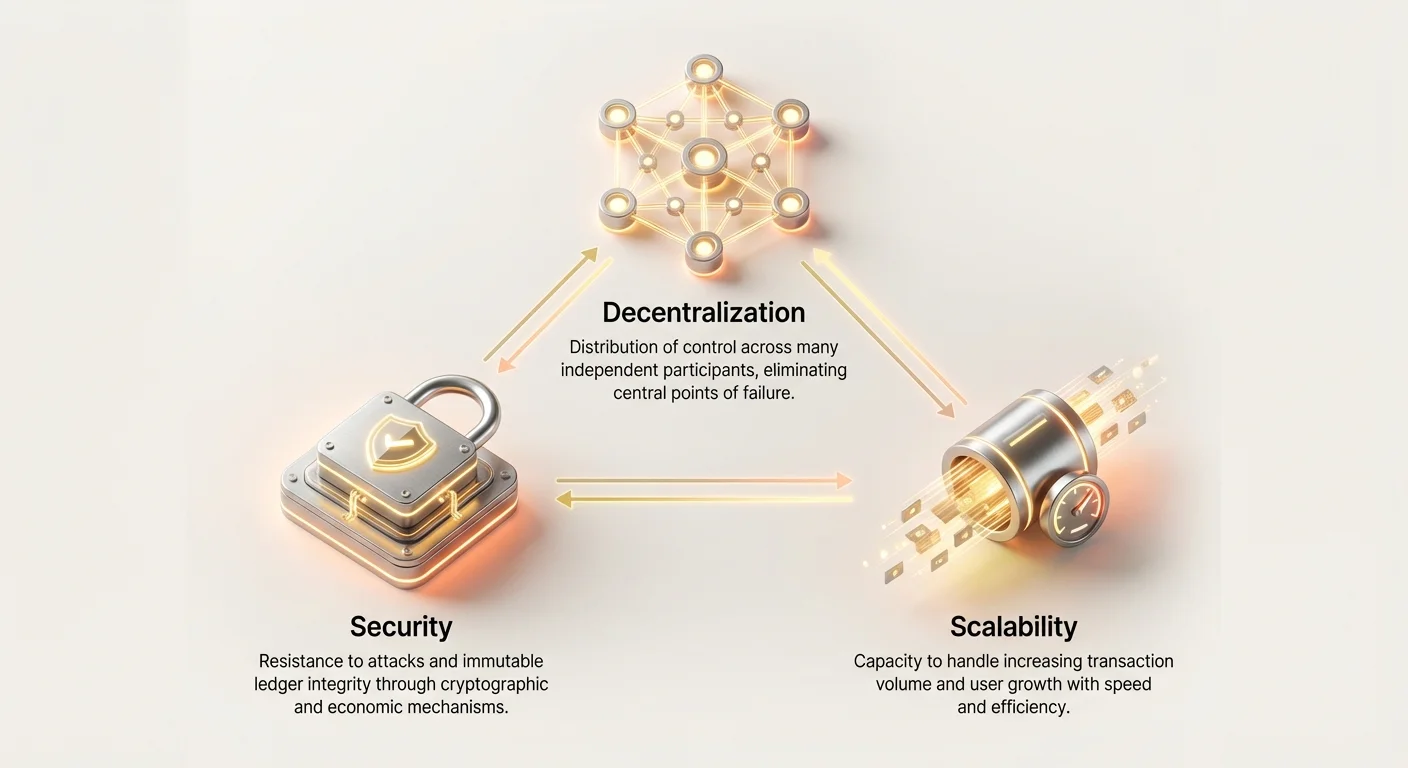
The Three Pillars of Blockchain Engineering
To fully appreciate the tradeoffs, we must first define the three pillars that form the corners of the Trilemma triangle. Each pillar represents an ideal state that crypto projects strive for, but cannot perfectly achieve simultaneously.
Pillar 1: Decentralization—The Heart of Crypto
Decentralization refers to the distribution of power and control away from a single point or small group of intermediaries. It is the defining feature of public blockchains, designed to eliminate the need for banks, governments, or tech giants as central authorities.
Defining Node Count and Distribution
A truly decentralized network is one where thousands of independent computers (nodes) across the globe store a copy of the ledger and validate transactions. The more widespread and varied the participants, the higher the degree of decentralization.
Why it matters: If a network is decentralized, it is censorship-resistant, meaning no single government or malicious actor can shut it down, tamper with history, or unilaterally refuse transactions. High decentralization ensures the network remains permissionless and trustless.
The Cost of Global Verification
Decentralization relies on every participant agreeing on the state of the network. This means every transaction must be propagated, verified, and recorded by every node. While this ensures integrity, it inherently slows down the system. Imagine trying to coordinate a simple meeting time across a thousand people versus across three—the verification process becomes exponentially more complex and time-consuming the more people you involve.
Pillar 2: Security—Protecting the Unstoppable Ledger
Security, in the context of a public blockchain, refers to the network’s ability to defend itself against external attacks and internal collusion, ensuring that once data is written to the ledger, it cannot be altered or reversed.
Attack Vectors and the 51% Problem
The most common theoretical threat to a decentralized public blockchain is the "51% attack." In networks using Proof-of-Work (PoW) or Proof-of-Stake (PoS), if a single entity controls more than half (51%) of the mining power or staked capital, they theoretically gain the power to reverse transactions, censor blocks, or prevent new transactions from being confirmed.
Security measures are designed to make controlling 51% prohibitively expensive or practically impossible.
The Relationship between Stake, Cost, and Security
Security is often directly tied to economic cost.
- For PoW chains (like Bitcoin), security is measured by the sheer amount of energy and hardware required to participate in mining. The high cost of this infrastructure makes a 51% attack economically unfeasible for a rational actor.
- For PoS chains (like Ethereum), security is measured by the total value of cryptocurrency locked up (staked) by validators. If a validator misbehaves or attempts to attack the network, their stake is automatically destroyed (slashed), imposing a heavy financial penalty.
Pillar 3: Scalability—Achieving Real-World Adoption
Scalability is the network's ability to handle a growing number of transactions and users without suffering from high fees, latency, or congestion. In simple terms, it measures how fast and cheap the blockchain is to use.
The Bottleneck: Transactions Per Second (TPS)
The speed of a blockchain is usually measured in Transactions Per Second (TPS). Traditional centralized payment processors (like Visa) handle tens of thousands of TPS, making real-time, global commerce possible. By contrast, early decentralized blockchains, prioritizing security and decentralization, have inherently low throughput:
- Bitcoin: Approximately 7 TPS
- Ethereum (before major upgrades): Approximately 15-30 TPS
This low throughput creates a bottleneck. When demand for block space exceeds capacity, transaction fees skyrocket, and confirmation times slow down, making the network impractical for everyday micro-transactions.
The Necessity of Efficient Data Processing
To achieve scalability, a blockchain must increase the speed at which it processes data (block speed) or increase the amount of data it processes in each block (block size). However, these increases directly impact the other two pillars.
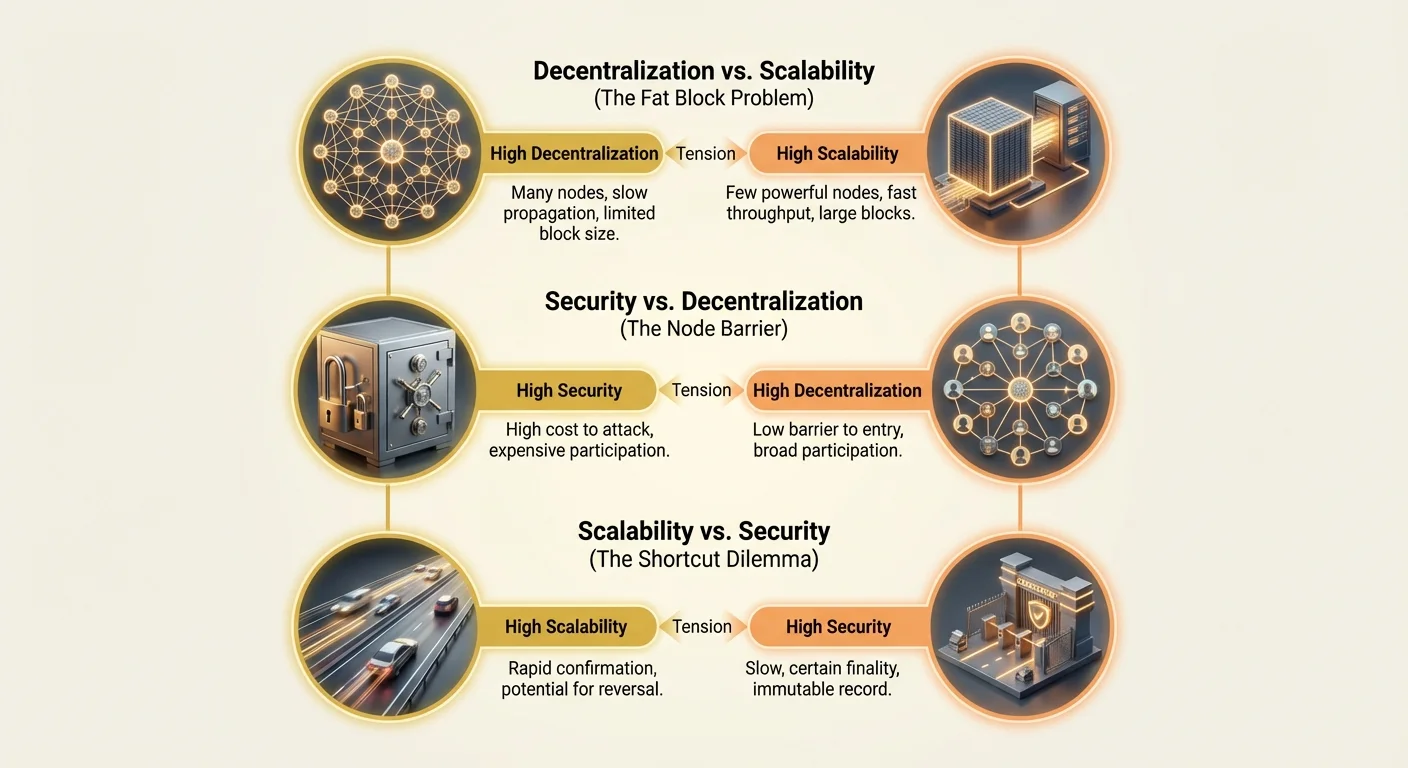
The Tradeoff in Practice: Analyzing the Core Conflicts
The Trilemma manifests as a set of direct conflicts, where optimizing for one pillar invariably diminishes another. This choice dictates the fundamental character and utility of the blockchain.
Conflict 1: Decentralization vs. Scalability (The Fat Block Problem)
This is perhaps the most obvious tradeoff. To make a blockchain faster (more scalable), engineers must find ways to process more data more quickly.
If a network dramatically increases its block size or block frequency (e.g., creating a new block every second instead of every ten minutes):
- Node Cost Increases: Larger blocks require nodes to have faster internet connections, more powerful CPUs, and significantly more hard drive space to store the ledger history.
- Decentralization Suffers: When the hardware requirements to run a full node become too high, only specialized entities (data centers, corporations, or wealthy individuals) can afford to participate.
- Outcome: The network becomes more centralized, as fewer people worldwide can run the verifying software. While fast, the network relies on a smaller, potentially colluding, group of validators, undermining its core trustlessness.
Analogy: Imagine a village trying to store all its financial records. If they only write down one transaction per day (low scale, high decentralization), anyone can easily keep a copy in a small notebook. If they decide to record a million transactions per minute (high scale), only institutions with massive server farms can keep up, centralizing control over the data.
Conflict 2: Security vs. Decentralization (The Node Barrier)
Security requires integrity, which is achieved either through immense economic commitment (PoS) or computational power (PoW). However, if the requirements to maintain security become too stringent, it can deter decentralization.
If a network requires validators to stake an enormous amount of capital (e.g., $10 million worth of crypto) to participate, the security of the network is high because the cost of attack is immense (losing $10 million).
However, by setting the bar for participation so high:
- Validator Pool Shrinks: The network is only run by a small number of extremely wealthy, known entities.
- Risk of Collusion: This smaller pool increases the risk of collusion or regulatory pressure from centralized governments targeting the handful of validators.
- Outcome: High security is achieved, but at the expense of decentralization. The network becomes resistant to external attack, but vulnerable to internal political or economic capture.
Conflict 3: Scalability vs. Security (The Shortcut Dilemma)
Trying to push transactions through too quickly can sometimes compromise the rigorous verification necessary for security.
If a blockchain speeds up block confirmation dramatically without relying on strong cryptographic proofs or economic incentives, it risks:
- Losing Finality: Transactions might be quickly confirmed but could potentially be reversed later, undermining the ledger’s integrity.
- Propagation Issues: Nodes in different parts of the world might receive blocks out of sync, leading to temporary forks or inconsistent states, making the network brittle and easier to attack.
A secure network must be able to withstand simultaneous data propagation worldwide and maintain consistent consensus, which inevitably imposes a speed limit.
Case Studies in Compromise: How Major Blockchains Choose
Every successful blockchain represents a conscious strategic decision about which pillar to emphasize and which to compromise on.
1. Bitcoin and Ethereum (Prioritizing Decentralization and Security)
Both Bitcoin and Ethereum were designed explicitly to maximize decentralization and security, often accepting slow transaction speeds and high fees as a consequence.
Bitcoin: The Immutable Digital Gold
Bitcoin is the classic example of prioritizing security and decentralization above all else. Its block time is ten minutes, resulting in low TPS. However:
- Decentralization: Its relatively small block size (1 MB) and open participation (Proof-of-Work mining) make it possible for nearly anyone to run a full node on consumer-grade hardware, ensuring a robust, globally distributed network.
- Security: The sheer economic cost of attacking Bitcoin’s PoW system is astronomical, making it the most secure ledger ever created.
- Tradeoff: It is not scalable for day-to-day coffee purchases, necessitating the creation of specialized scaling solutions like the Lightning Network (a Layer 2) to handle micro-transactions off-chain.
Ethereum: Evolving the Compromise
Ethereum initially followed the Bitcoin model but, with the transition to Proof-of-Stake (the Merge) and the implementation of sharding, it made a major engineering shift focused on scaling while retaining strong security.
- Security: By requiring validators to stake 32 ETH, Ethereum maintains a very high economic security budget.
- Decentralization: It lowered the hardware requirement for running a node post-Merge, improving accessibility, but participation in staking still requires significant capital, creating a minor centralization pressure point compared to Bitcoin’s open mining pool.
- Tradeoff: Ethereum accepts that the base layer (Layer 1) cannot handle global throughput alone. Instead, its scalability strategy involves building a "data availability" layer that supports a massive ecosystem of specialized Layer 2 solutions (like rollups), which handle the bulk of the transaction load.
2. High-Throughput Chains (Prioritizing Scalability)
Newer generations of blockchains, often referred to as "Layer 1 competitors," frequently prioritize high throughput to compete with centralized financial systems.
Example: Chains Built for Speed
Certain networks achieve thousands of TPS by employing exotic consensus mechanisms that require far fewer, yet far more powerful, validating nodes.
- Scalability: Extremely high TPS and low latency, making them suitable for trading, gaming, and high-frequency applications.
- Decentralization: The requirement for high-end, costly hardware and specific network architectures often restricts the validating pool to large enterprises or specialized data centers.
- Tradeoff: Users gain speed and low cost, but must accept a potentially weaker degree of decentralization, as the network relies on a smaller, more easily identifiable set of operators.
Engineering Solutions: Escaping the Trilemma via Layers
The central purpose of the Trilemma is to show that a single, monolithic blockchain cannot achieve all three goals simultaneously. The industry’s solution has been to redefine the problem, specializing functions across multiple layers.
Layer 2 Solutions and Sharding (The Path to Mass Adoption)
The modern approach to scaling involves offloading the heaviest transaction work to secondary networks (Layer 2s) while relying on the highly secure, decentralized base layer (Layer 1) solely for final data settlement and security guarantees.
- Layer 1 (The Base): Focuses on maximizing Security and Decentralization. Its job is slow but certain consensus and data availability. (E.g., Ethereum, Bitcoin).
- Layer 2 (The Scaler): Focuses on maximizing Scalability. These networks process millions of transactions cheaply and quickly, but periodically post a cryptographic proof of all their activity back to the Layer 1 for final verification.
This specialized approach allows the entire ecosystem to achieve all three goals without compromising the fundamental security of the root ledger. This is the path forward for mass adoption.
The Role of Oracles in Maintaining Integrity
As smart contracts become more complex, they need access to real-world data—like the price of assets, weather conditions, or the outcome of a sports match—to execute specific commands. However, smart contracts live inside the secure, closed environment of the blockchain.
Blockchain Oracles act as the bridge, securely and reliably importing external, off-chain data onto the blockchain.
- Trilemma Context: Oracles are essential for maximizing the functionality (and therefore, the effective scalability) of smart contracts. However, if the oracle itself is centralized, it creates a single point of failure that compromises the entire contract’s Security and Decentralization.
- The Solution: Decentralized Oracles (like those provided by Chainlink) ensure that the data fed to the smart contract is verified by a decentralized network of independent data providers, preserving the core security and decentralization of the system while enabling powerful external functionality.
Conclusion: Tradeoffs as Design Choices
The Decentralization Trilemma is not a flaw in blockchain technology; it is the fundamental constraint of creating a globally distributed, immutable public record that operates without central control. Every design choice a blockchain engineer makes—from selecting a consensus mechanism to setting block size limits—is a conscious decision about how to manage these tradeoffs.
For the novice user, the takeaway is simple:
- If you prioritize safety and autonomy (like storing long-term wealth), you will lean toward chains that prioritize decentralization and security (even if they are slow and expensive).
- If you prioritize speed and low cost (like conducting everyday commerce or high-frequency gaming), you will utilize highly scalable Layer 2 networks, trusting their security is anchored by a robust underlying Layer 1.
By understanding the Trilemma, you gain the vocabulary to analyze blockchain infrastructure not just by what it does, but by the engineering compromises it was built upon. This knowledge is essential for making informed decisions about where to transact, store value, and build the future of decentralized applications.