
Understanding Decentralized Exchange Architecture
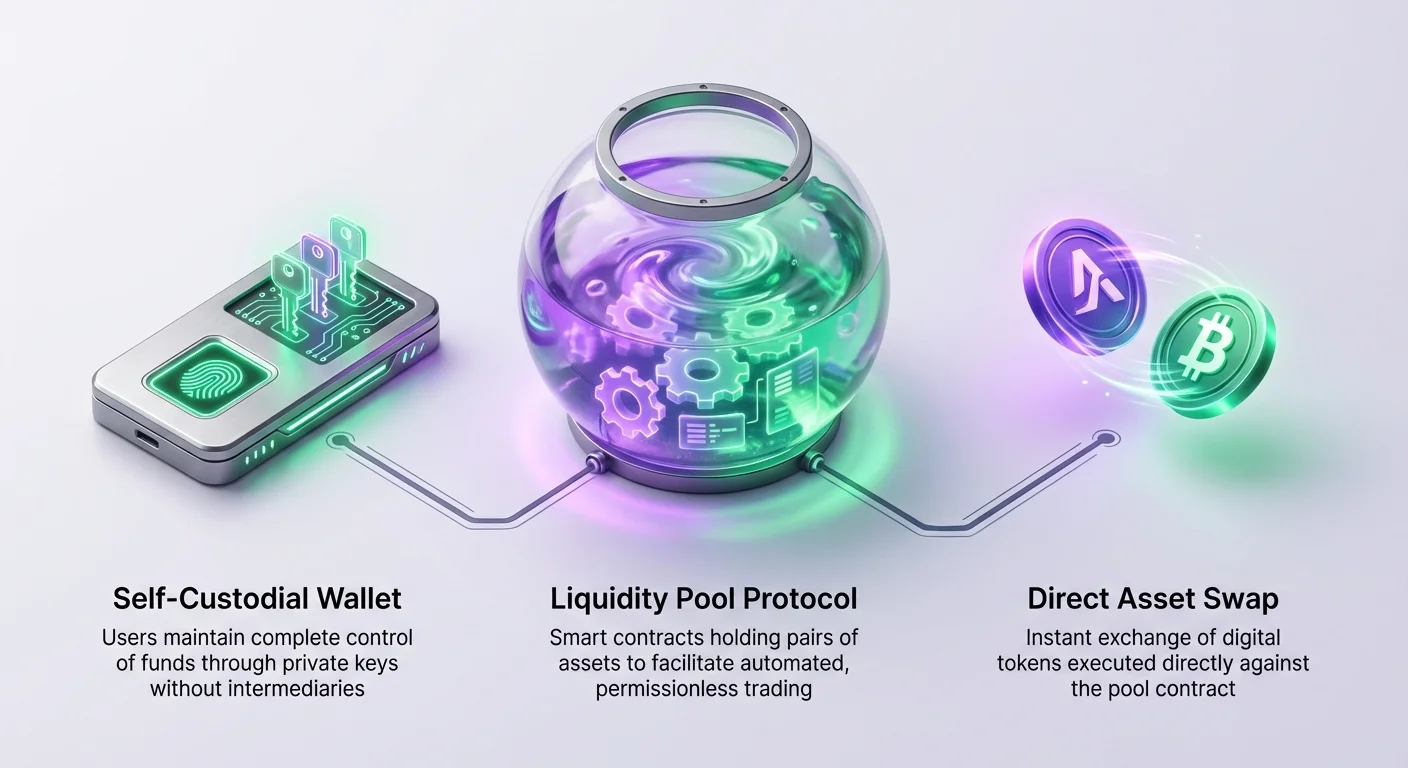
Decentralized exchanges, commonly referred to as DEXs, serve as the foundational infrastructure for the decentralized finance ecosystem. Unlike their centralized counterparts, these platforms operate without a central authority or intermediary managing the order book. They facilitate peer-to-peer transactions directly between users. This structure fundamentally changes how assets are traded, moving away from trusted third parties toward code-based execution.
In a traditional setup, a company holds custody of your funds and matches buy orders with sell orders. A decentralized exchange removes this custodial risk entirely. Users retain full control of their private keys and assets until the exact moment a trade is executed. The exchange protocol acts merely as a mechanism to swap one digital asset for another based on pre-programmed rules. This autonomy is the primary appeal for many users seeking financial independence.
The Shift from Centralized to Peer-to-Peer
The transition from centralized exchanges (CEXs) to decentralized platforms represents a significant shift in market structure. On a CEX, trading relies on an order book where market makers and takers list prices they are willing to accept. The exchange software matches these requests. While efficient, this requires users to deposit funds into a wallet controlled by the exchange, creating a potential point of failure if the exchange faces insolvency or security breaches.
DEXs eliminate this requirement by allowing traders to interact directly with smart contracts. These contracts are self-executing pieces of code located on the blockchain. When a user initiates a trade, they are sending a transaction to a smart contract that verifies the input and returns the output. This permissionless nature means anyone with an internet connection and a compatible wallet can participate. There are no geographic restrictions or identity verification hurdles, commonly known as KYC (Know Your Customer), required to start trading.
The Role of Automated Market Makers
Most modern decentralized exchanges utilize a model known as the Automated Market Maker (AMM). This system replaces the traditional buy and sell order book with liquidity pools. An AMM allows digital assets to be traded in a permissionless and automatic way by using liquidity pools rather than a traditional market of buyers and sellers.
In this model, prices are determined by a mathematical formula rather than just buyer and seller demand at a specific moment. This formula ensures that there is always a price quote available for a trade, regardless of the trade size, provided there is enough liquidity in the pool. Users do not trade against another person directly. Instead, they trade against the liquidity pool itself.
This innovation solves the liquidity problem that early decentralized exchanges faced. By incentivizing users to deposit their idle assets into these pools, AMMs ensure that traders can always execute swaps without waiting for a counterparty to appear. This mechanism is what makes instant, decentralized swapping possible across thousands of different tokens.
Essential Tools for DEX Interaction
Before engaging in any swapping activities, users must set up the necessary digital infrastructure. A decentralized exchange is not an account you log into with a username and password. Instead, it is a web interface that interacts with a digital wallet. The wallet acts as your identity, your bank account, and your transaction signer all in one. Without a properly configured wallet, interaction with these protocols is impossible.
The Importance of Self-Custodial Wallets
To use a DEX, you must possess a digital wallet, often referred to as a Web3 or crypto wallet. The most critical feature of these wallets is self-custody. Self-custody means that you, and only you, possess the private keys or recovery phrases that grant access to the funds. Unlike a custodial wallet on a centralized exchange where the company holds the keys, a self-custodial wallet places the responsibility and control entirely in your hands.
Popular examples include mobile apps or browser extensions that allow you to store, send, and receive digital assets. When you connect this wallet to a DEX, you are granting the site permission to view your balances and request approval for transactions. The site cannot move funds without your explicit digital signature for each action. This security model ensures that even if the DEX interface goes down, your funds remain safe in your wallet on the blockchain.
Native Assets for Network Fees
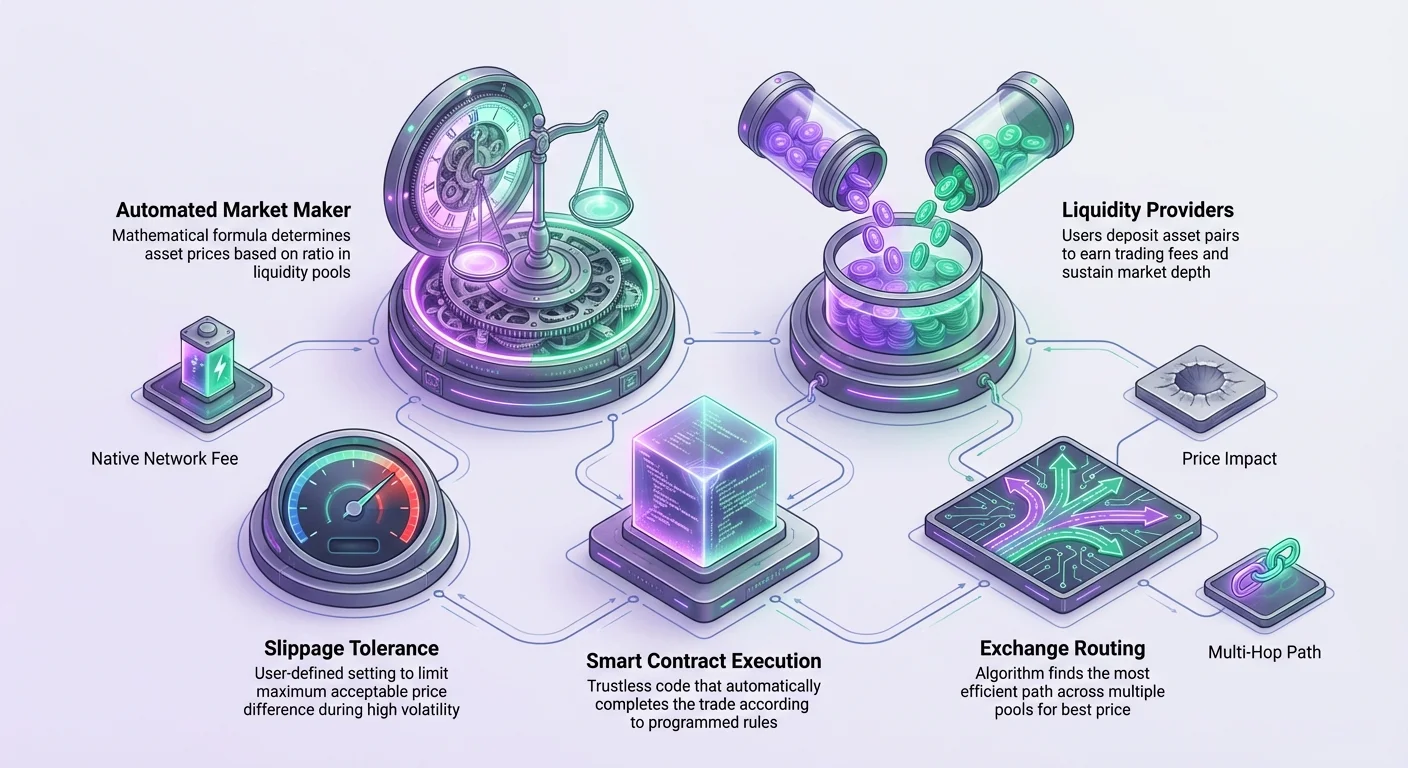
A common hurdle for beginners is understanding the need for native cryptocurrency to pay for transaction fees. Every action that changes the state of a blockchain, such as a swap, requires a fee. These fees are paid to the network validators or miners, not necessarily the DEX itself. Crucially, these fees must be paid in the blockchain's native currency.
For example, if you are trading tokens on the Ethereum network, you must have ETH in your wallet to pay for the gas fees. Even if you are swapping a different token, like USDC for VERSE, you cannot pay the network fee with USDC. You must hold a sufficient balance of ETH. Similarly, if you are on the Polygon network, you need MATIC (or POL), and on Bitcoin Cash, you need BCH. Failing to maintain a balance of the native asset will result in the inability to execute any trades, regardless of how much value you hold in other tokens.
Deep Dive into Liquidity Pools
Liquidity is the lifeblood of any decentralized exchange. Without it, the platform cannot function. In the context of a DEX, liquidity refers to the funds deposited into smart contracts to facilitate trading. These collections of funds are known as liquidity pools. They usually consist of two assets paired together, such as VERSE and WETH.
When a trader initiates a swap, they are putting one asset into the pool and withdrawing the other. The ratio of assets in the pool determines the price. If a pool has deep liquidity, meaning a large amount of both assets, large trades can occur with minimal impact on the price. If the liquidity is low, even small trades can skew the ratio significantly, causing the price to fluctuate wildly.
How Pools Facilitate Trade
Pools operate on the principle of crowdsourcing. Unlike traditional finance where large institutions provide liquidity, DEXs allow anyone to become a liquidity provider (LP). Users deposit an equal value of two tokens into a pool. In return, they receive LP tokens that represent their share of the pool.
These providers are incentivized to lock their assets in the protocol because they earn a portion of the trading fees. For every swap that occurs through that pool, a small percentage is collected and distributed to the liquidity providers proportional to their share. This system creates a sustainable loop: traders get the liquidity they need to swap, and providers earn yield on their holdings. Without these providers, the AMM model would collapse, as there would be no funds available to trade against.
The Relationship Between Depth and Stability
The health of a market is directly correlated to the depth of its liquidity pools. Deep pools act as a buffer against volatility. Imagine a pool with millions of dollars worth of tokens. A trade worth ten thousand dollars will barely shift the ratio of assets, meaning the price remains stable.
Conversely, consider a pool with only twenty thousand dollars of liquidity. A ten thousand dollar trade would remove a massive chunk of the available supply of one asset. This would drastically alter the price for the current trade and subsequent traders. This phenomenon is why looking at liquidity analytics is a vital safety step. A thin pool is a high-risk environment where you are likely to receive a poor exchange rate. Safe swapping requires identifying pairs that have sufficient backing to support your trade size.
| Feature | Deep Liquidity Pool | Shallow Liquidity Pool |
|---|---|---|
| Price Stability | High stability | High volatility |
| Slippage Risk | Low risk | Significant risk |
| Trade Size Capacity | Large trades accepted | Only small trades viable |
Mastering Slippage Control
One of the most critical concepts for safe execution on a decentralized exchange is slippage. Slippage refers to the difference between the expected price of a trade and the price at which the trade is actually executed. This discrepancy occurs because market conditions can change in the split second between when you submit a transaction and when it is confirmed on the blockchain.
Understanding and managing slippage is the primary way a user protects their value during a swap. If you ignore slippage settings, you risk losing a percentage of your trade value to market volatility or predatory bot behavior. Most DEX interfaces provide a settings menu where you can adjust your "Slippage Tolerance." This setting acts as a safety guardrail for your transaction.
Defining Price Slippage
Slippage happens for two main reasons: market volatility and low liquidity. In a fast-moving market, the price of an asset can shift while your transaction is pending in the memory pool waiting for confirmation. If the price moves against you, you receive fewer tokens than estimated.
The second cause is related to the trade size relative to the liquidity pool. As discussed, large trades in small pools shift the price as they execute. The quote you see on the screen is often the price for the very first unit of the token. However, as you buy more, the price increases incrementally for each subsequent unit. The final average price you pay will be higher than the initial spot price. This difference is often categorized as price impact, but it contributes to the overall slippage experience.
Setting the Right Tolerance
Slippage tolerance is a percentage value you set to tell the DEX how much price movement you are willing to accept. For example, if you set a tolerance of 1%, you are telling the smart contract: "If the price changes by more than 1% during this transaction, cancel the trade."
It is generally not advisable to increase your slippage tolerance unnecessarily. A high tolerance, such as 5% or 10%, leaves you vulnerable. Predatory trading bots scan the network for pending transactions with high slippage tolerances. They can execute a "sandwich attack" by buying the asset right before you to drive the price up, forcing your trade to execute at the maximum limit of your tolerance, and then selling immediately after for a profit.
Conversely, setting the tolerance too low can cause transactions to fail. If you set it to 0.1% in a volatile market, the natural price movement may exceed this limit before the block is mined. The transaction will revert to protect you, but you will still lose the network gas fee paid for the attempt. Finding a balance—usually between 0.5% and 1% for standard pairs—is key to safe execution.
Navigation and Execution of Swaps
The actual process of swapping on a DEX follows a specific workflow designed to ensure security and accuracy. The interface typically presents two main fields: the "input" field for the asset you wish to sell and the "output" field for the asset you wish to acquire. The first step is to connect your wallet to the platform. This does not transfer funds; it simply creates a communication link.
Once connected, you select the token you currently hold in the top field. You then select the token you want to receive in the bottom field. It is crucial to double-check that you have selected the correct token, as many tokens have similar names or ticker symbols. Verifying the contract address is a best practice for advanced safety.
After selecting the tokens, you enter the amount you wish to swap. The interface will automatically calculate the estimated amount of the second token you will receive based on the current exchange rate and pool reserves. At this stage, if you are trading a token for the first time, you will likely see an "Approve" button. This is a security permission. You must pay a small gas fee to grant the DEX protocol permission to spend that specific token from your wallet. This is a one-time action per token.
Once the token is approved, the "Swap" button becomes active. Clicking this prompts a confirmation window showing the final details: the exchange rate, the minimum received amount (calculated based on your slippage setting), and the network fee. Review these numbers carefully. Specifically, look at the "Minimum Received" number. This is the worst-case scenario amount you will get. If this number is acceptable, you proceed to confirm the transaction in your wallet app.
Understanding Exchange Routes
A decentralized exchange does not always swap directly between two assets. Sometimes, a direct trading pair for the assets you want does not exist, or the direct pair suffers from low liquidity. To ensure you get the best price, the DEX employs a routing algorithm. This system scans the available liquidity pools to find the most efficient path for your trade.
For example, imagine you want to trade Token A for Token C. If there is no pool for A-C, the exchange might find that there is a deep pool for A-B and another for B-C. The router will automatically execute a multi-hop trade: swapping A for B, and then immediately swapping B for C in a single transaction. This happens in the background, and the user simply sees input A and output C.
Routes can become complex, sometimes involving three or four hops to maximize efficiency. While this ensures the trade is possible, users should be aware that multi-hop trades generally cost slightly more in network gas fees because the smart contract is performing more computations. However, the improved exchange rate from using liquid pools usually outweighs the slight increase in gas costs.
Modern DEX interfaces will display the route being used. It is beneficial to glance at this. If you see a highly complex route for a common pair, it might indicate that liquidity is currently fragmented or low. In some cases, the route might involve a token you are unfamiliar with. This is standard operation for the algorithm, which prioritizes the mathematical best output over simplicity. Understanding that your trade might flow through assets like WETH or USDC before reaching its destination helps demystify the process and confirms that the protocol is working to minimize your price impact.
Analyzing Market Data
To swap safely, one must move beyond the simple swap interface and utilize the analytics provided by the DEX. Most sophisticated decentralized exchanges provide a dashboard or an "Analytics" section. This area offers a transparent view of the protocol's health and the specific metrics of trading pairs. Checking this data before executing a large trade is a hallmark of a professional or cautious trader.
The analytics dashboard aggregates data directly from the blockchain. It visualizes the activity occurring within the smart contracts, allowing users to verify that there is actual activity and volume supporting the tokens they intend to trade. Blindly trading without checking these statistics can lead to entering dead markets where exiting becomes difficult or costly due to high slippage.
Interpreting Volume and Liquidity
Two primary metrics stand out: Volume and Liquidity. Volume represents the total dollar value of trades that have occurred for a specific pair over a set timeframe, usually 24 hours or 7 days. High volume indicates that the pair is active and popular. It suggests that many other users are trading it, which generally implies the price discovery is functioning well. Liquidity, as previously touched upon, is the total value of assets locked in the pool. When analyzing a pair, you want to see a healthy ratio of volume to liquidity. If volume is extremely high but Liquidity is low, volatility will be extreme. Conversely, high liquidity with low volume might indicate a stagnant asset, though it is generally safe to trade. The analytics page usually lists the top pairs. Clicking into a specific pair, such as VERSE-WETH, reveals granular details like fees generated and recent transaction history, helping you confirm the market is behaving normally.
Liquidity, as previously touched upon, is the total value of assets locked in the pool. When analyzing a pair, you want to see a healthy ratio of volume to liquidity. If volume is extremely high but liquidity is low, volatility will be extreme. Conversely, high liquidity with low volume might indicate a stagnant asset, though it is generally safe to trade. The analytics page usually lists the top pairs. Clicking into a specific pair, such as VERSE-WETH, reveals granular details like fees generated and recent transaction history, helping you confirm the market is behaving normally.
Identifying Healthy Trading Pairs
A healthy trading pair exhibits consistent volume and deep liquidity. When looking at the analytics charts, you should look for stability or steady growth in liquidity. Sudden drops in liquidity can be a warning sign that liquidity providers are pulling their funds, which could precede a price crash or a "rug pull" in the case of newer, unverified tokens.
Furthermore, the analytics section allows you to see the reserve breakdown. You can verify exactly how much of Token A and Token B are in the pool. This transparency is unique to DeFi. In a centralized exchange, you have to trust the reported numbers. In a DEX, the analytics are reading the on-chain truth. If you are trading a volatile asset, checking the analytics to ensure there is enough liquidity to absorb your trade size without causing double-digit percentage price impact is a necessary safety precaution.
Fee Structures and Incentives
Every swap on a decentralized exchange incurs fees, and understanding where this money goes helps clarify the incentives of the ecosystem. There are typically two distinct types of fees involved in a single transaction: the network fee and the exchange fee.
The network fee, often called gas, is paid to the blockchain miners or validators. This fee varies based on network congestion and the complexity of the transaction. It does not go to the DEX or the liquidity providers. It is the cost of using the blockchain infrastructure.
The exchange fee is specific to the DEX protocol. For instance, a platform might charge 0.3% of the trade volume. This fee is deducted from the tokens being swapped. This revenue is split. A majority portion, often around 83% of the fee, is typically distributed directly to the liquidity providers. This is the reward that encourages them to park their capital in the pools. The remaining portion usually goes to the protocol's treasury or governance mechanisms.
By paying this fee, you are effectively paying for the service of instant liquidity. It is important to view this not just as a cost, but as the mechanism that sustains the decentralized marketplace. Without this fee, there would be no incentive for providers, and thus no liquidity for your trades.
Conclusion
Decentralized exchanges represent a powerful evolution in financial technology, offering users true ownership and permissionless access to markets. By utilizing liquidity pools and automated market makers, these platforms remove the need for trusted intermediaries, allowing for peer-to-peer value transfer on a global scale. However, this freedom comes with the responsibility of understanding the mechanics of the system, from self-custodial wallets to the intricacies of transaction routing.
Safety in this environment is derived from knowledge. Mastering concepts like slippage tolerance ensures that you protect your assets from volatility and predatory actors. Utilizing analytics tools to verify liquidity depth prevents the frustration of failed trades or poor exchange rates. Recognizing that you are interacting directly with smart contracts emphasizes the need for double-checking inputs and understanding the fee structures that power the underlying protocol.
Ultimately, safe swapping is a deliberate process. It involves more than just clicking a button; it requires an assessment of market conditions, a verification of asset contracts, and a correct configuration of wallet and interface settings. As the DeFi landscape continues to mature, the ability to navigate these platforms competently will remain a fundamental skill for any crypto participant.
Always verify liquidity depth and set appropriate slippage tolerance before confirming any decentralized transaction.