
The world of cryptocurrency, specifically Bitcoin, often feels shrouded in intimidating jargon, complex code, and high financial barriers. You hear terms like "blockchain," "decentralization," and "mining," which can make starting your educational journey feel overwhelming.
This guide cuts through the complexity. We aim to provide a simple, non-technical definition of Bitcoin, focusing on its utility and core components. Crucially, we will tackle the biggest misconception that prevents most newcomers from taking the first step: the perceived high cost. By introducing the Satoshi (or "sat") scale immediately, we will redefine Bitcoin's affordability and show you how to start building your stake today, regardless of how much you have to invest.
Think of this page as your friendly entry point to the digital economy. We are breaking down the fundamentals of what Bitcoin is, how it’s measured, and how you access it, setting the stage for self-sovereignty.
What Exactly *Is* Bitcoin? The Simple Definition
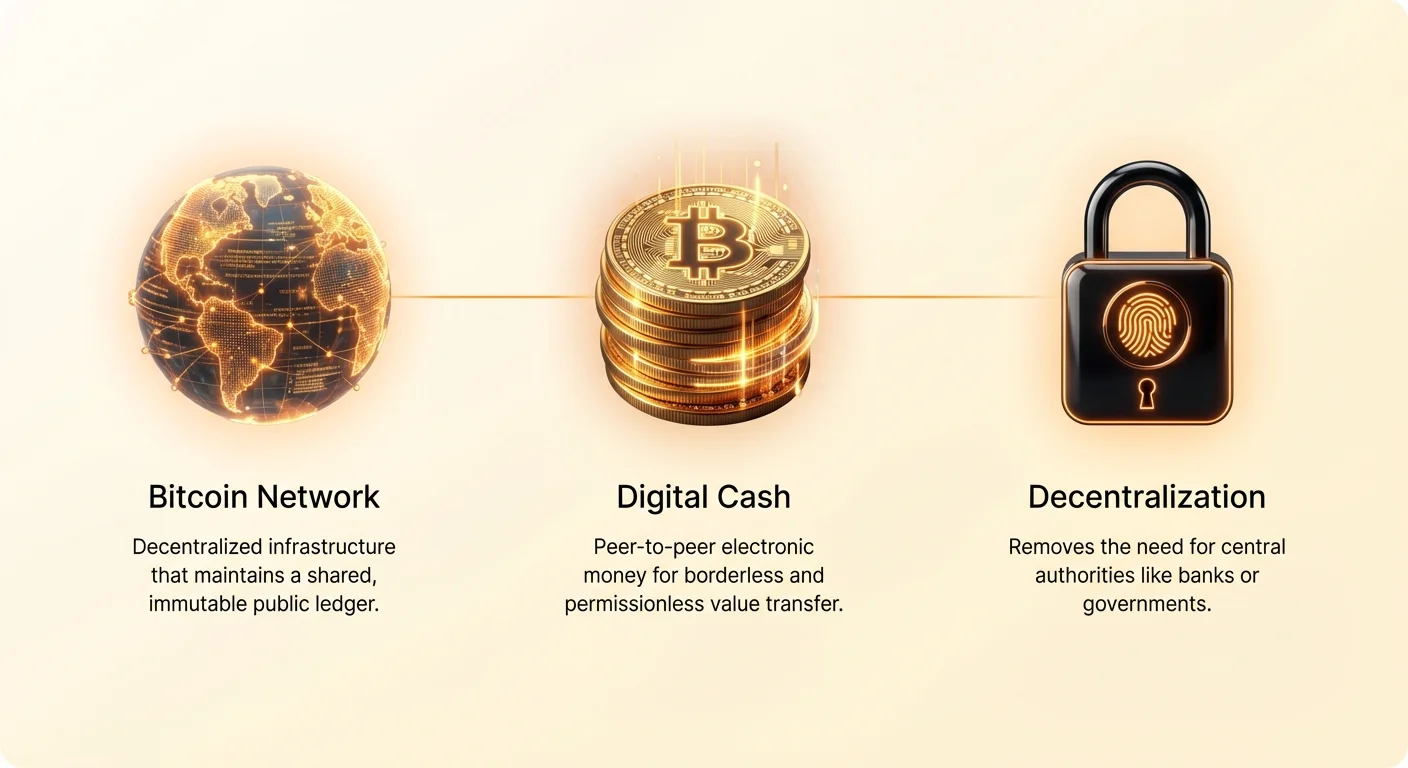
At its core, Bitcoin is simply a form of digital money designed to work without central control, like a bank or government. It is a peer-to-peer electronic cash system. To understand its revolutionary nature, you must understand that "Bitcoin" is actually two things: the currency (the BTC token) and the network (the technological infrastructure).
Bitcoin as Digital Cash (The Use Case)
Imagine cash in your pocket. It’s physical, fungible (meaning one dollar is the same as any other dollar), and you can exchange it directly with another person without needing a third party like a bank to approve the transaction.
Bitcoin is designed to replicate these qualities digitally, but with a few crucial upgrades:
- It’s Borderless: You can send value across the world just as easily as sending an email.
- It’s Permissionless: No bank can block you from sending or receiving funds.
- It’s Scarce: Unlike traditional currencies, which governments can print infinitely, the total supply of Bitcoin is capped at 21 million units.
Bitcoin as a Decentralized Ledger (The Technology)
If Bitcoin is digital cash, how do we know who owns what without a central bank tracking balances? This is where the network aspect—the underlying technology known as the blockchain—comes in.
Think of the Bitcoin network as a giant, public, shared Excel spreadsheet that millions of computers around the world constantly maintain and verify. This ledger contains a record of every transaction ever made.
- Decentralized: No single person or entity controls this spreadsheet. If one computer goes down, millions of others still hold the record.
- Immutable (Permanent): Once a transaction is added to the ledger (the "block"), it cannot be changed or deleted. This permanence is what creates trust in the system.
How Bitcoin Solves the "Double-Spend" Problem (Trustlessness)
Historically, digital money had one major flaw: the "double-spend problem." If I have a digital file (money), what stops me from sending a copy of that file to two different people simultaneously?
Traditional banking solved this by having a central authority (the bank) track balances and reject the second transaction. Bitcoin solved the double-spend problem using cryptography and the decentralized network. The global network constantly verifies that when you send BTC, the original amount is simultaneously removed from your available balance, making it mathematically impossible to spend the same unit twice. This system allows for trustless exchange—you don’t need to trust the other party or a bank; you only need to trust the mathematics and the open-source code.
The Biggest Misconception: Bitcoin is Too Expensive
When newcomers first look at Bitcoin, they often see a price tag in the tens of thousands of dollars. This immediately leads to the conclusion: "I can't afford Bitcoin." This is perhaps the most significant barrier to entry, but it is based on a fundamental misunderstanding of the unit of account.
Why the Price Tag is Deceptive
If you want to buy gold, you don't have to buy an entire 400-ounce bar. You can buy one ounce, a gram, or even a tiny fraction of a gram. Bitcoin works the exact same way.
The price you see quoted on exchanges—say, $70,000—is the price for one whole Bitcoin (1 BTC). However, Bitcoin is highly divisible, far more divisible than any traditional currency. Because the market always quotes the price of a whole BTC, beginners are tricked into thinking they need to purchase the entire unit. You absolutely do not.
The Solution: Meet the Satoshi (The Smallest Unit)
The key to understanding Bitcoin affordability is recognizing its smallest denomination: the Satoshi, or simply "sat."
The Satoshi is named after the pseudonymous creator of Bitcoin, Satoshi Nakamoto. It serves the same function for Bitcoin that a penny serves for the U.S. Dollar, but on a vastly larger scale.
1 Whole Bitcoin (1 BTC) is divisible into 100,000,000 Satoshis.
This means that you can buy and own a tiny fraction of a Bitcoin, down to one hundred-millionth of a single coin. When you buy $50 worth of Bitcoin, you are purchasing thousands, or even hundreds of thousands, of Satoshis, depending on the current price.
The Sat Scale: Thinking in Smaller Units
Adopting the "sat scale" is more than just a mathematical exercise; it’s a necessary mental shift for successful, stress-free investing in Bitcoin. It transforms Bitcoin from an abstract, high-priced asset into an accessible savings technology.
Breaking Down the Math: 1 BTC = 100,000,000 Sats
Understanding the relationship between the whole unit (BTC) and the micro-unit (sats) is critical for tracking your investments. Bitcoin transactions are actually calculated in Satoshis on the network.
Here is the simple breakdown:
| Unit | Decimal Equivalent (of 1 BTC) | Number of Satoshis |
|---|---|---|
| 1 BTC | 1.0 | 100,000,000 |
| 0.1 BTC | 0.1 | 10,000,000 |
| 0.01 BTC | 0.01 | 1,000,000 |
| 0.001 BTC | 0.001 | 100,000 |
| 0.00001 BTC | 0.00001 | 1,000 |
| 0.00000001 BTC | 0.00000001 | 1 Sat |
When you decide to purchase $25 of Bitcoin, you are not chasing the price of the whole coin; you are acquiring a specific quantity of Satoshis.
Practical Mental Modeling (The "Penny" Analogy)
To make sats tangible, adopt this analogy:
- The Dollar Analogy: If the U.S. Dollar were divisible by 100 million, the highest bill would be a $100 Million Bill (1 BTC), and the smallest unit you could transact with would be a "millipenny" (1 Sat).
- The Investment Mindset: Instead of focusing on owning "one Bitcoin" (which feels unattainable), focus on accumulating a target number of Satoshis (e.g., "I want to save 5 million sats this year").
This reframing is essential for using the DCA (Dollar-Cost Averaging) investment strategy, where you regularly buy small amounts of sats over time, minimizing the stress of short-term price fluctuations. When you think in sats, volatility becomes less intimidating; you simply know you acquired a certain number of digital savings units that day.
Why Buying Sats Makes Sense for Beginners
- Affordability: You can start with $1 or $10. There is no minimum investment beyond what the exchange requires.
- Goal Setting: Setting goals in sats (e.g., reaching 1 million sats) is far more motivating and measurable than trying to achieve 1.0 BTC.
- Future-Proofing: Many experts believe that as the price of Bitcoin continues to appreciate over decades, the primary unit of account used in daily transactions may eventually shift from BTC to sats. Thinking in sats now prepares you for that future.
Actionable Tip: When you buy Bitcoin on an exchange, switch the display setting (if available) from BTC to Sats. This reinforces the mental model that you are accumulating thousands of units, not just tiny fractions of a whole coin.
Accessing Your Bitcoin: A Brief Look at Wallets
Once you understand what Bitcoin is and how it’s measured in Satoshis, the next natural question is: How do I hold and access my money? The answer is through a Bitcoin Wallet.
A Bitcoin wallet is not a physical place where your BTC is stored. Remember, Bitcoin lives permanently on the global, decentralized ledger (the blockchain). Your wallet is simply the tool that holds the necessary cryptographic keys allowing you to prove ownership and authorize transactions.
What is a Wallet Address? (The Public Key)
When you set up a Bitcoin wallet, the first thing you generate is your public key, or wallet address.
- Analogy: This is your public bank account number or email address.
- Function: This is the address you give to someone when you want to receive Bitcoin (sats). It is public and safe to share. It allows others to see your balance on the public ledger, but they cannot spend your money.
The Key to Your Wealth: Private Keys (The Secret)
The most critical component of your wallet is the private key.
- Analogy: This is your PIN, bank login password, and authorization signature all rolled into one.
- Function: The private key is a highly sensitive piece of data (usually represented by a 12- or 24-word "seed phrase") that mathematically proves you own the Satoshis associated with your public address. If someone gains access to your private key, they can steal all your funds. If you lose your private key, your funds are permanently locked away.
In Bitcoin, you are your own bank, which means you are solely responsible for protecting your private key.
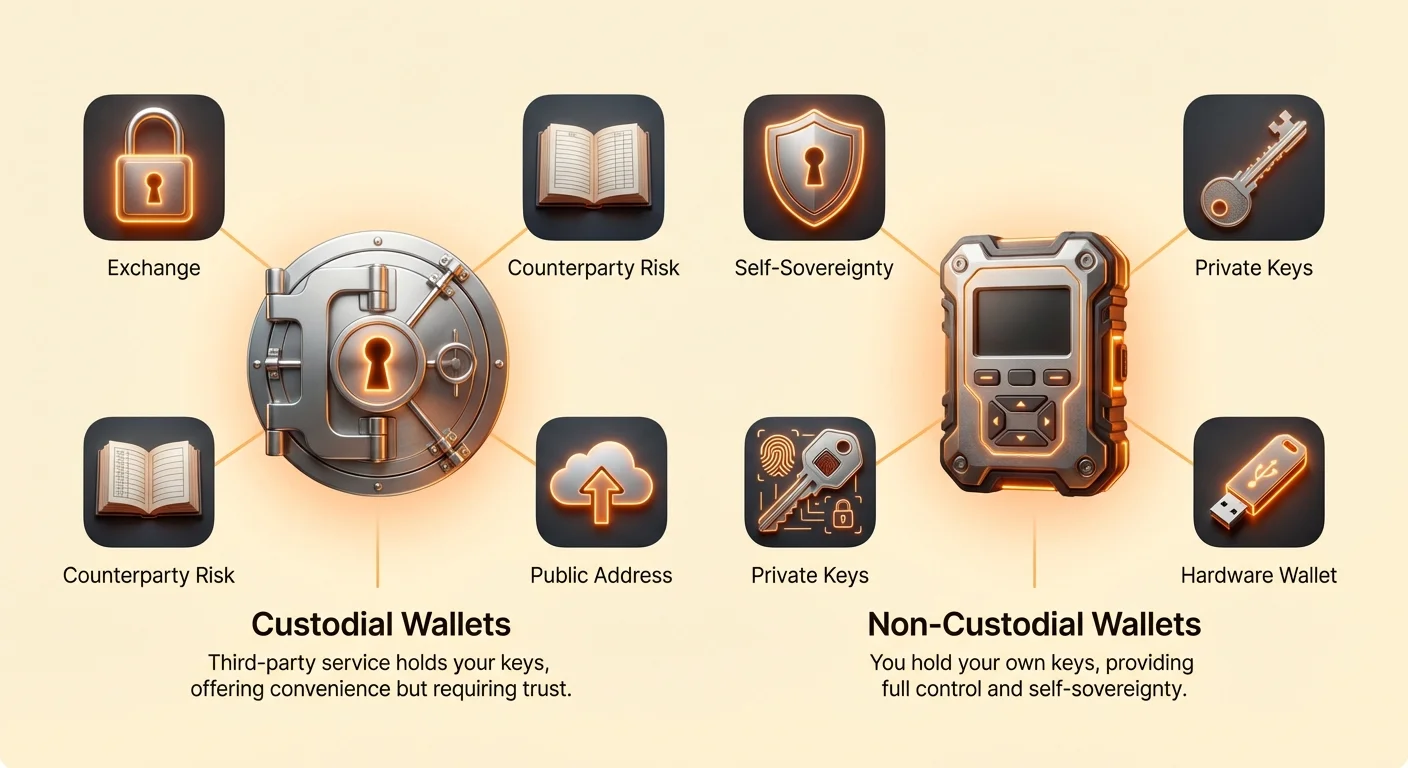
Custodial vs. Non-Custodial Wallets
Choosing a wallet is one of the first major decisions a newcomer makes, and it boils down to where the private key is stored.
| Wallet Type | Who Holds the Private Key? | Best For | Risk/Benefit |
|---|---|---|---|
| Custodial | A third-party service (e.g., a major exchange). | Absolute beginners; small testing amounts. | Benefit: If you forget your password, the exchange can recover access. Risk: You must trust the third party not to be hacked or freeze your assets. (Not self-sovereign.) |
| Non-Custodial | Only you hold the key (on a personal device or hardware). | Anyone seeking true financial freedom and control. | Benefit: You have 100% control and ownership; no third party can freeze your funds. Risk: If you lose the keys, your funds are gone forever. (Requires security discipline.) |
The choice between these two types directly impacts your level of self-sovereignty. While custodial wallets offer convenience, moving toward a non-custodial wallet is the necessary step for truly embracing the ethos of Bitcoin. (We explore the spectrum of custody risks in detail in the next guide.)
Conclusion: Starting Your Journey in Sats
Bitcoin is a revolutionary financial technology—a decentralized, transparent, and scarce digital currency underpinned by a permanent ledger.
The biggest takeaway for any beginner should be this: Bitcoin is not too expensive. By recognizing the Satoshi scale, you realize you can participate in this new financial system immediately, turning small, regular savings into long-term self-sovereignty.
Your next steps involve moving from theory to practice: setting up your first wallet (non-custodial wallets are highly recommended for security and control) and learning how to efficiently purchase and acquire your first batches of Satoshis. The journey to understanding Bitcoin starts now, one sat at a time.