
The Evolution of Yield in Decentralized Finance
Decentralized exchanges have fundamentally altered how financial markets operate by removing the need for a centralized intermediary. In traditional finance, banks and large institutions provide the capital necessary for markets to function. They earn the fees associated with facilitating trade, keeping the profits for themselves. The decentralized finance landscape flips this model by allowing individual users to step into the role of the bank. By depositing digital assets into a smart contract, anyone can facilitate trading and earn a portion of the fees generated by the platform. Web3 vs. Traditional Finance
This democratization of market making has introduced new terminology and complex mechanisms for earning returns. Concepts like yield farming and liquidity provision offer opportunities to generate passive income on crypto holdings. However, the metrics used to calculate these returns can often be misleading for newcomers. Understanding the true nature of these earnings requires looking beyond the headline numbers.
Investors must distinguish between simple interest and compound growth. They must also differentiate between yield derived from actual trading volume and yield derived from inflationary token rewards. Navigating this environment requires a firm grasp of the underlying mechanics that power decentralized exchanges.
The Foundation of Market Liquidity
Liquidity is arguably the most critical measurement of health for any market, whether in traditional stocks or cryptocurrencies. In the context of a decentralized exchange, liquidity refers to how easily two assets can be exchanged without causing dramatic shifts in the price of either asset. When a market has deep liquidity, large trades can occur with minimal impact on the current market price.
Low liquidity creates a volatile and inefficient environment. If a trading pair lacks sufficient funds, a single relatively small transaction can significantly skew the price. This phenomenon is known as slippage. Slippage occurs when the expected price of a trade differs from the price at which the trade is actually executed. High slippage makes a market practically unusable for traders, as they lose value on every swap they perform. Liquidity and Slippage Mastery
To prevent this, decentralized exchanges must incentivize users to deposit their assets. Without a steady supply of liquidity, the exchange cannot function smoothly. This necessity drives the economic model of the platform. The exchange gives a share of the trading fees to the people who add liquidity, effectively paying them rent for the use of their assets.
The Structure of Liquidity Pools
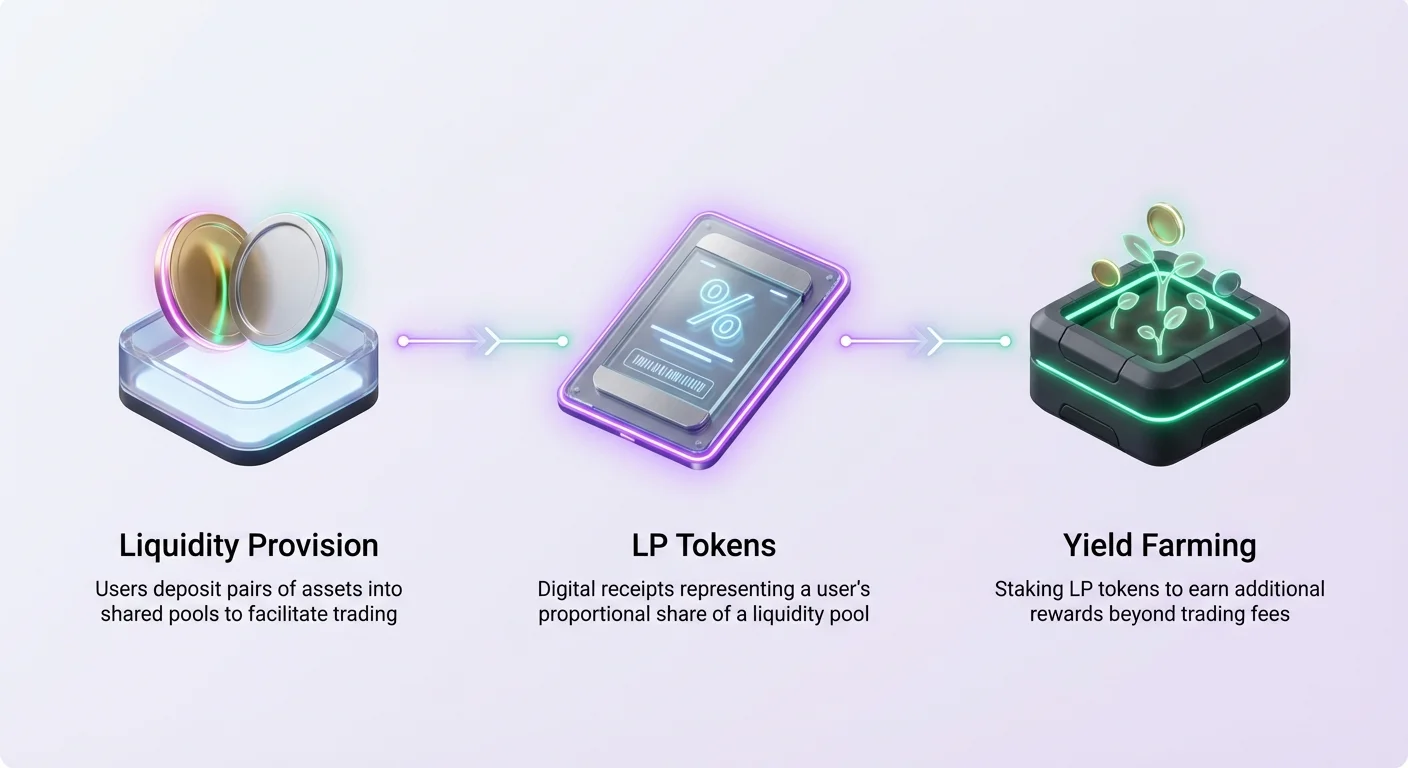
Every trading pair on a decentralized exchange has its own dedicated reservoir of funds. These are technically referred to as liquidity pools. For instance, a trading pair between VERSE and Ethereum (WETH) is supported by a specific pool containing both assets. The technical details of these pools are governed by smart contracts, which are self-executing code on the blockchain.
Most liquidity pools represent trading pairs that require a balanced ratio of assets. To deposit into a pool, a user must generally provide an equal value of two different cryptoassets. If the market price dictates that one unit of Ethereum is worth 1,600 units of USDC, the liquidity provider must deposit them in that exact ratio. This ensures the pool remains balanced relative to the wider market price at the moment of deposit.
The requirement for equal value deposits is a fundamental check within the smart contract. It prevents the pool from starting with a skewed price. Once the funds are deposited, they become available for other users to trade against. The liquidity provider is no longer holding the specific tokens in their wallet; they have contributed them to the communal pot.
Liquidity Provider Tokens Explained
When a user deposits funds into a liquidity pool, the smart contract needs a way to track that contribution. It mints and sends a specific digital asset to the user's wallet. This is known as a liquidity pool token, or LP token. This token acts as a receipt of ownership. It represents the user's proportional share of the total liquidity in that specific pool.
LP tokens are essential for realizing rewards. They are the keys that allow a user to withdraw their deposited cryptoassets at a later date. If the user decides to exit the position, they trade the LP token back to the smart contract. In return, the contract releases the user's share of the underlying assets, plus any fees that have accrued during the holding period.
It is important to note that the ratio of the returned cryptoassets might differ from the ratio originally deposited. As traders swap back and forth against the pool, the balance of the two assets changes. The LP token guarantees a claim on a percentage of the pool's total value, not a guaranteed return of the specific number of coins deposited.
The Mechanics of Yield Farming
While providing liquidity generates revenue through trading fees, decentralized exchanges often introduce a second layer of incentives. This practice is known as yield farming. Yield farming allows users to earn additional rewards by staking their LP tokens into a separate smart contract known as a farm. This process effectively pays the user twice: once from trading fees and again from farming rewards.
Farms are designed to attract deep liquidity to the exchange. By offering extra incentives, the protocol encourages users to keep their capital on the platform for longer periods. This stability is vital for the long-term health of the exchange. Deep liquidity attracts more traders, which generates more volume, which in turn generates more fees for the liquidity providers.
Sources of Farming Rewards
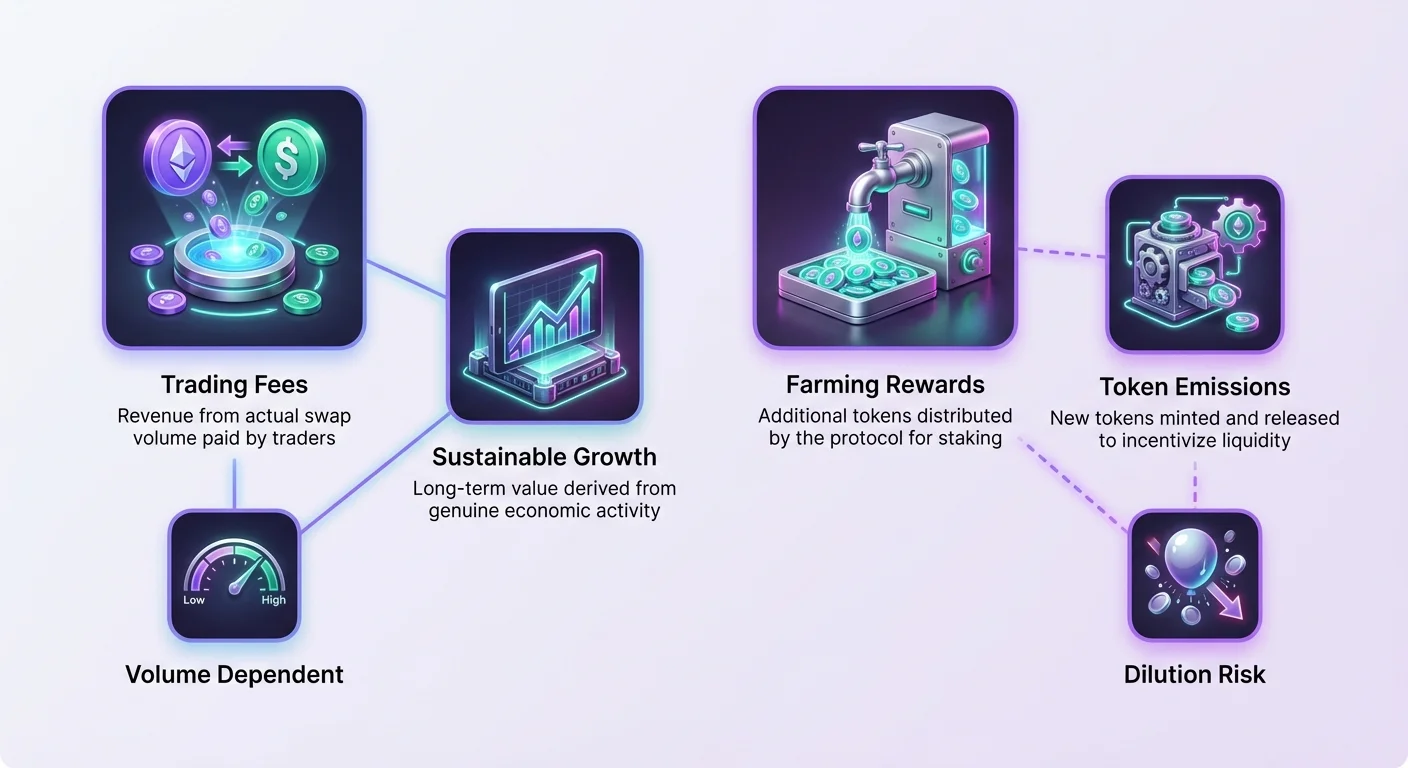
Farming rewards differ from trading fees. Trading fees come directly from the volume of swaps occurring on the platform. In contrast, farming rewards usually come from the exchange's own treasury or token supply. The operators of the exchange allocate a portion of the native token supply to be distributed to farmers over a set period.
In many cases, these rewards are paid in the native token of the decentralized exchange. For example, a platform might allocate 35% of its total token supply to incentives. These tokens are released linearly, often on a block-by-block basis, to users who have deposited their LP tokens in the farm. This creates a continuous stream of income for the farmer, regardless of whether trading volume is high or low on that specific day.
The distribution period is set by the exchange operators. It might be set at one-week intervals or longer durations. The goal is to distribute the governance or utility token of the protocol to a wide network of users. This incentivizes community growth and helps bootstrap the network activity in its early stages.
Calculating Reward Distribution
Farm rewards are allocated based on a user's specific share of the farm. If a user owns 1% of the LP tokens deposited in the farm, they are entitled to 1% of the rewards distributed during that block. The calculation is dynamic and updates constantly as other users enter or exit the farm.
If a farm has very few deposits, the rewards are split among fewer people. This results in a higher yield for the early participants. As more capital flows into the farm, the same amount of rewards is diluted across a larger number of participants. This naturally lowers the return rate for everyone involved.
This dynamic creates a self-balancing mechanism. High rewards attract capital, which dilutes the rewards, which eventually stabilizes the inflow of new capital. Smart contracts manage this distribution automatically. They ensure that rewards are paid out precisely according to the time the LP tokens were held in the farm.
Deconstructing APY versus APR
When analyzing returns in DeFi, two acronyms appear frequently: APR and APY. While they are often used interchangeably in casual conversation, they represent distinct mathematical concepts. Understanding the difference is crucial for accurately projecting potential earnings from a farming strategy.
APR stands for Annual Percentage Rate. It typically refers to the simple interest earned over a year. In the context of yield farming, APR usually represents the raw emission rate of rewards if no reinvestment occurs. If a farm pays out 10% APR, and you deposit $1,000, you would earn $100 worth of tokens over the course of a year, assuming the rate and token price stay constant.
APY stands for Annual Percentage Yield. This metric includes the effects of compound interest. Compounding occurs when the interest earned is reinvested into the principal to earn even more interest. In DeFi, this means taking the tokens earned from farming, converting them back into liquidity, and redepositing them into the farm. Yield Generation & Staking Strategies
| Metric | Interest Type | Reinvestment | Result |
|---|---|---|---|
| APR | Simple | None | Linear growth |
| APY | Compound | Periodic | Exponential growth |
The Impact of Compounding Frequency
The difference between APR and APY becomes more pronounced based on how frequently the compounding occurs. If rewards are claimed and reinvested daily, the APY will be significantly higher than the APR. If rewards are never reinvested, the user is effectively earning the APR rate, regardless of what the APY headline might claim.
Most decentralized exchanges display yield as APY to show the maximum potential return. However, this assumes the user is actively managing their position. If the process is manual, the user must pay transaction fees (gas) every time they claim and reinvest. High gas fees can eat into profits, making frequent compounding inefficient for smaller positions.
Some platforms offer auto-compounding features, but standard farming often requires manual intervention. Users should verify whether the displayed rate is a projection based on daily compounding or a raw simple interest rate. Misunderstanding this distinction can lead to disappointment when actual returns do not match the exponential projections.
Projecting Future Yields
Yield projections in DeFi are inherently unstable. A displayed APY of 80% is a snapshot of the current moment. It assumes that the current price of the reward token remains the same and that the amount of liquidity in the pool remains constant for an entire year. Neither of these variables is static in the crypto market.
If the price of the reward token drops, the real value of the yield drops, even if the token emission rate remains the same. Conversely, if the token price rises, the effective yield increases. Furthermore, if the farm becomes popular and total deposits double, the yield for each individual participant is cut in half.
Therefore, APY should be viewed as an estimation rather than a promise. It is a model that relies on distribution periods and current participation levels. The actual realized yield will fluctuate week to week based on market conditions and community behavior.
The Sustainability of Real Yield
In the rush to attract users, some decentralized exchanges offer astronomical APY figures, sometimes exceeding 1000%. While these numbers are eye-catching, they are rarely sustainable. High yields are generally paid out by printing new tokens at a rapid pace. This inflates the supply of the token.
If the supply increases too quickly without a corresponding increase in demand, the price of the token will collapse. This leads to a situation where a user might earn a 1000% yield in terms of token count, but the value of those tokens drops by 99%. The net result is a loss in dollar value.
This dynamic attracts what is known as mercenary liquidity. Mercenary providers are participants who deposit funds solely to capture the high initial rewards. They sell the reward tokens immediately, putting downward pressure on the price. Once the rewards dry up or the yield decreases, they withdraw their liquidity and move to the next platform.
Identifying Real Yield
Sustainable yield farming programs focus on value-adding growth rather than short-term hype. "Real yield" is often defined as revenue derived from actual economic activity—specifically, trading fees—rather than just token emissions. Decoding Farm Tokenomics
When a liquidity provider earns a share of the 0.25% exchange fee, they are earning a portion of the volume moving through the platform. If the pool processes $100,000 in volume, $250 is collected in fees. This is real revenue paid by traders for a service. It does not rely on the inflation of a governance token.
| Yield Source | Mechanism | Sustainability |
|---|---|---|
| Trading Fees | % of Volume | High (Activity based) |
| Farm Rewards | Token Inflation | Low (Dilution based) |
The Balance of Incentives
A healthy decentralized exchange balances these two sources. It uses farming incentives to bootstrap liquidity in the early stages or for specific strategic pairs. The goal is to reach a level of liquidity where the trading experience is smooth enough to attract organic volume. Once organic volume is high, the trading fees alone should be sufficient to retain liquidity providers.
Programs that allocate rewards linearly over long periods, such as seven years, are generally more sustainable. This slow release prevents a flood of new tokens from hitting the market all at once. It aligns the incentives of the liquidity providers with the long-term success of the protocol.
Investors should look for platforms that have a clear plan for transitioning from high farming rewards to sustainable fee-based revenue. The most robust returns come from pools that generate consistent trading volume, ensuring a steady stream of fee income regardless of the reward token's price action.
Calculating Your Farming Position
To accurately estimate earnings, a user must understand their specific contribution relative to the total pool. The math is straightforward but dynamic. Returns are calculated based on the user's proportional share of the total liquidity.
If you are the only liquidity provider in a pool, you earn 100% of the fees generated. If the pool does $100,000 in daily volume and the fee is 0.25%, you earn $250. However, being the sole provider is rare and risky. In a more realistic scenario, you might provide 1% of the liquidity. In that same $100,000 volume scenario, your share of the fees would be $2.50.
This creates a direct relationship between pool size and individual yield. A smaller pool offers a larger slice of the pie, but it might attract less volume because of high slippage. A massive pool attracts more volume, but the user's slice of the fees is microscopic. The sweet spot for a yield farmer is often a pool with moderate liquidity but high trading activity.
Tracking Performance
Most decentralized exchanges provide analytics pages to help users track these metrics. A "Pools" tab will typically display the total liquidity, the 24-hour volume, and the recent earnings. Third-party DeFi tools can also be used to monitor LP positions across different platforms.
It is important to remember that fees are typically added to the liquidity pool rather than paid out directly to the wallet. This means the value of the LP token increases over time. When the user withdraws their liquidity, they receive more cryptoassets than they deposited, representing their principal plus the accrued fees.
Farming rewards, on the other hand, usually accumulate in a separate contract. They must be manually claimed. Some platforms allow users to claim these rewards without withdrawing the underlying liquidity. Others might require an interaction with the farm contract to harvest the yield.
Risks and Considerations
Yield farming is not without risk. Beyond the smart contract risks inherent in using any decentralized application, financial risks must be considered. The most prominent is the concept of divergence loss, often called impermanent loss.
This occurs when the price of the deposited assets changes compared to when they were deposited. Because the pool automatically rebalances to maintain equal value, a user might end up with more of the token that is dropping in value and less of the token that is rising. In some cases, simply holding the assets in a wallet would have been more profitable than providing liquidity. Understanding Impermanent Loss
Furthermore, smart contract bugs can pose a threat. It is vital to use reputable decentralized exchanges that have been audited by third-party security firms. Audits do not guarantee safety, but they indicate that the code has been reviewed for common vulnerabilities.
Lockup Periods
Some farming strategies enforce lockup periods, preventing users from withdrawing their funds for a set amount of time. This is done to stabilize the liquidity, but it reduces flexibility. If the market crashes during a lockup, the user cannot exit the position to cut losses.
Other platforms, specifically explicitly mentioned in the source material like Verse DEX, do not have lockup periods. Users can withdraw their LP tokens at any time. They remain entitled to their share of rewards for the exact duration their tokens were deposited. This flexibility allows users to react to market changes instantly, though it also makes the pool's total liquidity more volatile.
Practical Steps for Liquidity Provision
Participating in liquidity provision and yield farming requires a specific set of tools. The barrier to entry is technical rather than financial, as anyone with a compatible wallet can participate.
The Necessity of Self-Custody
To interact with a DEX, a user needs a self-custodial digital wallet. Unlike an account on a centralized exchange where the company holds the keys, a self-custodial wallet gives the user full control. The user is the only one with access to the funds. This is a requirement for interacting with smart contracts directly. Setting up your secure self-custody wallet
The wallet serves as the passport to the decentralized web. It holds the cryptocurrency needed for the deposit and the native coin required to pay for transaction fees. For example, interacting with an Ethereum-based DEX requires holding ETH to pay for gas.
Acquiring the Assets
Before farming, the user must acquire the necessary assets. Since liquidity pools usually require a pair of assets, the user must hold both in their wallet. If a user wants to farm in a VERSE-ETH pool but only holds ETH, they must first swap half of their ETH for VERSE.
Once the assets are acquired, the user navigates to the liquidity section of the DEX. They deposit the pair and approve the transaction in their wallet. This action mints the LP tokens.
Finalizing the Farm
The final step is to take those LP tokens and deposit them into the farm tab of the exchange. This is often a separate transaction. Merely holding the LP tokens is not enough to earn farming rewards; they must be staked in the farm contract. Once staked, the dashboard will begin updating to show the accrued rewards in real-time.
Conclusion
Navigating the world of DeFi yield farming requires a shift in mindset from passive saving to active participation. By understanding the difference between APY and APR, investors can better evaluate the true potential of an opportunity. Recognizing that APY implies compounding allows for more realistic planning regarding reinvestment strategies and gas costs.
Furthermore, distinguishing between real yield derived from trading fees and incentive yield derived from token emissions is critical for long-term success. While high token emissions can offer lucrative short-term gains, they often carry higher risks of volatility. Sustainable wealth generation in decentralized finance typically comes from providing liquidity to pools with genuine trading volume and utility.
Ultimately, the power of decentralized exchanges lies in their permissionless nature. They offer tools that allow anyone to become a market maker. By carefully selecting pools, monitoring positions, and understanding the underlying mechanics of smart contracts, users can effectively harness these platforms to generate yield on their digital assets.
Real yield comes from protocol revenue and patience, while unsustainable hype chases high numbers that rarely last.