
Decentralized exchanges have fundamentally altered how digital assets are traded and managed. Unlike centralized counterparts that rely on intermediaries, these platforms enable permissionless exchange through code and community participation. The core engine driving this system is liquidity. Without a steady flow of assets provided by users, decentralized markets cannot function efficiently.
For investors and crypto enthusiasts, this opens a pathway to earn yield by participating directly in the market's infrastructure. By understanding the mechanics of liquidity provision and yield farming, users can construct a framework for managing digital assets. This approach requires careful attention to timing, operational costs, and the underlying efficiency of the specific blockchain network being used.
The Foundation of Decentralized Trading
At the heart of a decentralized exchange (DEX) lies the concept of the liquidity pool. A pool is essentially a smart contract that holds funds for a specific trading pair. While traditional markets use order books to match buyers and sellers, DEXs use these pools to facilitate automated swaps.
Anyone can contribute to these pools. There are no gatekeepers or approval processes. A user simply deposits assets into the smart contract to strengthen the trading pair. In return for locking their assets in the protocol, liquidity providers earn a portion of the trading fees generated by the platform.
For example, if a user contributes to a pool, they might earn a share of the 0.25% fee charged on every trade. This fee is distributed proportionally among all providers in that specific pool. If a pool generates substantial trading volume, the fees collected can represent a significant return on the deposited assets.
Understanding Liquidity Depth
Liquidity is the most critical metric for the health of any market. It measures how easily an asset can be converted into another asset without causing a drastic shift in price. Deep liquidity implies that large transactions can occur with minimal price impact.
When liquidity is low, the market becomes inefficient. A single trade can skew the price significantly, making the pair volatile and unreliable. This creates a poor experience for traders and discourages volume.
DEXs solve this by incentivizing deep liquidity through fee sharing. The more assets are deposited into a pool, the more stable the price becomes. This stability attracts more traders, which in turn generates more fees for the liquidity providers, creating a positive feedback loop.
The Impact of Slippage
One of the primary consequences of low liquidity is slippage. Slippage occurs when the price at which a trade is executed differs from the expected price at the time the transaction was submitted. In a pool with shallow liquidity, a medium-sized buy order might push the price up significantly before the order is fully filled.
High slippage makes a market practically unusable for serious trading. Traders lose value on every swap, eroding their capital. Therefore, DEXs prioritize maintaining healthy liquidity levels to minimize slippage and ensure accurate pricing for all participants.
Constructing the Position
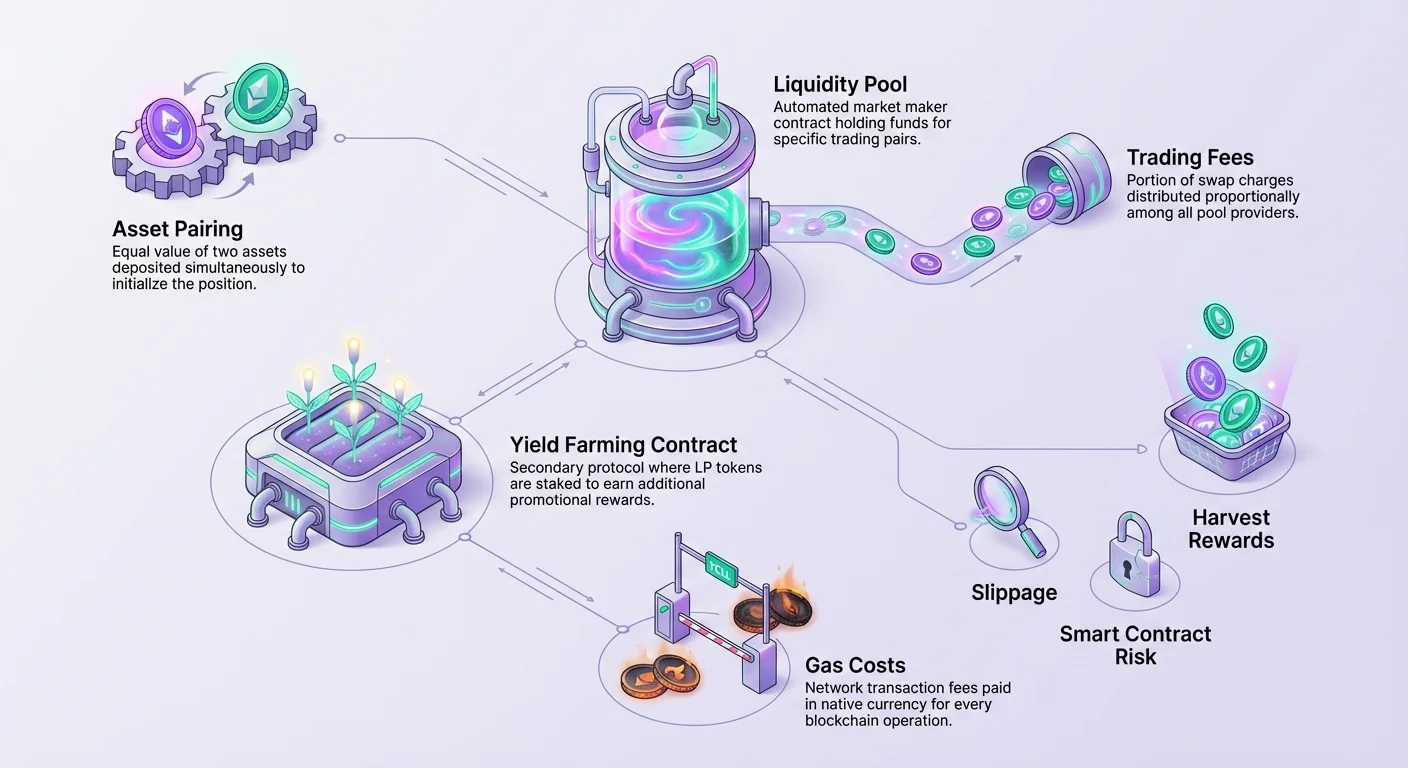
Providing liquidity is not as simple as sending a single token to a contract. Most liquidity pools represent trading pairs, requiring the provider to deposit an equal value of both assets. This 50/50 value ratio is a fundamental requirement of the Automated Market Maker (AMM) model used by most DEXs.
For instance, if a user wishes to provide liquidity for an Ethereum and USDC pair, they cannot simply deposit Ethereum. They must calculate the dollar value of their Ethereum and deposit an equivalent dollar value of USDC simultaneously.
Self-Custody Essentials
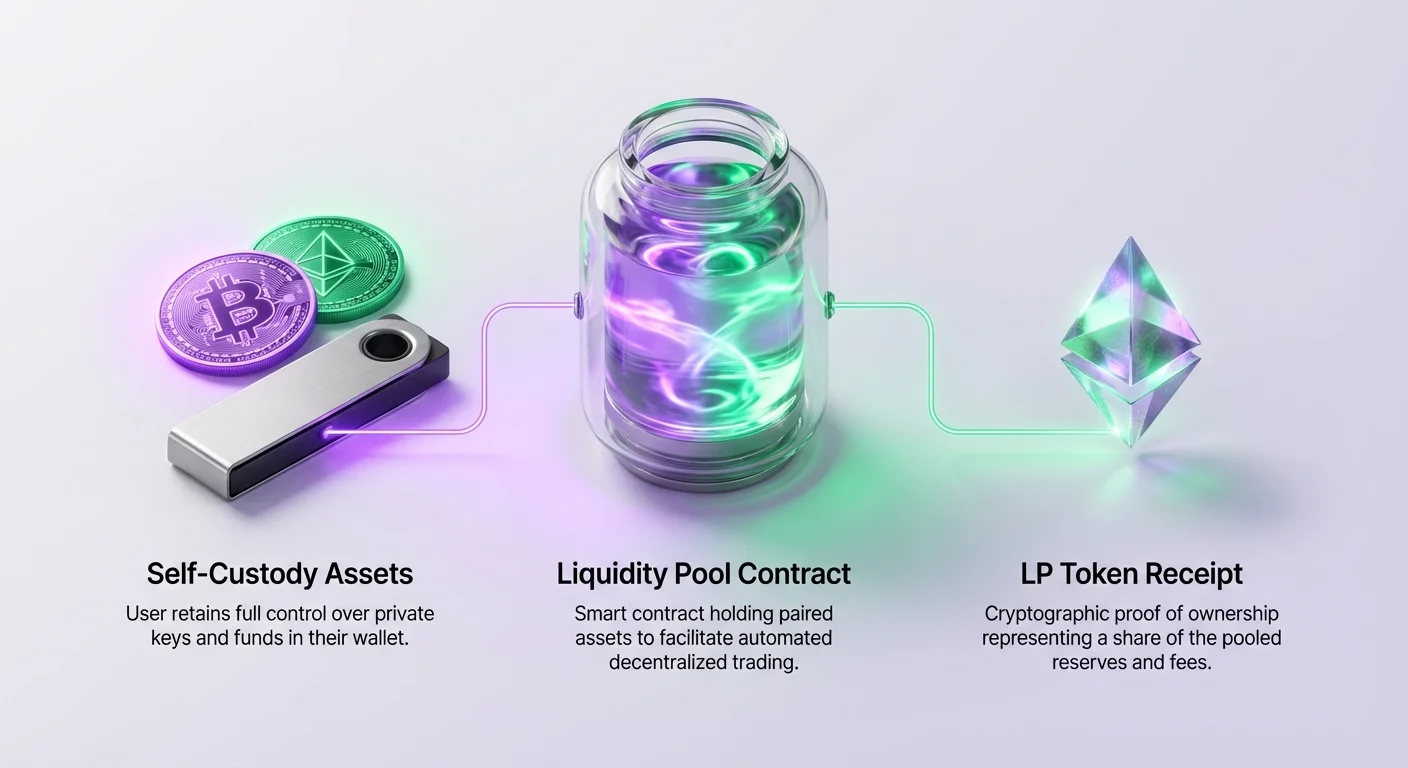
Before interacting with any liquidity protocol, a user must possess a digital wallet. The most secure and functional option for this activity is a self-custodial wallet. Self-custody ensures that the user retains full control over the private keys and the assets within the wallet.
Custodial wallets, where a third party manages the funds, often do not support direct interaction with decentralized applications (DApps). A self-custodial web3 wallet acts as the passport to the decentralized finance (DeFi) ecosystem. It allows the user to approve transactions, sign contracts, and manage their positions without an intermediary.
Asset Pairing Mechanics
The requirement for equal value deposits means users must hold both assets in their wallet before initializing the position. This often involves swapping one asset for another to achieve the correct ratio.
The valuation is determined by the current market price on the DEX. If 1 ETH is valued at 2,000 USDC, a user depositing 1 ETH must also deposit 2,000 USDC. The smart contract validates this ratio before accepting the transaction.
Once the deposit is made, the assets are transferred from the user's wallet to the liquidity pool contract. The user no longer holds the individual tokens in their wallet. Instead, they hold a claim on a portion of the pool's total reserves.
The Liquidity Pool Token
When assets are deposited into a pool, the DEX protocol issues a receipt to the user. This receipt is known as a Liquidity Pool (LP) token. It is a cryptographic token that represents the user's specific share of the total liquidity in that pool.
LP tokens are crucial for tracking the value of a position. They are used to calculate the user's share of the accumulated trading fees. When a user decides to exit the position, they must return the LP tokens to the smart contract. The contract then burns the LP tokens and releases the underlying assets plus any earned fees back to the user's wallet.
The ratio of assets returned may differ from the ratio originally deposited. This is due to price fluctuations and trading activity within the pool. The LP token ensures that the user can always withdraw their proportional share of the current pool reserves, whatever that ratio may be.
| Component | Function | Description |
|---|---|---|
| Smart Contract | Custody | Holds the pooled assets securely |
| LP Token | Receipt | Proves ownership of the deposit |
| Trading Fee | Incentive | Rewards paid to providers (e.g., 0.25%) |
Yield Farming Framework
While earning trading fees is the primary incentive for providing liquidity, many DEXs offer an additional layer of rewards known as yield farming. Yield farming allows liquidity providers to put their LP tokens to work to earn extra yield, usually paid in the platform's native token.
This process involves a secondary step. After providing liquidity and receiving LP tokens, the user deposits these LP tokens into a specific "Farm" contract. This effectively stakes the LP tokens, locking them in exchange for a structured reward.
The Farming Mechanism
Farming creates a tiered reward structure. The user earns trading fees from the liquidity pool simply by holding the LP tokens. By depositing those tokens into a farm, they earn promotional rewards on top of the trading fees.
The farm acts as an incentive alignment tool. It encourages users to keep their liquidity in the pool for longer periods. As long as the LP tokens are staked in the farm, the user accumulates rewards based on an Annual Percentage Yield (APY) set by the protocol.
Source of Rewards
Farming rewards typically come from the project's treasury or reserved token supply. For example, a portion of a token's total supply might be allocated specifically for ecosystem incentives. These tokens are released linearly over time, often on a block-by-block basis.
This distribution method ensures a steady flow of rewards to participants. The rate of distribution and the total allocation determine the APY. If the price of the reward token rises, the APY increases. If the price falls, the value of the rewards decreases.
Timing and Sustainability
The profitability of a liquidity strategy heavily depends on timing and the sustainability of the yields offered. Not all farming opportunities are created equal. Some protocols offer astronomically high APYs to attract attention, but these are often short-lived and risky.
High APYs can attract "mercenary liquidity." these are providers who enter a pool solely to capture the high rewards and then immediately sell the tokens and withdraw their liquidity. This behavior can cause the token price to collapse and leave the DEX with no liquidity.
Distribution Periods
Smart contracts often define distribution periods for rewards. These can be set at various intervals, such as weekly or monthly. The projected APY assumes that the current level of participation remains constant throughout the period.
If participation is low, the rewards are split among fewer users, resulting in a higher yield for each individual. If more users enter the farm, the same amount of rewards is diluted across a larger capital base, lowering the APY. Monitoring these fluctuations is key to timing entry and exit.
Analyzing Reward Volatility
Sustainable farming programs focus on long-term value rather than short-term spikes. For instance, a program might distribute tokens over several years to ensure longevity.
Users should evaluate the source of the yield. Rewards paid from a fixed supply that is distributed carefully over time are generally more sustainable than rewards printed recklessly to inflate APY numbers. A sustainable opening APY, such as 80%, is designed to bootstrap liquidity without destroying the token's value through hyperinflation.
Efficiency and Cross-Chain Logistics
Efficiency in liquidity provision is often dictated by transaction costs. Every action on a blockchain requires a fee, known as a gas fee, paid in the network's native currency. For Ethereum, this is ETH; for other chains, it is their respective coin.
These fees act as a tax on the user's operations. Providing liquidity involves multiple transactions: approving the token spend, the deposit transaction itself, and potentially staking the LP token in a farm. Each step incurs a cost.
Transaction Fee Management
To maintain efficiency, users must ensure that the value of the rewards earned exceeds the cost of gas fees. On high-cost networks, frequent transactions can erode profits entirely.
Users must hold a sufficient amount of the native currency in their wallet to cover these fees. Running out of ETH on the Ethereum network, for example, will leave a user unable to withdraw their funds or claim rewards, regardless of how profitable the position is.
Multichain Opportunities
Modern DEXs often operate across multiple blockchains. This allows users to engage in cross-chain trading and liquidity provision. A user might trade or provide liquidity for Bitcoin, Bitcoin Cash, and Ethereum assets within the same interface.
Cross-chain efficiency involves selecting the network that offers the best balance of security, volume, and transaction costs. While Ethereum might offer deep liquidity and high volume, other chains might offer significantly lower fees, making smaller positions more viable.
| Factor | Impact | Consideration |
|---|---|---|
| Gas Fees | Operational Cost | High fees reduce net yield |
| Native Token | Utility | Required for all transactions |
| Network | Speed/Cost | Choose based on capital size |
Managing the Lifecycle
Once a position is open and farming rewards are accumulating, the user must manage the lifecycle of the investment. This involves decisions on when to claim rewards and when to rebalance or withdraw liquidity.
Some protocols impose lockup periods where funds cannot be withdrawn for a set time. However, flexible frameworks allow users to withdraw their funds at any time. This liquidity is essential for reacting to market changes.
Harvesting Rewards
Rewards accumulate in real-time or block-by-block. Users can monitor their earnings through the DEX interface or third-party DeFi tools. Claiming rewards is a transaction that incurs a gas fee.
Therefore, it is rarely efficient to claim rewards daily or hourly. Users should time their claims to ensure the accumulated value is significantly higher than the transaction fee. Some farms allow users to claim rewards without unstaking their LP tokens, enabling continuous compound interest if the user chooses to reinvest the rewards.
Withdrawing Liquidity
To exit a position completely, the process is reversed. First, the user withdraws the LP tokens from the farm. This action claims any pending rewards automatically in many protocols.
Next, the user returns the LP tokens to the liquidity pool smart contract. The contract burns the tokens and sends the underlying crypto assets back to the user's wallet. The amount returned will include the user's share of the trading fees collected during the period.
Risk Management Factors
Providing liquidity carries specific risks that must be factored into any framework. The primary technical risk lies in the smart contracts themselves. If the code contains a vulnerability, it can be exploited. Using reputable DEXs that have undergone third-party security audits helps mitigate this danger.
Another risk is the divergence of asset prices. Since the pool maintains a specific ratio, significant price movements can result in the user holding more of the depreciating asset and less of the appreciating asset compared to simply holding them in a wallet.
Slippage and Market Health
Users should also consider the health of the market they are entering. Low liquidity pairs are prone to high slippage. While this doesn't directly hurt the liquidity provider, it discourages trading volume.
Without trading volume, there are no fees to earn. Therefore, providers should look for pools with active trading volume to ensure a steady stream of fee income. A stagnant pool with no volume generates zero yield from fees, regardless of the APY displayed for farming rewards.
The Role of Volume
Volume is the engine of fee revenue. A pool with $100,000 in liquidity that processes $100,000 in daily volume generates far more fees than a pool with $1 million in liquidity doing $10,000 in daily volume.
In the first scenario, the fees are distributed among a smaller pool of capital, resulting in a higher yield percentage for each provider. Users should analyze the volume-to-liquidity ratio when selecting where to deploy capital.
Conclusion
Establishing a liquidity rebalancing framework requires a blend of technical understanding and strategic timing. It begins with the fundamental act of pairing assets to facilitate permissionless trading. By providing liquidity, users support the infrastructure of decentralized finance while earning a share of the platform's revenue. The introduction of yield farming adds a layer of complexity and potential reward, utilizing LP tokens as a bridge between simple fee-sharing and active incentive programs.
Success in this arena depends on operational efficiency. Users must navigate transaction costs, select the appropriate blockchain networks, and manage the timing of their deposits and withdrawals. By avoiding mercenary behavior and focusing on sustainable, high-volume pools, investors can align their strategies with the long-term health of the DEX. This approach minimizes waste and maximizes the potential for consistent returns.
Effective liquidity provision is not passive; it is an active management of assets, costs, and timing to capture value from market efficiency.