
For most retail investors, buying cryptocurrency is a simple process: logging into a centralized exchange (CEX) or decentralized exchange (DEX), placing a market or limit order, and instantly seeing the transaction executed. This system works flawlessly for purchases of a few hundred or a few thousand dollars.
However, when an individual investor, a corporate treasury department, or a large institutional fund needs to acquire or sell tens of millions of dollars worth of Bitcoin or Ethereum, using standard exchanges becomes highly inefficient and extremely costly. Attempting to execute such a large trade directly onto a public order book would immediately consume all available liquidity, causing the asset’s price to spike or crash dramatically before the entire order is filled—a costly phenomenon known as market impact.
This is where Over-The-Counter (OTC) trading markets become essential. OTC desks provide a private, confidential venue designed specifically for handling high-volume transactions without disrupting the public markets. They serve as a crucial bridge connecting high-net-worth individuals (HNWIs) and large institutions to the digital asset world, ensuring efficient execution, minimized price volatility, and specialized regulatory compliance. For anyone moving beyond basic crypto investing into strategic asset management, understanding the mechanics of OTC trading is fundamental to optimizing efficiency and preserving capital.
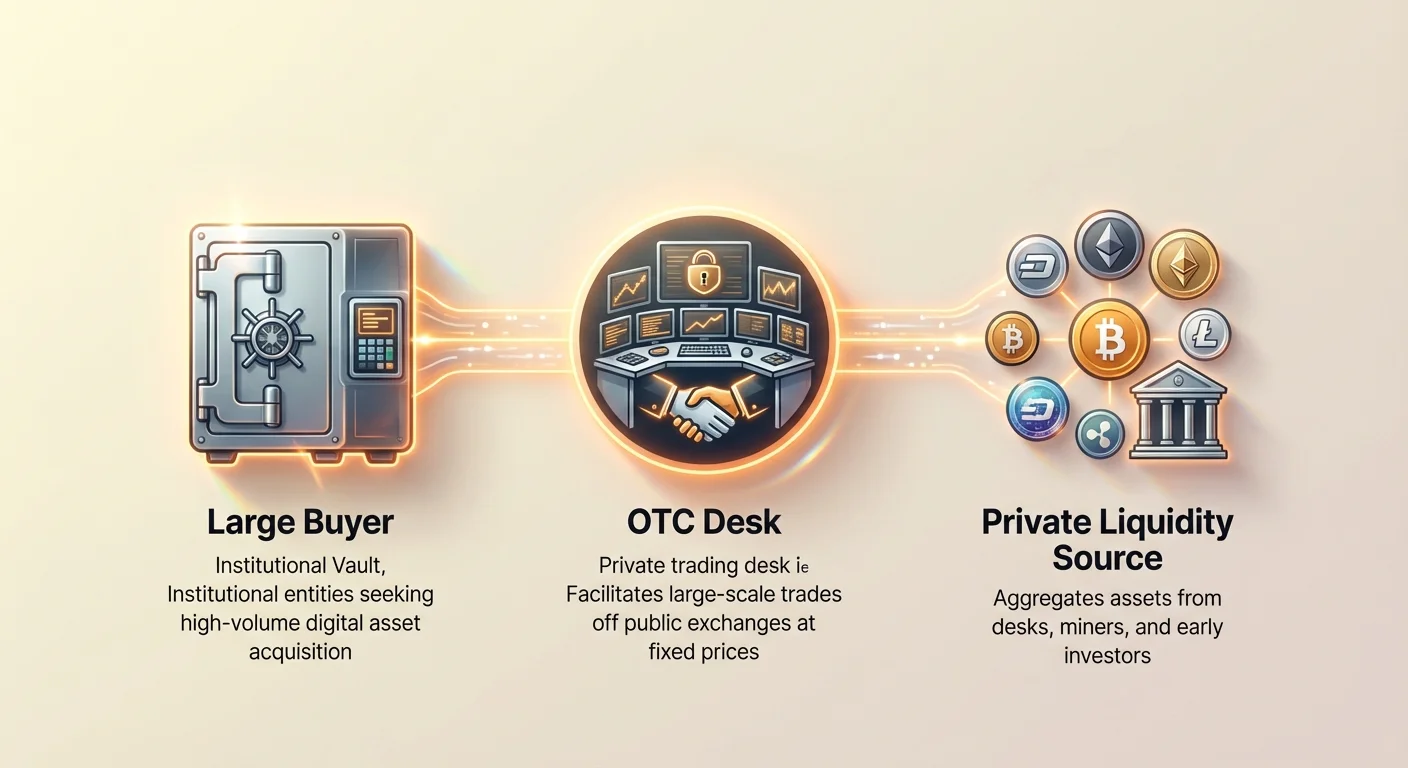
The Foundations of Over-The-Counter (OTC) Trading
The term "Over-The-Counter" simply means that the transaction is happening directly between two parties—a buyer and a seller—or through a trusted intermediary (the OTC desk) rather than via a formal, centralized exchange mechanism. In traditional finance, OTC markets predate exchanges and remain vital for trading specialized securities and complex derivatives. In the crypto world, the function is primarily focused on achieving massive scale and execution efficiency.
Defining the OTC Market
Unlike centralized exchanges (like Coinbase or Kraken) which rely on a publicly visible, continuous order book, the crypto OTC market operates through principal trading desks. These desks act as market makers, ready to buy or sell large blocks of assets from their own inventory.
When a client wants to execute a trade—say, selling $50 million of Bitcoin—they communicate directly with the OTC desk, usually through private channels like chat applications or specialized trading portals. The desk then quotes a fixed, guaranteed price for the entire block. If the client accepts, the trade is executed instantly at that locked price, regardless of how the execution affects the public market. This instantaneous, fixed-price execution is the core benefit of the OTC structure for large transactions.
OTC vs. Centralized Exchanges (CEX)
The distinctions between retail exchanges and OTC desks are critical, especially when considering execution strategies:
| Feature | Centralized Exchange (CEX) | OTC Trading Desk |
|---|---|---|
| Visibility | Publicly visible order books. | Private negotiations; no public visibility. |
| Pricing | Variable; dependent on available liquidity (market price). | Fixed, negotiated price for the entire block. |
| Liquidity Source | Retail and institutional limit orders. | The desk’s own inventory or aggregated liquidity from other institutions/dark pools. |
| Market Impact | High risk of slippage and market impact on large orders. | Market impact is externalized and absorbed by the desk; slippage is virtually eliminated. |
| Typical Volume | Small to mid-size trades (under $1 million). | High-volume block trades (typically over $100,000 to millions). |
For corporate treasuries managing large portfolios, the ability to negotiate a fixed price for an entire block of assets, thereby eliminating price uncertainty and market impact risk, is non-negotiable.
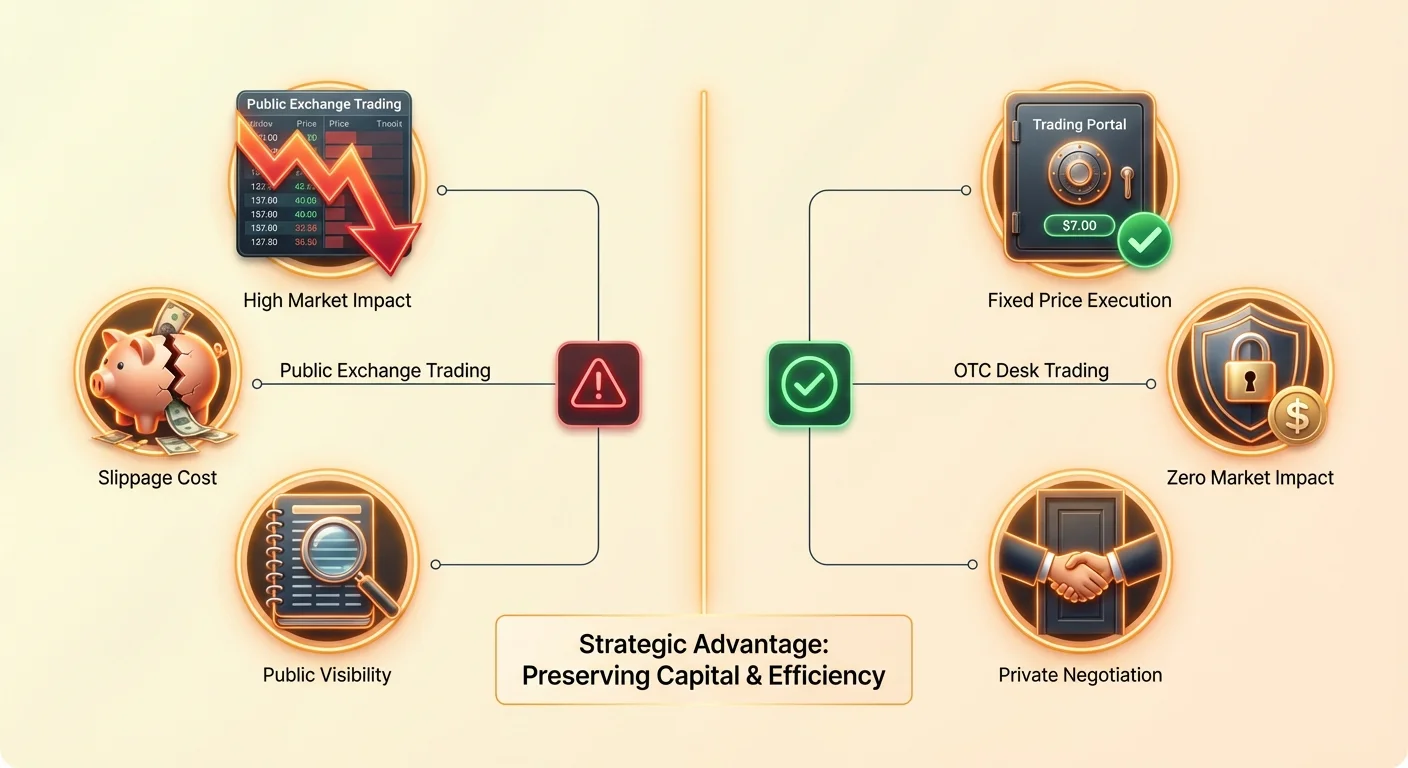
The Core Challenge: Managing Market Impact and Slippage
The primary reason institutions avoid executing large orders on public exchanges is the high cost associated with market impact and slippage. Understanding these concepts is essential to grasp the strategic value of OTC services.
Understanding Slippage and Market Impact
Slippage occurs when the expected price of a trade is different from the executed price. This typically happens in volatile or illiquid markets.
Market Impact is the movement of the asset's price caused by the trade itself. If you attempt to buy $10 million worth of Bitcoin instantly on an exchange, you must fill all the best available sell orders on the order book. Once those initial orders are consumed, the system moves to higher-priced orders deeper in the book. By the time your $10 million order is complete, the last portion of your purchase may have been executed at a price significantly higher than where the trade began. This price movement caused by your massive demand is market impact.
For example, if an exchange’s order book only has $1 million worth of BTC available at $60,000, but the next $9 million is scattered at prices up to $61,000, your $10 million market buy will cause the price to jump by $1,000 immediately, effectively raising your average purchase cost far above the initial market price.
How OTC Desks Neutralize Market Impact
OTC desks solve this problem by executing the trade off-chain and acting as the principal. When you sell $50 million in BTC to an OTC desk, they agree to buy it all at a predetermined price, say $60,000 per coin. The OTC desk then takes on the risk and the responsibility for selling or hedging that massive block.
The desk uses sophisticated internal tools to source liquidity from multiple venues globally—including other OTC desks, institutional liquidity pools, and sometimes even smaller tranches on CEXs—often executing the total order slowly over time or distributing it across proprietary dark pools. Because the client’s transaction is settled instantly and privately with the desk, the public market never sees the massive order, and the client pays zero market impact. This strategic benefit saves high-volume traders potentially hundreds of thousands or even millions of dollars per large transaction.
Strategic Advantages of Using an OTC Desk
Beyond slippage reduction, leveraging an OTC desk offers several distinct strategic and operational benefits tailored for HNWIs and institutional trading.
Guaranteed Pricing and Faster Execution
When dealing with an exchange, even large limit orders are subject to partial fills and queue risks. With an OTC desk, the pricing is fixed and guaranteed once the quote is accepted. This certainty is vital for corporate treasuries or fund managers who need to meet strict NAV (Net Asset Value) reporting requirements or close transactions based on specific market timelines.
Furthermore, OTC trades typically involve instant settlement between the client and the desk. While final custody transfer may take a few minutes (due to blockchain confirmation times), the financial obligation and asset transfer are locked immediately, providing execution speed that public exchanges cannot match for multi-million dollar trades.
Privacy and Confidentiality
In institutional finance, knowledge of a major position change (a large buy or sell) can be weaponized by rival traders or market participants. If a large corporation were known to be planning a $100 million BTC purchase, front-running traders could quickly push the price up, costing the institution millions.
OTC transactions are inherently private. The trade details—the size, the price, and the identity of the buyer/seller—are known only to the two counterparties and the desk itself. This confidentiality prevents market manipulation and preserves the efficiency of the capital deployment strategy. This is one of the most compelling reasons institutions prioritize OTC access.
Access to Specialized Assets and Altcoin Liquidity
While Bitcoin and Ethereum enjoy high liquidity, many smaller altcoins or specialized tokens often have very thin order books on public exchanges. Attempting a large block trade in a mid-cap altcoin on a CEX would be catastrophic in terms of market impact.
OTC desks often maintain relationships with various large-scale liquidity providers, token issuers, and early investors, enabling them to source massive amounts of illiquid assets that simply are not available on the open market without causing extreme volatility. This specialized access is crucial for portfolio managers focusing on diversified crypto strategies.
Advanced Institutional Access: Dark Pools and Prime Brokerage
As the crypto market matures, the sophistication of institutional services has grown far beyond simple OTC block trading. High-frequency traders, hedge funds, and major financial players utilize complex systems that blend trading, custody, financing, and settlement—often referred to as prime brokerage services.
The Role of Dark Pools
Dark pools are private trading venues where institutional orders are matched anonymously and executed without being displayed on public order books. They are essentially OTC markets managed by large brokers or dedicated financial technology firms, designed to find institutional buyers and sellers efficiently.
In crypto, dark pools are used to execute complex algorithmic trades and internal cross-matches between clients of the same brokerage. They offer the highest level of confidentiality and are specifically engineered to eliminate information leakage (and therefore, market impact) during execution. A large institutional client might utilize a dark pool to execute an extremely large order by splitting it into many smaller, randomized segments that are quietly filled against internal liquidity before being settled.
Understanding Crypto Prime Brokerage
In traditional finance, a prime broker acts as a central counterparty providing a suite of integrated services. Crypto prime brokerage replicates this model, offering institutions an all-in-one solution for managing digital assets. This typically includes:
- Unified Trading Access: Providing access not just to the desk's internal OTC liquidity, but also routing orders to external CEXs, DEXs, and dark pools for best execution.
- Institutional-Grade Custody: Secure, often insured, storage solutions for assets, minimizing counterparty risk and operational complexity.
- Financing and Lending: Allowing institutions to borrow assets (for short-selling) or borrow fiat currency (leveraging existing crypto holdings).
- Reporting and Compliance: Integrated systems for generating regulatory reports, managing margin, and auditing transactions.
For institutions, using a prime brokerage service simplifies operational flow, allowing them to manage billions in assets across multiple strategies through a single legal and technical relationship.
Critical Risk Management and Compliance
While OTC trading offers significant benefits, it is not without risks. Managing counterparty risk and navigating the complex regulatory landscape are essential components of high-volume trading strategy.
Mitigating Counterparty Risk
Since an OTC transaction is bilateral (direct between two parties), the risk that the counterparty—the OTC desk itself—fails to uphold its end of the bargain must be addressed. This is known as counterparty risk.
To mitigate this, sophisticated traders employ several tactics:
- Pre-Trade Due Diligence: Thoroughly vetting the desk’s financial health, capitalization, insurance coverage, and reputation. Only working with desks that have clear regulatory registrations (e.g., licensed money transmitters or regulated financial services providers).
- Clear Settlement Procedures: Insisting on defined settlement mechanisms, often involving multi-signature wallets or escrow accounts where assets are held by a neutral third party until both sides confirm the exchange. This ensures that assets are exchanged simultaneously (Atomic Swaps or Delivery vs. Payment setups).
- Diversification of Relationships: Institutions rarely rely on a single OTC desk. Maintaining relationships with two or three top-tier desks ensures that liquidity is always available and risk exposure to any single entity is minimized.
Regulatory Considerations for Large Block Trades
Regulatory compliance is significantly more rigorous for large block trades than for retail transactions. Corporate treasuries and institutional funds operate under stringent Anti-Money Laundering (AML) and Know Your Customer (KYC) laws, often requiring verifiable source-of-wealth documentation.
OTC desks specializing in institutional clients are crucial compliance partners because they provide:
- Robust KYC/AML Infrastructure: They conduct intensive due diligence on their clients, which often satisfies regulatory requirements for both the desk and the client.
- Tax Documentation: They are equipped to provide the comprehensive transaction records needed for generating accurate tax reports regarding capital gains and losses, especially crucial when dealing with complex corporate tax structures. (As seen in the source material, platforms exist specifically to simplify crypto tax reporting for complex transactions).
- Jurisdictional Expertise: Many top-tier desks have licenses across multiple jurisdictions, allowing them to advise clients on the most compliant way to execute trades based on their legal domicile.
Executing a trade through a reputable, regulated OTC desk provides a critical layer of auditable compliance, which is a necessity for corporate clients accountable to shareholders or regulators.
OTC Desk Selection Criteria for HNWIs and Corporations
Choosing the right OTC partner is a strategic decision that depends heavily on the client’s size, complexity, asset focus, and jurisdiction. The following criteria should guide the selection process:
1. Reputation and Institutional Backing
The desk’s track record, years of operation, and institutional pedigree matter immensely. Is the desk run by experienced finance professionals? Are they backed by major venture capital or integrated within a larger regulated financial entity? A desk associated with a strong, solvent financial organization generally presents lower counterparty risk. Seek out desks that have successfully executed multi-hundred-million dollar trades.
2. Depth of Liquidity and Asset Coverage
A top-tier OTC desk should demonstrate the ability to handle massive block trades without relying solely on its own inventory. Ask the desk about its aggregated liquidity sources—how many exchanges, dark pools, and banking relationships does it utilize?
Furthermore, ensure the desk can consistently quote prices for all the assets relevant to your investment thesis, particularly if you plan on trading smaller-cap tokens where liquidity sourcing is challenging.
3. Fee Structure and Pricing Transparency
OTC desks make money through a spread—the difference between the price at which they buy an asset and the price at which they sell it. This spread is often tighter than the effective slippage cost incurred on a public exchange for a large trade, but it must be transparent.
Some desks charge a small commission plus the spread. Sophisticated clients often negotiate bespoke pricing tiers based on committed annual volume. Understanding the total cost of execution is key to evaluating the desk's value proposition against CEX execution fees and potential slippage.
4. Technical Integration and Settlement Speed
For institutions running sophisticated portfolio management systems, the OTC desk must offer robust technical integration, often via an Application Programming Interface (API). This allows the client's internal system to request quotes and execute trades programmatically, reducing manual error and increasing speed.
Confirm the desk’s standard settlement time. For assets like Bitcoin, settlement should be near-instantaneous (minutes) once the trade is locked, facilitated by secure cold storage or multi-sig wallet solutions provided by the desk’s custodial partner.
5. Custody and Security Offerings
Since high-volume trades involve substantial assets, the security protocols of the OTC provider are paramount. If the desk offers prime brokerage or integrated custody, investigate the following:
- Insurance Coverage: Is the stored crypto insured against theft or operational failure?
- Cold Storage Policy: What percentage of client funds are held in air-gapped cold storage?
- Withdrawal Controls: Does the desk offer custom withdrawal approval protocols (e.g., requiring approvals from three different officers within the client company)?
Conclusion
Over-The-Counter (OTC) trading is not merely an alternative way to buy crypto; it is a specialized strategic tool designed to address the inefficiencies inherent in high-volume transactions on public exchanges. For high-net-worth individuals, corporate treasuries, and institutional investors, the ability to eliminate market impact and slippage via a private, negotiated price is critical for preserving capital and achieving optimal execution.
By leveraging the confidentiality of dark pools, the consolidated services of prime brokerage, and the guaranteed pricing of a professional OTC desk, sophisticated practitioners shift from reactive, open-market trading to proactive, strategic asset deployment. Mastery of OTC market dynamics is therefore essential for anyone seeking to manage significant digital asset holdings efficiently and compliantly in the evolving digital economy.