
When new investors enter the cryptocurrency market, the initial focus is often placed solely on which asset to buy. However, a crucial skill that separates profitable, professional trading from costly novice mistakes is understanding how and where to execute a trade. The venue you choose—whether it is a common retail platform or a private negotiation—can drastically affect the final price you receive, the fees you pay, and the security of your assets.
Optimizing crypto trade execution means finding the most efficient pathway to complete your transaction, minimizing costs like slippage and trading fees, and ensuring your trade is completed reliably at the desired price. This optimization is not one-size-fits-all; the best environment for a $100 Bitcoin purchase is entirely different from the best environment for a $1 million institutional trade.
This guide provides a comprehensive decision matrix, helping you navigate the three primary execution environments—Centralized Exchanges (CEX), Over-the-Counter (OTC) desks, and Decentralized Exchanges (DEX)—to ensure your trading strategy is executed flawlessly, regardless of your volume or complexity requirements.
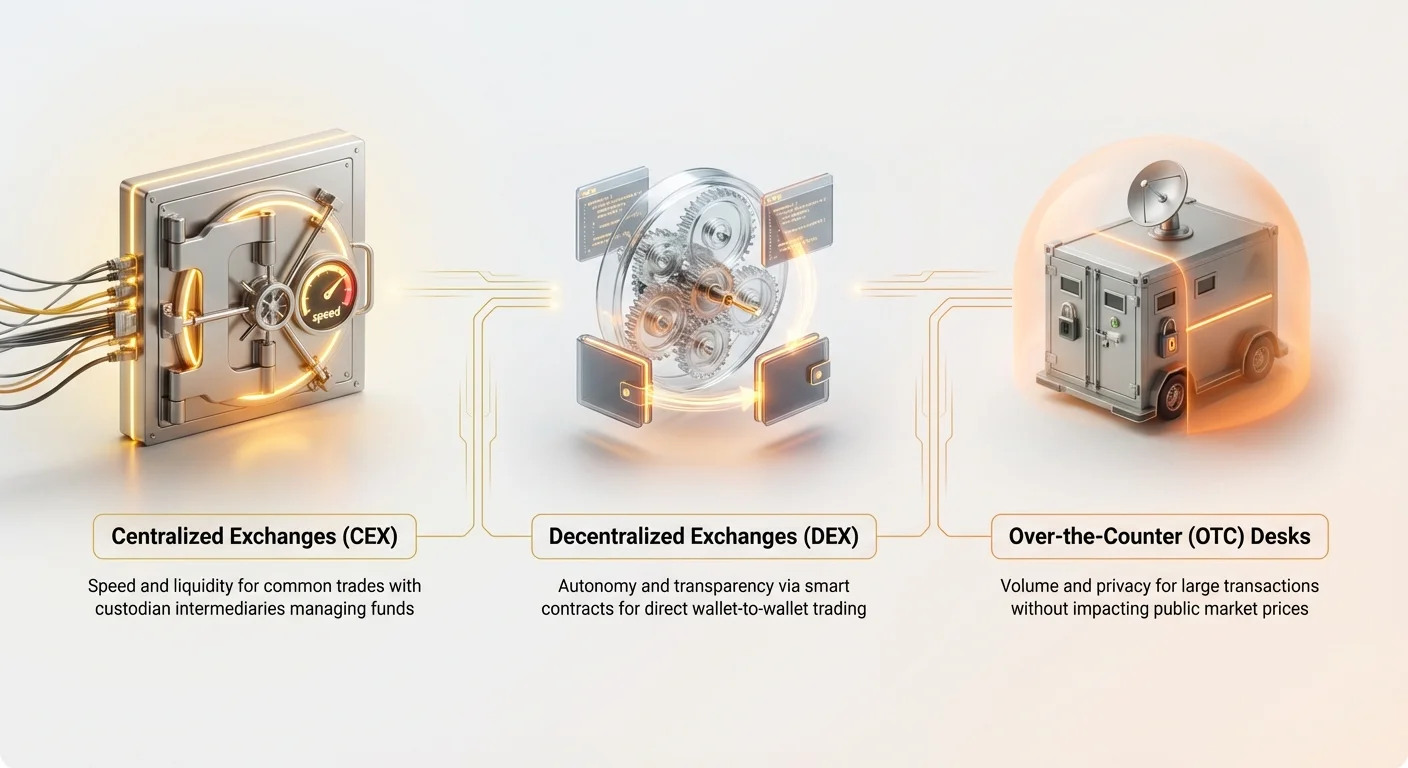
Understanding the Three Primary Execution Venues
Before we compare strategies, it is essential to understand the fundamental mechanics, advantages, and risks associated with the three main locations where crypto transactions take place.
Centralized Exchanges (CEX): Speed and Liquidity
Centralized Exchanges, such as Coinbase, Kraken, or Binance, are the most common entry points for retail traders. They operate like traditional stock exchanges, acting as a custodian and intermediary between buyers and sellers.
Mechanism: Users deposit funds into an account managed by the exchange. Trades are matched using an internal order book. Key Advantage: Exceptional liquidity (the ability to buy or sell large amounts quickly without affecting the price), fast execution, user-friendly interfaces, and easy fiat (traditional money) on-ramps. Key Drawback: Requires Know Your Customer (KYC) verification, and users do not hold the private keys to their crypto (custodial risk).
Decentralized Exchanges (DEX): Autonomy and Transparency
Decentralized Exchanges allow users to trade directly with one another using automated smart contracts, typically within the Ethereum or other blockchain ecosystems. Uniswap and Sushiswap are prime examples.
Mechanism: Trades happen directly from the user’s self-custodied wallet. They rely on Automated Market Makers (AMMs) and liquidity pools instead of traditional order books. Key Advantage: No third-party custodian, no mandatory KYC, and access to a wider variety of niche or newly launched tokens. Key Drawback: Higher complexity for beginners, potential for high transaction (gas) fees during network congestion, and risks associated with smart contract vulnerabilities.
Over-the-Counter (OTC) Desks: Volume and Privacy
OTC trading involves private, direct transactions between two parties (or facilitated by a broker/dealer) without using the public order book of an exchange. This service is primarily utilized by high-net-worth individuals, institutional investors, and corporations.
Mechanism: The buyer and seller negotiate a price directly with the OTC desk. Once agreed, the desk executes the transaction privately, usually offering a fixed price (a “spread”) for the trade volume. Key Advantage: The best venue for large crypto orders. Execution has zero market impact, meaning a massive buy order doesn't drive the price up for other traders. Offers high discretion and personalized service. Key Drawback: Minimum trade size requirements (often $50,000 or more) and prices are determined by the broker's negotiated spread rather than the real-time market order book. Understanding OTC trading.
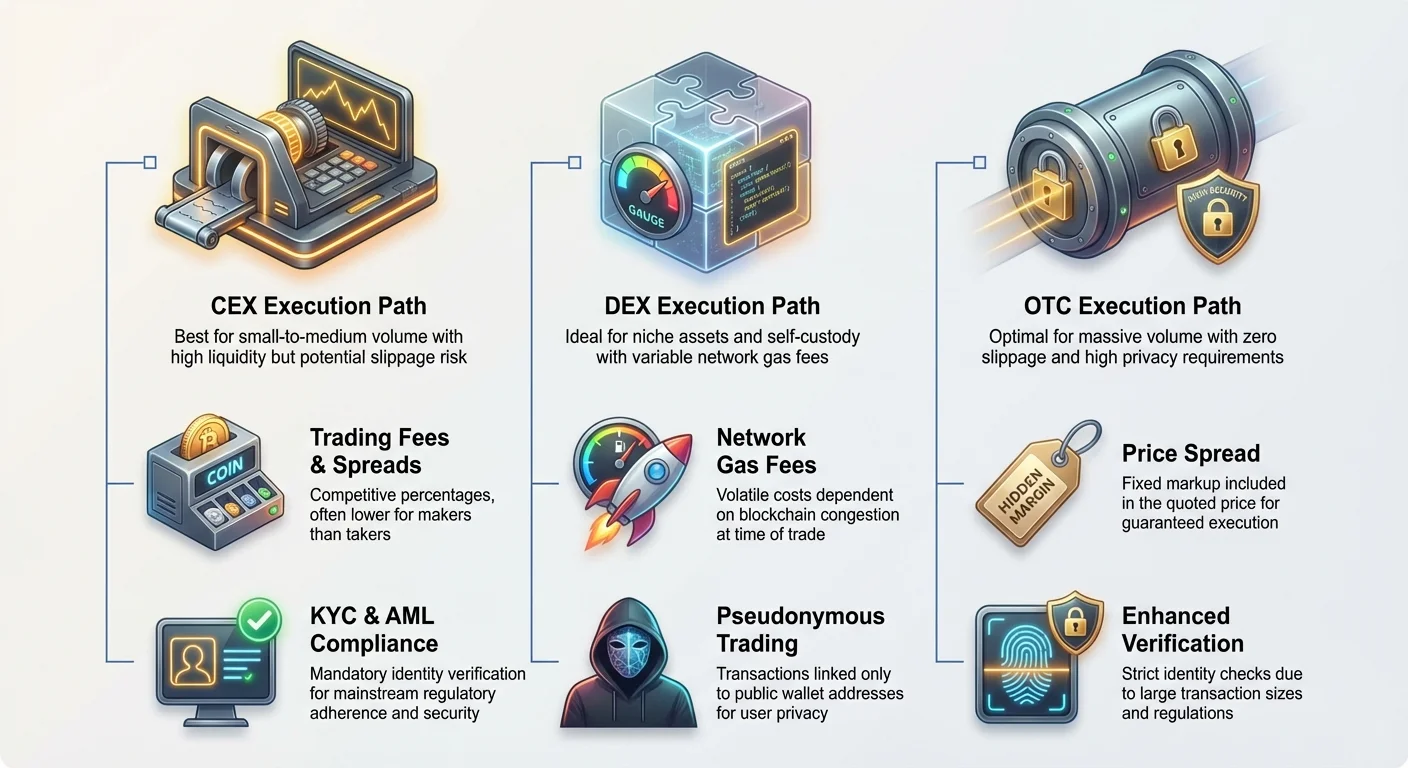
The Decision Matrix: Factors Driving Your Venue Choice
Choosing the optimal execution environment requires evaluating your specific trade requirements against the features of each venue. Use these factors to guide your decision-making process.
Analyzing Trade Volume and Order Size
The size of your trade is arguably the most critical factor in determining the correct venue. This is primarily due to the risk of slippage.
What is Slippage? Slippage occurs when the executed price of a trade differs from the expected price. If you try to buy 100 ETH instantly on a CEX, and the order book lacks enough immediate volume at the current price, your order will ‘slip’ down the book, filling subsequent orders at increasingly higher prices. Slippage mastery is crucial.
| Order Volume Threshold | Recommended Venue | Rationale for Choice |
|---|---|---|
| Small (Under $10,000) | CEX or DEX | Liquidity is sufficient on CEX; DEX fees might be competitive if network gas is low. |
| Medium ($10,000 - $50,000) | CEX (Using Limit Orders) | CEX provides necessary liquidity, but a Market Order risks slippage. Use a Limit Order to ensure the desired price. |
| Large ($50,000+) | OTC Desk (Primary) or Advanced CEX Features | OTC guarantees execution with zero market impact and eliminates slippage risk. Avoids disrupting the public market. |
Assessing Cost: Fees, Spreads, and Slippage
While most traders focus on explicit trading fees, the hidden costs of inefficient execution can be much higher.
1. Trading Fees (CEX): CEX platforms charge small percentages (e.g., 0.1% to 0.6%) on trades. These are highly competitive, especially for "Makers" (those adding liquidity with Limit Orders) who often pay lower fees than "Takers" (those removing liquidity with Market Orders).
2. Network Fees (DEX): DEX users pay gas fees to the underlying blockchain (e.g., Ethereum). These fees fluctuate wildly based on network congestion. A $50 swap might cost $5 in fees on a quiet day, or $100 during a market frenzy. This volatility makes DEX execution inherently unpredictable regarding cost.
3. Spreads (OTC): OTC desks typically do not charge separate fees; instead, they quote a price slightly above (for buyers) or below (for sellers) the current market rate. This difference is the "spread," and it represents the desk’s profit. While the percentage might look higher than CEX fees, the benefit of guaranteed, zero-slippage execution on massive orders often makes it cheaper overall.
Prioritizing Compliance and Anonymity
Compliance and privacy are key differentiators, often reflecting the user’s priorities or jurisdictional requirements.
CEX Compliance: CEX platforms operating in regulated areas strictly enforce KYC and Anti-Money Laundering (AML) standards. This means linking your identity, banking information, and potentially reporting transactions to tax authorities. This is necessary for mainstream investors prioritizing security and regulatory peace of mind.
DEX Anonymity: DEX transactions are pseudonymous—they are linked only to a public wallet address, not to a legal identity. For users prioritizing privacy and self-sovereignty, DEX is the preferred route, though it places the full burden of security and compliance onto the user.
OTC Compliance: While OTC desks offer privacy regarding market actions, most regulated retail and institutional OTC providers require robust identity verification due to large transaction sizes and regulatory scrutiny (particularly in North America and Europe).
CEX Execution: Advanced Features and Security
For the majority of active retail traders, the Centralized Exchange remains the workhorse. To move beyond basic buying and selling, understanding the advanced tools available on these platforms is crucial for maximizing execution efficiency.
Leveraging Advanced Order Types
The simple Market Order (buy/sell immediately at the current best price) should be used sparingly, particularly in volatile markets or for large sums, because it guarantees execution but not price. Optimized execution relies on strategic use of other order types.
- Limit Orders: This is the foundation of smart trading. A Limit Buy Order sets the maximum price you are willing to pay; the order will only fill when the market price hits that level or lower. This guarantees the price but does not guarantee execution speed.
- Stop Orders: Used for risk management. A Stop-Loss Order is executed when the price drops to a certain level, limiting potential losses. Similarly, a Stop-Limit Order converts into a Limit Order when the stop price is hit.
- Trailing Stop Orders: This advanced order type dynamically follows the market price as it moves in your favor, locking in profits. If the market reverses by a specified percentage, the trade executes.
Integrating Automated Strategies (APIs and Bots)
For complex strategies, speed and precision are paramount—tasks that human traders cannot perform reliably. CEX platforms facilitate this through Application Programming Interfaces (APIs).
APIs allow third-party software (like trading bots or custom algorithms) to communicate securely with the exchange’s backend. This infrastructure enables:
- Algorithmic Trading: Programs that automatically execute large orders in small increments over time to minimize market impact (known as "slicing" an order).
- Arbitrage: Bots that instantly detect price discrepancies between two or more exchanges and execute simultaneous buy and sell orders to profit from the difference. Low-latency infrastructure is essential for this high-speed execution method.
- Copy Trading: Automatically replicating the trades of established, successful users.
Using CEX APIs for automation is the benchmark for high-frequency execution strategies due to the reliability and speed of centralized infrastructure.
Security and Custody Considerations
While CEX platforms offer robust security measures (Two-Factor Authentication, cold storage for assets), the inherent risk is that the exchange holds your private keys. A centralized entity remains a target for hackers.
Best Practice: Only hold the funds necessary for active trading on a CEX. Use the platform for execution, but move long-term holdings to a self-custodied wallet (a cold or hardware wallet) once the trade is complete.
OTC and DEX Execution: Specialized Use Cases
While CEX dominates retail trading, the other two venues serve critical, specialized functions that cannot be handled efficiently elsewhere.
The OTC Solution for Large Orders
If you need to move $500,000 worth of Bitcoin, executing that on a public order book would immediately deplete the liquidity at the top price levels, driving your average execution price higher (high slippage). This loss of value is called market impact.
OTC desks eliminate market impact entirely. The trader agrees to a fixed price with the broker, and the broker fulfills the order from their own inventory or by discreetly sourcing the crypto from other institutions. The transaction itself occurs off-chain until the final delivery of the asset.
When to Choose OTC:
- You require guaranteed execution at a specific price point.
- Your trade size is large enough that it would measurably impact the public market ($50k+).
- You need to move assets quickly without public knowledge of your positioning (discretion).
DEX Swaps for Niche Assets and Self-Custody
The power of DEX lies in its ability to list and trade any token with minimal regulatory friction, provided a liquidity pool exists. If you are looking to purchase a brand-new, emerging altcoin that has not yet been approved or listed by a major CEX, the DEX environment (like Uniswap) is often the only available execution venue.
Furthermore, a significant portion of the crypto community prefers DEX execution simply because it aligns with the core philosophy of self-custody. Since trades are executed directly from your wallet via a smart contract, your assets never leave your control—a key advantage over CEX custody risks.
Addressing Liquidity and Aggregation in DEX: While native DEX pools sometimes suffer from shallow liquidity, resulting in high slippage, the modern solution is using a DEX aggregator. Aggregators scan multiple DEX liquidity pools simultaneously to route your trade through the most cost-effective path, effectively optimizing execution across the decentralized environment. This is akin to using an algorithmic bot to find the best price, but across decentralized venues instead of centralized ones.
Best Practices for Optimized Trade Execution
Regardless of the venue you choose, adopting these fundamental practices will improve your execution results and protect your capital.
The Importance of Liquidity Checks
Liquidity is the oxygen of efficient trade execution. Before placing any significant order, especially on a CEX or a smaller DEX, examine the order book depth.
On a CEX: Look at the cumulative buy and sell orders near the current market price. If the total volume available within 1% of the current price is less than your trade size, you are virtually guaranteed to incur slippage. In this case, either use a Limit Order or execute the trade through an OTC desk.
On a DEX: Check the size of the liquidity pool. A small pool (e.g., $10,000 in total value locked) means a large swap will result in massive price impact due to the mechanics of the AMM model.
Understanding Cost Versus Speed Trade-Offs
Optimization requires balancing the priority of cost (lowest fees/spread) against speed (instant execution).
- Prioritize Speed (Market Order/CEX): Necessary when acting on breaking news, executing critical arbitrage, or trying to exit a volatile position immediately. You will pay the highest fees and potentially the highest slippage.
- Prioritize Cost (Limit Order/DEX with Low Gas/OTC): Necessary for accumulating assets over time, placing strategic bets, or moving massive amounts of capital. You risk non-execution (Limit Orders) or slow, expensive execution (high DEX gas fees).
Actionable Tip: Always pre-calculate the total execution cost. This includes the explicit trading fee plus the estimated slippage cost. If the slippage loss outweighs the savings from lower trading fees on one venue, switch to the more expensive, but more stable, execution environment (like an OTC desk).
Strategy Implementation: Aggregators vs. Native Execution
For sophisticated traders, relying on a single exchange is rarely optimal. The market is dynamic, and the best price for an asset may shift from CEX A to DEX B moment-to-moment.
Aggregators (Smart Order Routing): These tools—available in both centralized (via institutional CEX brokers) and decentralized forms (DEX aggregators)—scan the entire market landscape in real-time. They automatically split and route your order to multiple venues to ensure the absolute lowest overall execution cost. This technique is highly recommended for optimizing mid-to-large volume retail trades that may not yet qualify for a private OTC desk.
Native Execution: This refers to placing the order directly on the chosen platform. This is simpler and sufficient for small-volume retail trades where the benefits of aggregation are offset by the complexity or additional costs.
Conclusion: Trading with Intent
Optimizing crypto trade execution moves the focus from speculative guessing to calculated efficiency. For new investors, the CEX remains the default choice due to its ease of use and high liquidity for standard volumes. However, as your portfolio grows and your trading strategy matures, understanding the capabilities of OTC desks for discretion and large-volume management, and DEX for self-custody and niche asset access, becomes essential.
The ultimate takeaway is to trade with intent. Before clicking "Buy" or "Sell," answer three questions: What is my volume threshold? What is my tolerance for slippage? And what is my priority: speed, cost, or regulatory compliance? By systematically answering these questions and choosing the appropriate venue (CEX, OTC, or DEX), you shift your focus from simply participating in the market to mastering the infrastructure required for sustained trading success.