
The cryptocurrency landscape has evolved into a complex ecosystem where technological utility often competes with social sentiment. At the forefront of this battle for attention are memecoins. These assets were once dismissed as internet jokes or fleeting distractions. Today they command billions of dollars in market capitalization and drive significant volume on decentralized exchanges.
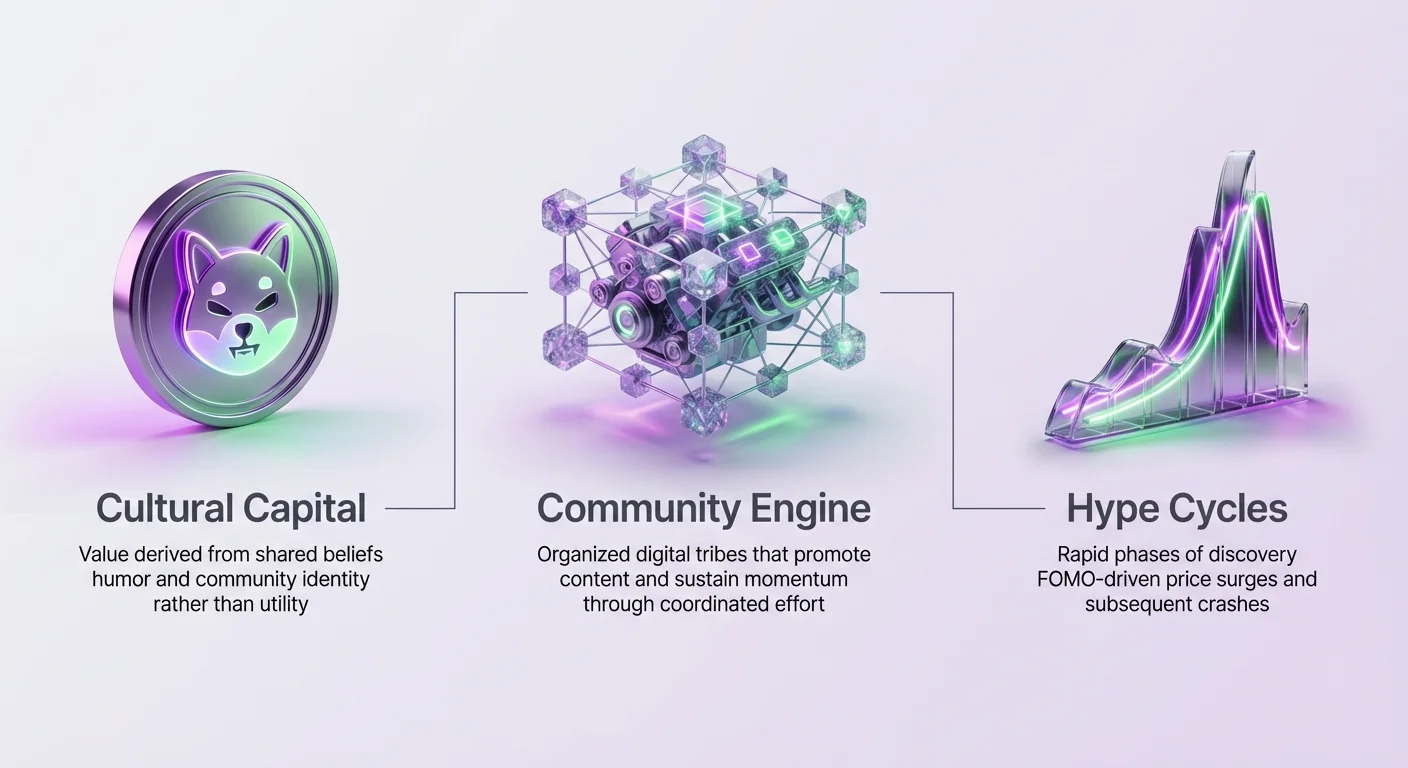
To understand this phenomenon, one must look beyond traditional financial metrics. Memecoins operate on a different set of rules known as cultural capital. This concept suggests that value can be derived from shared beliefs, humor, and community identity rather than revenue streams or technical innovation. The market has validated this theory through the explosive growth of assets like Dogecoin and Shiba Inu.
However, the rise of memecoins introduces extreme volatility and risk. Investors must navigate a treacherous environment filled with hype cycles, liquidity traps, and market manipulation. Understanding the mechanics behind these tokens is essential for anyone participating in this sector. It requires analyzing how tokenomics interact with social media trends to create temporary but powerful value systems.
The Mechanics of Cultural Capital
Cultural capital in the crypto market functions as a form of social currency. When a community rallies around a specific image or idea, they generate attention. In the digital economy, attention is a scarce resource that can be monetized. Memecoins act as the vehicle for this monetization. They allow users to speculate on the virality of a concept.
This dynamic creates a feedback loop. As more people join the community, the perceived value of the "culture" increases. This draws in new investors who want to be part of the movement. The price rises, validating the community's belief and attracting media coverage. This cycle converts social energy into financial liquidity.
Unlike Bitcoin, which is often valued for its scarcity and security, memecoins are valued for their inclusivity and entertainment value. They lower the barrier to entry for new crypto users. The concepts are often simple to understand. A funny dog or a popular frog is easier to relate to than complex decentralized finance protocols or layer-2 scaling solutions.
Community as the Engine
The primary driver of any successful memecoin is its community. These groups often form on platforms like Discord, Telegram, and X (formerly Twitter). They operate similarly to digital tribes. Members work together to promote the token, create content, and defend the project against critics. This coordinated effort is what sustains the hype cycle.
Active communities can keep a token alive long after the initial joke has faded. They may pressure developers to add utility or burn tokens to reduce supply. In some cases, the community takes over the project entirely. This effectively decentralizes the marketing and development efforts, distributing the workload across thousands of motivated holders.
However, community strength is difficult to quantify. It relies on sentiment, which can shift rapidly. A community that is vibrant one day can become toxic the next if prices fall. This emotional volatility is directly reflected in the price charts of these assets.
The Role of Influencers and Trends
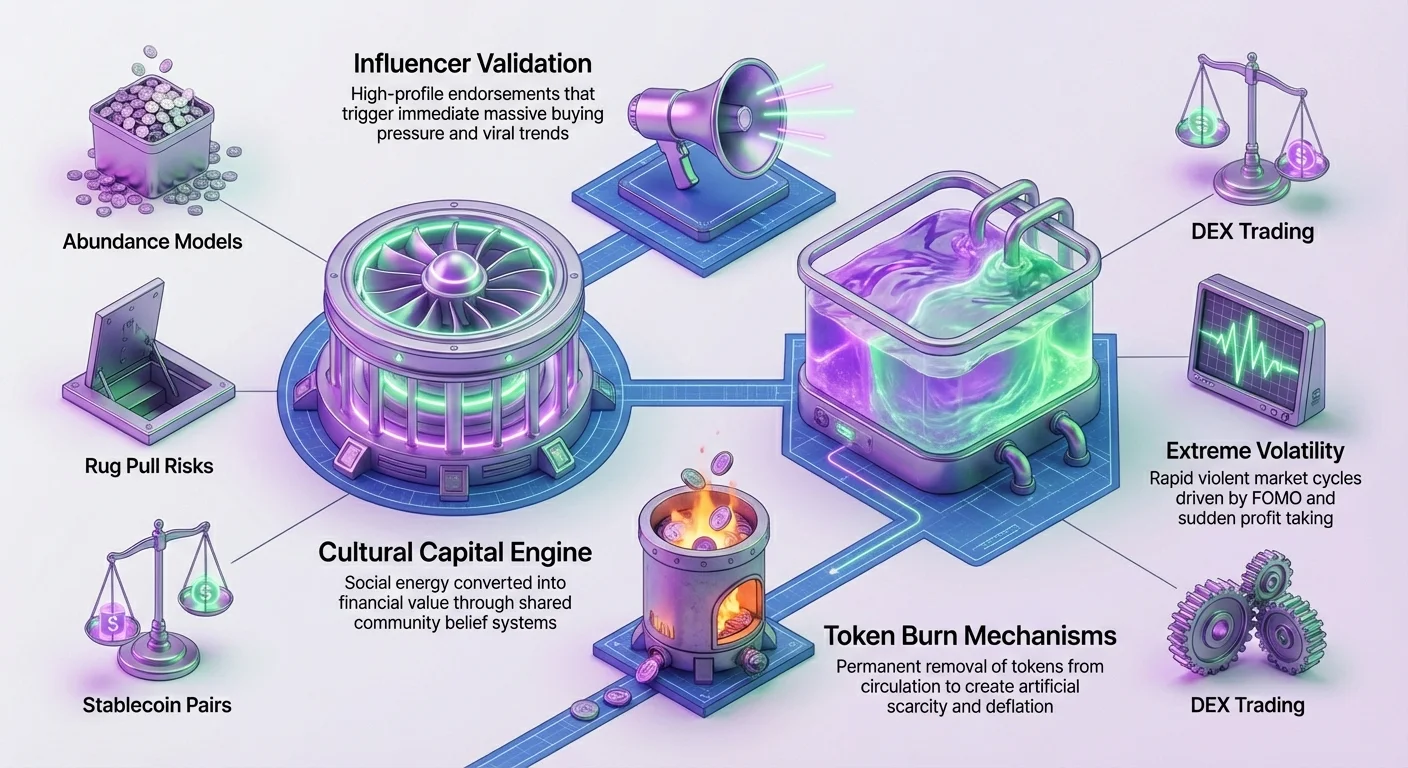
External validation plays a massive role in the valuation of memecoins. Endorsements from high-profile individuals can trigger massive buying pressure. The history of Dogecoin is inextricably linked to public comments made by figures like Elon Musk. A single post on social media can add or subtract billions in market value within minutes.
This sensitivity to trends makes memecoins highly reactive. They often mirror current events or pop culture moments. For example, coins may launch in response to political events, viral videos, or celebrity scandals. The "Official Trump" coin mentioned in market reports is a prime example of this reactivity.
Traders who specialize in this sector often monitor social metrics as closely as technical indicators. They look for spikes in mentions or engagement. This strategy attempts to front-run the "hype" before it translates into price action. It is a high-stakes game where timing is everything.
Tokenomics: Abundance vs. Scarcity
Traditional cryptocurrencies often use scarcity to drive value. Bitcoin has a hard cap of 21 million coins. In contrast, memecoins frequently utilize models of abundance. It is common for these projects to launch with supplies in the trillions or quadrillions.
This massive supply serves a psychological purpose. It allows investors to own millions or billions of tokens for a relatively small investment. This is known as "unit bias." New investors often feel more wealthy owning a million units of a cheap coin than a fraction of a significantly more expensive coin, even if the dollar value is identical.
The low price per unit also creates the illusion that the token has more room to grow. Investors might believe that a token priced at $0.00001 could easily reach $0.01 or $1.00. While mathematically unlikely due to market cap constraints, this hope drives speculative buying.
Burn Mechanisms and Deflation
To combat the issue of oversupply, many memecoins implement burn mechanisms. Burning refers to the permanent removal of tokens from circulation. This is usually done by sending tokens to a "dead" address that has no access keys.
Some projects burn a portion of the supply at launch to create immediate scarcity. Others implement transaction taxes that automatically burn a small percentage of every trade. The goal is to make the token deflationary over time. If demand remains constant while supply decreases, the price should theoretically rise.
Community-led burn initiatives are also common. Holders may voluntarily send their own tokens to a burn address to demonstrate commitment to the project. These events are often used as marketing tools to reignite interest during periods of stagnation.
Distribution and Fairness
The distribution of tokens at launch is a critical factor in a memecoin's legitimacy. In a "fair launch," developers do not pre-allocate tokens to themselves or early insiders. Everyone has an equal opportunity to buy at the start. This prevents creators from dumping large amounts of tokens on retail investors.
However, many projects suffer from concentrated ownership. If a small group of wallets holds a majority of the supply, they control the market price. They can crash the value at any moment by selling their holdings. Analytical tools are often used by savvy investors to check the "holder distribution" before buying.
Projects that lock their liquidity or vest team tokens over long periods are generally considered safer. These mechanisms ensure that the developers cannot exit the project immediately with the funds. It aligns their incentives with the long-term success of the token, a common requirement in institutional due diligence.
Market Liquidity and Trading Infrastructure
Liquidity is the lifeblood of any financial asset, but it is particularly vital for memecoins. Liquidity refers to the ease with which an asset can be bought or sold without causing drastic price changes. In the world of memecoins, liquidity is often provided by users on decentralized exchanges (DEXs).
When a memecoin launches on a DEX, the creator must deposit an initial amount of the token along with a base asset, usually a stablecoin or the blockchain's native coin (like ETH or SOL). This creates a liquidity pool. Traders interact with this pool to swap assets.
If the liquidity pool is small, even a modest sell order can crash the price. This is known as high slippage. Traders may find that the price they get for their tokens is significantly lower than the displayed market price. Deep liquidity pools are necessary to support large trading volumes and maintain price stability.
The Role of Stablecoins
Stablecoins are the unsung heroes of the memecoin economy. Assets like USDT (Tether) and USDC (USD Coin) provide the stable counter-party for volatile trades. When traders take profits from a surging memecoin, they typically swap into stablecoins to lock in the value.
These stable assets bridge the gap between the wild volatility of memes and the traditional fiat banking system. They allow traders to stay within the crypto ecosystem without exposure to market fluctuations. Without deep stablecoin liquidity, the memecoin market would function inefficiently.
Different stablecoins offer different risk profiles. Centralized options like USDT and USDC are backed by reserves and widely used. Decentralized options like DAI or the newer USDE offer alternative structures that avoid reliance on a single central issuer. Traders choose their stablecoin pairs based on their trust in the underlying mechanism.
Rug Pulls and Liquidity Locking
The decentralized nature of DEXs allows anyone to list a token. This freedom also enables a common scam known as a "rug pull." In this scenario, a developer creates a token, adds liquidity, and waits for investors to buy in. Once the price rises, the developer withdraws all the liquidity from the pool.
This leaves investors holding worthless tokens that cannot be sold, as there is no base asset left in the pool to swap against. To prevent this, reputable projects use liquidity locking services. These smart contracts prevent the developer from withdrawing the liquidity for a set period, often months or years.
Checking for locked liquidity is a standard due diligence step for meme investors. It does not guarantee the project's success, but it removes the immediate risk of the developer stealing the backing funds.
Hype Cycles and Volatility
Memecoins experience market cycles that are faster and more violent than traditional assets. A cycle typically begins with discovery. Early adopters find the token and begin promoting it. If it gains traction, it enters the "pump" phase. FOMO (Fear Of Missing Out) kicks in, driving the price up vertically.
This phase is often short-lived. Once early buyers begin to take profits, the price can crash just as quickly. This is the "dump" phase. Many projects die here. However, tokens with strong communities may enter a consolidation phase. If they survive, they can experience secondary pumps.
The speed of these cycles requires constant attention. What is popular this week may be irrelevant next week. This creates a high-stress environment for traders. Unlike investing in established protocols, holding memecoins "forever" is rarely a profitable strategy unless the token achieves "blue chip" meme status like Dogecoin.
Risk vs. Reward: The Gambling Spectrum
Investing in memecoins is often compared to gambling. The lack of fundamental utility means that price predictions are nearly impossible based on traditional analysis. The potential for massive gains is counterbalanced by the high probability of total loss.
| Factor | Established Crypto (e.g., Bitcoin) | Memecoins |
|---|---|---|
| Value Source | Utility, Store of Value | Sentiment, Community |
| Volatility | High | Extreme |
| Lifespan | Long-term | Often Short-term |
Traders accept these risks in pursuit of "asymmetric upside." This is the idea that a small investment could yield a 100x or 1000x return. Even if nine out of ten investments fail, one massive success can cover the losses.
However, this mindset can lead to reckless behavior. Many investors allocate more capital than they can afford to lose. The emotional highs of a winning trade can lead to addiction-like behaviors, chasing the next big pump.
The Intersection with Privacy and Future Tech
As the market matures, the lines between different crypto sectors blur. While memecoins are currently transparent and public, there is growing interest in privacy-focused technologies. Privacy coins like Monero and Zano offer anonymity that public blockchains do not.
Currently, most memecoin transactions are traceable on public ledgers. Anyone can see who bought what and when. This transparency is a double-edged sword. It allows for verifying fair distribution, but it also exposes user activity to surveillance.
Future developments could see the rise of "private memecoins" or the integration of memecoins into privacy ecosystems. For example, platforms that support confidential assets could allow users to trade memes without revealing their balances or transaction history.
Confidential Assets and Cultural Capital
The technology behind confidential assets allows for the creation of tokens that inherit privacy features. This could theoretically apply to any token type, including stablecoins or memecoins. A private stablecoin like fUSD (Freedom Dollar) demonstrates that stability and privacy can coexist.
If this technology is applied to the meme sector, it would change the cultural dynamic. Currently, "flexing" or showing off large holdings is part of the culture. Privacy would remove this public signaling mechanism. However, it would add a layer of security for "whales" (large holders) who currently face the risk of being targeted or tracked.
This evolution would represent a shift from purely performative capital to a more secure form of wealth storage within the meme sector. It remains to be seen if the community values privacy enough to adopt these more complex technologies.
Regulatory Landscape and Challenges
Regulators worldwide are paying close attention to the memecoin sector. The high prevalence of scams and the gambling-like nature of the market raise consumer protection concerns. Different jurisdictions are taking different approaches.
Some regulators view these tokens as securities, arguing that investors are expecting profits based on the work of others (the developers). Others view them as commodities or simply as digital collectibles. The lack of clear definitions creates uncertainty.
Stablecoins, which facilitate meme trading, are also under scrutiny. Regulations requiring strict reserve audits or banking licenses for stablecoin issuers could impact liquidity. If stablecoins become harder to access, buying and selling memecoins becomes more difficult.
The Impact of Censorship Resistance
One of the core values of cryptocurrency is censorship resistance. This ensures that transactions cannot be blocked by central authorities. Memecoins benefit from this property. Even if a government dislikes a specific meme or the community behind it, they cannot easily stop the blockchain from processing transactions.
This resilience is vital for the survival of controversial projects. However, it also means that law enforcement has limited tools to recover funds lost to scams. The responsibility for safety falls entirely on the user.
Privacy technologies enhance this resistance. Tools that obscure transaction details make it even harder for outside parties to interfere. This aligns with the ethos of financial freedom but puts the sector at odds with strict regulatory compliance frameworks.
Conclusion
Memecoins represent a fascinating and chaotic intersection of finance, technology, and sociology. They challenge traditional notions of value by proving that cultural relevance can be just as powerful as technical utility. The market for these assets is driven by community energy, viral marketing, and the universal desire for rapid wealth accumulation.
However, the risks are undeniable. The reliance on hype cycles, the prevalence of liquidity scams, and the extreme volatility make this sector dangerous for the uninformed. While the potential for high returns exists, it is inextricably linked to the possibility of total loss. The future of memecoins will likely involve a struggle between maintaining their wild, deregulated roots and integrating with more sophisticated, privacy-preserving technologies.
Cultural capital is a potent economic force, but without liquidity and transparency, it remains a speculative illusion.