
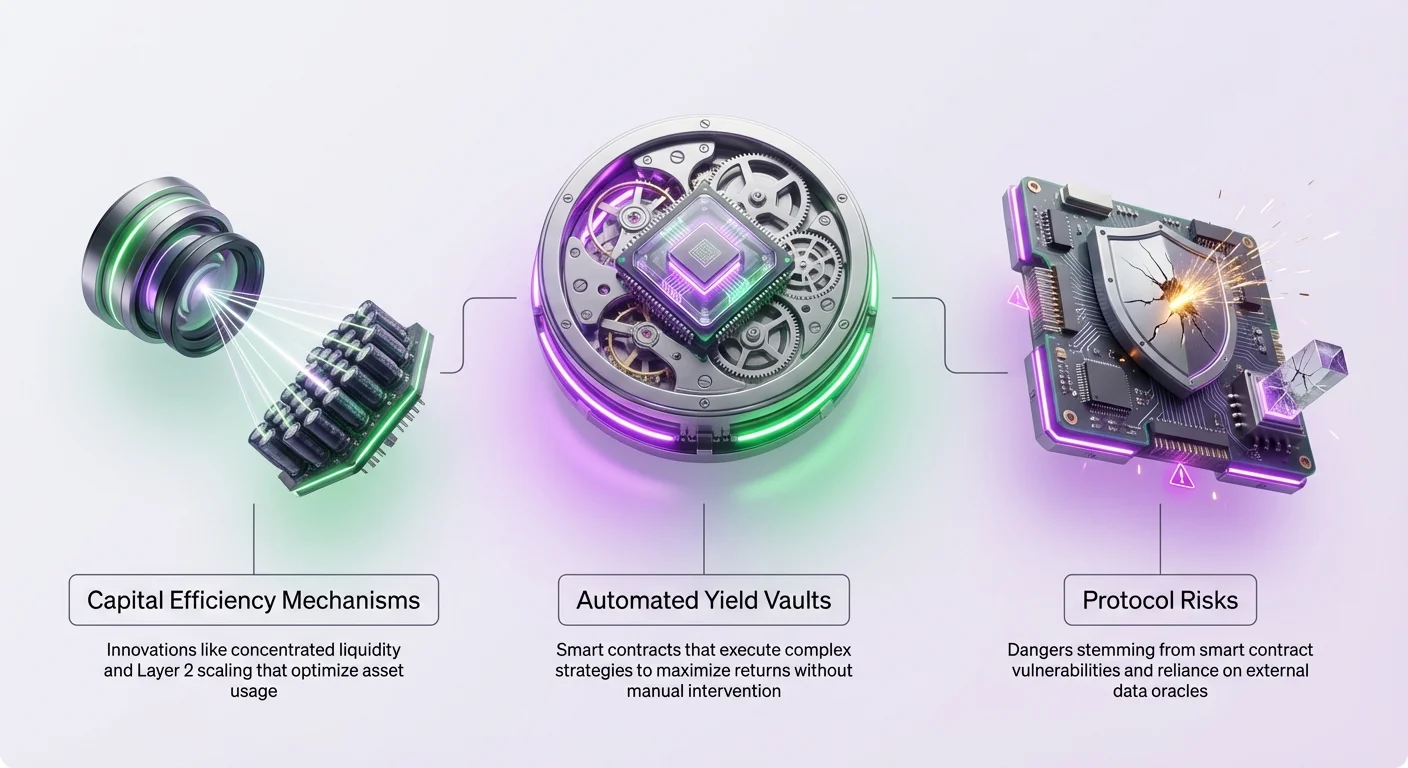
The rapid expansion of decentralized finance has introduced a complex array of opportunities for generating returns on digital assets. What began as simple lending and borrowing has evolved into a sophisticated ecosystem of yield farming, liquidity provision, and automated strategy execution. At the heart of this evolution are yield vaults and aggregators, tools designed to simplify the user experience while maximizing potential returns.
These mechanisms serve as a bridge between raw protocols and investors who may lack the time or technical expertise to manage intricate strategies manually. By pooling resources and automating interactions with smart contracts, vaults can execute high-frequency tasks that would be prohibitively expensive for individual users.
However, the pursuit of higher capital efficiency introduces distinct layers of risk. Users must navigate not only market volatility but also the technical intricacies of the underlying code. Understanding how these systems function, from the automated market makers that facilitate trading to the oracles that secure price data, is essential for any participant.
This analysis explores the architecture of modern yield strategies, the critical role of infrastructure like Layer 2 scaling solutions, and the inherent risks involved in smart contract interactions. It examines how protocols optimize capital usage and the safeguards necessary to protect value in a decentralized environment.
The Mechanics of Yield Aggregation
Yield aggregation platforms fundamentally change how investors interact with decentralized finance protocols. Instead of manually moving assets between different lending markets to chase the highest current interest rate, users deposit funds into a smart contract known as a vault. This vault acts as an automated fund manager, programmed to execute specific strategies without human intervention.
A prime example of this utility is found in protocols like Yearn Finance. Originally launched as a lending aggregator, the system was designed to automatically switch assets between platforms to capture the best yield. This process, often referred to as yield farming, involves complex sequences of depositing, borrowing, and redepositing assets to maximize token rewards.
Strategies and Automation
The core innovation of a vault lies in its strategy. A strategy is a set of coded instructions that the vault follows to generate returns. For instance, a vault might deposit a stablecoin into a lending protocol to earn interest, harvest the reward tokens generated by that deposit, and then sell those reward tokens on the open market.
The proceeds from this sale are then used to purchase more of the underlying asset, which is added back to the principal deposit. This cycle creates a compounding effect, growing the user's initial investment over time. This automation is crucial because executing these steps manually would require constant monitoring and incur significant transaction fees, eroding potential profits for smaller investors.
Simplifying Complex Transactions
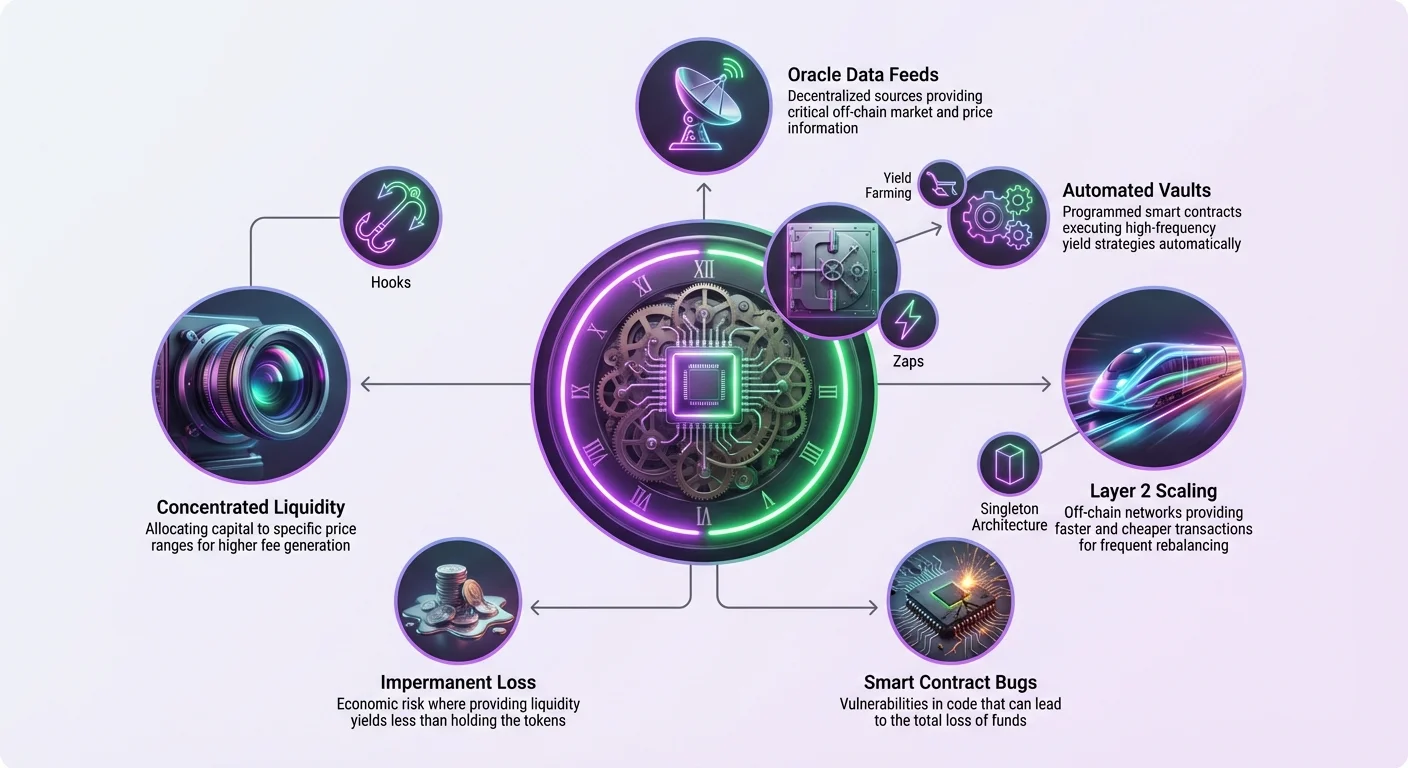
Aggregators also introduce features like "Zaps" to streamline the user experience. In many DeFi scenarios, entering a specific position requires multiple steps. A user might need to trade one token for another, deposit it into a liquidity pool to receive a receipt token, and then stake that receipt token in a gauge.
A Zap function collapses this entire workflow into a single click. The smart contract handles the intermediate swaps and deposits in the background. This not only saves time but also reduces the risk of user error during the multi-step process. By abstracting the complexity, aggregators make advanced yield strategies accessible to a broader audience.
Capital Efficiency in Decentralized Exchanges
The foundation of many yield strategies is the decentralized exchange (DEX). Platforms like Uniswap have revolutionized trading by replacing traditional order books with automated market makers (AMMs). In this model, users trade against a pool of tokens rather than a specific counterparty. The price is determined mathematically, ensuring liquidity is always available.
Evolution of Liquidity Provision
Early versions of AMMs distributed liquidity evenly across the entire price curve, from zero to infinity. While this ensured that trades could happen at any price, it was highly inefficient. The vast majority of liquidity was rarely used, as assets typically trade within a narrow price range.
Later iterations, such as Uniswap v3, introduced the concept of concentrated liquidity. This allows providers to allocate their capital to specific price ranges where trading is most active. By focusing liquidity where it is needed most, providers can earn significantly more trading fees with less capital. This shift drastically improved capital efficiency but increased the complexity of managing positions.
Hooks and Customization
The drive for efficiency continues with newer developments like Uniswap v4, which introduces "hooks." Hooks are external smart contracts that run at specific points in a pool's action lifecycle. Developers can use hooks to implement custom features such as on-chain limit orders, dynamic fee adjustments based on volatility, or internalized manufacturing of oracle prices.
This modularity allows for the creation of highly specialized pools tailored to specific asset types. For yield vaults, this means strategies can be even more precise, reacting to market conditions in real-time to optimize fee generation or protect against downside risk.
The Singleton Architecture
Another leap in efficiency comes from architectural changes that consolidate liquidity. Traditional DEX designs often required a new smart contract for every single token pair. This fragmentation increased the gas costs associated with multi-hop trades.
Newer protocols are moving toward a "singleton" architecture, where all pools live within a single smart contract. This design significantly reduces the gas required to create pools and execute swaps across multiple pairs. For aggregators and high-frequency traders, lower gas costs translate directly to higher net returns, as less value is lost to network fees during rebalancing and compounding operations.
Scaling Solutions and Infrastructure
The viability of complex yield strategies is heavily dependent on the underlying blockchain infrastructure. High transaction fees on mainnets like Ethereum can render many strategies unprofitable, especially for users with smaller capital allocations. If the cost to harvest and reinvest rewards exceeds the value of the rewards themselves, the compounding mechanism fails.
The Role of Layer 2 Networks
Scaling solutions like Polygon have emerged to address these limitations. By processing transactions off the main Ethereum chain and settling them in batches, Layer 2 networks offer faster speeds and significantly lower costs. This environment is fertile ground for DeFi applications that require frequent transactions.
On a network with negligible fees, yield vaults can rebalance their positions much more frequently. This allows them to react to market changes swiftly, capturing fleeting arbitrage opportunities or adjusting leverage ratios to avoid liquidation. The result is a more responsive and efficient strategy that can generate higher aggregate returns over time.
Zero-Knowledge Technology
The evolution of scaling technology is moving toward zero-knowledge (ZK) rollups. Solutions like the Polygon zkEVM mirror the Ethereum environment but use advanced cryptography to prove the validity of transactions. This allows developers to deploy existing Ethereum smart contracts to a high-performance network without rewriting code.
This compatibility is vital for the yield ecosystem. It means that battle-tested codes for vaults and strategies can be ported to scalable networks easily. Furthermore, new interoperability protocols are enabling "shared liquidity" across different chains. This prevents the fracturing of capital and allows yield strategies to access deep liquidity regardless of where the assets are originated.
Data Integrity and Oracle Reliance
Smart contracts are self-executing code, but they are blind to the outside world. They cannot inherently know the market price of an asset, the outcome of a real-world event, or the interest rate on a different platform. To function correctly, they rely on oracles to bridge the gap between on-chain code and off-chain data.
The Necessity of Accurate Feeds
Chainlink serves as a decentralized oracle network that provides this critical data. For a yield vault, accurate price feeds are non-negotiable. If a vault uses collateral to borrow assets, it needs to know the precise value of that collateral to maintain a healthy health factor.
If an oracle provides incorrect data, even for a moment, it can trigger catastrophic events. A falsely low price could cause a lending protocol to liquidate a vault's position, resulting in the loss of user funds. Conversely, a falsely high price could allow an attacker to drain the protocol by borrowing more than their collateral is worth.
Aggregation and Validation
To mitigate these risks, decentralized oracles use a process of aggregation. Rather than relying on a single source, the network requests data from multiple independent node operators. These nodes retrieve information from various market aggregators and APIs.
The data is then aggregated and validated on-chain to ensure it reflects the true market price. This consensus mechanism makes it extremely difficult for a single bad actor to manipulate the data feed. For yield strategies that operate autonomously, this reliability is the bedrock of security. Without trustworthy data, the automation becomes a liability rather than an asset.
Emerging Models in Capital Allocation
As the sector matures, new models for capital efficiency and yield generation are emerging. These go beyond simple lending and trading, incorporating elements of governance, real-world assets, and computational resources.
Governance and Compliance
Projects like World Liberty Financial represent a shift toward regulatory-compliant DeFi. By integrating Know Your Customer (KYC) protocols directly into the platform, these systems aim to attract institutional capital that is otherwise sidelined by regulatory uncertainty.
These platforms often utilize governance tokens that may have restricted transferability. Unlike typical tradeable assets, these tokens focus purely on voting rights, allowing holders to shape the direction of the protocol without the speculative volatility associated with open markets. This model prioritizes long-term alignment over short-term profit.
DePIN and Computational Yield
Another frontier is the intersection of blockchain and physical infrastructure, often called DePIN. Platforms like NodeAI allow users to monetize hardware resources, specifically GPUs. Instead of staking tokens to validate transactions, users stake computational power to support AI processing and rendering tasks.
In this model, yield is derived from the economic value of the compute provided. Stakers earn rewards in Ethereum or native tokens based on the utilization of their hardware. This represents a tangible connection between crypto assets and real-world utility, offering a yield source that is uncorrelated with the volatility of DeFi lending markets.
Risk Analysis and Smart Contract Security
While yield vaults offer automation and efficiency, they aggregate risk alongside capital. When a user deposits funds into a vault, they are exposing themselves to the risks of every underlying protocol that the strategy interacts with.
Smart Contract Vulnerabilities
The most pervasive risk is code failure. Bugs or exploits in a smart contract can lead to the total loss of funds. This risk is compounded in aggregators because they often stack multiple protocols on top of each other—a concept known as "money Legos." If one block in the tower fails, the entire structure can collapse.
Audits by firms like PeckShield are a standard defense, but they are not a guarantee of security. Investors must consider the track record of the protocol and the robust nature of its testing. Open-source code allows for community verification, but it also allows attackers to study the contract for weaknesses.
Impermanent Loss and Economic Risk
For strategies that involve providing liquidity to AMMs, impermanent loss is a constant threat. This occurs when the price of the tokens in a liquidity pool changes relative to when they were deposited. In many cases, simply holding the tokens would have resulted in a higher value than providing liquidity, even after accounting for trading fees.
Automated vaults attempt to mitigate this by selecting correlated assets or stablecoin pairs where price divergence is minimal. However, in volatile market conditions, algorithmic rebalancing can sometimes lock in losses rather than preventing them.
Strategy Comparison Matrix
| Strategy Type | Primary Yield Source | Risk Profile | Capital Efficiency |
|---|---|---|---|
| Lending Vaults | Interest paid by borrowers | Low to Moderate | Moderate |
| Liquidity Mining | Trading fees + Token rewards | High (Impermanent Loss) | High |
| Aggregators | Auto-switching best rates | Moderate (Smart Contract) | Very High |
The Future of Decentralized Trading
The trajectory of DeFi points toward deeper integration and smoother user experiences. Innovations like Uniswap's Unichain aim to create a unified environment across different blockchains. This would allow users to swap assets and provide liquidity across multiple networks without navigating complex bridges or fragmentation.
Cross-Chain Interoperability
The ability to move value seamlessly between Ethereum, Polygon, Arbitrum, and Optimism is becoming a reality. Protocols are developing standards that allow liquidity to be shared rather than siloed. For yield farmers, this means strategies can hunt for returns across the entire crypto ecosystem, not just a single chain.
The Role of Hooks in Yield
As developers embrace hooks and custom execution logic, we can expect a new generation of "smart" liquidity pools. These pools might automatically hedge against impermanent loss using options markets or adjust fees dynamically based on off-chain volatility data provided by oracles. This level of programmability transforms passive liquidity provision into an active, professional-grade strategy accessible to retail users.
Conclusion
Yield vaults and aggregation strategies represent a significant maturation of the cryptocurrency landscape. By automating complex processes and leveraging the speed of Layer 2 networks, these tools unlock capital efficiency that was previously unattainable for the average investor. They transform static assets into productive capital, utilizing every mechanism from concentrated liquidity to algorithmic rebalancing to generate returns.
However, this sophistication does not eliminate risk; it merely transforms it. The reliance on interconnected smart contracts, external oracles, and specific economic conditions means that users must remain vigilant. The difference between a profitable strategy and a total loss often lies in the integrity of the code and the accuracy of the data it consumes.
As the technology evolves, the line between simple holding and active participation will continue to blur. Innovations in cross-chain interoperability and real-world asset integration promise to expand the definition of yield. For the informed participant, these tools offer powerful capabilities, provided one navigates the underlying risks with caution and understanding.
Automation maximizes potential returns, but rigorous due diligence is the only true safeguard against the inherent risks of decentralized finance.