
The cryptocurrency market has evolved significantly beyond simple spot trading where investors buy and hold digital assets. As the ecosystem matures, financial instruments have become increasingly sophisticated. These instruments mimic traditional finance but operate with the unique volatility and 24/7 nature of the blockchain world. Among these advanced tools are derivatives, which include futures, options, and more exotic variations like binary options.
Derivatives are financial contracts between two or more parties that derive their value from an underlying asset. In the context of cryptocurrency, the underlying asset is typically a digital currency like Bitcoin or Ethereum. These instruments allow traders to speculate on future price movements without necessarily owning the asset itself. This opens up strategies for hedging against risk and amplifying potential returns through leverage.
However, the complexity of these instruments introduces significant risks. While spot trading carries the risk of asset depreciation, derivatives add layers of complexity involving liquidation, expiration dates, and funding rates. Understanding the mechanics of these financial products is essential for anyone looking to navigate the advanced sectors of the crypto economy.
The Mechanics of Binary Options
Binary options represent one of the simplest yet most high-risk forms of derivative trading. As the name suggests, the outcome of a binary option is a "yes or no" proposition. A trader speculates on whether the price of a specific cryptocurrency will be above or below a certain level at a specific time. This binary nature results in a fixed payout or a total loss.
Unlike traditional options, where the potential profit or loss can vary depending on how far the price moves, binary options have a capped upside and downside. If the trader’s prediction is correct, they receive a predetermined payout. This is often a percentage of the investment. If the prediction is incorrect, the trader loses the entire initial stake.
The appeal of binary options lies in their simplicity and the speed of settlement. Contracts can be extremely short-term, sometimes lasting only minutes or even seconds. This allows for rapid turnover of capital. However, this speed also encourages impulsive decision-making. The "all-or-nothing" structure means that even a small price deviation against the trader results in a 100% loss of the trade amount.
Risk Factors in Binary Trading
The primary risk in binary options is the negative expected value over time. Since payouts are typically less than 100% of the investment (often ranging from 70% to 90%), a trader must win more than 50% of their trades just to break even. This creates a mathematical hurdle similar to the house edge in casino games.
Volatility is another critical factor. Cryptocurrency markets are known for sharp, unpredictable price swings. In a standard trade, a temporary dip might be recoverable. In a binary option with a fixed expiry, a momentary fluctuation at the wrong second causes a total loss. The lack of liquidity in some binary option markets can also lead to pricing discrepancies.
Regulatory concerns are paramount in the binary options space. Many jurisdictions have banned or heavily restricted these instruments due to their resemblance to gambling and the prevalence of fraudulent platforms. Traders engaging in binary options often face higher counterparty risks, as they must rely entirely on the platform's integrity to honor payouts and provide accurate price data.
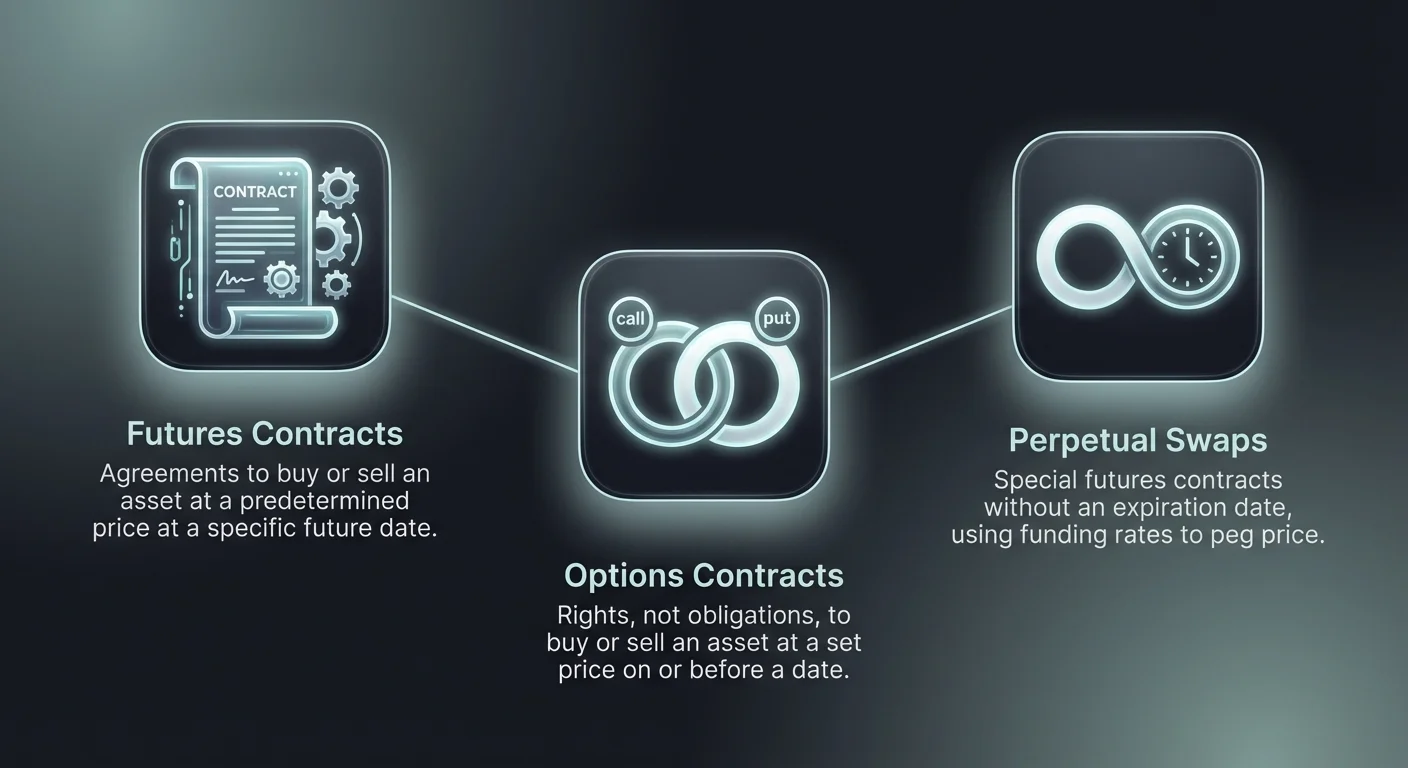
Terminske pogodbe in večne zamenjave
Terminske pogodbe so sporazumi za nakup ali prodajo sredstva po vnaprej določeni ceni ob določenem času v prihodnosti. Na trgu kriptovalut ti instrumenti omogočajo trgovcem, da špekulirajo o prihodnji vrednosti digitalnih sredstev. služijo dvema primarnima funkcijama: špekulaciji in zaščiti. Špekulatorji uporabljajo terminske pogodbe za dobiček iz gibanja cen, medtem ko rudarji ali imetniki uporabljajo za zaklepanje cen in omiliti tveganja.
Med tradicionalnimi terminskimi pogodbami in edinstvenimi 'večnými' pogodbami na kripto obstajajo jasne razlike. Tradicionalne terminske pogodbe imajo določen datum izteka. Na ta datum se pogodba poravna, stranke pa morajo izpolniti svoje obveznosti. Cena terminske pogodbe se lahko razlikuje od spot cene sredstva in se približa šele ob približevanju datuma izteka.
Večne terminske pogodbe: Kripto standard
Večne terminske pogodbe, pogosto imenovane 'perp', so posebna vrsta terminskih pogodb brez datuma izteka. To omogoča trgovcem, da držijo pozicije nedoločen čas, če ohranjajo zadostno maržo za izogib likvidaciji. Ker ni datuma poravnave, večne terminske pogodbe uporabljajo mehanizem, imenovan 'stopnja financiranja', da ohranjajo ceno pogodbe blizu spot cene osnovnega sredstva.
Stopnja financiranja je periodična plačila, ki se izmenjujeta med dolgimi in kratkimi trgovci. Če je cena perpetuala višja od spot cene, je stopnja financiranja pozitivna, imetniki dolgih pozicij plačajo imetnikom kratkih pozicij. To spodbuja trgovce k prodaji in znižuje ceno. Obratno, če je perpetual cenejši od spot, kratki plačajo dolgim, kar spodbuja nakupni pritisk.
Ta mehanizem zagotavlja, da se cena derivata ne oddalji bistveno od realne vrednosti kriptovalute. Za trgovce stopnje financiranja predstavljajo strošek nošenja ali potencialni prihodkovni tok, odvisno od njihove tržne pozicije in splošnega tržnega sentimenta. Prezrtje stopenj financiranja lahko erodira dobičke skozi čas, zlasti na močno trendno usmerjenih trgih.
Pojasnilo inverznih terminskih pogodb
Druga variacija na trgih kriptovalut je inverzna terminska pogodba. V standardnih linearnih terminskih pogodbah je marža in poravnava običajno denominirana v stabilcoinu, kot je USDT ali USDC. V inverznih terminskih pogodbah je pogodba maržirana in poravnana v osnovni kriptovaluti sami, kot je Bitcoin ali Ethereum.
Ta struktura privlači trgovce, ki želijo akumulirati osnovno sredstvo. Če trgovec gre dolg na inverzno terminsko pogodbo Bitcoina in cena naraste, dobiček izhaja iz povečanja vrednosti pogodbe in apreciacije Bitcoina, ki ga drži kot kolateral. Vendar je tveganje na spodnji strani tudi stopnjevano. Če vrednost kolaterala pade, se likvidacijska cena doseže hitreje kot pri stabilcoin kolateralu.
The Fundamentals of Options Trading
Options trading provides a different set of strategic possibilities compared to futures. An options contract gives the buyer the right, but not the obligation, to buy or sell an asset at a specific price on or before a certain date. This distinction is crucial. While futures commit the trader to a transaction, options offer the choice to execute the trade only if it is profitable.
There are two primary types of options: calls and puts. A call option gives the holder the right to buy the asset. This is typically used when a trader expects prices to rise. A put option gives the holder the right to sell the asset, which is useful when anticipating a price decline.
Call and Put Mechanics
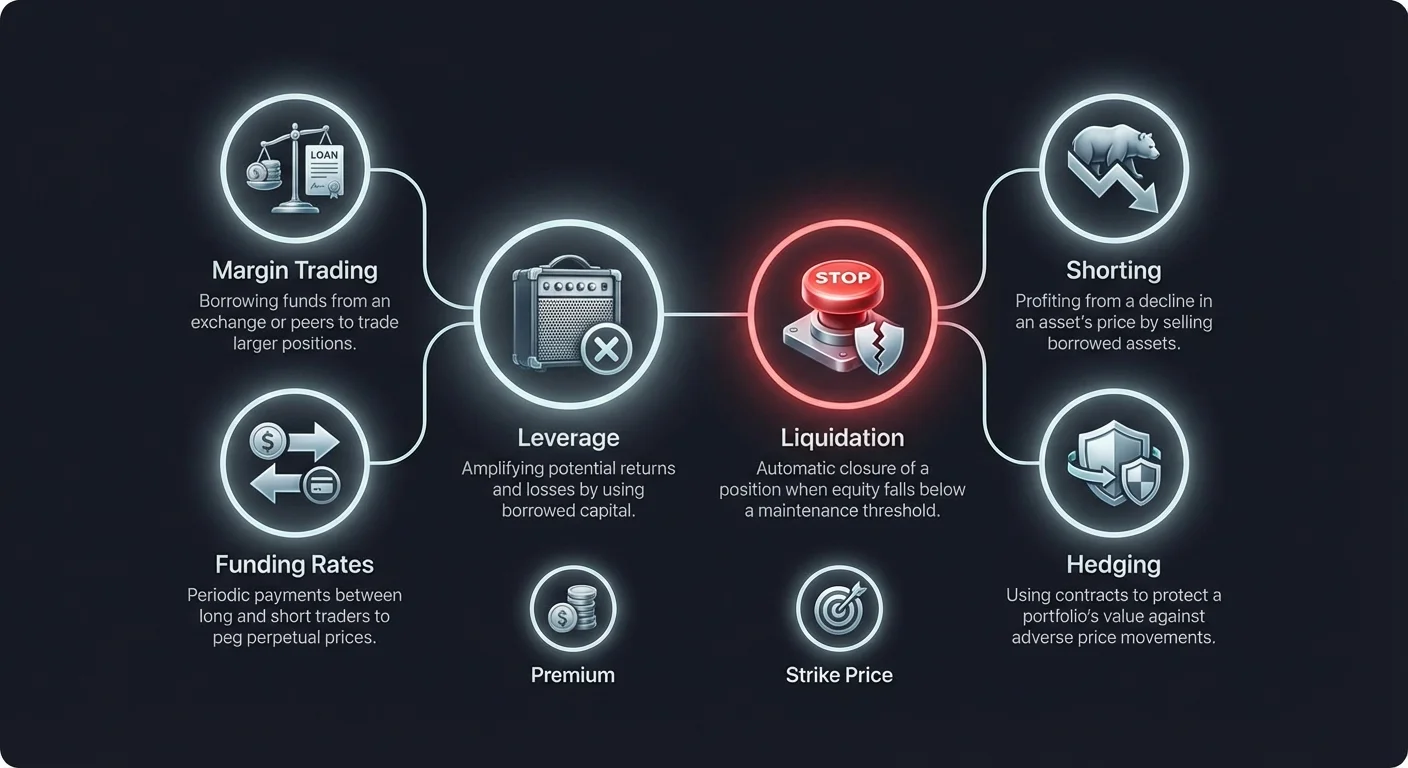
When buying a call option, the trader pays a fee known as the premium. If the market price rises above the "strike price" (the agreed-upon price in the contract) plus the premium paid, the trader makes a profit. If the price stays below the strike price, the trader simply lets the option expire. The loss is limited strictly to the premium paid upfront.
Put options work in reverse. The buyer of a put option profits if the market price falls below the strike price. This makes puts an effective insurance policy. For example, a holder of Bitcoin concerned about a short-term market crash might buy put options. If the market crashes, the profit from the put option offsets the loss in the value of their holdings.
American vs. European Options
Options are further categorized by when they can be exercised. American options allow the holder to exercise their right to buy or sell at any point before the expiration date. This flexibility offers more strategic control but often commands a higher premium.
European options, on the other hand, can only be exercised on the exact date of expiration. While less flexible, they are common in the institutional crypto market and often come with lower premiums. Traders must understand which type of option they are purchasing, as it fundamentally alters the exit strategy and potential liquidity of the position.
| Feature | American Options | European Options |
|---|---|---|
| Exercise Time | Any time before expiry | On expiry date only |
| Flexibility | High | Low |
| Premium Cost | Generally Higher | Generally Lower |
Shorting and Market Downturns
Shorting is a trading strategy used to profit from a decline in an asset's price. In the context of cryptocurrency, shorting allows traders to make money even when the market is entering a bearish phase. The mechanics involve borrowing an asset and selling it at the current market price. The trader's goal is to repurchase the asset later at a lower price to return it to the lender.
The difference between the selling price and the repurchase price represents the profit. For instance, if a trader shorts Bitcoin at $50,000 and buys it back at $40,000, they profit $10,000 per unit, minus any fees. This capability adds depth to the market, allowing for price discovery in both directions rather than just upward speculation.
Risks of Short Positions
While shorting offers profit potential during downturns, it carries a unique risk profile. When buying an asset (going long), the maximum loss is capped at the amount invested; the price cannot fall below zero. However, when shorting, the potential loss is theoretically unlimited.
If the price of the asset rises instead of falls, the trader must buy it back at a higher price to close the position. Since there is no theoretical ceiling on how high a cryptocurrency price can go, the losses can accumulate rapidly. This is particularly dangerous in crypto, where prices can double or triple in short periods.
Short squeezes occur when a highly shorted asset unexpectedly rises in price. As short sellers rush to buy back the asset to cut their losses, their buying pressure drives the price even higher. This forces more shorts to liquidate, creating a feedback loop of rising prices and cascading liquidations.
Methods of Shorting
There are several ways to execute a short position. Margin trading is the most direct method, where the exchange lends the asset directly to the trader. Futures contracts are another popular vehicle, as they allow traders to open short positions without ever handling the underlying asset.
Inverse Exchange-Traded Products (ETPs) and leveraged tokens also offer short exposure. These are financial products designed to move in the opposite direction of the underlying asset. For example, a "3x Short BTC" token aims to increase by 3% for every 1% drop in Bitcoin's price. These products simplify the process by removing the need to manage margin or borrowing manually, though they carry their own risks related to rebalancing and decay.
Margin Trading and Leverage
Margin trading is the practice of using borrowed funds to trade a financial asset. This borrowed capital acts as leverage, allowing the trader to open a position larger than their actual account balance would permit. The funds are typically provided by the exchange or other users on the platform who earn interest on the loan.
The primary benefit of margin trading is capital efficiency. A trader can gain exposure to a large position with a relatively small amount of initial capital, known as collateral. If the trade is successful, the percentage return on the trader's equity is magnified.
Calculating Leverage Mechanics
Leverage is expressed as a ratio, such as 2:1, 10:1, or even 100:1. A 10:1 leverage ratio means that for every $1 of their own capital, the trader controls $10 of the asset. If the asset price moves by 1% in the desired direction, the trader gains 10% on their equity (minus fees).
However, leverage works both ways. A 1% move against the position results in a 10% loss of equity. This amplification of volatility is why leverage is considered a double-edged sword. High leverage ratios leave very little room for market noise. In a 100x leverage scenario, a mere 1% price move against the trade can result in a total loss of the collateral.
Maintenance Margin and Liquidation
To keep a leveraged position open, traders must maintain a minimum equity level known as the maintenance margin. If the market moves against the trade and the account equity falls below this threshold, the exchange will initiate a margin call.
In traditional finance, a margin call involves a request for the trader to deposit more funds. In the fast-paced crypto market, however, exchanges often use automatic liquidation engines. If the maintenance margin is breached, the system automatically closes the position to prevent the loss from exceeding the collateral. This process, known as liquidation, often comes with additional fees and results in the loss of the initial investment.
| Leverage Ratio | Price Move for 100% Gain | Price Move for Liquidation (Approx) |
|---|---|---|
| 2x | +50% | -50% |
| 10x | +10% | -10% |
| 50x | +2% | -2% |
Contract Trading Strategies
Traders utilize various strategies when engaging with contracts and derivatives. These approaches vary based on time horizon, risk tolerance, and market conditions. Understanding these strategies helps in selecting the right instrument for the specific market view.
Scalping is a high-frequency strategy where traders aim to profit from small price changes. Scalpers may execute dozens or hundreds of trades in a single day. Derivatives like perpetual futures are often preferred for this due to high liquidity and tight spreads. Leverage is frequently used to make the small price movements meaningful in terms of profit.
Swing Trading and Hedging
Swing trading involves holding positions for several days or weeks to capture significant market moves. Unlike scalpers, swing traders are less concerned with minute-to-minute volatility. They rely on technical analysis to identify trends. Contract trading allows swing traders to profit from both bullish and bearish trends with equal ease.
Hedging is a risk management strategy rather than a profit-seeking one. Investors who hold large amounts of physical cryptocurrency may use short contracts to protect their portfolio value. If the market drops, the profit from the short contract offsets the decline in the portfolio's value. This is common among miners who want to lock in revenue streams against price volatility.
Arbitrage Opportunities
Arbitrage involves exploiting price discrepancies between different markets or instruments. In contract trading, a common strategy is funding rate arbitrage. If the funding rate for a perpetual contract is high, a trader might sell the perpetual contract and buy the spot asset.
By doing this, they capture the funding payment while remaining market-neutral, as the long spot position and short futures position cancel out price risk. This strategy requires precise execution and an understanding of the costs involved, but it offers a way to generate yield with reduced exposure to directional price movements.
Provizije in stroški v trgovanju z derivati
Trgovanje z derivati vključuje kompleksno strukturo provizij, ki lahko bistveno vpliva na dobičkonosnost. Za razliko od trgovanja na mestu, ki običajno vključuje preprosto transakcijsko provizijo, derivati nosijo stalne stroške, ki jih je treba vključiti v katero koli strategijo.
Najpogostejši stroški so transakcijske provizije, pogosto razdeljene na maker in taker provizije. Makerji, ki zagotavljajo likvidnost z limitnimi naročili, običajno plačajo nižje provizije ali celo prejmejo povrnitve. Takerji, ki izvajajo tržna naročila, ki odstranjujejo likvidnost, plačajo višje provizije. Visokofrekvenčne strategije, kot je scalping, so še posebej občutljive na te transakcijske stroške.
Stroški financiranja in izposoje
Za večne terminske pogodbe je stopnja financiranja spremenljiv strošek. Čeprav lahko služi kot vir dohodka, je pogosto strošek za prenatrpano stran trga. Med močnim bikovskim trgom lahko dolgi trgovci plačajo znatne vsote v provizijah financiranja za ohranjanje pozicij odprtih.
V trgovanju z maržo se obresti za izposojo zaračunajo na sredstvih, uporabljenih za vzvodno pozicijo. Te obresti se kopičijo skozi čas, običajno na urni ali dnevni osnovi. Za dolgoročne pozicije lahko ti obrestni stroški postanejo znatni in erodirajo potencialne dobičke iz trgovanja. Provizije za likvidacijo so še en potencialen strošek, zaračunan, če je pozicija prisilno zaprta, kar doda žalost k finančni poškodbi.
Exotic Instruments and Products
Beyond standard futures and options, the crypto market offers various "exotic" instruments. These products are often designed to package complex trading strategies into simpler tokens or contracts. However, simplicity in execution often masks complexity in structure and risk.
Leveraged tokens are one such example. These are assets that trade on spot markets but represent a leveraged position in a futures market. For instance, a "3x Long ETH" token automatically manages a 3x leveraged position in Ethereum. The token rebalances itself daily to maintain the target leverage.
Volatility and Decay Risks
The primary risk with leveraged tokens and similar structured products is volatility decay. Because the tokens rebalance daily, they perform poorly in chopping or sideways markets. If an asset price goes up 10% one day and down 10% the next, a holder of the underlying asset has lost about 1%. A holder of a leveraged token would lose significantly more due to the mathematical compounding effects of rebalancing.
Other exotic instruments include move contracts, which allow traders to bet on the magnitude of price movement rather than the direction. These are pure volatility plays. While they offer unique ways to profit from market uncertainty, they require a sophisticated understanding of market mechanics and implied volatility.
The Regulatory Landscape
The regulatory environment for crypto derivatives is fragmented and evolving. Different jurisdictions view these instruments through vastly different lenses, creating a complex compliance landscape for global platforms and traders.
In some regions, crypto derivatives are strictly regulated. Platforms must register with financial authorities, implement strict Know Your Customer (KYC) protocols, and adhere to capital requirements. These regulations often limit the amount of leverage available to retail traders to protect them from excessive risk.
Bans and Restrictions
Other jurisdictions have taken a more prohibitive approach. Several countries have banned the sale of crypto derivatives to retail investors entirely, citing the high risk of loss and the complexity of the products. In these regions, only professional or institutional investors are permitted to access these markets.
The lack of a unified global framework means that the availability of specific instruments, such as binary options or high-leverage futures, depends heavily on the user's location. Traders often face geo-blocking or are redirected to specific subsidiaries of exchanges that comply with local laws. Operating on unregulated platforms carries the risk of sudden service termination or lack of legal recourse in disputes.
Centralized vs. Decentralized Derivatives
The venue where derivatives are traded fundamentally affects the risk profile and user experience. Centralized Exchanges (CEXs) have historically dominated the market. They offer deep liquidity, high-speed matching engines, and customer support. CEXs act as the custodian of funds, meaning traders must trust the platform to secure their assets.
Centralized platforms are generally easier for beginners to navigate. They offer fiat on-ramps, allowing users to deposit traditional currency to start trading. However, they are single points of failure. If a centralized exchange goes offline during high volatility, traders may be unable to manage their positions, leading to unfair liquidations.
The Rise of Decentralized Derivatives
Decentralized Exchanges (DEXs) offer an alternative by facilitating trading through smart contracts on a blockchain. In this model, users retain custody of their funds until the moment the trade executes. This eliminates the risk of the exchange mismanaging user funds or freezing accounts.
Decentralized derivative platforms are maturing but face challenges regarding liquidity and speed. On-chain transactions can be slower and more expensive than centralized database updates. However, innovations like Layer 2 scaling solutions are narrowing this gap. DEXs also provide greater privacy and are accessible to anyone with a wallet, though this openness often puts them at odds with regulatory compliance requirements.
Risk Management in Derivatives
Given the high stakes of derivative trading, risk management is not optional; it is essential for survival. The use of leverage and the volatility of the underlying assets create a precarious environment where capital preservation must be the priority.
Position sizing is the foundation of risk management. Traders should never risk more than a small percentage of their total capital on a single trade. By keeping position sizes small, a string of losses does not result in a catastrophic blow to the portfolio. This is particularly important in binary options and high-leverage futures where total loss is a distinct possibility.
Stop-Losses and Diversification
A stop-loss order is a tool that automatically closes a position once the price reaches a certain level. It acts as a safety net, ensuring that a bad trade is cut short before it drains the account. In volatile crypto markets, "guaranteed" stop-losses are valuable but not always available; slippage can occur where the execution price is worse than the stop price during a crash.
Diversification across different strategies and timeframes can also mitigate risk. Instead of putting all capital into a single high-leverage long position, a trader might mix spot holdings, low-leverage swings, and hedging contracts. This balanced approach helps smooth out the equity curve and reduces the emotional stress associated with trading.
Technical Analysis and Indicators
Successful derivative trading often relies heavily on technical analysis. Because these instruments are used for speculation, price action and market sentiment are primary drivers of decision-making. Traders use charts to identify support and resistance levels, trends, and potential reversal points.
Indicators such as the Relative Strength Index (RSI), Moving Averages, and Bollinger Bands help traders gauge market momentum and volatility. In binary options, where timing is everything, oscillators that indicate overbought or oversold conditions are frequently used. In futures trading, open interest (the total number of outstanding contracts) is a critical metric. Rising open interest combined with rising prices typically confirms a strong trend, while diverging signals may warn of a reversal.
Conclusion
The world of binary options and exotic crypto instruments offers a vast array of opportunities for traders willing to engage with complexity and risk. From the simplicity of binary outcomes to the perpetual mechanics of futures and the strategic depth of options, these tools allow for precise expressions of market views. They enable strategies that go far beyond simple appreciation, allowing for profit in falling markets, hedging against losses, and capitalizing on volatility itself.
However, these instruments are powerful tools that demand respect. The inclusion of leverage, the threat of liquidation, and the intricacies of funding rates and premiums create a landscape where mistakes are costly. The regulatory environment adds another layer of consideration, as access to these markets varies significantly by jurisdiction. Success requires not just the ability to predict price movements, but a disciplined approach to risk management and a thorough understanding of the contractual mechanics at play.
Derivatives amplify both the efficiency of your capital and the speed at which you can lose it.