
The cryptocurrency landscape has evolved significantly beyond simple buy-and-hold strategies. Investors today have access to a sophisticated array of financial instruments designed to generate yield, manage risk, and optimize portfolio performance regardless of market direction. Among the most prominent developments in this sector are advanced structured products that utilize derivatives, lending mechanisms, and automated execution to enhance returns.
Understanding the underlying components of these products is essential for any investor looking to navigate the modern digital asset economy. By dissecting the mechanics of volatility management, lending protocols, and derivative markets, market participants can better comprehend how structured yield is generated. This exploration begins with the fundamental forces that drive these opportunities, specifically the unique behavior of crypto markets compared to traditional finance.
The Role of Market Volatility in Yield Generation
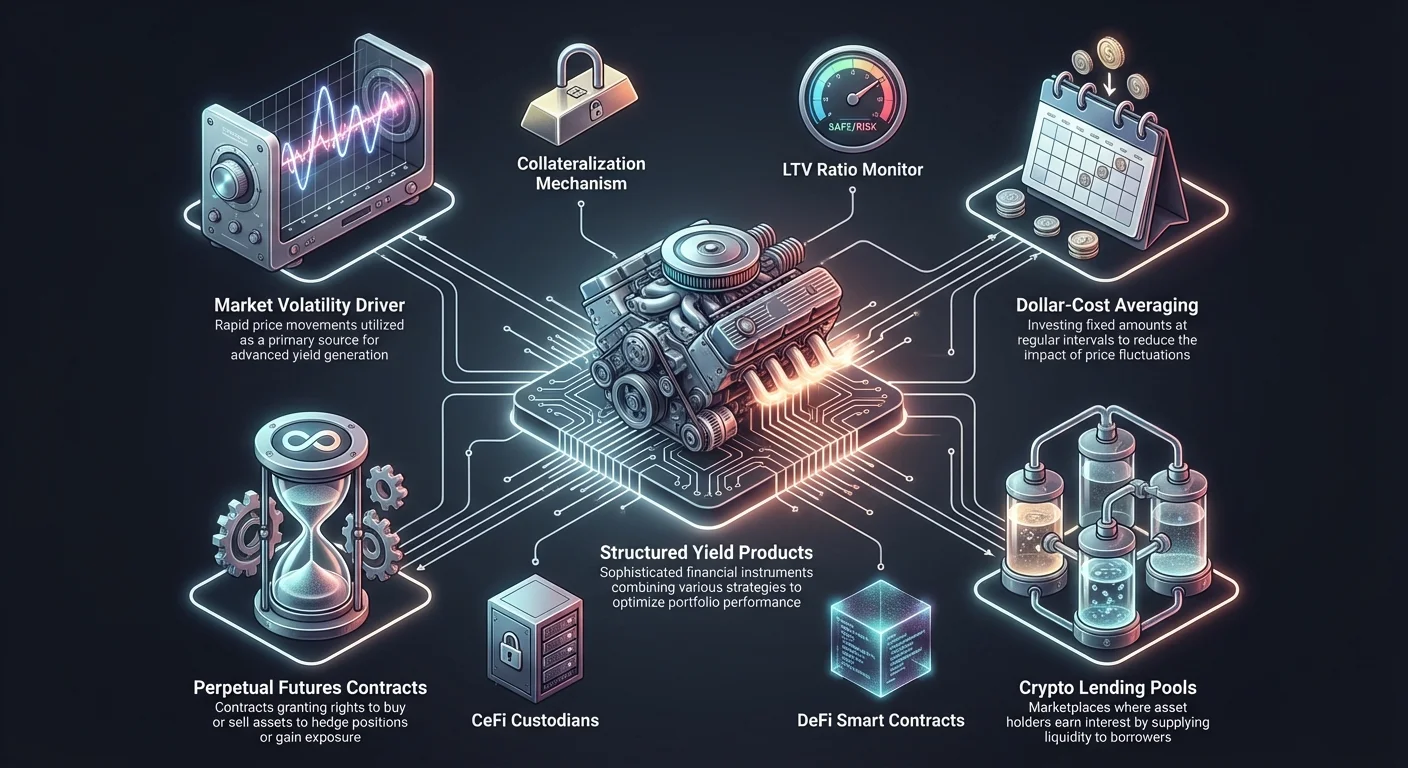
Volatility refers to the frequency and magnitude of price movements within a market. In the cryptocurrency sector, volatility is often significantly higher than in traditional asset classes like stocks, bonds, or commodities. This characteristic is not merely a risk factor but a primary driver for yield generation in structured products. When prices fluctuate rapidly, the premiums for options and the demand for liquidity often increase, creating fertile ground for advanced strategies.
Several factors contribute to this heightened volatility. The first is market maturity. Cryptocurrencies represent a relatively new asset class that has not yet reached the stability found in established financial systems. The market is growing and evolving at a pace that far exceeds traditional assets. Because digital assets are still in a phase of price discovery, participants often lack the historical data required to price assets accurately, leading to uncertainty and rapid shifts in valuation.
Market size and liquidity also play critical roles. Despite its growth, the cryptocurrency market remains smaller than global equity or currency markets. In a smaller market, trades that would be considered insignificant in traditional finance can have a substantial impact on asset prices. This liquidity dynamic means that large buy or sell orders can trigger significant price swings, creating the volatility that structured yield products often seek to capitalize on.
Dollar-Cost Averaging as a Foundational Strategy
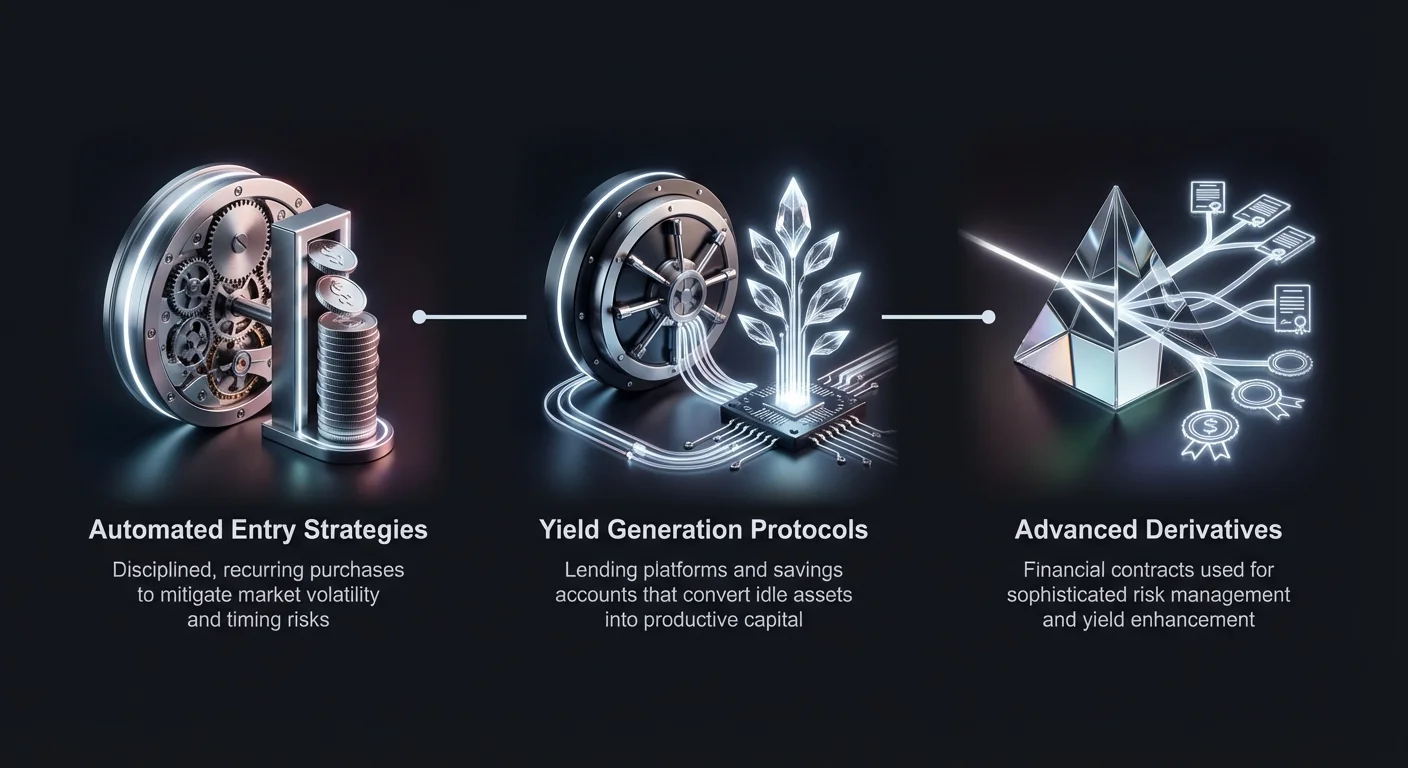
Dollar-cost averaging (DCA) serves as a fundamental building block for many automated investment products. This strategy involves investing a fixed amount of money at regular intervals, regardless of the asset's price at that moment. The primary objective is to mitigate the risk of timing the market incorrectly. By spreading purchases over time, investors reduce the impact of short-term price fluctuations and emotional decision-making.
Analyzing Performance in Different Market Conditions
To understand how structured approaches utilize time-based entry, one must examine performance in extreme market scenarios. Consider a scenario often referred to as "buying the top." This occurs when an investor purchases an asset at its peak value before a significant decline. Predicting peaks and troughs is notoriously difficult, even for professional traders.
Historical data provides insight into how averaging strategies perform against lump-sum investments during downturns. In a hypothetical example, an investor enters the market on January 1, 2018, with Bitcoin priced at $13,657. Over a two-year period, the price drops to $7,200. A lump-sum investment of $2,100 at the peak would result in a portfolio value of approximately $1,055 after two years, representing a loss of roughly 50%.
In contrast, applying a dollar-cost averaging strategy to the same capital yields different results. By investing $20 every week for 105 weeks, the investor accumulates assets at various price points as the market falls. At the end of the two-year period, the total value of the investment would be approximately $2,327. This represents a profit of roughly 11%, demonstrating how consistent entry can turn a potential loss into a modest gain.
Catching the Bottom and Market Recovery
The strategy also functions effectively during market recoveries, often described as "catching the bottom." This refers to attempting to buy an asset at its lowest price during a correction. While profitable if executed perfectly, accurately predicting the absolute bottom is risky and difficult. Structured buying mitigates this risk by ensuring participation throughout the recovery phase.
Consider a scenario starting on January 1, 2019, with Bitcoin priced at $3,844. Over the subsequent two years, the price rises to $29,374. A lump-sum investment of $2,100 at the start would yield a portfolio value of $15,274, resulting in a 400% profit. This assumes the investor correctly identified the entry point.
A dollar-cost averaging approach during this same period, investing $20 weekly, would result in a portfolio value of $7,591. While the total profit of 260% is lower than the perfect lump-sum timing, it remains a significant gain achieved without the risk of needing to identify the exact bottom. This demonstrates that automated, structured entry preserves capital during downturns while still capturing substantial upside during growth phases.
Automated Investment Infrastructures
Modern crypto exchanges have integrated these strategies into automated frameworks known as Auto DCA. This infrastructure allows users to set specific parameters for recurring purchases, removing the manual effort required to execute trades. By automating the process, investors ensure discipline and avoid the psychological pitfalls of reacting to daily market noise.
Mechanics of Automated Buying
Auto DCA functions by executing buy orders at pre-set intervals—daily, weekly, biweekly, or monthly. The system deducts funds from a designated source and purchases the target cryptocurrency at the current market rate. This mechanism ensures that the investor accumulates more units when prices are low and fewer units when prices are high, effectively averaging the cost per unit over the long term.
The flexibility of these systems allows for customization based on individual financial goals. Users can adjust the investment amount or frequency at any time. This adaptability is crucial for maintaining a long-term strategy that can evolve with changing financial circumstances. Furthermore, these automated systems support a wide range of assets, including Bitcoin, Ethereum, and various stablecoins, allowing for diversified portfolio construction.
Benefits of Automation in Yield Products
Integrating automation into investment strategies offers several distinct advantages. The most significant is the reduction of volatility risk. By avoiding a single large entry point, the portfolio is less susceptible to immediate market crashes. This smoothing effect is particularly valuable in the crypto market, where double-digit percentage moves within a single day are not uncommon.
Simplicity and discipline are also key benefits. Advanced trading often requires complex technical analysis and constant monitoring. Automated strategies remove this burden, making disciplined investing accessible to those without expert financial knowledge. It eliminates the stress associated with trying to time the market, allowing investors to focus on long-term wealth accumulation rather than short-term price action.
The preservation of optionality is another critical advantage. By deploying capital in fractions rather than a lump sum, investors maintain cash reserves. This liquidity provides the flexibility to adapt to new opportunities or changing market conditions. Instead of being fully committed to a single position, the investor retains the ability to pivot or increase allocations if market dynamics shift favorably.
Crypto Lending and Yield Generation
A core component of many structured yield products is the underlying lending market. Crypto lending platforms facilitate the borrowing and lending of digital assets, creating a marketplace for liquidity. This system allows holders of cryptocurrency to earn passive income by providing their assets to borrowers, who in turn pay interest on the loans.
How Lending Platforms Operate
Lending platforms function as intermediaries that connect liquidity providers with borrowers. Lenders deposit their crypto assets into a pool, which is then utilized to fund loans. In return for depositing their assets, lenders receive interest payments. The interest rates are typically determined by supply and demand dynamics within the specific platform and asset class.
Borrowers on these platforms are often traders seeking leverage or liquidity without selling their long-term holdings. To secure a loan, borrowers must typically provide collateral. This collateral is usually in the form of other cryptocurrencies and must exceed the value of the loan to provide a safety margin for the lender.
Collateralization and Loan-to-Value Ratios
The safety of the lending ecosystem relies heavily on collateralization. Most crypto loans are over-collateralized, meaning the borrower pledges assets worth more than the loan amount. This protects the lender against default and market volatility. The relationship between the loan amount and the collateral value is expressed as the Loan-to-Value (LTV) ratio.
For example, if a platform offers a 50% LTV, a borrower depositing $10,000 worth of Bitcoin can access a loan of up to $5,000. A lower LTV ratio generally implies lower risk for the lender and may result in more favorable interest rates for the borrower. Conversely, higher LTV ratios increase the borrowing power but also heighten the risk of liquidation if the collateral's value drops.
| Component | Definition | Implication |
|---|---|---|
| LTV Ratio | Loan amount vs. collateral value | Determines borrowing power and risk level |
| Collateral | Assets pledged to secure loan | Protects lender from borrower default |
| Liquidation | Selling collateral to cover loan | Occurs when collateral value drops too low |
Margin Calls and Liquidation Risks
Managing collateral is a dynamic process due to the volatile nature of cryptocurrency prices. If the value of the pledged collateral falls significantly, the LTV ratio increases. When this ratio breaches a critical threshold, the borrower receives a margin call. This is a notification requiring the borrower to deposit additional collateral to restore a healthy LTV ratio.
If the borrower fails to add collateral or if the market drops too rapidly, the platform executes a liquidation. This involves selling a portion or all of the collateral to repay the loan and accrued interest. This mechanism ensures that the lender's principal is protected even in adverse market conditions. Understanding these mechanics is vital for anyone participating in structured yield products that rely on lending protocols.
Savings Accounts and Interest Mechanisms
Crypto savings accounts represent the passive side of the lending equation. These accounts allow users to deposit digital assets and earn interest, similar to traditional bank savings but often with significantly higher yields. The interest generated is a result of the platform lending these assets out to institutional borrowers, traders, or decentralized protocols.
Centralized vs. Decentralized Savings
There are two primary approaches to crypto savings: Centralized Finance (CeFi) and Decentralized Finance (DeFi). CeFi platforms are managed by companies that act as custodians of the user's funds. They manage the lending activities, compliance, and security. Users trust the platform to safeguard their assets and generate returns. These platforms often offer user-friendly interfaces and customer support.
DeFi platforms, in contrast, operate through smart contracts on a blockchain. There is no central intermediary; instead, code governs the lending and borrowing rates based on real-time pool utilization. Users retain control of their assets via non-custodial wallets. While DeFi eliminates counterparty risk associated with a central company, it introduces smart contract risk, where vulnerabilities in the code could be exploited.
Flexible vs. Fixed-Term Options
Savings products often come in two formats: flexible and fixed-term. Flexible accounts allow users to withdraw their funds at any time. This liquidity is ideal for investors who may need to access their capital quickly or who wish to trade actively. However, flexible accounts typically offer lower interest rates compared to their fixed counterparts.
Fixed-term accounts require users to lock their assets for a predetermined period, such as 30, 60, or 90 days. In exchange for sacrificing liquidity, users receive higher interest rates. This structure provides the platform with stable capital for lending, allowing them to offer better returns to depositors. Choosing between these options depends on the investor's time horizon and liquidity needs.
Asset-Specific Yield Potential
The potential yield varies significantly depending on the asset deposited. Stablecoins like USDT and USDC often command higher interest rates, typically ranging from 6% to 12% APY. This is driven by the high demand for stable collateral in trading and lending markets. Investors seek stablecoins to hedge against volatility or to facilitate efficient settlement.
Major cryptocurrencies like Bitcoin and Ethereum generally offer lower yields compared to stablecoins, often between 1% and 7%. However, holding these assets in interest-bearing accounts allows investors to compound their holdings of the underlying asset. Other altcoins, such as Polkadot or Solana, may offer higher staking-based rewards, reflecting their specific network inflation and demand dynamics.
Derivatives and Options Market Infrastructure
Advanced structured products often utilize derivatives to enhance yield or hedge positions. Derivatives are financial contracts whose value is derived from an underlying asset. In the crypto space, the most common derivatives are futures and options. These instruments allow traders to speculate on price movements or manage risk without necessarily holding the asset itself.
Mechanics of Options Trading
Options trading provides the holder with the right, but not the obligation, to buy or sell an asset at a specific price before a certain date. This distinct feature separates options from futures, where the contract holder is obligated to execute the trade. Options are categorized into two main types: calls and puts. A call option gives the right to buy, while a put option gives the right to sell.
Options exchanges facilitate these trades, offering advanced strategies for experienced market participants. Traders use options to hedge against potential price drops or to generate income through premium collection. For example, selling call options against a held position (covered calls) is a common strategy to generate yield in flat or slightly bearish markets.
Futures and Perpetual Contracts
Futures contracts are agreements to buy or sell an asset at a predetermined price at a future date. These are widely used for hedging risks or speculating on market trends. A specific type of futures contract popular in crypto is the perpetual future. Unlike standard futures, perpetuals do not have an expiration date. Traders can hold positions indefinitely as long as they maintain sufficient margin.
Perpetual futures use a funding rate mechanism to keep the contract price aligned with the spot price of the asset. If the futures price is higher than the spot price, longs pay shorts. If it is lower, shorts pay longs. This funding rate can be a significant source of yield for traders who take the opposite side of the dominant market trend.
Leverage and Margin Trading
Margin trading platforms allow users to trade with borrowed funds, amplifying their buying power. This leverage can significantly increase potential profits but also magnifies losses. In the context of structured products, leverage is often managed carefully to enhance yield without exposing the portfolio to excessive liquidation risk.
Trading with leverage involves maintaining a maintenance margin. If the market moves against the position, the equity in the account may drop below this level, triggering a liquidation. Advanced platforms offer various tools to manage this risk, including stop-loss orders and real-time margin monitoring.
Tokenizirana sredstva in alternativni trgi
Obseg strukturiranega donosa se razteza onkraj domačih kriptovalut do vključevanja tokeniziranih predstavitev realnih sredstev. Tokenizirane delnice so digitalni tokeni, ki sledijo ceni javno trgovalnih podjetij. Ta sredstva omogočajo kripto investitorjem pridobitev izpostavljenosti tradicionalnim trgom z delnicami z uporabo digitalne valute.
Prednosti tokeniziranih delnic
Trgovanje s tokeniziranimi delnicami ponuja več prednosti v primerjavi s tradicionalnimi posredniškimi računi. Eden primarnih prednosti je delna lastnina. Na tradicionalnih trgih nakup ene delnice visoko cenjene delnice, kot sta Tesla ali Amazon, je lahko prepreden za nekatere investitorje. Tokenizirane delnice omogočajo nakup delov delnice, kar demokratizira dostop do visokovrednih delnic.
Druga pomembna prednost je trgovanje 24/7. Tradicionalni borze delnic delujejo z specifičnimi urami odpiranja in zapiranja, kar omejuje, kdaj lahko investitorji reagirajo na novice. Tokenizirana sredstva na kripto borzah se pogosto lahko trgujejo ves čas, kar zagotavlja večjo prilagodljivost. Poleg tega se ti posli poravnavajo na blockchainu, kar ponuja preglednost in hitrost, ki pogosto presega zapuščene sisteme poravnave.
Globalni dostop in diverzifikacija
Tokenizirane delnice zagotavljajo globalni dostop do trgov, ki bi sicer bile omejene zaradi geografskih ovir. Investitorji lahko diverzificirajo svoje portfelje z združevanjem volatilnih kripto sredstev z potencialno stabilnejšimi tradicionalnimi delnicami. Ta diverzifikacija je ključna komponenta upravljanja tveganj, ki razporedi izpostavljenost čez različne razrede sredstev z različnimi korelacijami.
Ti tokeni so običajno podprti z dejanskimi osnovnimi delnicami, ki jih drži skrbnik. Ta struktura zagotavlja, da vrednost tokena sledi realnemu sredstvu. Vendar morajo investitorji zagotoviti, da uporabljajo regulirane platforme, ki preverjajo podporo teh tokenov, da se izognejo protistranskim tveganjem.
Selecting Platforms for Advanced Strategies
Choosing the right platform is critical for executing advanced structured strategies safely and efficiently. The market offers various types of exchanges, each with distinct features, fee structures, and security protocols.
Centralized vs. Decentralized Exchanges
Centralized Exchanges (CEX) are managed by a central authority and offer high liquidity, user-friendly interfaces, and a wide range of services including fiat on-ramps. They are generally the best entry point for beginners. CEXs often provide integrated yield products, making it easy to participate in lending or staking without technical expertise. However, they require users to trust the platform with the custody of their funds.
Decentralized Exchanges (DEX) operate without a central authority, allowing for direct peer-to-peer trading. They offer enhanced privacy and non-custodial security, meaning users retain full control of their private keys. DEXs are essential for accessing DeFi yield farming and liquidity provision opportunities. However, they can have lower liquidity for obscure assets and a steeper learning curve.
Hybrid and P2P Platforms
Hybrid exchanges attempt to combine the liquidity and usability of centralized platforms with the security of decentralized ones. They aim to offer the best of both worlds, though they are less common than pure CEX or DEX models. Peer-to-Peer (P2P) exchanges facilitate direct trades between users. These platforms allow for flexible payment methods and can be useful for converting fiat to crypto in regions with limited banking support.
Evaluating Fees and Liquidity
Trading fees and liquidity are decisive factors when selecting a platform. High liquidity ensures that trades can be executed quickly without significant price slippage. This is particularly important for strategies involving derivatives or large volume trades. Fee structures, including maker/taker fees and withdrawal costs, directly impact net returns.
| Feature | Centralized Exchange (CEX) | Decentralized Exchange (DEX) |
|---|---|---|
| Custody | Platform holds funds | User holds funds |
| Liquidity | Typically High | Varies by pool |
| Privacy | KYC often required | High (No KYC) |
| Ease of Use | Beginner-friendly | Steep learning curve |
Risk Management and Security Protocols
Participating in advanced yield products involves inherent risks that must be managed through rigorous security practices and due diligence. The safety of the underlying platform is as important as the strategy itself.
Platform Security Standards
Investors should prioritize platforms that employ robust security measures. Two-factor authentication (2FA) is a standard requirement for securing accounts against unauthorized access. Cold storage is another critical feature, where the exchange keeps the majority of user funds offline in secure wallets, inaccessible to online hackers.
Regulatory compliance is also a strong indicator of a platform's reliability. Exchanges that adhere to local regulations and undergo regular audits are generally safer. Users should look for platforms with a transparent track record and proof of reserves, ensuring that client funds are fully backed and not misused.
Custodial vs. Non-Custodial Risks
The choice between custodial and non-custodial solutions involves a trade-off between convenience and control. Custodial platforms manage the technical aspects of security but introduce counterparty risk. If the platform fails or is hacked, user funds may be lost. Non-custodial wallets give the user complete control but place the full responsibility of security on the individual. Losing private keys in a non-custodial setup results in the permanent loss of funds.
Market and Protocol Risks
Beyond platform security, investors must consider market risks. Volatility can lead to liquidation in leveraged positions or impermanent loss in liquidity pools. In DeFi protocols, smart contract bugs can lead to exploits. Diversification across different platforms, assets, and strategies is the most effective way to mitigate these systemic risks.
Conclusion
The landscape of cryptocurrency investment has matured to offer mechanisms that go far beyond simple asset ownership. By leveraging the inherent volatility of the market through strategies like dollar-cost averaging, investors can smooth out entry prices and mitigate timing risks. When combined with yield-generating infrastructures such as lending platforms and savings accounts, these strategies transform idle assets into productive capital.
Furthermore, the integration of derivatives like options and futures allows for sophisticated risk management and speculation. Whether through centralized custodians or decentralized protocols, the tools available today empower investors to structure their portfolios for diverse market conditions. Success in this arena requires a deep understanding of these components, a disciplined approach to execution, and a rigorous focus on security and risk management.
Consistently applying disciplined strategies while understanding market mechanics is the key to navigating advanced crypto yield products.