
The cryptocurrency landscape has evolved dramatically over the last decade. In 2025, the market offers a sophisticated array of platforms that cater to every type of investor. Whether you are a complete novice making your first purchase or an institutional trader executing complex derivatives strategies, the infrastructure has matured to meet diverse needs. However, this variety introduces complexity.
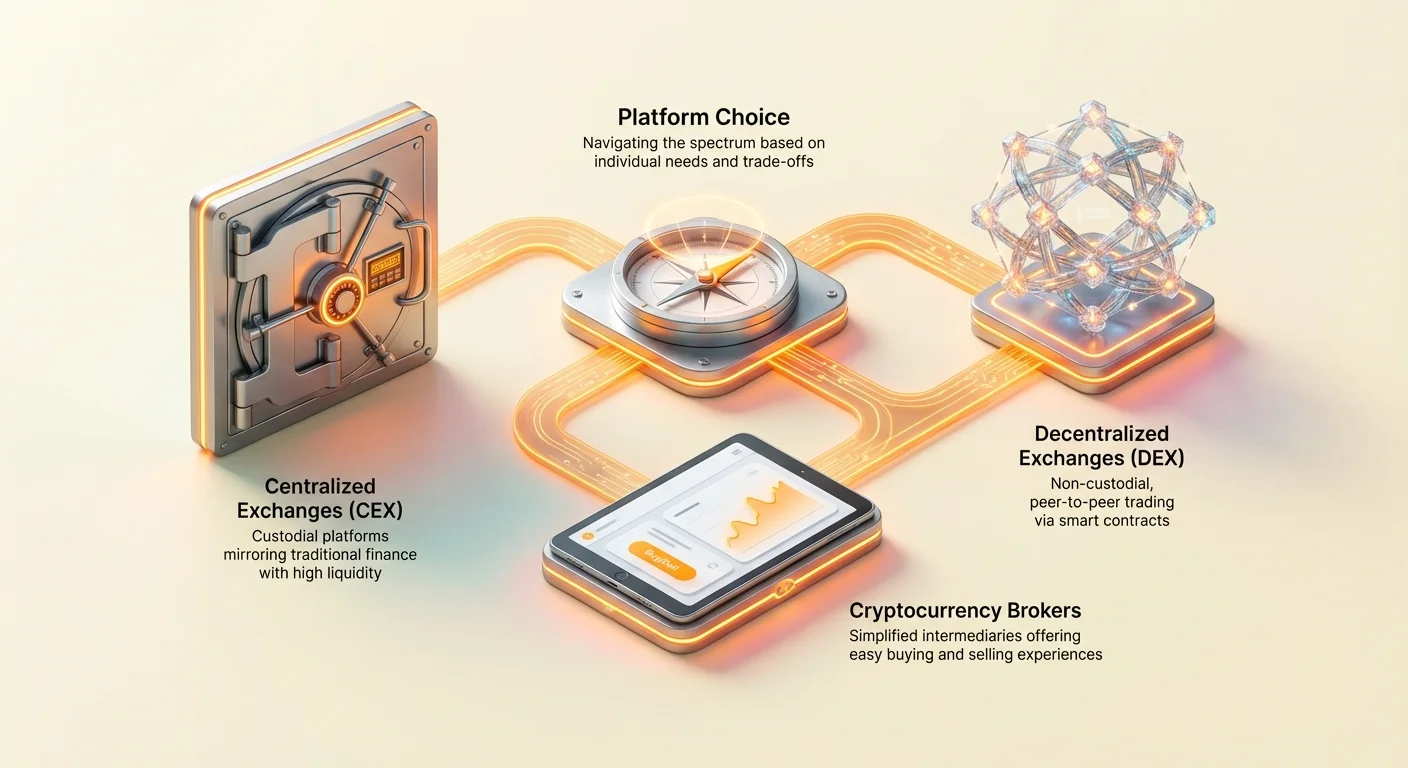
Choosing where to trade is no longer a simple binary choice. It involves navigating a spectrum of platforms that vary significantly in how they handle custody, security, fees, and regulatory compliance. The three primary pillars of this ecosystem are Centralized Exchanges (CEX), Decentralized Exchanges (DEX), and Cryptocurrency Brokers. Each operates on fundamentally different mechanics and serves distinct user bases.
Selecting the right platform is arguably the most critical decision a trader makes. It dictates the safety of your assets, the costs you incur per transaction, and the tools available at your disposal. A mismatch between a trader's strategy and their chosen platform can lead to unnecessary fees, security vulnerabilities, or a lack of necessary liquidity.
This guide provides a comprehensive framework for understanding these platforms. By dissecting their operational models, fee structures, and security protocols, you can determine which environment aligns best with your financial goals. The decision matrix presented here moves beyond surface-level features to explore the underlying architecture of modern crypto trading.
Defining the Core Platform Types
To make an informed decision, one must first understand the structural differences between the available options. The market is primarily divided into three categories, though hybrid models are emerging.
Centralized Exchanges (CEX)
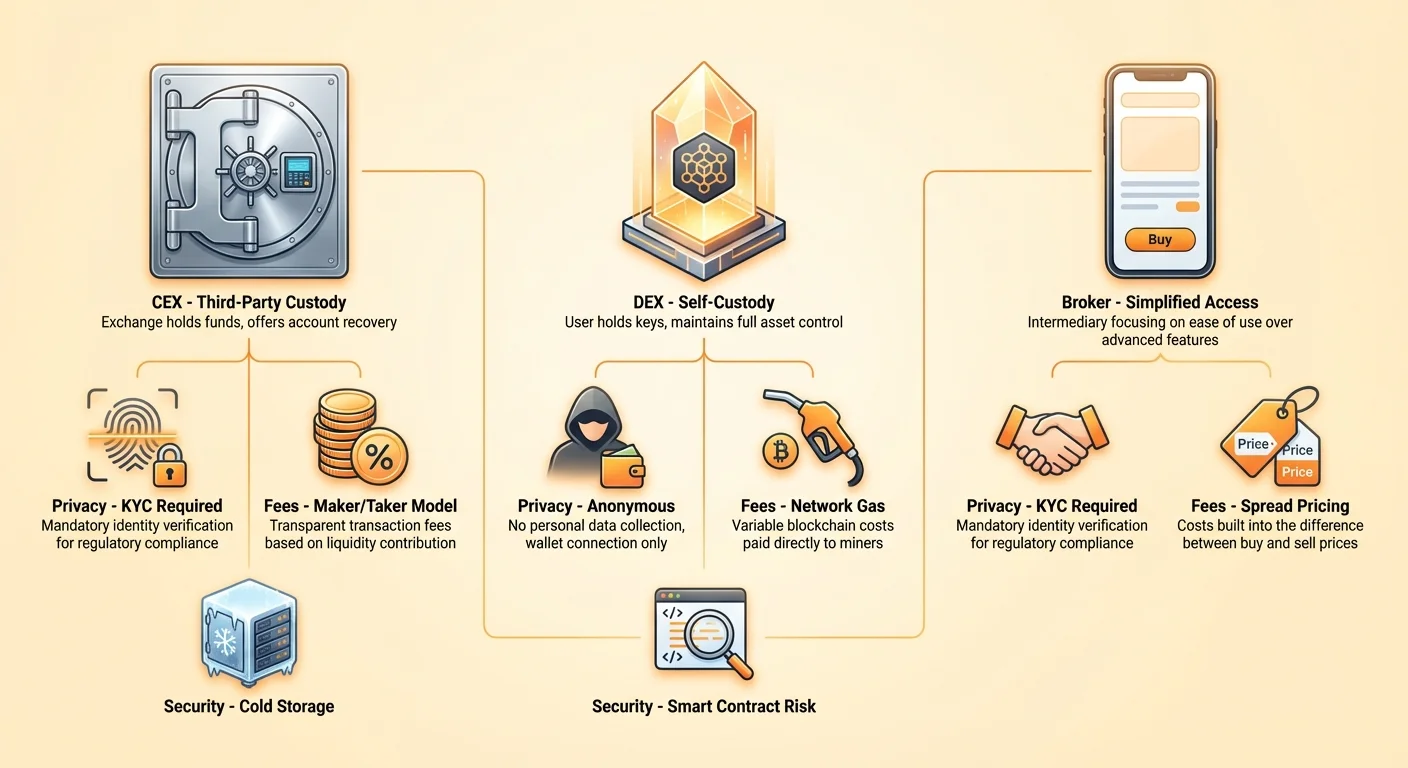
Centralized exchanges function similarly to traditional stock exchanges. They are operated by a central authority or company that facilitates trades between buyers and sellers. When you use a CEX, you are depositing your funds into a custodial wallet controlled by the exchange. The platform manages an order book, matching buy and sell orders internally.
These platforms are often the primary gateway for new users because they offer fiat on-ramps. This means you can deposit government-issued currency like USD or EUR via bank transfer or credit card. CEXs typically offer high liquidity, meaning it is easy to buy or sell large amounts of assets without significantly impacting the price.
Decentralized Exchanges (DEX)
Decentralized exchanges operate without a central authority. Instead of trusting a company to hold your funds and match your trades, you interact directly with smart contracts on a blockchain. DEXs utilize liquidity pools and Automated Market Maker (AMM) protocols to facilitate trading.
The defining feature of a DEX is self-custody. You trade directly from your private wallet, maintaining full control of your private keys and assets at all times. This eliminates the risk of an exchange hack resulting in the loss of user funds, provided the smart contracts themselves are secure. However, this places the burden of security entirely on the user.
Cryptocurrency Brokers
Brokers act as intermediaries. Unlike an exchange where you trade against other users, a broker often sells you assets directly from their own inventory or routes your order to other exchanges. Brokerage platforms prioritize user experience and simplicity over advanced trading features.
Brokers are often integrated into mainstream financial apps. They allow users to buy crypto alongside stocks or ETFs. The trade-off is often in the fees, which can be built into the "spread"—the difference between the buying and selling price—rather than displayed as a separate transaction fee.
The Centralized Exchange (CEX) Ecosystem
Centralized exchanges remain the dominant force in the cryptocurrency market by volume. Their infrastructure is built to mirror traditional finance, providing a familiar environment for investors.
Liquidity and Order Books
The primary advantage of a top-tier CEX is liquidity. Because these platforms attract millions of users, there is usually a high volume of buying and selling activity. This depth ensures that trades execute instantly at the market price.
CEXs use an order book system. This is a real-time list of buy and sell orders organized by price level. Advanced matching engines pair these orders in milliseconds. For high-frequency traders or those moving large capital, this efficiency is non-negotiable.
Custodial Risks and Benefits
The custodial nature of CEXs is a double-edged sword. On the positive side, it allows for account recovery. If you lose your password, the exchange can verify your identity and restore access. This safety net is crucial for beginners who are intimidated by the technical responsibility of managing private keys.
However, custody implies risk. "Not your keys, not your coins" is a popular mantra for a reason. If a centralized exchange halts withdrawals due to insolvency or regulatory pressure, users may lose access to their funds. History contains several examples of exchanges failing, which underscores the importance of choosing platforms with proof of reserves and regulatory compliance.
Regulatory Compliance
Most major CEXs implement strict Know Your Customer (KYC) and Anti-Money Laundering (AML) procedures. Users must verify their identity using government IDs. While this removes anonymity, it allows these platforms to operate legally in strict jurisdictions. This compliance often brings easier banking integration and legal protections for consumers.
The Decentralized Exchange (DEX) Landscape
Decentralized exchanges represent the ethos of cryptocurrency: permissionless, trustless, and open. They have grown from niche experiments to robust financial infrastructures handling billions in volume.
Most DEXs do not use order books. Instead, they rely on Automated Market Makers (AMMs). In this model, users trade against a pool of tokens known as a liquidity pool. These pools are funded by other users (liquidity providers) who earn fees in exchange for depositing their assets.
This system allows for trading even in low-liquidity environments. As long as there are tokens in the pool, a trade can happen. The price is determined by a mathematical formula based on the ratio of assets in the pool. This innovation opened the door for thousands of new tokens to be traded without needing a centralized listing approval.
Privacy and Sovereignty
Privacy is a major draw for DEX users. Generally, no account creation or identity verification is required. You simply connect a Web3 wallet, execute a trade, and disconnect. This preserves user anonymity and prevents data leaks of personal information.
Sovereignty refers to asset control. On a DEX, funds never leave your wallet until the moment of the trade. The smart contract swaps the assets atomically. If the exchange website goes down, you can often still interact with the smart contract directly through the blockchain explorer.
The downside of DEXs often lies in complexity and network fees. Users must understand concepts like 'gas fees,' which are paid to the blockchain network miners or validators, not the exchange. During times of network congestion, these fees can skyrocket, making small trades economically unviable. Additionally, users must manage their own security, as there is no customer support to reverse a transaction or recover a lost wallet.
Brokerage Platforms: The Gateway for Beginners
Brokers serve a specific segment of the market: those who value convenience above all else. These platforms strip away the complexity of order books, wallet addresses, and gas fees.
Simplified User Experience
Brokerages often present a clean, "buy/sell" interface. There are no charts with technical indicators unless requested, and no confusing order types like "stop-limit" or "post-only." You enter the amount of fiat currency you want to spend, and the broker tells you how much crypto you will receive.
This simplicity reduces the learning curve significantly. For an investor who simply wants to hold Bitcoin as a long-term asset, a broker provides the path of least resistance.
The Cost of Convenience
The trade-off for this seamless experience is usually cost. Brokers may charge a "spread." For example, if the market price of Bitcoin is $50,000, the broker might sell it to you for $50,500 and offer to buy it back at $49,500.
This hidden fee can be substantial compared to the transparent percentage-based fees of a CEX. Furthermore, some brokers do not allow you to withdraw the actual cryptocurrency to an external wallet, meaning you only hold a claim to the asset within their ecosystem.
Hybrid and P2P Platforms
Beyond the "Big Three," alternative models exist that attempt to blend features or offer entirely different mechanisms.
Hybrid Exchanges
Hybrid exchanges attempt to combine the liquidity and speed of a CEX with the security of a DEX. They might match orders off-chain for speed but settle trades on-chain for security. While promising, these platforms often struggle to gain the same liquidity depth as major CEXs.
Peer-to-Peer (P2P) Exchanges
P2P platforms function like a classifieds listing. Buyers and sellers post ads stating their desired price and payment method. The platform provides an escrow service to ensure fairness.
When a trade is initiated, the crypto is locked in escrow. The buyer sends payment directly to the seller (via bank transfer, PayPal, cash, etc.). Once the seller confirms receipt, the crypto is released. This method is vital in regions with banking restrictions or for users who prefer personalized payment methods.
Analyzing Fee Structures
Fees are the silent killer of profitability. Understanding the different fee models is essential for selecting a cost-effective platform.
Centralized exchanges typically use a Maker/Taker model.
- Makers: Users who place limit orders that sit on the order book. They add liquidity to the market. They are usually charged a lower fee.
- Takers: Users who place market orders that match immediately with existing orders. They remove liquidity. They are charged a higher fee.
High-volume traders often look for platforms with the lowest taker fees or volume-based discounts.
Spread Pricing
Brokers and some consumer-facing CEX apps use spread pricing. As mentioned earlier, this is a markup on the market price. It allows the platform to offer "zero fee" trading while still making a profit. Investors should calculate the effective percentage of the spread to compare it accurately against standard trading fees.
Network and Withdrawal Fees
Regardless of the platform, moving crypto on a blockchain incurs network fees. CEXs usually charge a flat withdrawal fee to cover this cost, often adding a small margin. DEX users pay the network fee directly. It is crucial to check withdrawal fees for specific assets, as they can vary wildly depending on network congestion.
Security Protocols and Safety Measures
In an industry where transactions are irreversible, security is paramount. The safety mechanisms employed by a platform should be a primary decision factor.
Cold Storage
The gold standard for CEX security is cold storage. This involves keeping the vast majority (often 95%+) of user funds in offline wallets that are not connected to the internet. This makes them inaccessible to remote hackers. Only a small percentage of funds are kept in "hot wallets" to facilitate immediate withdrawals.
Proof of Reserves
Following high-profile collapses in the industry, many exchanges now publish Proof of Reserves (PoR). This is a cryptographic verification that the exchange actually holds the assets it claims to hold for its users. While not a guarantee against all forms of mismanagement, regular PoR audits add a layer of transparency.
Two-Factor Authentication (2FA)
On the user side, 2FA is critical. The safest exchanges support hardware security keys (like YubiKeys) or authenticator apps. SMS-based 2FA is considered less secure due to the risk of SIM swapping.
Insurance Funds
Some top-tier platforms maintain an insurance fund. In the event of a minor hack or operational error resulting in loss of funds, the exchange uses this pool of money to reimburse affected users. This is distinct from government-backed insurance like FDIC, which generally does not cover crypto assets.
Privacy and Regulatory Compliance
The balance between privacy and compliance creates a divide in platform selection. This factor often determines which platforms are available to users in specific regions.
Know Your Customer (KYC)
Regulated exchanges must comply with local laws. This requires collecting personal data: names, addresses, and government ID scans. While some privacy advocates view this as a vulnerability, it provides legal recourse. If a regulated exchange defrauds you, there are legal pathways to pursue.
No-KYC and Anonymous Trading
Anonymous exchanges or DEXs do not collect personal data. This appeals to users living in regimes with strict capital controls or those who philosophically oppose data collection. However, these platforms are often unregulated. If they disappear or suffer a technical failure, there is often no legal entity to sue and no support team to contact.
The Regulatory Trade-off
Strictly regulated platforms often have fewer asset listings because they avoid tokens that might be classified as unregistered securities. Unregulated platforms may list hundreds of exotic altcoins but carry a higher risk of regulatory shutdowns or asset delistings.
Liquidity and Market Impact
Liquidity is a measure of how easily an asset can be converted into cash or another coin without affecting its price.
Why Volume Matters
High trading volume attracts more volume. A platform with deep liquidity ensures that spreads are tight. If you try to sell a large amount of Bitcoin on an illiquid exchange, you might crash the local price, receiving far less value than you expected. This phenomenon is known as slippage.
CEX vs. DEX Liquidity
Historically, CEXs held a massive advantage in liquidity. However, top-tier DEXs now rival centralized platforms for major pairs like ETH/USDC. For smaller, niche tokens, DEXs often have better liquidity because it is easier for projects to launch a liquidity pool than to pay listing fees for a major exchange.
User Experience (UX) and Tools
The interface of a trading platform can dictate your workflow. Platforms generally cater to specific user personas through their design choices.
Beginner Interfaces
Beginner-focused platforms prioritize clarity. They use large buttons, simple charts, and jargon-free language. They might strip away the order book entirely. The goal is to prevent user error, such as placing a market order when a limit order was intended.
Advanced Trading Suites
Professional traders require granular data. Advanced CEXs and some aggregators offer depth charts, technical analysis indicators (RSI, MACD), and API access for algorithmic trading bots. These interfaces can be overwhelming for new users but are essential for technical analysis.
Mobile Accessibility
For many, the primary trading device is a smartphone. Top exchanges invest heavily in native mobile apps that offer full functionality. DEXs are increasingly accessible via mobile wallets with integrated browsers, though the experience is generally less seamless than a dedicated CEX app.
Payment Methods and On-Ramps
How you fund your account is a logistical hurdle that varies by platform.
Fiat On-Ramps
To buy crypto with cash, you generally need a centralized entity. CEXs and Brokers excel here. They integrate with banking networks (ACH, SEPA, SWIFT) and card networks (Visa, Mastercard). Some even accept PayPal or Apple Pay.
Peer-to-Peer Payment Flexibility
P2P platforms offer the widest range of payment methods. Because you are paying an individual, you can use methods that exchanges cannot support directly, such as gift cards, Western Union, or local cash deposits.
DEX On-Ramps
Directly purchasing on a DEX is difficult. Most users must first buy on a CEX and transfer to a wallet, or use third-party "fiat-on-ramp" widgets integrated into the DEX interface. These widgets often charge higher processing fees than a direct bank transfer to a CEX.
Derivatives and Leverage
For advanced traders, spot trading (buying and holding) is only half the picture. Derivatives markets allow for hedging and speculation.
Futures contracts allow traders to bet on the future price of an asset. Perpetual futures are a crypto-native innovation that creates a contract that never expires. These instruments are widely available on major CEXs.
Leverage
Leverage allows traders to borrow funds to increase their position size. A 10x leverage trade means a 1% price move results in a 10% gain or loss. CEXs offer high leverage (sometimes up to 100x). Some decentralized protocols now offer on-chain leverage, but liquidity and latency can be issues compared to the lightning-fast matching engines of centralized derivatives platforms.
Options Trading
Options give the right, but not the obligation, to buy or sell at a specific price. This is complex and requires high liquidity. While CEXs dominate this sector, decentralized options protocols are emerging, offering transparent pricing without a central clearinghouse.
Decision Framework: The Beginner
If you are new to cryptocurrency, your priorities should be safety, simplicity, and support.
Recommended Path
A regulated Centralized Exchange or a reputable Broker is the logical starting point. The ability to recover a lost password is invaluable when learning.
Key Features to Look For
- Educational Resources: Platforms that reward you for learning about crypto.
- Simple Buy/Sell Widget: Avoids the confusion of order books.
- Local Currency Support: Direct deposits from your bank account.
- Customer Support: Live chat or email responsiveness is crucial if a deposit gets stuck.
Pitfalls to Avoid
Avoid high-leverage platforms or anonymous exchanges initially. The complexity and lack of safeguards increase the risk of accidental loss.
Decision Framework: The Day Trader
Active traders prioritize efficiency. Every basis point in fees eats into the bottom line, and execution speed is critical.
Recommended Path
A top-tier Centralized Exchange with deep liquidity and API support is standard. Alternatively, high-performance DEXs on fast blockchains (like Solana or Layer 2 solutions) are gaining traction.
Key Features to Look For
- Maker/Taker Fee Structure: Look for tiered fees that reward volume.
- Advanced Charting: Integration with tools like TradingView.
- Order Types: Stop-loss, trailing stop, and OCO (One Cancels the Other) orders.
- Derivative Support: Access to futures for hedging or shorting.
Pitfalls to Avoid
Avoid brokers with spread pricing. The invisible fees will make short-term scalping strategies unprofitable. Avoid platforms with low liquidity where slippage is high.
Decision Framework: The Privacy Advocate
For those who prioritize data sovereignty and anonymity, the path is distinct.
Recommended Path
Decentralized Exchanges and P2P platforms are the primary tools.
Key Features to Look For
- No KYC Requirements: The ability to trade with just a wallet connection.
- Non-Custodial: You always hold the keys.
- Privacy Coin Support: Availability of assets like Monero.
- On-Chain Transparency: Verifiable code and smart contracts.
Pitfalls to Avoid
Avoid CEXs that require ID verification. Be aware that moving from a KYC-compliant on-ramp to a private wallet can sometimes link your identity to your on-chain address via blockchain analysis.
Risks and Mitigation Strategies
Regardless of the platform chosen, risks exist. Mitigation requires active management.
Platform Insolvency
If a CEX goes bankrupt, user funds are often tied up in litigation for years.
- Mitigation: Never keep your entire portfolio on a single exchange. Use cold storage for long-term holdings.
Phishing and Hacks
Hackers often target users rather than the exchange itself, using fake emails or websites to steal credentials.
- Mitigation: Bookmark your exchange's URL. Never click links in emails. Use hardware-based 2FA.
Smart Contract Risk
On a DEX, a bug in the code can allow hackers to drain the liquidity pool.
- Mitigation: Use established DEXs with long track records and multiple security audits. Avoid new, untested protocols with large sums of money.
User Error
Sending crypto to the wrong address or losing a seed phrase is irreversible.
- Mitigation: Always send a small test transaction before moving large amounts. Back up seed phrases on physical media (paper or metal), never digitally.
Feature Comparison Matrix
The following table summarizes the core attributes of the three main platform types to assist in quick comparison.
| Feature | Centralized Exchange (CEX) | Decentralized Exchange (DEX) | Brokerage |
|---|---|---|---|
| Custody | Third-party (Exchange holds funds) | Self-custody (User holds funds) | Third-party (Broker holds funds) |
| Privacy | Low (KYC Required) | High (No KYC usually) | Low (KYC Required) |
| Fees | Low to Medium (Maker/Taker) | Variable (Network Gas + Fees) | High (Often hidden in spread) |
Fee Type Breakdown
Understanding the terminology of costs is essential for accurate comparison.
| Fee Type | Definition | Best Strategy |
|---|---|---|
| Maker Fee | Charged for adding liquidity (limit orders). | Use limit orders to pay less. |
| Taker Fee | Charged for removing liquidity (market orders). | Avoid market orders for large trades. |
| Spread | Difference between buy and sell price. | Avoid platforms with wide spreads. |
Conclusion
The "best" crypto platform does not exist in a vacuum. It is entirely dependent on your specific requirements regarding security, convenience, cost, and privacy. A beginner looking to buy $100 of Bitcoin has fundamentally different needs than a day trader moving $100,000 daily.
For most users, a diversified approach works best. Using a reputable CEX or Broker as an on-ramp for fiat currency provides ease of access. Meanwhile, learning to use a DEX opens up a world of new assets and ensures that long-term holdings remain truly under your control.
Ultimately, the decision matrix is a balance of trade-offs. Centralization offers recourse and ease but demands trust. Decentralization offers sovereignty and privacy but demands technical responsibility. By understanding these dynamics, you can navigate the crypto market with confidence and security.
The most secure strategy is to use exchanges for trading and private wallets for holding.