
Entering the cryptocurrency market requires a bridge between traditional government-issued money and digital assets. This bridge is commonly referred to as a "fiat on-ramp." It serves as the entry point where users exchange currencies like the US Dollar, Euro, or Yen for digital currencies such as Bitcoin or Ethereum. Selecting the right on-ramp is crucial because it dictates the cost, speed, and security of your initial investment.
The process involves more than simply clicking a "buy" button. You must navigate a variety of platforms, each with distinct fee structures and settlement times. Some methods offer instant access to your assets but charge premium fees for the convenience. Others might take several days to clear funds but offer significantly lower costs, maximizing the amount of crypto you actually receive.
Understanding the mechanics of these transactions is essential for any investor. You are not just choosing a payment method; you are choosing a venue that will hold custody of your financial data and potentially your funds. The choice depends on whether you prioritize privacy, speed, or getting the best possible market rate. This guide examines the variables involved in moving from fiat to crypto to help you make an informed decision.
The Ecosystem of Entry Points
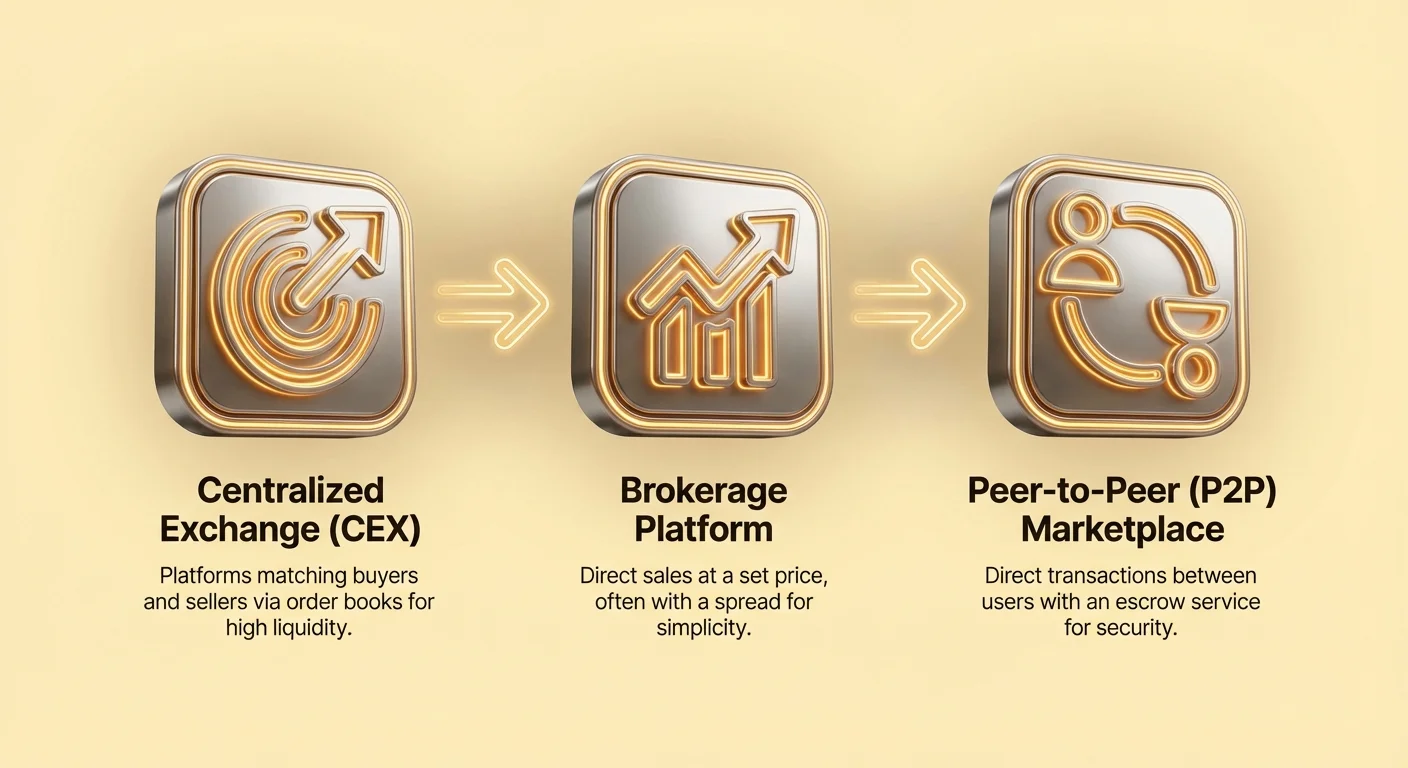
To begin, it is necessary to distinguish between the different types of platforms that facilitate these transactions. The most common venue is the Centralized Exchange (CEX). These platforms operate like traditional stock brokerages. They match buyers with sellers using an order book system. Centralized exchanges typically offer the highest liquidity, meaning there are enough assets available to execute trades quickly without significantly impacting the price.
Brokerage platforms are another common entry point, often preferred by beginners. Unlike an exchange where you trade with other users, a brokerage sells you crypto directly at a set price. This eliminates the complexity of order books and charts. However, brokerages often charge a "spread," which is a difference between the market price and the price you pay. This hidden fee is the cost of simplicity.
Peer-to-Peer (P2P) marketplaces offer a different approach entirely. These platforms connect buyers directly with sellers without a central intermediary holding the funds during the negotiation. Buyers can browse listings that specify the payment method, exchange rate, and seller reputation. While this method offers flexibility in how you pay, it requires more active involvement from the user.
Speed Versus Cost Considerations
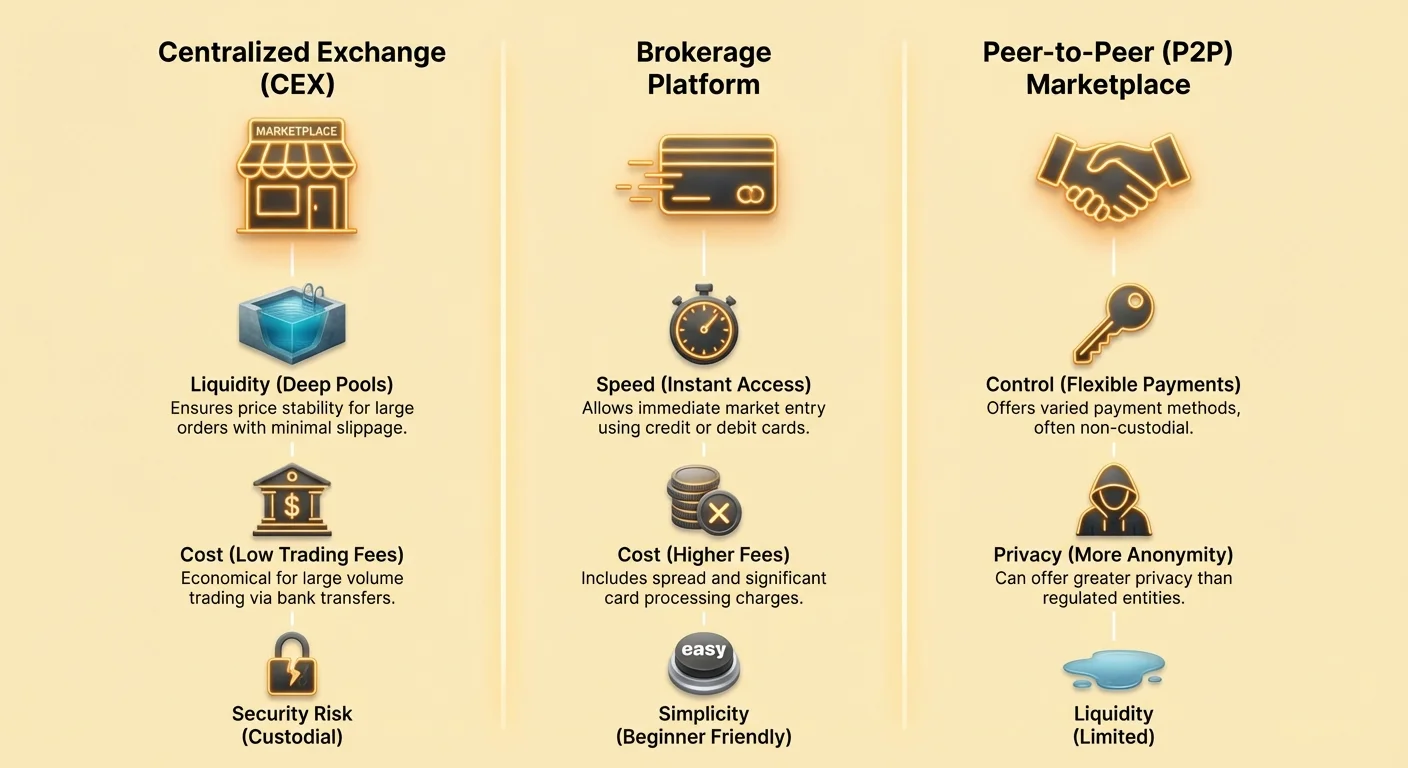
The most significant trade-off in buying cryptocurrency is between speed and cost. Financial networks that settle transactions instantly charge higher fees to cover the risk of fraud and the speed of processing. Slower networks have fewer overhead costs and pass those savings to the user.
| Payment Method | Speed | Cost Profile |
|---|---|---|
| Credit/Debit Card | Instant | High |
| Bank Transfer (Wire/SEPA) | 1-3 Days | Low |
| P2P (Cash/Payment Apps) | Varies | Medium to High |
Credit and debit cards represent the fastest way to acquire digital assets. When you use a card, the transaction is authorized immediately, and the platform typically releases the crypto to your account within minutes. This speed allows traders to react instantly to market movements. If Bitcoin dips suddenly, a card purchase ensures you catch that specific price point.
However, card processors charge significant interchange fees. Crypto exchanges pass these fees on to the buyer, often adding their own service charge on top. It is not uncommon to pay between 3% and 5% of the total transaction value in fees alone. For a $1,000 purchase, you might lose $50 immediately to processing costs.
Bank transfers, such as ACH in the US or SEPA in Europe, sit at the other end of the spectrum. These transfers are extremely cheap, often free or costing a nominal flat fee. The downside is settlement time. It can take several business days for the funds to arrive in your exchange account. By the time your money clears, the price of the cryptocurrency may have changed, potentially altering your entry point.
Buying with Credit and Debit Cards
For many users, the familiarity of using a card makes it the default choice. It mirrors the experience of online shopping. When using a debit card, you are spending funds directly from your bank account. This is generally safer than using credit, as you are limited to the funds you actually possess.
Using a credit card introduces additional financial considerations. Many credit card issuers classify cryptocurrency purchases as "cash advances" rather than standard purchases. This distinction is critical. Cash advances often incur a separate, higher interest rate that begins accruing immediately, with no grace period.
Furthermore, the cash advance fee is charged by your bank, not the exchange. This means you could pay the exchange's transaction fee plus the bank's cash advance fee. Users should verify their cardholder agreement before using a credit card to buy crypto to avoid unexpected charges.
Despite the costs, cards remain popular because they are user-friendly. They require no pre-funding of accounts. You simply enter your details, authorize the transaction, and the assets appear. For small, one-time purchases where convenience outweighs cost, cards are often the optimal solution.
Direct Bank Transfers and Wires
Bank transfers are the engine of institutional and large-volume retail trading. If you plan to invest a significant amount, the percentage-based fees of credit cards become prohibitive. A 3% fee on a $10,000 investment is $300, a substantial loss of purchasing power. A wire transfer might cost a flat fee of $20 to $30 regardless of the amount, making it far more economical for larger sums.
"Banked" exchanges are platforms that allow you to link your bank account directly. Fully banked exchanges allow for both deposits and withdrawals of government currency. This two-way street is vital for those who eventually plan to convert their crypto gains back into cash.
The process involves initiating a transfer from your bank's online portal to the exchange's bank account. You must ensure that the reference codes provided by the exchange are included in the transfer details. Missing this step can lead to delays in the funds appearing in your account, as the exchange must manually locate your deposit.
Some exchanges offer "Instant ACH" or similar features. This allows you to trade immediately with provisional credit while the bank transfer clears in the background. However, you typically cannot withdraw those crypto assets from the platform until the bank transfer is fully finalized, which protects the exchange from failed payments.
Peer-to-Peer Trading Dynamics
Peer-to-Peer (P2P) trading offers a decentralized alternative to corporate on-ramps. On these platforms, you deal directly with another individual. This structure allows for payment methods that centralized exchanges cannot support. You might find sellers willing to accept gift cards, local payment apps, or even cash in person.
P2P platforms utilize an escrow service to secure the transaction. When a trade is initiated, the seller's crypto is locked in a digital vault. The buyer sends the payment directly to the seller according to the agreed instructions. Once the seller confirms receipt of the payment, the escrow releases the crypto to the buyer.
This method is particularly useful in regions with limited banking infrastructure or where banks restrict crypto transactions. It effectively bypasses the traditional banking layer for the exchange platform itself, as the platform never touches the fiat currency. The money moves strictly between the two users.
Privacy is a major driver for P2P usage. While many P2P platforms now require identity verification, some still offer more privacy than centralized entities. However, the trade-off is risk. You must trust that the counterparty will release the funds or send the payment. Reputation systems, which display a user's trading history, are essential tools for mitigating this risk.
Digital Wallets and In-App Purchases
Modern non-custodial wallets have integrated buying features directly into their interfaces. A non-custodial wallet is software where you control the private keys, meaning you have total ownership of the assets. Historically, you had to buy on an exchange and then send the coins to your wallet. Now, you can often buy without leaving the app.
These wallets typically integrate with third-party payment processors. When you click "Buy" inside a wallet app, you are actually interfacing with a service that handles the fiat-to-crypto conversion. The crypto is then sent directly to your wallet address on the blockchain.
This method offers superior security regarding asset ownership. "Not your keys, not your coins" is a popular mantra in the industry. By buying directly into a self-custody wallet, you eliminate the risk of an exchange freezing your account or suffering a hack that drains user funds.
The trade-off for this convenience and security is often price. The third-party processors integrated into wallets charge fees similar to, or sometimes higher than, centralized exchanges. Additionally, because the transaction occurs on-chain immediately, you must pay network mining fees, which can be high during periods of congestion.
The Role of Identity Verification
Regulated on-ramps must comply with Know Your Customer (KYC) and Anti-Money Laundering (AML) laws. This means you cannot simply buy crypto anonymously on most major platforms. You must verify your identity by providing personal information and government-issued identification.
The level of verification often dictates your buying limits. A basic account verified only by email might have a very low lifetime purchase limit or might not allow fiat deposits at all. To unlock higher daily limits and bank transfer capabilities, you usually need to upload a photo of your passport or driver's license and possibly a selfie.
This process ensures the platform is not being used for illicit activities. It protects the exchange's ability to operate within the banking system. For the user, it adds a layer of friction. Verification can take anywhere from a few minutes to several days depending on the platform's efficiency and backlog.
Users prioritizing speed must account for this verification window. You cannot decide to buy Bitcoin instantly on a new platform if you have not yet passed KYC. Setting up accounts on reputable exchanges in advance ensures you are ready to act when market conditions are favorable.
Understanding Fee Structures
Fees are the silent erasers of investment returns. Understanding the different types of costs involved in an on-ramp transaction is vital for efficient buying. The visible fee is the transaction charge, but other costs lurk beneath the surface.
Trading Fees
Exchanges charge fees for executing trades. These are often categorized into "Maker" and "Taker" fees. A "Maker" is someone who places a limit order that does not fill immediately. They add liquidity to the order book. A "Taker" places a market order that fills immediately, removing liquidity. Makers usually pay lower fees than takers.
The Spread
Brokerages and "instant buy" features often charge zero explicit trading fees but make money on the spread. This is the gap between the buying and selling price. If Bitcoin is trading at $50,000, a brokerage might charge you $50,500 to buy it. That $500 difference is a hidden fee that is often more expensive than a transparent trading commission.
Network Fees
When you move crypto from an exchange to your personal wallet, you pay a network fee. This fee goes to the miners or validators who secure the blockchain, not the exchange. Bitcoin and Ethereum fees fluctuate based on network traffic. During busy times, sending even a small amount of crypto can be expensive.
| Fee Type | Description | Who Gets It |
|---|---|---|
| Trading Fee | Cost to execute order | Exchange |
| Spread | Markup on asset price | Broker/Platform |
| Network Fee | Cost to transfer on-chain | Miners/Validators |
| Deposit Fee | Cost to fund account | Bank/Card Processor |
Liquidity and Market Impact
Liquidity refers to the ability to buy or sell an asset without causing a drastic change in its price. Major fiat on-ramps connect to deep pools of liquidity. This ensures that if you want to buy $1,000 worth of Bitcoin, the price remains stable during your purchase.
Low-liquidity platforms carry the risk of "slippage." This occurs when there are not enough sellers at your desired price. To fill your order, the platform must go further up the order book, buying from sellers asking for higher prices. The result is that your average entry price is higher than the market rate you saw on the screen.
Centralized exchanges typically offer the deepest liquidity because they aggregate thousands of users. P2P marketplaces and smaller brokerages may have thinner liquidity. On a P2P site, you are limited to the amount the individual seller has available. If they only have $500 worth of crypto and you need $1,000, you must find a second seller, potentially at a different rate.
Security During the On-Ramp
The moment of purchase involves significant security considerations. When you buy on a centralized exchange, the exchange holds the private keys to your new assets. You have a claim to those assets, effectively an IOU, but you do not possess them cryptographically.
This custodial model is convenient but introduces counterparty risk. If the exchange becomes insolvent or is hacked, your funds are vulnerable. History contains several examples of exchanges failing and users losing their deposits. This is why many experts recommend moving funds to a self-custody wallet immediately after purchase.
Security features on the exchange account itself are the first line of defense. Two-factor authentication (2FA) should be considered mandatory. Using an authenticator app is more secure than SMS-based verification, which can be vulnerable to SIM-swapping attacks.
For P2P transactions, the risk profile is different. You do not worry about a central exchange hack, but rather individual scammers. Users must be vigilant against social engineering. Never release funds from escrow until you have confirmed the payment is irreversible and fully cleared in your account.
Off-Ramps and Spending Utility
While this guide focuses on buying, the "off-ramp"—selling back to fiat—is equally important. A good on-ramp should ideally function as an off-ramp too. Banked exchanges allow you to sell your crypto and wire the cash back to your account. This symmetry simplifies tax reporting and portfolio management.
Debit cards have emerged as a popular tool for liquidity. These cards allow you to spend your cryptocurrency anywhere that major credit cards are accepted. They effectively function as an instant off-ramp. When you swipe the card, the provider sells the necessary amount of crypto to cover the purchase price in fiat.
There are two main types of crypto debit cards. Preloaded cards require you to manually sell crypto into fiat and load the card balance. Auto-conversion cards hold your balance in crypto and sell it in real-time at the point of sale. Auto-conversion offers the benefit of keeping your assets invested until the very last second.
Using these cards bridges the gap between the digital and physical economy. They remove the need to wait days for a bank transfer when you want to use your crypto wealth. However, users should be aware that every swipe is a taxable event in many jurisdictions, as it constitutes selling an asset.
Conclusion
Choosing the optimal fiat on-ramp is a balancing act between three competing priorities: speed, cost, and control. If immediate market entry is your goal, credit cards or instant-buy brokerage features provide the fastest path, albeit at a premium. For long-term investors deploying significant capital, bank transfers to centralized exchanges offer the most efficient cost structure.
Privacy-conscious users or those in underbanked regions may find P2P marketplaces to be the only viable option. Meanwhile, those prioritizing asset security above all else might opt for direct purchases through non-custodial wallets to ensure they never relinquish control of their keys. There is no single "best" method for everyone; the right choice depends entirely on your specific financial circumstances and investment strategy.
The best on-ramp is one that matches your urgency with your budget while ensuring you maintain control over your assets.