
Kriptovalūtas bieži apraksta, izmantojot sarežģītu tehnisko žargonu — hašēšanas algoritmus, kriptogrāfiskās funkcijas un izplatītās virsgrāmatas. Lai gan šie tehniskie komponenti ir būtiski, īstā Bitkoina pamattehnoloģijas, Darba pierādījuma (PoW), ģenialitāte slēpjas nevis pašā kodā, bet gan ekonomiskajos un stratēģiskajos principos, ko tā nodrošina.
Darba pierādījums ir konsensa mehānisms, kas nodrošina decentralizēto tīklu, piemēram, Bitcoin, drošību, godīgumu un aizsardzību pret manipulācijām, nepaļaujoties uz nevienu centrālo iestādi. Tas ir ģeniāls risinājums klasiskai datorzinātnes problēmai, kas pazīstama kā Bizantijas ģenerāļu problēma (BGP), risinot uzticības un koordinācijas jautājumus ar kvantificējamiem, dārgiem enerģijas izdevumiem.
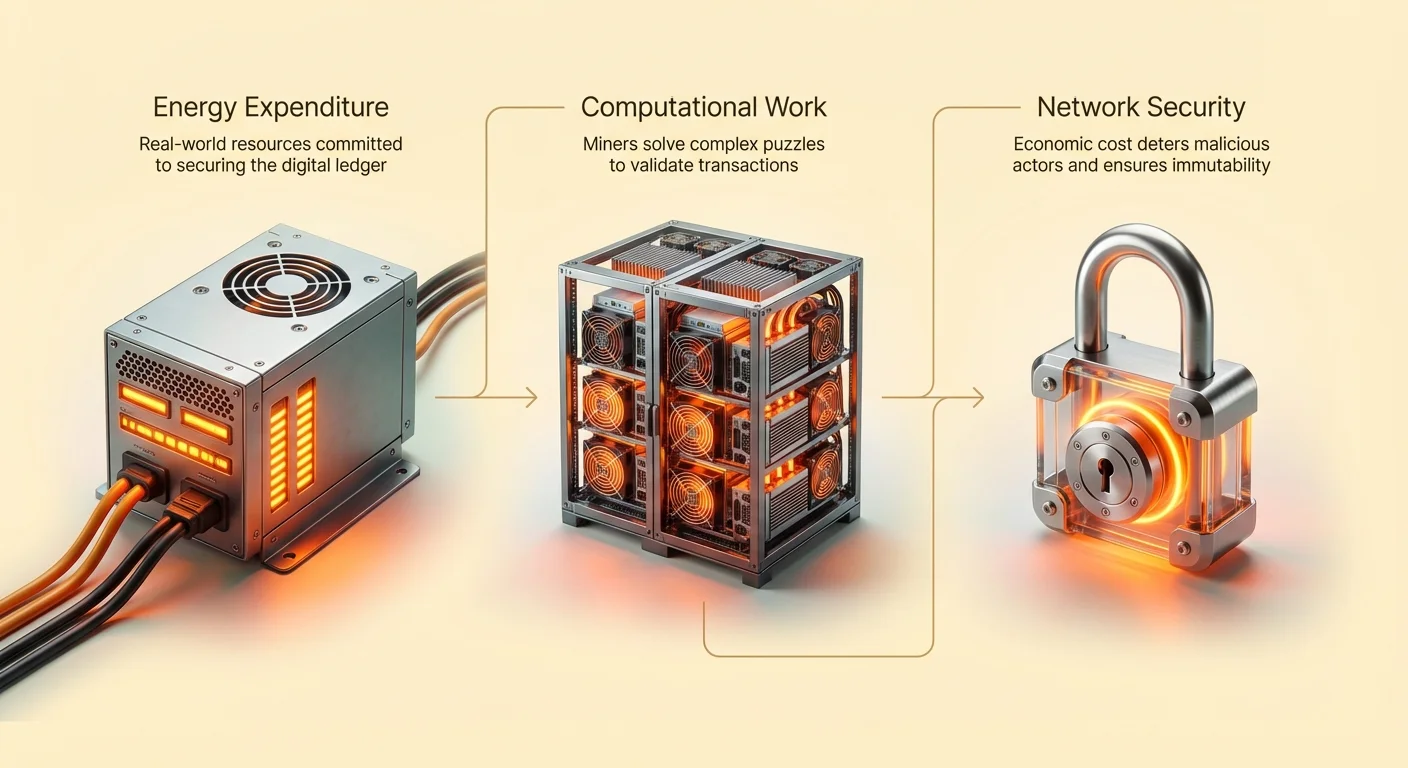
Šī analīze pārsniedz vienkāršu PoW tehnisko definīciju. Mēs izpētīsim, kā šis mehānisms kalpo kā ekonomisks atturētājs — veids, kā garantēt, ka racionāli aktieri vienmēr ir motivēti spēlēt pēc noteikumiem. Piespiežot dalībniekus ieguldīt reālas pasaules resursus (elektroenerģiju un aparatūru), lai nodrošinātu digitālo virsgrāmatu, PoW nostiprina kriptovalūtas nemateriālo pasauli pie fiziskajiem enerģijas ierobežojumiem, izveidojot nepārspējamus drošības garantus.
The Fundamental Problem: Achieving Consensus in a Distrustful Network (The Need for PoW)
Before we can understand how Proof of Work functions, we must first appreciate the monumental challenge it was designed to overcome: achieving perfect, verifiable agreement among thousands of anonymous, distributed parties who have no reason to trust one another.
This challenge breaks down into two primary issues: the technical problem of double-spending and the strategic problem of fault tolerance (the Byzantine Generals Problem).
The Double-Spend Conundrum
In the traditional centralized financial system (like banks), transferring money is trivial because a trusted third party (the bank) verifies and logs all transactions. If you try to spend the same $10 twice, the bank simply checks your balance and rejects the second attempt.
Digital currency, however, presents a unique difficulty: digital information is easy to copy. If I have a digital file representing $10, I can copy and paste that file infinitely, spending the same money many times over. This is the "double-spend problem."
In a distributed, peer-to-peer network where there is no central ledger keeper, we need a mechanism that definitively proves that a specific amount of money has been spent only once, and that all participants agree on the order in which transactions occurred. PoW forces nodes to dedicate real resources to ordering transactions, making it prohibitively expensive to insert a fraudulent, double-spent transaction into the verified history.
The Byzantine Generals Problem (BGP)
The technical challenge of double-spending is closely related to a deeper strategic dilemma formalized in computer science: the Byzantine Generals Problem.
Imagine a group of Byzantine generals surrounding an enemy city. They must agree on a unified plan of attack (e.g., "Attack at Dawn") or retreat ("Retreat Immediately"). If some generals attack while others retreat, they will all fail. The challenge is that the generals are separated by distance and rely on messengers to communicate. Crucially, some of the generals may be traitors (Byzantine faults) who deliberately send false messages to sow confusion and ensure the entire campaign fails.
How can the loyal generals achieve consensus and guarantee that everyone executes the same plan, even if they suspect up to one-third of their colleagues are lying?
In the context of a cryptocurrency network:
| BGP Analogy | Bitcoin Network Equivalent |
|---|---|
| Generals | Individual Nodes/Computers |
| Traitors (Faults) | Malicious Nodes attempting to double-spend |
| The City | The Shared Ledger or Transaction History |
| The Plan | The Order and Validity of Transactions (the next Block) |
| The Messenger | The Internet/Network Propagation |
The BGP shows that achieving consensus in an untrustworthy environment is incredibly difficult. PoW is Bitcoin’s elegant solution: it doesn't try to identify the traitors, but rather makes the act of being a traitor so costly that it is economically irrational.
Solving the Byzantine Generals Problem with Economic Deterrence
Proof of Work solves the BGP by introducing an economic element to the communication process. Instead of trusting a messenger (or node), the generals require the messenger to perform a costly, verifiable, and non-reusable task before their message is accepted.
Shifting from Trust to Cost (The PoW Innovation)
Traditional security models rely on identity (KYC, passwords) or trust (a central bank). PoW fundamentally shifts the security model from trusting identity to trusting verifiable economic commitment.
The core idea is simple: if you want the network to accept your proposed block of transactions as the truth, you must prove that you expended a significant amount of computing power and energy—the "Work."
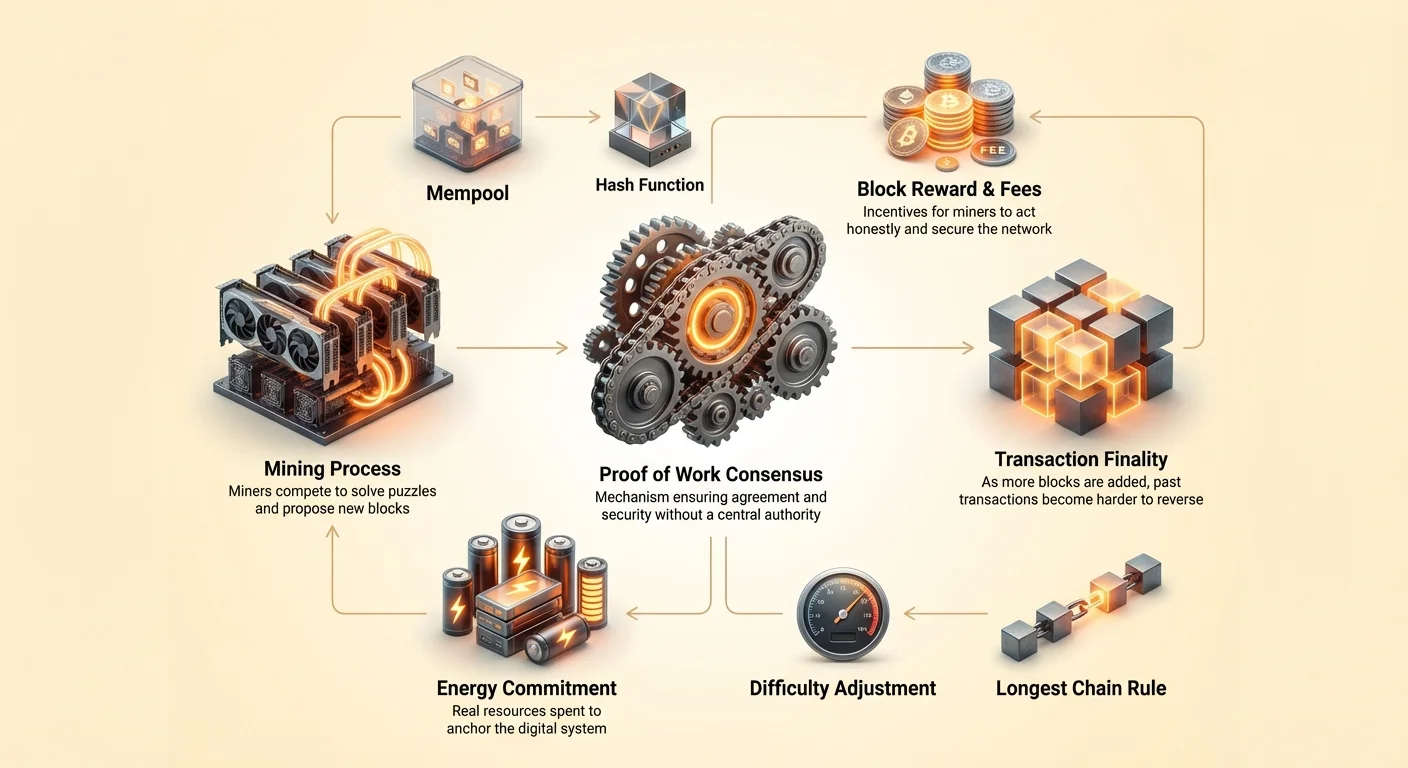
This work is performed through a process called mining. Miners compete fiercely to solve a specific cryptographic puzzle that requires brute force computational guessing. When a miner finds the solution, they get to propose the next valid block to the network, and they are rewarded for their effort.
Because finding the solution requires real, measurable energy expenditure, PoW transforms the transaction ledger into something that is physically anchored by physics and economics.
The Costly Signal: Energy as Commitment
Why is the consumption of energy—the literal burning of electricity—central to security? Because energy is scarce, costly, and cannot be faked.
- Immutability: Once the energy is spent and the solution is found, that "proof" is broadcast to the network. Every node can instantly verify the correctness of the proof without having to re-spend the energy.
- Deterrence: If a malicious general (miner) wanted to cheat and insert a fraudulent block (a double-spend), they would have to repeat the entire costly process. Furthermore, to successfully change the past (rewrite the blockchain), they would have to outpace the honest majority by continually solving new blocks faster than everyone else combined.
- Finality: The longer a block remains on the blockchain, the more energy has been expended on top of it (as subsequent blocks are chained to it). This commitment makes older transactions exponentially more expensive to rewrite. This economic gravity provides transaction finality.
By forcing the network participants to pay a real-world energy tax, PoW ensures that participating honestly is overwhelmingly more profitable than attempting an attack.
Anatomy of Proof of Work: Hashing and the Difficulty Target
To execute this economic deterrence strategy, PoW relies on a precise technical mechanism involving cryptographic hashing and a continually adjusting difficulty level.
The Role of the Cryptographic Hash Function
The backbone of PoW is the cryptographic hash function (Bitcoin uses SHA-256). A hash function is an algorithm that takes an input of any size (text, images, transaction data) and outputs a fixed-length string of characters (the hash).
Crucially, cryptographic hashes have three key properties:
- Deterministic: The same input always produces the exact same output hash.
- Irreversible (One-Way): It is mathematically impossible to determine the input simply by looking at the output hash.
- Avalanche Effect: Even the smallest change to the input data (e.g., changing one comma in a transaction list) results in a completely different, unpredictable output hash.
In mining, the miner bundles all pending transactions (from the Mempool—the waiting area for transactions), along with the previous block’s hash, and a random guess number called the nonce. The entire package is run through SHA-256 to generate the new block's hash.
The Race to Zero: Solving the Block Puzzle
The core of the "work" is a guessing game. The network does not require just any hash; it requires a hash that meets a specific difficulty target. This target is always defined by requiring the hash to begin with a certain number of zeroes (e.g., 0000000000000000001a...).
Finding a hash that starts with the required number of zeroes is mathematically just as hard as guessing a specific lottery number—it is pure chance. Since you cannot reverse-engineer the required input (due to the one-way nature of the hash function), the only way to find a compliant hash is to change the input data slightly (by changing the nonce) and try again.
Miners use specialized hardware (ASICs) to execute trillions of these guesses per second, hoping that one of their attempts yields a hash that satisfies the current difficulty target. The first miner globally to find this solution wins the right to propose the new block and collect the block reward (subsidy plus fees).
The Difficulty Adjustment: Maintaining the 10-Minute Rhythm
If the difficulty remained static, the time it takes to find a block would decrease rapidly as technology improves and more powerful miners join the network. This would destroy the reliable rhythm Bitcoin needs to maintain consensus.
To counter this, the Bitcoin network automatically adjusts the difficulty of the puzzle every 2016 blocks (roughly every two weeks).
The purpose of the Difficulty Adjustment is to ensure that, no matter how much hashing power (hashrate) is applied to the network, a new block is found, on average, every 10 minutes.
- If blocks are found faster than 10 minutes: The difficulty increases (requiring more leading zeroes).
- If blocks are found slower than 10 minutes: The difficulty decreases (requiring fewer leading zeroes).
This mechanism makes the economic cost to participate extremely adaptive. The barrier to entry for securing the network is dynamically adjusted, ensuring that the expense required to generate a new block remains consistently high, thereby maintaining the integrity of the economic deterrence model.
Cryptoeconomics: Incentives and Security Guarantees
Proof of Work is sustained by a brilliant application of cryptoeconomics—the merging of cryptography and economic incentives to secure decentralized systems. PoW works because the participants are economically rational; they act in their own self-interest, and the rules of the system ensure that honest behavior is the most profitable strategy.
Why Miners Spend Money: The Block Subsidy and Transaction Fees
Miners are not driven by altruism; they are running businesses with immense operational costs (electricity, hardware, cooling). They participate only because they are rewarded by the network. This reward comes in two parts:
- The Block Subsidy: This is the primary reward for creating a new, valid block. This subsidy (paid in native cryptocurrency, like BTC) is halved approximately every four years in an event known as "halving." As of 2024, this subsidy is the main driver of profitability.
- Transaction Fees: The miner includes all the pending transactions they select into their newly found block. For each transaction, the sender pays a small fee to the miner.
As the block subsidy continues to decrease every four years, transaction fees become an increasingly vital part of the miner’s revenue model, ensuring long-term network security remains viable even when the subsidy eventually phases out entirely. The total reward (subsidy + fees) must always exceed the miner’s operational costs to maintain the security function of PoW.
The Economic Cost of a 51% Attack
The primary security guarantee of PoW is its resilience against a 51% attack. This is the scenario where a single entity or coordinated group controls more than 50% of the network’s total hashing power (hashrate).
If an attacker achieves a 51% majority, they could potentially:
- Reverse transactions: Specifically, double-spend their own coins.
- Halt transactions: Prevent legitimate transactions from being confirmed.
However, controlling 51% of the network requires an extraordinary capital expenditure. They would need to acquire more hardware, consume more electricity, and manage more infrastructure than the entire rest of the world combined.
The economic reality is that the cost to acquire and maintain 51% of the network's computing power far exceeds the potential gain from cheating. If an attacker manages to double-spend, they would simultaneously devalue the very currency they hold and rely on for profit, making the attack financially self-defeating. The game theory dictates that the attacker’s most profitable path is always to participate honestly and collect the block rewards, rather than attempt a costly, network-destroying attack.
The Game Theory of Honesty
PoW is built on the assumption that miners are rational economic actors. This leads to several stable equilibrium points based on game theory:
- Positive Reinforcement: The current structure rewards honest miners with a guaranteed, scheduled payout (the block reward).
- Negative Reinforcement: If a miner attempts to include an invalid transaction or proposes a fraudulent block, the rest of the honest network (the other 49% or more) will simply reject that block. The malicious miner loses the energy they spent, the time they wasted, and the reward they hoped to gain.
- Self-Correction: If one miner begins to fall out of line, the economic incentive for all other miners is to maintain the longest, valid chain—the one that will earn them the most money—forcing the attacker onto an unprofitable path.
This system ensures that the network’s security is not maintained by moral high ground, but by the cold, hard logic of financial self-interest.
Tīkla nodevas un transakciju prioritāte: Ieguvēja lēmums
Kaut arī bloka subsīdija ir kritiska drošības sastāvdaļa, transakciju nodevas spēlē izšķirošu lomu tīkla plūsmas pārvaldībā un ieguvēju motivācijā efektīvi apstrādāt transakcijas. Nodevas ir cena par ierobežotu bloka vietu.
Mempool un bloka izmēra ierobežojumu loma
Katru reizi, kad transakcija tiek nosūtīta, bet vēl nav apstiprināta, tā gaida Mempool (Memory Pool). Tas būtībā ir gaidīšanas telpa visām gaidāmajām transakcijām visā globālajā tīklā.
Bitcoin blokiem ir izmēra ierobežojums. Kad ieguvējs atrod mīklas risinājumu, viņam ātri jākompilē jauns bloks ar transakcijām no Mempool. Tā kā bloka izmērs ir ierobežots, ieguvēji nevar iekļaut visas gaidāmās transakcijas, īpaši augsta pieprasījuma periodos.
Bloka ierobežojums, ko nodrošina PoW noteikumi, rada deficītu. Šis deficīts rada apstiprināšanas prioritātes tirgu — transakciju nodevu tirgu.
Maksājums par apstiprināšanas ātrumu (kā darbojas transakciju nodevas)
Kad jūs nosūtāt transakciju, jūs pievienojat nodevu. Šī nodeva nav fiksēts maksājums; tas ir dinamisks piedāvājums, ko jūs izvadat, lai motivētu ieguvēju iekļaut jūsu transakciju nākamajā blokā.
Ieguvēji ir racionāli ekonomiskie aktieri; viņi prioritizē transakcijas, kas dod augstāko atdevi. Viņi atlasa no Mempool transakcijas ar augstāko nodevas likmi (mērītu satoshi par virtuālo baitu, vai sat/vB), līdz bloks ir pilns.
Tāpēc nodeva nosaka ne tikai vai jūsu transakcija tiks apstiprināta, bet kā ātri.
| Nodevas stratēģija | Apstiprināšanas ātrums | Risks/Atlīdzība |
|---|---|---|
| Augsts nodevas piedāvājums | Parasti apstiprināts pašā nākamajā blokā (10 minūtes vai mazāk). | Ātrāks transakciju galīgums, augstākas izmaksas. |
| Vidējs nodevas piedāvājums | Apstiprināts dažu stundu laikā, atkarībā no tīkla noslodzes. | Mērenas izmaksas, pieņemams gaidīšanas laiks. |
| Zems nodevas piedāvājums | Var gaidīt stundas vai pat dienas, potenciāli izkritis no Mempool. | Zemākās izmaksas, augsts ilgstošas kavēšanās vai atkārtotas sūtīšanas risks. |
Nodevas piedāvāšana un tirgus dinamika
Šī dinamika nodrošina, ka transakciju sistēma paliek izturīga pret cenzūru, bet arī ekonomiski efektīva.
- Decentralizēta piešķiršana: Nekāda centrāla entītija nediktē, kas iegūst bloka vietu; tirgus izlemj, balstoties uz gatavību maksāt.
- Stimulu saskaņošana: Transakciju nodevas garantē, ka pat tad, kad bloka subsīdija nākotnē samazināsies, ieguvēji joprojām būs spēcīgi motivēti nodrošināt tīklu un efektīvi apstrādāt ekonomiski visvērtīgākās transakcijas.
- Drošības uzlabošana: Augstas nodevas augsta pieprasījuma periodos arī palielina kopējo ieguves atlīdzību, efektīvi paaugstinot slieksni 51% uzbrukuma uzsākšanai, pievienojot vēl vienu slāni PoW drošības garantijai.
Comparing PoW to Alternatives and Criticisms
While Proof of Work is the most time-tested and robust decentralized consensus mechanism, it is not the only one. Understanding its unique characteristics requires briefly examining alternatives and addressing its primary criticisms.
PoW vs. Proof of Stake (PoS): A Security Model Comparison
The most common alternative to PoW is Proof of Stake (PoS), now used by Ethereum and many other networks. The primary difference lies in the definition of "commitment":
| Feature | Proof of Work (PoW) | Proof of Stake (PoS) |
|---|---|---|
| Commitment | Real-world energy expenditure (Cost of mining hardware and electricity). | Locking up digital assets (Staking the native cryptocurrency). |
| Consensus Driver | Computational brute force and cost of electricity. | Economic penalties (slashing) and capital ownership. |
| Barrier to Attack | The cost of acquiring 51% of global hashing power. | The cost of acquiring 51% of the total staked currency. |
| Economic Anchor | Physics/Energy. | The value of the staked token itself. |
PoW secures the network by anchoring it to a costly, external resource (energy). PoS secures the network by anchoring it to an internal resource (the asset itself). While PoS is often viewed as more energy-efficient, PoW advocates argue that the external commitment provided by energy provides a far superior and less flexible security guarantee against malicious actors.
Addressing Energy Consumption Criticisms
The most frequent and often cited criticism of Proof of Work is its immense energy consumption. Detractors view the energy expenditure as wasteful; however, proponents of PoW argue that this high energy cost is not a bug—it is the central, non-negotiable feature that provides Bitcoin’s security guarantee.
- Security Guarantee Cost: The high energy cost is the "price" the network pays for guaranteed finality, censorship resistance, and immutability. If PoW required zero cost, it would require zero commitment and could be trivially attacked. The costliness is what solves the Byzantine Generals Problem.
- Verifiability: Energy consumption is a highly measurable, objective, and auditable cost. This makes the security of the network quantifiable (via the hashrate).
- Economic Context: When viewed globally, Bitcoin’s energy usage competes with less productive uses of energy (like running servers for online gaming or operating traditional data centers). Furthermore, many mining operations are moving toward utilizing renewable or stranded energy sources that would otherwise be wasted, optimizing global energy grids.
In the context of the Byzantine Generals Problem, the energy expenditure represents the mandatory tax paid by all loyal generals to prove they are following the agreed-upon plan and to deter any traitors from gaining power. Without this mandatory commitment, the system would collapse into distrust and failure.
Secinājumi
Proof of Work ir daudz vairāk nekā tehniska procedūra digitālās valūtas izveidei; tas ir ekonomisks un spēles teorētisks ietvars, kas risina uzticības pamatproblēmu decentralizētā, digitālā pasaulē.
Piespiežot dalībniekus patērēt dārgu, ierobežotu enerģiju — fizisku resursu —, PoW veiksmīgi piesaista digitālo virsgrāmatu reālajai pasaulei. Šis patēriņš kalpo kā neviltots ekonomisks ieguldījums, nodrošinot, ka godīga uzvedība vienmēr ir visizdevīgākais ceļš racionālam aktierim.
Proof of Work konsensa mehānisms ir Bitkoina pašizpildes risinājums Bizantijas ģenerāļu problēmai, nodrošinot nepārspējamās drošības garantijas un nemaināmību, kas veido patiesas digitālas pašsuverenitātes pamatu. Tīklam nobriestot, pāreja no subsīdijas balstītām atlīdzībām uz transakciju nodevām nodrošina, ka nepieciešamā ekonomiskā atturēšana paliek izturīga, nostiprinot jaunās digitālās ekonomikas pamatus uz gadu desmitiem.