
The world of cryptocurrency trading often starts with simple spot purchases—buying Bitcoin or Ethereum and holding the actual asset. However, as traders seek more complex strategies, higher returns, or the ability to bet against the market, they often encounter advanced instruments like Contracts for Difference (CFDs) and other derivatives.
CFDs represent a pivotal area where traditional finance intersects with digital assets. While they offer immense flexibility, allowing retail traders to access global markets with significant leverage, they also introduce complex risks and unique regulatory hurdles, particularly when compared to native crypto derivatives like perpetual futures.
This guide is designed for beginners transitioning into advanced trading concepts. We will demystify the mechanics of CFD contract trading, compare them to standard spot and futures markets, and critically examine the essential legal and regulatory frameworks that govern their use—aspects often overlooked but vital for protecting capital. Understanding these nuances is crucial before attempting to master this powerful but precarious financial tool.
The Basics of Contracts for Difference (CFDs)
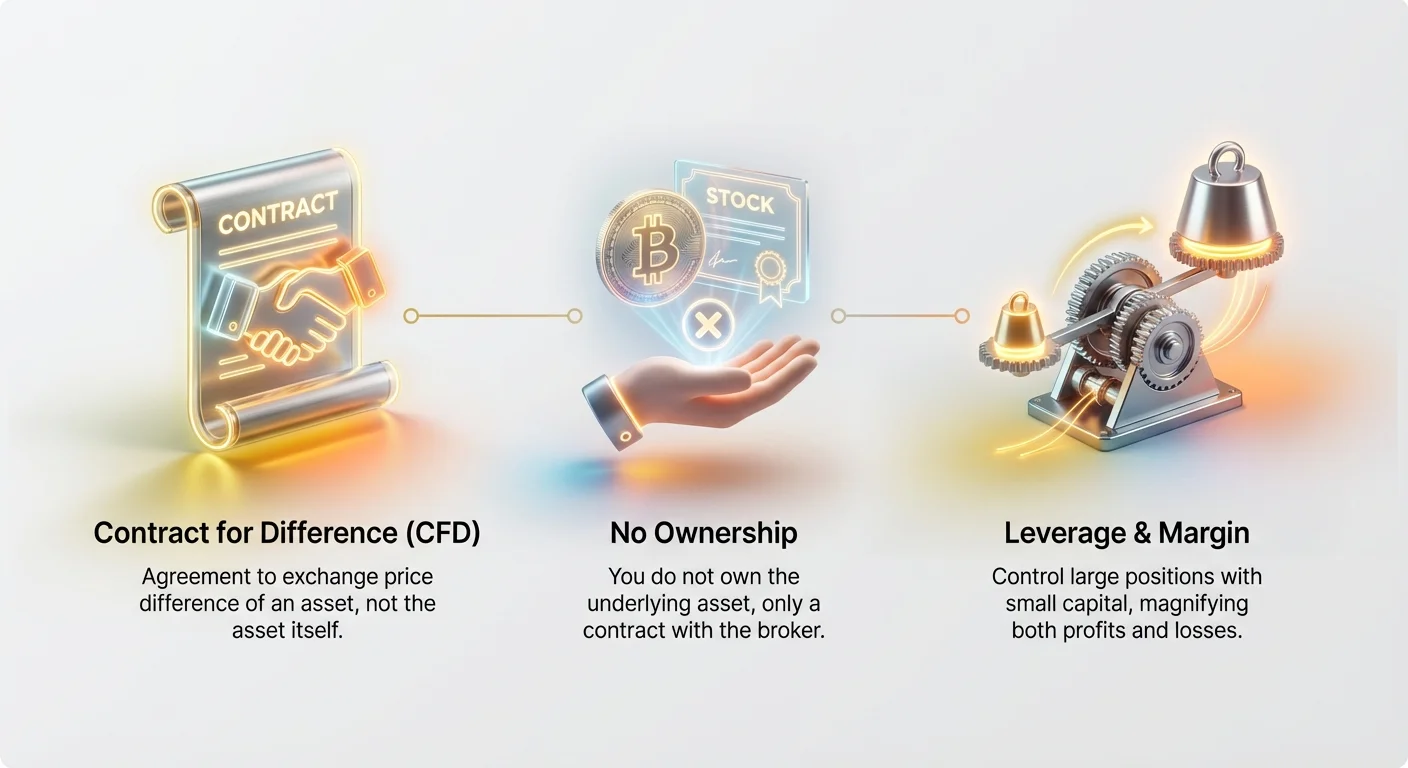
A Contract for Difference (CFD) is an agreement between two parties—typically a trader and a broker—to exchange the difference in the price of an asset from the time the contract is opened until it is closed.
In the simplest terms, when you trade a CFD, you are not buying or selling the underlying asset itself (whether it’s a share, a barrel of oil, or Bitcoin). Instead, you are speculating on the direction its price will move. If you believe the price will rise, you "Go Long" (buy the CFD); if you believe the price will fall, you "Go Short" (sell the CFD).
The core appeal of CFDs lies in their ability to provide exposure to volatile assets, like cryptocurrencies, without the trader having to physically hold or secure the underlying asset.
The Concept of Non-Ownership
This fundamental characteristic—non-ownership—is what defines a CFD. When you buy actual Bitcoin (spot trading), you own the private keys associated with that asset, making you the legal owner. When you trade a Bitcoin CFD, you own nothing related to the blockchain; you only own a contract with the broker, defining the [[spectrum of custody risks]].
This model carries significant implications:
- No Direct Rights: If you trade a stock CFD, you do not receive voting rights or dividends, as you are not a shareholder.
- Ease of Short Selling: Going short on a CFD is structurally simple, as the broker facilitates the contract without needing to borrow the underlying asset from another party (as is sometimes required in physical short selling).
- Counterparty Risk: Your profit or loss is entirely dependent on the solvency and integrity of your broker, as they are your counterparty in the contract.
How CFDs Offer Flexibility
CFDs are popular precisely because of the flexibility they offer. They are typically traded Over-The-Counter (OTC), meaning they are not traded on a formal public exchange. This setup allows brokers to offer CFDs on an incredibly diverse range of global assets, including:
- Cryptocurrencies (BTC, ETH, etc.)
- Foreign Exchange (Forex or FX)
- Stocks and Indices (e.g., S&P 500)
- Commodities (Gold, Oil)
This breadth allows a single trading account to speculate across multiple global markets instantly, a feature hard to replicate with traditional spot trading accounts.
CFD Contract Trading Mechanics: Costs, Spreads, and Leverage
Understanding the mechanics of CFD trading is essential for managing risk. While the calculation of profit and loss seems straightforward, the costs associated with maintaining a position can quickly erode capital, especially for beginners.
Understanding the Spread (The Broker's Cut)
The primary cost mechanism in CFD trading is the spread. Unlike traditional exchanges where you pay a flat commission or trading fee, CFD brokers build their profit directly into the prices they quote you, revealing the hidden trading costs.
The spread is the difference between the bid price (the price at which you can sell the asset) and the ask price (the price at which you can buy the asset).
Example: If the actual market price for Bitcoin is $60,000, your CFD broker might quote:
- Ask Price (Buy): $60,005
- Bid Price (Sell): $59,995
- Spread: $10
When you open a position, you immediately buy at the higher ask price, but the contract is valued against the lower bid price. This means you start the trade $10 in the negative. The underlying asset must move by at least the value of the spread before your position becomes profitable. Spreads can be fixed or variable, widening during periods of low liquidity or high volatility.
Calculating Profit and Loss (P&L)
Profit and Loss (P&L) is calculated based on the price movement, multiplied by the lot size or contract size (the number of units you are trading).
If you trade one Bitcoin CFD, the contract size is 1 BTC. If you trade 0.1 BTC, the contract size is 0.1.
Scenario Example:
- Asset: Bitcoin CFD
- Contract Size: 0.5 BTC
- Opening Price (Long): $60,000
- Closing Price: $60,500
- Price Change: $500
- Gross Profit: $500 (Price Change) x 0.5 (Contract Size) = $250
This calculation is then adjusted for the initial spread cost and any additional fees.
The Power and Peril of Margin and Leverage
CFD trading is intrinsically linked to leverage. Leverage allows traders to control a large position with a relatively small amount of capital, known as the margin.
If a broker offers 10:1 leverage, you can open a position worth $10,000 by only putting up $1,000 of your own money (the margin).
While leverage multiplies potential profits, it equally multiplies potential losses. If the market moves against a highly leveraged position, the trader can lose their entire margin quickly, leading to a margin call or liquidation.
- Related Concept: For a deeper dive into margin calculations and liquidation thresholds, see our guide: Leverage Trading Mechanics: Calculating Margin, Liquidation, and Risk Ratios.
The Cost of Holding: Overnight Financing Fees
A crucial distinction of CFDs is the overnight financing fee, often referred to as a rollover fee or swap fee.
CFDs are typically designed for short-term speculative trading. Because you are using the broker’s capital to maintain the leveraged position, the broker charges a daily interest fee (or credit, depending on the asset and direction).
This fee is calculated based on the full value of the leveraged position, not just your margin. If you hold a position open overnight, you incur this fee. For highly leveraged, long-term positions, these fees can accumulate rapidly, making CFDs unsuitable for "buy-and-hold" strategies common in spot crypto markets.
Distinguishing Derivatives: CFD vs. Spot vs. Futures
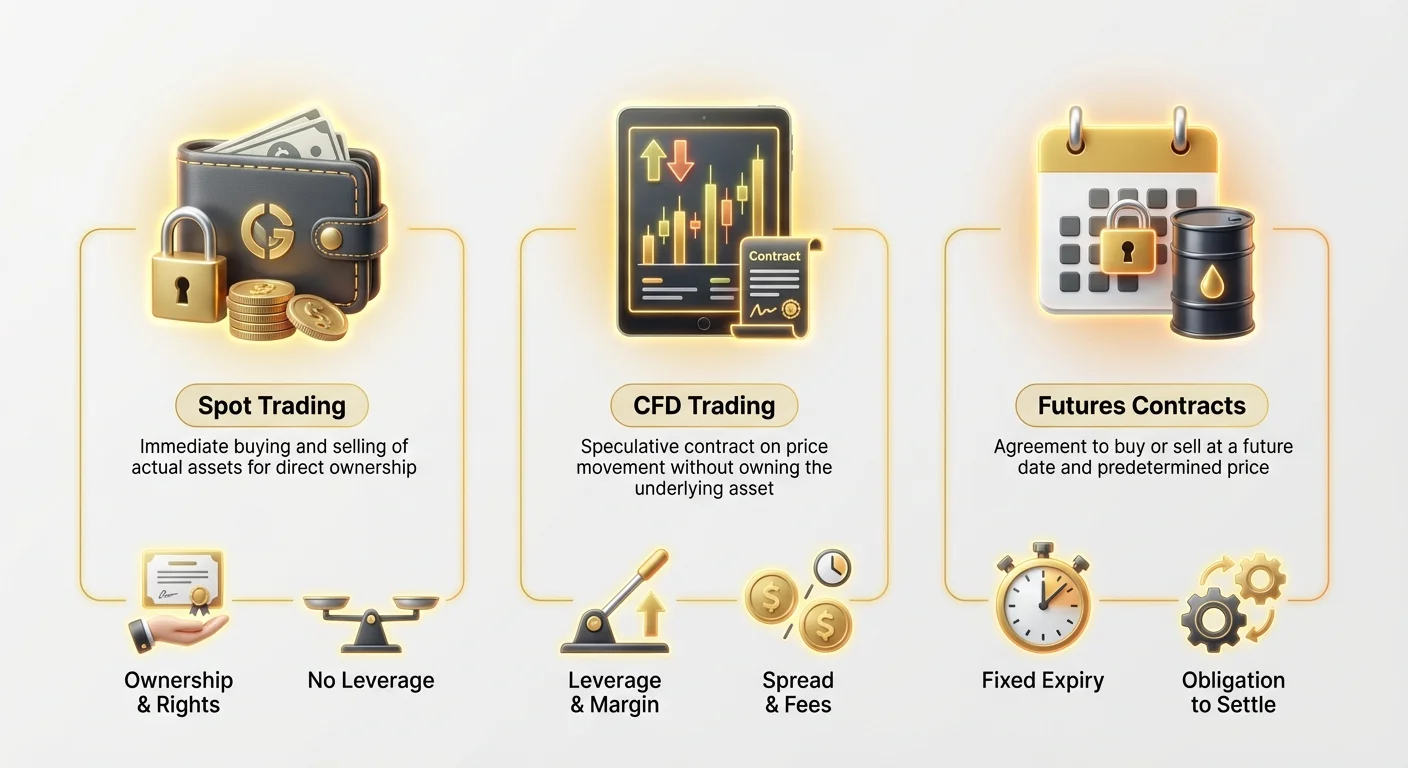
Understanding the Contract for Difference is easier when contrasted with the two primary alternatives available to crypto traders: spot markets and futures markets. While all three allow price speculation, their underlying mechanisms, legal implications, and risk profiles are fundamentally different.
Spot Trading: Immediate Ownership
Spot trading is the simplest form of exchange. When you execute a spot trade, you agree to buy or sell an asset immediately ("on the spot") for cash.
| Feature | Spot Trading |
|---|---|
| Ownership | Direct ownership of the asset (e.g., holding BTC in a wallet). |
| Settlement | Immediate delivery of the asset. |
| Leverage | Generally low or non-existent (unless using margin lending, which is separate). |
| Risk Focus | Volatility risk and custodial risk. |
Application: Spot trading is ideal for long-term investors or those prioritizing security and control over their assets.
Futures Contracts: Defined Expiry and Obligation
A futures contract is an agreement to buy or sell an asset at a predetermined price on a specific date in the future (the expiry date).
| Feature | Futures Contracts |
|---|---|
| Ownership | No direct ownership until settlement (if physically settled). |
| Settlement | Mandatory settlement (physical or cash) on the expiry date. |
| Leverage | High, defined by the exchange. |
| Risk Focus | Volatility, leverage, and basis risk (difference between spot and future price). |
The crypto world popularized perpetual futures, which lack an expiry date. They utilize a periodic funding rate mechanism to keep the contract price pegged closely to the underlying spot price. This funding rate acts like an interest payment that ensures the perpetual contract doesn't stray too far from the market price.
CFD Trading: The Broker-Counterparty Agreement
CFDs blend features of both spot and futures, but with the added layer of being a private agreement with the broker.
| Feature | CFD Trading |
|---|---|
| Ownership | No ownership; purely a contract for price difference. |
| Settlement | Closed by offsetting the original contract; no physical settlement. |
| Leverage | High, often set by regulatory limits or the broker. |
| Risk Focus | Volatility, leverage, and counterparty risk. |
Crypto CFD vs Futures: The Key Difference
For a retail crypto trader, the primary decision often lies between a broker-offered CFD and an exchange-offered Perpetual Futures contract.
The core difference is the counterparty and the mechanism for price tracking:
Counterparty Risk:
- Perpetuals: The counterparty is typically the exchange's clearing house or the other side of the trade pool. The risk is managed by the exchange's robust liquidation engine and insurance fund.
- CFDs: The counterparty is the specific broker. If the broker defaults or fails to manage its risks, your open positions may be affected.
Fees/Price Tracking:
- Perpetuals: Use a periodic funding rate to align with the spot price. This rate can be positive or negative.
- CFDs: Use a spread and daily overnight financing fee (interest) to cover the cost of maintaining the leveraged position.
While both instruments allow high-leverage speculation without owning the underlying asset, perpetual futures are a standardized product common in the crypto space, whereas CFDs are derivatives heavily regulated (or banned) in traditional finance jurisdictions.
Practical Applications of CFD Trading
Beyond simple speculation on Bitcoin price moves, CFDs offer versatile applications across various markets, making them a powerful tool for traders looking to diversify their strategies.
Using CFDs for Global Market Access
The primary utility of CFDs is providing easy access to markets that might otherwise be geographically restricted or require large capital commitments.
- FX (Foreign Exchange) Exposure: CFDs are often the preferred instrument for retail FX trading. Instead of needing to manage two physical currencies, traders speculate on pairs (like EUR/USD or USD/JPY). A CFD broker standardizes this process, offering extremely high leverage in major FX pairs.
- Commodity Exposure: Trading physical commodities like oil or gold typically requires specialized logistics or dedicated futures contracts. CFDs allow instantaneous speculation on the spot price of these commodities using small amounts of margin, allowing a crypto trader to hedge against inflation using gold CFDs from the same account they use to trade Solana CFDs.
- Indices: CFDs allow traders to take positions on entire stock market indices (e.g., the DAX 40 or FTSE 100) without buying every single stock within that index, providing broad exposure to economic health indicators.
Hedging Strategies with CFDs
CFDs are excellent tools for hedging, which means reducing potential risk in an existing portfolio by taking an offsetting position.
Example Hedging Scenario (Crypto): Imagine you hold 5 BTC in a cold storage wallet (long-term investment). You believe the Bitcoin price is due for a short-term correction but do not want to sell your spot holdings and trigger a taxable event.
- Strategy: You open a short CFD position for 1 BTC.
- Outcome: If the market drops 10%, your 5 spot BTC holdings lose value. However, your 1 short BTC CFD position profits from the downturn, offsetting some of the loss in your physical holdings. When the correction is over, you close the CFD position.
This allows traders to protect their long-term positions against temporary volatility without disturbing their core investment strategy.
The Critical Role of Regulation and Jurisdiction
For new traders, the biggest pitfalls in the CFD market are not always the mechanics of leverage, but the lack of understanding regarding regulatory risks. Because CFDs are OTC products, their availability and structure are entirely dependent on the legal jurisdiction of the trader and the broker.
Geographic Restrictions: Why the USA is Different
In the United States, CFDs are generally prohibited for retail investors. Regulatory bodies, including the Securities and Exchange Commission (SEC) and the Commodity Futures Trading Commission (CFTC), have determined that CFDs are too risky and lack adequate consumer protection due to their OTC nature.
- Implication: If you are a U.S. resident, using a traditional CFD broker based in Europe or Asia is likely illegal or strictly against the broker’s terms of service. Traders attempting this often operate with zero legal recourse if the broker fails or disappears.
This ban explains why U.S. residents often utilize crypto-native Perpetual Futures (offered by offshore exchanges) as the closest alternative to CFDs.
European Regulations (ESMA) and Consumer Safeguards
In contrast to the U.S. outright ban, major European jurisdictions (governed partly by ESMA—European Securities and Markets Authority) allow CFDs but impose stringent limits designed to protect retail traders.
Key European regulations include:
- Leverage Caps: ESMA caps the maximum leverage offered to retail traders based on asset volatility. For highly volatile assets like cryptocurrencies, leverage is typically capped at a very low level (e.g., 2:1 or 5:1).
- Negative Balance Protection (NBP): This is a critical consumer safeguard. NBP ensures that a client cannot lose more money than they deposited. If a sudden, extreme market movement causes a leveraged loss exceeding the margin, the broker is legally obligated to absorb the remaining debt.
- Margin Close-Out Rule: Brokers must automatically close a retail client’s position when the value of their equity falls to 50% of the minimum required margin for their open positions.
These regulations significantly reduce the worst-case financial disaster for retail traders, highlighting the importance of using a broker regulated by a reputable, investor-focused body (like the UK’s FCA, Cyprus’s CySEC, or Australia’s ASIC).
The Risk of Trading with Unregulated Brokers
The prevalence of "offshore" or unregulated CFD brokers offering 500:1 leverage is a significant danger area for beginners. These firms operate outside the reach of established regulatory bodies, creating substantial counterparty risk.
Regulatory Risks CFD Trading Include:
- Liquidation Manipulation: Unregulated brokers may manipulate pricing feeds or execution speeds to trigger margin calls and liquidate clients prematurely.
- Fund Security: Without regulatory oversight requiring the segregation of client funds, deposits may be mixed with the firm's operational capital. If the firm faces financial difficulty, client funds are not protected.
- Lack of Recourse: If a dispute arises regarding a trade, withdrawal, or forced liquidation, traders dealing with unregulated brokers have virtually no legal avenue for appeal or recovery of funds.
Before depositing capital, new traders must verify the broker's license number with the corresponding financial authority. The reputation of the regulator (e.g., FCA, CySEC, BaFin) is often more important than the platform’s advertised features.
Using CFDs for FX and Commodity Exposure
While this guide focuses on crypto fundamentals, understanding the broader applications of CFDs in traditional markets helps contextualize their power and mechanics. CFD trading platforms are inherently multi-asset, enabling sophisticated cross-market strategies.
Currency Pairs and Pips
Foreign Exchange (FX) CFD trading is centered on currency pairs (e.g., trading the strength of the Euro against the US Dollar). Movements in FX are measured in pips (Point in Percentage), which is usually the fourth decimal place of a currency quote (0.0001).
Because individual pip movements are small, FX traders rely heavily on high leverage to generate meaningful profits. This structure makes FX one of the most highly leveraged CFD markets globally, though regulated environments limit this leverage severely for retail clients.
Understanding Commodity Volatility
Commodities like crude oil (WTI or Brent) and precious metals (Gold and Silver) are highly sensitive to geopolitical events, weather patterns, and supply chain disruptions.
Trading commodity CFDs allows retail traders to participate in these highly volatile markets without needing extensive knowledge of futures rollover mechanisms. The CFD simply tracks the underlying price, simplifying the process of speculating on global events.
- Note on Pricing: Traders must be aware that commodity CFDs may track either the spot price or the front-month futures contract price. If they track the futures contract, they will involve a periodic fee or adjustment when the broker "rolls over" the contract to the next month’s price, which can impact profitability.
Synthetic Assets vs. CFDs
It is important to distinguish between CFDs and native crypto synthetic assets.
- CFDs: Agreements with a centralized broker, based on the broker's pricing feed.
- Synthetic Assets (e.g., tokenized stocks): Crypto tokens created on a decentralized platform (like a DeFi protocol) that algorithmically track the price of an external asset (stock, gold, fiat currency) and are backed by collateral on the blockchain.
While both serve the purpose of price exposure without ownership, CFDs are regulated centralized instruments, whereas synthetic assets are often decentralized, trustless, and exist within the crypto ecosystem, subject to smart contract risk rather than regulatory risk.
Mitigating Risks and Best Practices for CFD Traders
CFD trading, due to its inherent leverage, requires an organized and disciplined approach. Without strict risk management, a trader can quickly incur catastrophic losses.
The Dangers of Over-Leveraging
The most common mistake beginners make is maximizing leverage. While 100:1 leverage sounds attractive, it means a mere 1% move against your position will wipe out your entire margin.
Actionable Tip: Even if your broker offers 50:1 leverage, consider self-imposing a leverage cap of 5:1 or 10:1 until you have demonstrated consistent profitability across several market cycles. Always calculate the maximum potential loss before entering a trade.
Utilizing Stop-Loss Orders Religiously
In high-leverage trading, a stop-loss order is non-negotiable. A stop-loss is an automated instruction to your broker to close the position once the asset hits a specific, pre-determined negative price.
- Standard Stop-Loss: Executes the close at the next available market price after the trigger is hit.
- Guaranteed Stop-Loss (GSLO): Offered by some regulated brokers for an extra fee. A GSLO guarantees the position will close at the specified price, regardless of sharp market gaps (slippage). If trading highly volatile assets like cryptocurrencies or commodities, a GSLO may be worth the extra cost.
Start with a Demo Account
Before risking real capital, every beginner must utilize a demo account. Most CFD brokers offer virtual trading environments that perfectly simulate real market conditions and broker spreads, allowing you to execute CFD contract trading mechanics without financial exposure. This period should be used to test strategies, understand the impact of spreads and overnight fees, and confirm comfort with the platform’s liquidation process.
Due Diligence on Brokerage Licensing
Your safety as a CFD trader hinges entirely on the broker's regulation. Follow this checklist:
- Identify the Regulator: Determine the jurisdiction under which the broker operates (e.g., FCA, ASIC, BaFin, CySEC).
- Verify the License: Visit the regulator's official website and search for the broker's license number. Ensure the trading name listed on the license matches the name you are trading with.
- Check for Consumer Protections: Confirm if the regulatory body mandates Negative Balance Protection and segregation of client funds. If the broker is regulated in an area that does not require these protections, the risk level is significantly higher.
Conclusion
Contracts for Difference are sophisticated financial instruments that bridge the gap between traditional derivatives and high-leverage speculation on modern assets like cryptocurrencies. They offer unrivaled market access and capital efficiency but package these benefits with significant inherent risks, primarily stemming from leverage, overnight costs, and, crucially, counterparty reliance.
For the advanced crypto trader, mastering CFD contract trading mechanics requires moving beyond simple spot market logic to embrace concepts like spreads, financing fees, and mandatory margin maintenance, which are essential for portfolio construction with derivatives.
Most importantly, navigating this market requires an acute awareness of regulatory jurisdiction. Where you trade matters as much as what you trade. By prioritizing regulated brokers, adhering to strict risk management protocols (like utilizing stop-losses and avoiding over-leveraging), and understanding the fundamental differences between CFDs and exchange-native instruments like perpetual futures, new traders can approach this powerful segment of the financial world with discipline and confidence.