
Investing in a Crypto Venture Capital (VC) fund offers Limited Partners (LPs) the opportunity to gain exposure to early-stage blockchain innovation—the foundational projects, decentralized applications (DApps), and infrastructure that drive the digital economy. However, unlike simply buying Bitcoin or Ethereum on an exchange, investing in a VC fund means entering a sophisticated legal and financial contract that typically spans seven to ten years.
For novice investors or those transitioning from traditional equity markets, deciphering the fund’s economic engine is essential. This engine defines how the General Partner (GP)—the fund manager—is compensated, when LPs receive their capital back, and how profits are ultimately distributed. Understanding core terms like "carried interest," "hurdle rates," and "waterfall models" is the key to assessing risk, benchmarking performance, and protecting your capital.
This guide provides a comprehensive breakdown of the complex economics governing digital asset VC funds, focusing specifically on the financial mechanisms that dictate how LPs share in the success (or failure) of the fund's ventures.
The Foundation: Understanding the VC Fund Structure
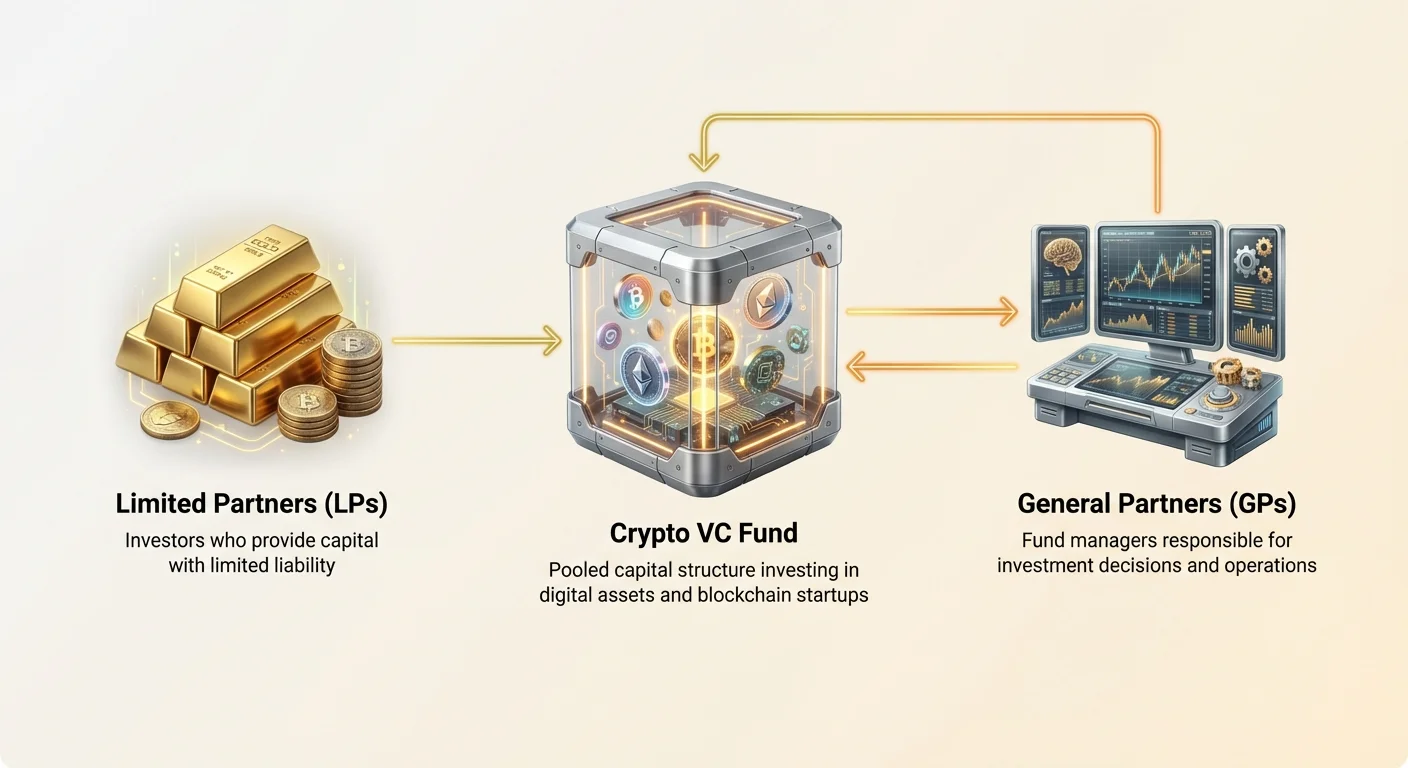
A VC fund operates as a partnership between those who manage the money (the GP) and those who provide the money (the LPs). This structure is designed to align interests over the long term, ensuring the fund managers work diligently to maximize returns for the investors.
The Role of the General Partner (GP)
The General Partner is the fund manager. They are responsible for sourcing investment opportunities, conducting due diligence, managing the portfolio companies (which may be early-stage startups or nascent protocols), and executing exit strategies (selling equity or tokens).
Crucially, the GP assumes unlimited liability for the fund’s operations (though this is often mitigated through legal structuring). Their compensation is twofold: a fixed management fee for their time and expenses, and a performance incentive known as carried interest.
The Role of the Limited Partner (LP)
The Limited Partner is the investor—often institutional entities (like pension funds or endowments), family offices, or high-net-worth individuals. LPs commit a specific amount of capital to the fund over its lifetime. Their liability is strictly limited to the amount of capital they commit, meaning they cannot be held responsible for the fund’s debts beyond their investment.
LPs are passive investors. They rely entirely on the GP’s expertise and strategy. Their primary focus is scrutinizing the fund’s terms (the legal contract) to ensure the economic distribution structure is fair and incentivizes high performance.
GP Compensation: Management Fees and Fund Expenses
Before a GP can earn a profit share, they must cover operational costs. This is managed through management fees and detailed expense clauses, which reduce the total capital available for investment.
Standard Management Fees and Capital Base
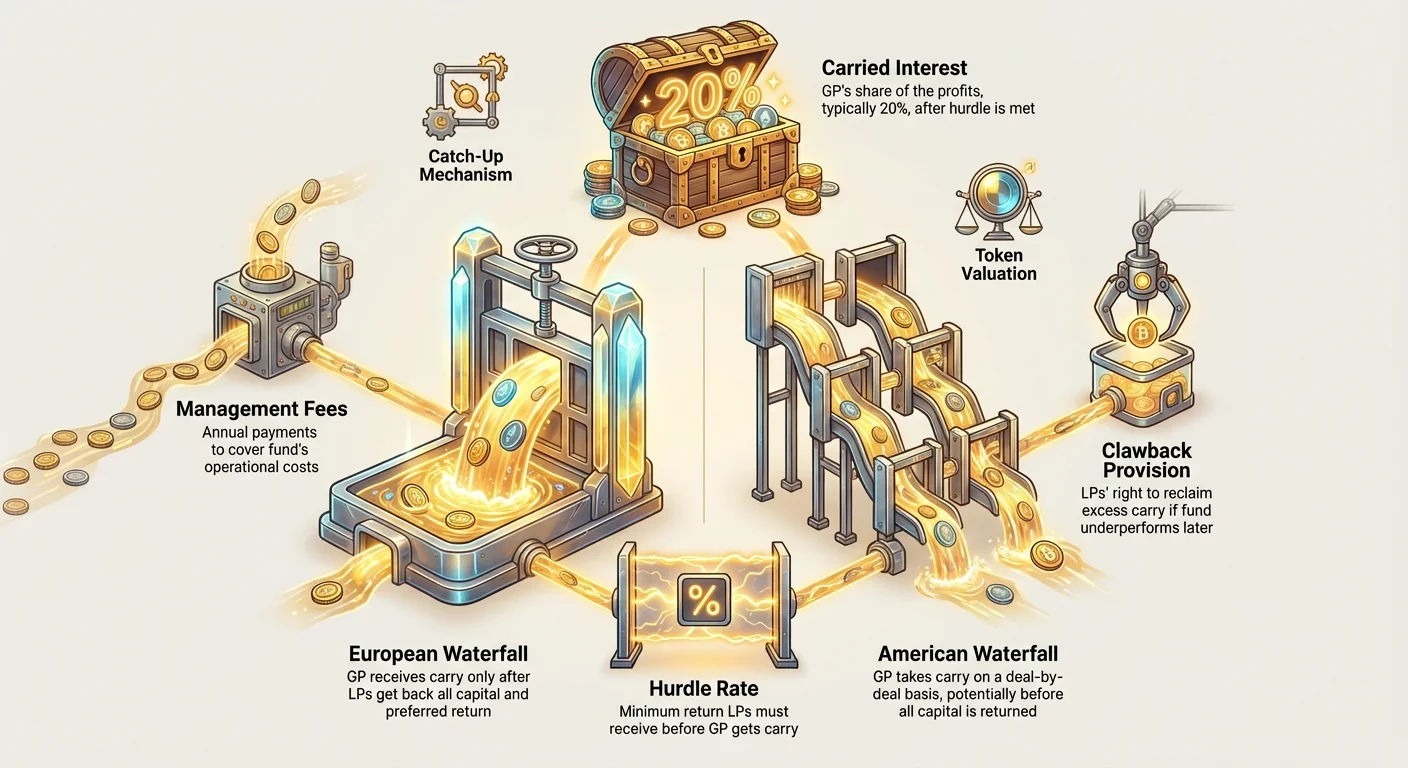
Management fees are annual payments made by the LPs to the GP to cover salaries, legal costs, office space, and general fund administration. This fee is paid regardless of whether the fund makes a profit.
In the VC world, the standard fee historically hovers around 2% per year. However, LPs must pay close attention to the basis on which this 2% is calculated:
- Committed Capital: In the early years of the fund (typically the first three to five years, the investment period), the fee is often charged on the total capital the LPs committed.
- Invested Capital: As the fund matures and fewer new investments are made, the fee may switch to being calculated only on the capital that has actually been deployed into portfolio companies.
LP Consideration: Due to the often intense due diligence and specialized expertise required in the rapidly changing digital asset space, some crypto VC funds may charge slightly higher management fees (up to 2.5% or 3%) compared to traditional VCs, justifying the premium with their specific blockchain knowledge and network access. LPs must confirm these fees are competitive and justifiable.
Operational Expenses and Fee Offsets
Beyond the management fee, VC funds incur specific expenses related to investment activity (e.g., travel for deal sourcing, specialized legal counsel for tokenomics review, or regulatory filings). These costs are generally passed through directly to the LPs.
Savvy LPs look for fee offsets. If the GP charges consultancy fees or receives director fees from portfolio companies, these payments should often be "offset" against the management fee paid by the LPs. This prevents the GP from double-dipping—being paid both by the LPs and by the companies the LPs are funding. Transparency regarding these offsets is a crucial element of LP due diligence.
Carried Interest: The Heart of the Deal
Carried interest, often simply called "carry," is the primary performance incentive for the General Partner. It represents the GP’s share of the profit earned by the fund, assuming specific performance targets are met.
Defining Carried Interest (The 20%)
The standard carry percentage in both traditional and crypto VC is 20%. This means that after all initial capital and expenses have been returned to the LPs (plus a preferred return, discussed below), the GP is entitled to 20% of the remaining profit, while the LPs retain 80%.
For example, if a fund returns $150 million on an initial investment of $100 million, the $50 million profit is subject to the carry split (e.g., $10 million to the GP, $40 million to the LPs, after the initial $100 million is returned).
In the crypto space, some funds dealing with highly technical or extremely high-risk, early-stage token deals may negotiate higher carry (sometimes 25% or 30%), reflecting the potential for outsized, though less certain, returns.
The Hurdle Rate (Preferred Return)
The hurdle rate, or preferred return, is a crucial protective measure for LPs. It represents the minimum rate of return the fund must achieve before the GP is allowed to take any carried interest.
The typical hurdle rate is an internal rate of return (IRR) of 7% to 8% annually.
Practical Example: If the fund has a 7% hurdle rate, LPs must first receive their committed capital plus an annualized 7% return on that capital. Only after this threshold is met are the remaining profits subject to the 80/20 carry split. This ensures that LPs are receiving an acceptable, moderate return before the GP gets their bonus. If the fund performs poorly and only returns 5%, the GP receives no carry, reinforcing alignment.
The Catch-Up Provision
Once the hurdle rate is cleared, the fund agreement usually includes a "catch-up" provision. This allows the GP to receive 100% of the profit distributions (up to a certain percentage) until the GP's share of profits equals their specified carry percentage (usually 20%).
- Step 1: LPs receive 100% of distributions until they have met the hurdle rate.
- Step 2 (The Catch-Up): The GP receives 100% of subsequent distributions until they have "caught up" to their 20% carry share on the total profits (including the hurdle amount).
- Step 3: Profits are distributed according to the standard 80/20 split.
This mechanism ensures the GP ultimately achieves the full 20% carry intended by the contract, provided the fund performs well enough.
The Distribution Mechanism: Understanding Waterfalls
The "waterfall" is the precise contractual mechanism that dictates the order in which cash flows from the fund’s investment realizations (exits) back to the LPs and the GP. The choice of waterfall model has significant implications for LP safety and risk exposure.
European Waterfall (Fund-as-a-Whole)
The European waterfall is generally considered the most LP-friendly structure. Under this model, the GP can only begin taking carried interest after the LPs have received:
- 100% of their total committed capital returned.
- 100% of the preferred return (hurdle rate) calculated on their capital.
This is a fund-as-a-whole approach. If the fund has 10 investments and 9 fail, the LPs must receive all their capital back from the one successful investment before the GP can earn carry. This structure minimizes the risk that the GP takes early profits on a successful deal only to have later deals drag the overall fund performance down.
American Waterfall (Deal-by-Deal)
The American waterfall allows the GP to take carried interest on a deal-by-deal basis. If the fund has an early, major success (e.g., an early-stage token sale that delivers a 10x return), the GP can immediately take their 20% carry on the profits of that specific deal, even if the majority of the fund’s capital has yet to be returned.
While the American model provides quicker incentive and liquidity for the GP, it carries more risk for the LP. If the GP takes carry on a successful Deal A, but subsequent Deals B, C, and D lose money, the GP may have profited while the LPs have not yet fully recovered their principal.
Due to the higher velocity of exits (such as vesting schedules or early liquidity events for tokens) in the crypto ecosystem, some digital asset funds prefer the American waterfall, arguing it better reflects the rapid nature of the market. However, LPs must ensure adequate protection exists.
Navigating the Clawback Provision
The clawback provision is the LP’s key defense against the American waterfall structure.
A clawback is a contractual right for the LPs to compel the GP to return any carried interest that was distributed prematurely, should the fund’s overall performance decline later in its life, resulting in the LPs not receiving their principal or hurdle rate.
If the GP took carry early under an American waterfall, but the fund later failed to meet the required hurdle rate, the GP is legally obligated to "claw back" the excess carry they received and return it to the LPs. LPs must insist that clawback obligations are secured (e.g., through an escrow account) and are joint and several, meaning all individual members of the GP team are liable for the returned funds.
Valuing Digital Assets in a Fund Context
Valuation is the single most complex issue separating crypto VC funds from traditional funds. Standard VC deals involve private equity, where valuation updates usually only occur during financing rounds. Crypto funds, however, deal with tokens that may become liquid, semi-liquid, or remain highly illiquid, requiring specific, often conservative, valuation methodologies.
Challenges in Valuing Illiquid Tokens
A crypto fund often invests in tokens long before they are listed on major exchanges. These tokens typically have multi-year vesting schedules, meaning they are locked and cannot be sold immediately.
When reporting to LPs, the GP must assign a value to these private assets:
- Cost Basis: The original price the fund paid for the token is the absolute minimum valuation.
- Subsequent Financing Rounds: If a later investor buys the token at a higher price, that price (or a conservative discount to it) may be used.
- Fair Market Value (FMV): If the token is listed on a secondary market but is still illiquid (due to vesting), the GP must choose a defensible valuation. Regulatory bodies often require the GP to value the token at the lower of the cost basis or the current market price, especially if the current price is depressed.
Mark-to-Market vs. Conservative Accounting
LPs prefer conservative accounting to avoid inflated "paper returns." A GP might be tempted to use "Mark-to-Market" valuation—simply using the current publicly traded price for all tokens, even those that are still locked by vesting schedules.
However, a prudent fund will apply significant discounts to illiquid assets. A token that cannot be sold for three years is worth less than an identical token that can be sold today. Therefore, LPs should look for clear policies on:
- Vesting Discounts: Applying a substantial discount (often 20% to 50%) to tokens that are not yet fully vested.
- Liquidity Discounts: Applying discounts to tokens traded on thin, illiquid exchanges where selling large quantities would crash the price.
- Audit Oversight: Ensuring a qualified, independent third-party auditor reviews and validates the valuation methodology at least quarterly.
LP Reporting, Due Diligence, and Tax Considerations
Effective LP participation requires diligent monitoring of fund performance metrics and proactive management of compliance and tax obligations.
Key Performance Indicators (KPIs)
While IRRs are important, LPs utilize three key public-market equivalent multiples to benchmark performance across different VC funds:
1. Distributed to Paid-In Capital (DPI)
DPI is the most honest metric. It measures the actual cash returned to LPs versus the capital they invested. A DPI of 1.0 means LPs have received all their principal back. Anything above 1.0 represents profit.
2. Residual Value to Paid-In Capital (RVPI)
RVPI represents the "paper value" of the unrealized investments. It relies heavily on the GP’s valuation methodology. A high RVPI with a low DPI suggests a strong portfolio but a lack of successful exits.
3. Total Value to Paid-In Capital (TVPI)
TVPI is the total measure of success, combining realized returns (DPI) and unrealized returns (RVPI). A TVPI of 2.0 means the fund has doubled the investors’ money on paper.
Essential LP Reporting
LPs receive several mandatory reports throughout the fund's life:
- Capital Call Notices: Official requests from the GP for LPs to transfer committed funds to the partnership bank account to make new investments. Capital is rarely deployed all at once; it is "called" as needed.
- Distribution Notices: Documentation detailing the specific timing and breakdown of profits (cash or tokens) being distributed back to LPs after an exit event.
- Quarterly Statements: Detailed reports covering the fund’s activities, investment performance (TVPI/DPI), valuation changes, and expense reports.
LPs must regularly audit these statements against the initial fund terms to ensure fees are calculated correctly and valuations are consistent.
The Importance of Tax Transparency
Taxation in crypto VC is notoriously complex, particularly for LPs in multi-jurisdictional funds. The treatment of capital gains, income from staking or lending activities (common in digital asset funds), and the tax implications of receiving token distributions (rather than cash) varies widely.
- Tax Basis Tracking: LPs must ensure the fund provides clear documentation on the cost basis of every asset distributed. Unlike traditional stock, which is easy to track, tokens often have fragmented cost bases from various purchases, sales, or staking rewards within the fund.
- Sustaining Compliance: Because crypto transactions can be numerous and complex (e.g., hundreds of micro-transactions from liquid staking protocols), LPs rely on the GP to maintain impeccable accounting records, often utilizing specialized crypto tax platforms that automate transaction reconciliation and provide the necessary reporting documents (like K-1s in the US context) for compliance. Failure to do so can create massive compliance headaches and potential liabilities for the LP.
Conclusion
Investing as an LP in a Crypto VC fund is an attractive proposition for long-term capital growth, offering access to high-growth, early-stage digital innovation. However, the sophistication of these agreements requires a deep understanding of fund economics.
The cornerstone of due diligence lies in analyzing the relationship between the management fee and the carried interest. LPs must insist on a structure—such as the European waterfall combined with a strong hurdle rate and robust clawback provision—that genuinely aligns the GP's financial success with the LP's overall long-term return. By mastering the nuances of carried interest, valuation methodologies, and performance benchmarking, LPs can navigate the complexities of digital asset funds and maximize their potential returns while effectively mitigating financial risks.