
Entering the world of digital assets—cryptocurrencies, NFTs, and various blockchain-based instruments—presents unique challenges and opportunities, particularly for professional managers handling significant capital. Unlike retail investors who focus primarily on personal security and basic portfolio diversification, institutional investors (such as hedge funds, corporate treasuries, endowments, and family offices) operate under a mandate of fiduciary duty. This means they must legally and ethically manage assets in the best interest of their clients, requiring rigorous security, compliance, and risk modeling.
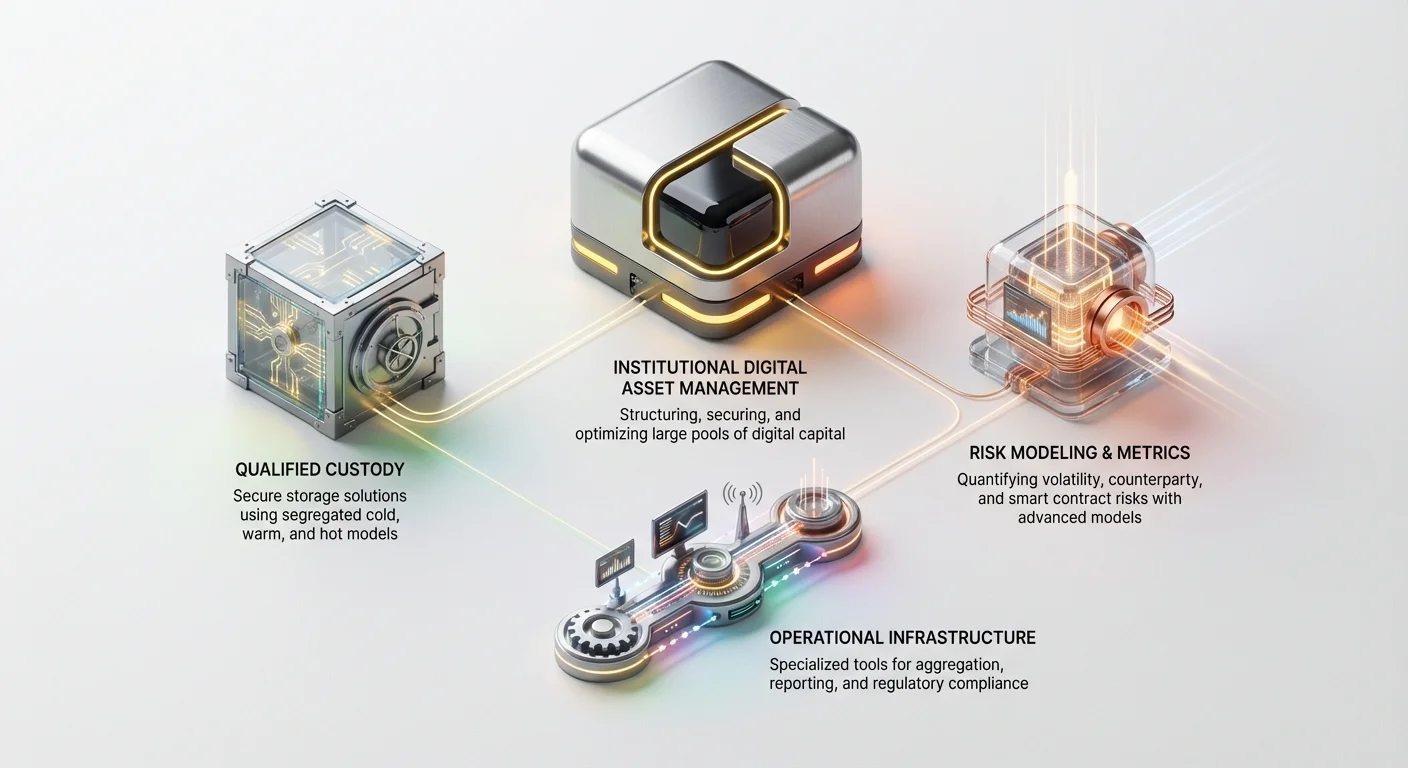
Institutional Digital Asset Management (IDAM) is the specialized practice of structuring, securing, and optimizing large pools of digital capital. It moves beyond simple "buy and hold" strategies. It involves complex decisions related to advanced custody solutions, sophisticated risk quantification, efficient trade execution, and navigating the often murky waters of global regulatory and tax compliance.
This comprehensive guide is designed to break down the highly specialized strategies employed by professional digital asset managers. We will explore the essential infrastructure required to secure multi-million or multi-billion dollar crypto portfolios, the mathematical models used to measure risk in volatile markets, and the operational tools necessary for achieving measurable, risk-adjusted returns in the decentralized economy.
The Foundation of Institutional Management: Professional Digital Asset Custody
For institutions, the phrase "not your keys, not your coin" must be balanced against the need for organizational control, regulatory compliance, and robust internal governance. Retail investors often use software wallets, but institutions require "Qualified Custodians"—third-party financial entities approved by regulators to hold assets on behalf of clients. Professional digital asset custody is the bedrock upon which all institutional crypto strategies are built.
Segregation and Security Models (Cold, Warm, and Hot Storage)
Effective institutional custody necessitates a tiered security architecture that balances safety with accessibility. Assets are not stored in one location; rather, they are distributed across specialized environments:
- Cold Storage (Offline): This is the highest security tier, often involving hardware devices or paper backups stored in secured, geographically dispersed vaults (often hardened facilities akin to bank vaults). Keys are never connected to the internet. Cold storage is ideal for the vast majority (often 95%+) of the total portfolio, as these assets are intended for long-term holding and minimal trading.
- Warm Storage (Limited Connectivity): This uses systems that are periodically connected to the network to facilitate slow, carefully controlled movements of funds (such as rebalancing or transferring to a trading account). Warm storage minimizes risk by isolating assets from continuous internet threats while maintaining necessary operational flexibility.
- Hot Storage (Online): This involves wallets and keys hosted on internet-connected servers, used exclusively for immediate trading, yield generation, or managing small operational reserves (e.g., gas fees). While convenient, hot storage carries the highest risk and holds only a small fraction of the total capital.
Regulatory Requirements and Qualified Custodians
A critical differentiator between retail and institutional custody is regulatory oversight. In jurisdictions like the United States, investment advisors managing client funds must use Qualified Custodians. These entities must meet stringent financial, technological, and procedural standards set by regulatory bodies (like the SEC).
Qualified Custodians provide benefits that go far beyond simple security:
- Auditing and Reporting: They provide verifiable proofs of reserves and transaction histories necessary for financial audits.
- Insurance: Many offer robust insurance policies against theft, internal fraud, or technological failure, providing a necessary layer of protection for large amounts of client capital.
- Segregation of Duties: They ensure that the people who authorize transactions are separate from the people who execute the transactions, a key internal control mechanism for preventing fraud.
The Role of Multi-Party Computation (MPC)
Multi-Party Computation (MPC) represents the cutting edge of professional digital asset custody. MPC technology allows multiple independent parties to jointly calculate a transaction signature without ever revealing the full private key to any single party.
Instead of a single private key, the key is mathematically split into multiple "shards." To authorize a transaction, a predetermined threshold of these shards must be brought together (e.g., 3 out of 5 required signatures).
Why MPC is crucial for institutions:
- Eliminates Single Point of Failure: Losing one shard does not compromise the entire key.
- Decentralized Control: Shards can be held by different executives, different geographical locations, or even by the custodian and the client simultaneously, enforcing governance rules automatically.
- Enhanced Speed: Unlike traditional multi-signature schemes (which rely on on-chain smart contracts and can be slow), MPC can generate signatures instantly and off-chain, increasing execution speed without sacrificing security.
Building and Modeling Institutional Crypto Portfolios
Institutional crypto asset management requires disciplined portfolio construction that prioritizes risk tolerance, long-term thesis, and measurable returns over speculative trading. The strategies employed are often adaptations of classical finance models, customized for the unique volatility and technological risks inherent in blockchain assets.
Strategic Allocation Beyond Market Cap
Retail investors often rely on simple market capitalization rankings (e.g., allocating 60% to Bitcoin, 30% to Ethereum). Institutional managers must adopt more nuanced strategic allocations driven by long-term thematic theses and technological development stages:
- Layer 1 Infrastructure (L1): Investing in foundational blockchain networks (e.g., Ethereum, Solana, Avalanche). This thesis centers on capitalizing on the adoption of the entire ecosystem built atop the protocol.
- Decentralized Finance (DeFi) Yield: Allocating capital to protocols offering measurable, sustainable yield through lending, staking, or liquidity provision. This requires intense vetting of smart contract security and token economic models.
- Thematic Clusters: Focusing on specific verticals, such as Web3 Gaming, Supply Chain Tokenization, or Decentralized Identity solutions. This requires deep domain expertise to identify early-stage winners.
Integrating Traditional Finance (TradFi) Metrics
For institutional managers, performance must be quantified using metrics familiar to Limited Partners (LPs) and stakeholders. This means adopting and adapting traditional finance (TradFi) metrics:
- Sharpe Ratio: This measures the average return earned in excess of the risk-free rate per unit of total risk (volatility). A higher Sharpe Ratio indicates better risk-adjusted performance. Institutional managers strive to achieve a high Sharpe Ratio by finding assets that offer substantial returns without proportionally increasing portfolio volatility.
- Alpha: This measures the skill of the manager—the portfolio’s return relative to a relevant benchmark index (e.g., a custom crypto index or the overall digital asset market). Positive Alpha means the manager outperformed the market, suggesting successful active management and selection.
- Maximum Drawdown (MDD): The largest peak-to-trough decline during a specific period. This is a crucial metric for institutional risk tolerance, helping managers stress-test how much loss the portfolio could sustain before hitting client-mandated stop limits.
Managing Liquidity and Transaction Costs at Scale
A major challenge for institutional managers is liquidity. While Bitcoin and Ethereum are highly liquid, moving large amounts of capital into smaller-cap tokens or DeFi positions can impact the price significantly—an effect known as slippage.
To combat this, institutional strategies focus on:
- Executing Block Trades: Large orders are often executed privately or through specialized Over-the-Counter (OTC) desks rather than public exchanges, minimizing market impact.
- Timing and Splitting Orders: Orders are automatically split into smaller chunks (iceberg orders) and executed over time using smart order routing (SOR) systems to minimize visible market manipulation or sudden price spikes caused by the trade itself.
- Optimizing for Gas Fees: When interacting with smart contracts (especially on Ethereum), high gas fees can erode profits on large transactions. Institutional platforms often use sophisticated fee estimation and batching techniques to execute complex strategies as cost-effectively as possible.
Measuring and Mitigating Digital Asset Risk (Crypto Risk Metrics)
Cryptocurrency markets exhibit volatility levels far exceeding traditional equities or bonds. Institutional managers cannot rely on simple diversification; they must utilize specialized crypto risk metrics and sophisticated modeling techniques to understand the exposure profile of their holdings.
Understanding Volatility and Value at Risk (VaR)
Volatility is the measure of how quickly and dramatically the price of an asset can change. While high volatility can lead to high returns, it also signals high risk.
Value at Risk (VaR) is the standard industry metric for quantifying risk. VaR estimates the maximum expected loss over a specific time horizon (e.g., 24 hours or 10 days) at a given confidence level (e.g., 99%).
- Traditional VaR Adaptation: Standard financial models assume market returns follow a normal (bell curve) distribution. Crypto returns, however, exhibit "fat tails"—meaning extreme price movements (crashes or spikes) occur far more frequently than predicted by a normal distribution. Institutional managers must use advanced methodologies like Historical VaR or Conditional VaR (CVaR) to account for these fat tails, providing a more realistic estimate of catastrophic loss potential.
- Stress Testing: Managers run simulations to test portfolio performance under extreme, improbable conditions (e.g., "What if BTC drops 50% in a week while ETH gas fees spike 100x?"). This helps determine adequate liquidity buffers.
Counterparty Risk in Centralized vs. Decentralized Finance (CeFi vs. DeFi)
Counterparty risk is the risk that the entity on the other side of a transaction (the counterparty) will fail to meet its obligations. This risk exists differently in centralized and decentralized environments.
- Centralized Finance (CeFi) Risk: When using centralized exchanges (CEXs) or crypto lending platforms, institutions face traditional business risk (e.g., bankruptcy, regulatory failure, internal fraud). Mitigation strategies include stringent due diligence on the exchange’s financial health, auditing history, and proof-of-reserve procedures.
- Decentralized Finance (DeFi) Risk: In DeFi, counterparty risk transforms into Smart Contract Risk. Instead of trusting a company, managers trust code. The primary risk is a flaw or bug in the underlying smart contract that allows funds to be exploited or locked. Mitigation involves:
- Using established, battle-tested protocols (e.g., Aave, MakerDAO).
- Relying only on protocols that have completed multiple, reputable, third-party code audits.
- Maintaining insurance coverage against smart contract exploits (DeFi insurance).
Operational and Smart Contract Risk Assessment
Beyond market volatility and counterparty failure, two hidden risks demand intense institutional focus:
- Operational Risk: This covers human error, security failures (e.g., phishing attacks, insider threats), and process breakdown. Because digital assets are irreversible, a simple mistake (sending a transaction to the wrong address) can result in permanent loss. Institutional mitigation requires multi-person approval processes (the "four-eyes principle"), rigorous employee training, and specialized security operations centers (SOCs) monitoring for threats 24/7.
- Key Management Risk: The complexity of key generation, storage, recovery, and destruction is a major operational headache. Institutions must implement documented, immutable Key Management Policies that dictate every step of the key lifecycle, often leveraging dedicated hardware security modules (HSMs) and geographically distributed key ceremonies.
Operational Excellence: Aggregation, Accounting, and Compliance
The sheer complexity and volume of transactions—spanning various blockchains, exchanges, lending protocols, and staking rewards—create an administrative nightmare for traditional finance systems. Operational excellence in IDAM is achieved through specialized technology designed to centralize data and ensure regulatory adherence.
Portfolio Aggregation Tools and Real-Time Reporting
Institutional portfolio management requires a single, accurate view of total assets across all platforms at any given moment. This is impossible to achieve manually.
Portfolio Aggregation Tools (or institutional reporting dashboards) solve this problem by:
- Data Ingestion: Connecting via APIs (Application Programming Interfaces) to all major centralized exchanges, DeFi protocols, and custodial wallets.
- Normalization: Converting disparate data (e.g., staking rewards from Protocol A, trading profits from Exchange B, and gas fees from Chain C) into a standardized format for consolidated reporting.
- Performance Calculation: Automatically calculating performance metrics (P&L, Alpha, Sharpe Ratio) in real-time, allowing managers to respond instantly to market shifts.
These tools are essential for satisfying LP demands for transparent, frequent reporting that details risk exposure and historical performance metrics.
Navigating Complex Crypto Tax and Accounting Standards
Tax and accounting standards for digital assets are often vague, constantly changing, and differ significantly across jurisdictions. For institutions dealing with thousands of transactions across multiple countries, this is a mission-critical challenge.
- Cost Basis Tracking: Every crypto transaction, including swaps, staking rewards, and yield generation, must be accurately tracked to determine the cost basis for capital gains and losses calculations. Using methods like FIFO (First-In, First-Out) or LIFO (Last-In, First-Out) for millions of micro-transactions is computationally heavy.
- Specialized Tax Platforms and Firms: Institutions invariably rely on specialized crypto tax software and full-service accounting firms (like those highlighted in the introductory sources) that integrate directly with their aggregation systems. These platforms automate the calculation of complex liabilities across various jurisdictions and generate audit-ready financial statements.
- Mark-to-Market vs. Historical Cost: Institutions must decide on the appropriate accounting method. Most large investment funds use mark-to-market accounting (valuing assets at current market price), which provides the most accurate, real-time reflection of the fund's net asset value (NAV).
Implementing Robust Internal Controls and Governance
Compliance is not just about filing reports; it's about establishing governance structures that prevent operational failures and maintain integrity.
- Travel Rule Compliance: Institutions engaging in money transfers must adhere to the global "Travel Rule," which requires financial institutions to share specific identifying information about the sender and recipient when the transaction exceeds a certain monetary threshold. IDAM systems must be engineered to capture and transmit this data accurately.
- Whitelisting and Wallet Review: To prevent funds from being sent to malicious or unauthorized addresses, institutional systems enforce strict whitelisting policies. Any new wallet address must be reviewed, approved by multiple parties, and added to the secure whitelist before a transfer can be initiated.
- Regulatory Watchlists: Constant monitoring of Anti-Money Laundering (AML) and Know Your Customer (KYC) compliance is required, often by linking transaction data to blockchain analytics software that flags interactions with known sanctioned entities or illicit sources.
The Institutional Toolkit: Prime Brokerage and Advanced Services
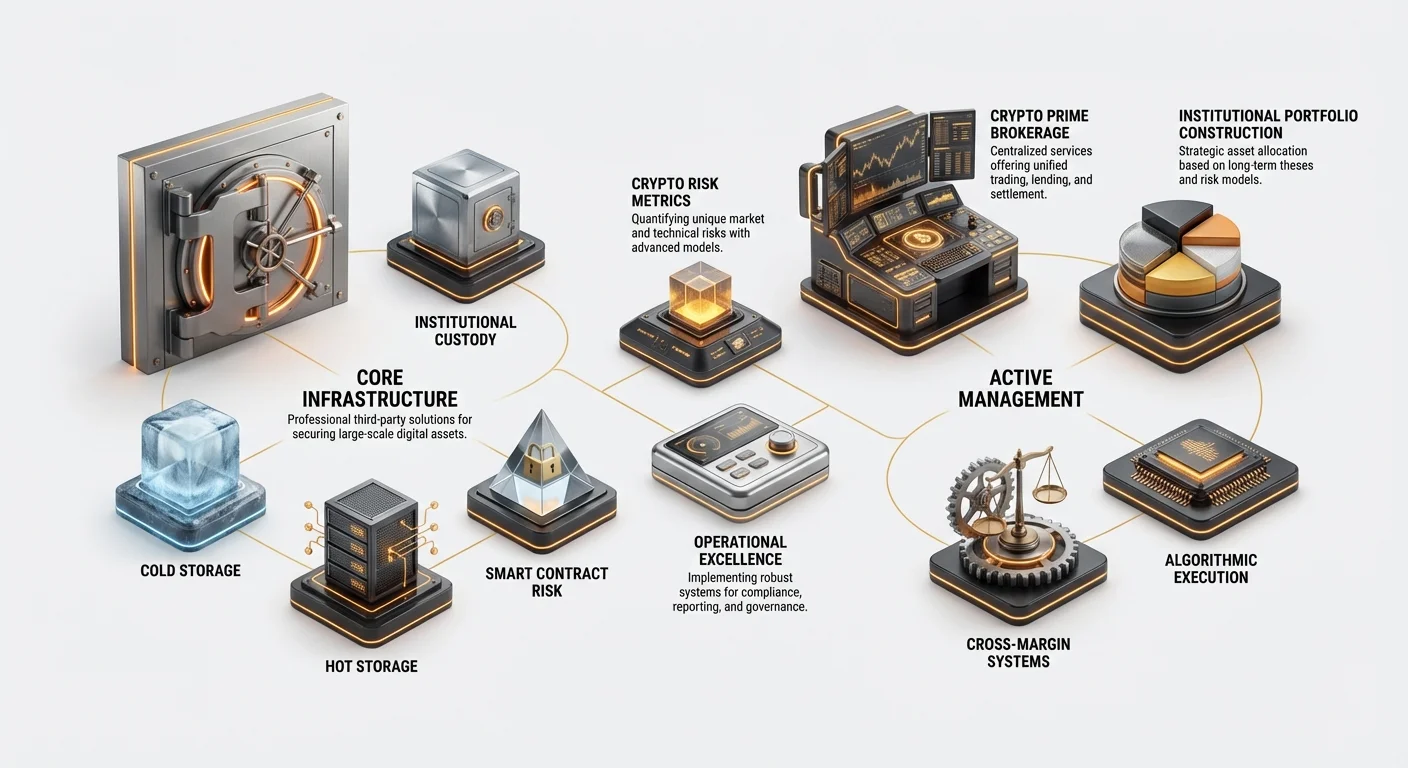
As institutional engagement matures, specialized services developed in TradFi are being adapted for crypto markets. Crypto Prime Brokerage services are arguably the most critical tools for institutional scale and capital efficiency.
Functions of Crypto Prime Brokers
In traditional finance, a prime broker acts as a single centralized counterparty, offering a suite of services to large clients, simplifying complex operations. Crypto Prime Brokers fulfill similar functions:
- Unified Trading Interface: Instead of opening and funding accounts at ten different exchanges, a prime broker provides a single interface to access liquidity across all major venues.
- Centralized Collateral Management: The institutional manager deposits collateral once with the prime broker, who then manages that collateral for lending, borrowing, derivatives trading, and margin trading across various platforms.
- Institutional Lending and Borrowing: Facilitating large-scale, often bilateral, over-the-counter (OTC) loans of digital assets, allowing managers to execute short-selling or leveraged strategies.
- Settlement and Clearing: The prime broker takes on the risk of settlement, ensuring trades are executed and confirmed securely, often netting trades across multiple venues to reduce transaction fees and complexity.
Strategies for Capital Efficiency (Collateral Management and Cross-Margin)
Capital efficiency is paramount for institutional managers. Leaving capital idle or fragmented across different venues reduces potential returns.
- Cross-Margin Systems: Traditional crypto trading often uses isolated margin, where collateral is tied only to a specific position. Prime brokers utilize cross-margin systems, where the entirety of a client’s portfolio (the collateral pool) can be used to back any open trade or loan. If one position starts losing value, the entire pool acts as a buffer, optimizing capital utilization.
- Synthetic Exposure: Instead of purchasing and holding the underlying assets directly, managers often use crypto derivatives (futures, options, swaps) facilitated by prime brokers. This allows them to gain exposure to market movements without the operational burden and custody risk associated with managing the spot asset itself.
Executing Large Block Trades and Minimizing Slippage
For institutions moving hundreds of millions of dollars, market execution must be perfect to avoid massive losses due to slippage.
- Dark Pools and Request-for-Quote (RFQ) Systems: Prime brokers provide access to "Dark Pools"—private exchanges where orders are matched anonymously without being displayed publicly. This is essential for large block trades. Additionally, RFQ systems allow institutions to request price quotes from multiple liquidity providers simultaneously, locking in the best possible price before execution.
- Algorithmic Execution: Specialized algorithms are used to slice large orders into smaller, market-agnostic trades that are deployed across multiple venues at optimal times. These algorithms are designed to minimize detection by other traders, ensuring the price of the asset is not unduly moved by the institutional order flow.
Conclusion
Institutional Digital Asset Management is a highly specialized field that applies the discipline of traditional finance to the unique technological realities of the blockchain. For any organization looking to manage significant digital capital, success hinges on establishing three core pillars: world-class professional digital asset custody (leveraging MPC and Qualified Custodians), sophisticated crypto risk metrics (adapting VaR and focusing on smart contract scrutiny), and robust operational infrastructure (using aggregation tools and specialized prime brokerage services).
By anchoring strategies in strong governance, regulatory compliance, and technological resilience, professional digital asset managers can move beyond the speculative nature of early crypto adoption and focus on generating verifiable, risk-adjusted returns for their stakeholders. As the digital asset space continues to mature, adherence to these institutional best practices will define the next generation of wealth management.