
The core premise of decentralized infrastructure—whether it's Bitcoin, Ethereum, or a new decentralized application (dApp)—is the removal of centralized authority. If there is no CEO, no Board of Directors, and no single company running the show, who makes the critical decisions? Who manages the finances?
The answer lies in the Decentralized Autonomous Organization (DAO). A DAO is essentially an internet-native organization owned and managed by its members. Decisions are made through proposals and voting, usually based on the ownership of native tokens. While the concept sounds like pure digital democracy, the reality is far more complex. The way a DAO structures its voting, manages its treasury, and handles legal liability determines its true level of decentralization.
This article moves beyond the simple definition of a DAO to analyze the core engineering trade-offs inherent in different governance models. We will examine why common voting systems often lead to hidden centralization and explore the innovative solutions being developed to foster genuine, broad-based participation in the decentralized ecosystem.
I. Defining the Decentralized Autonomous Organization (DAO)
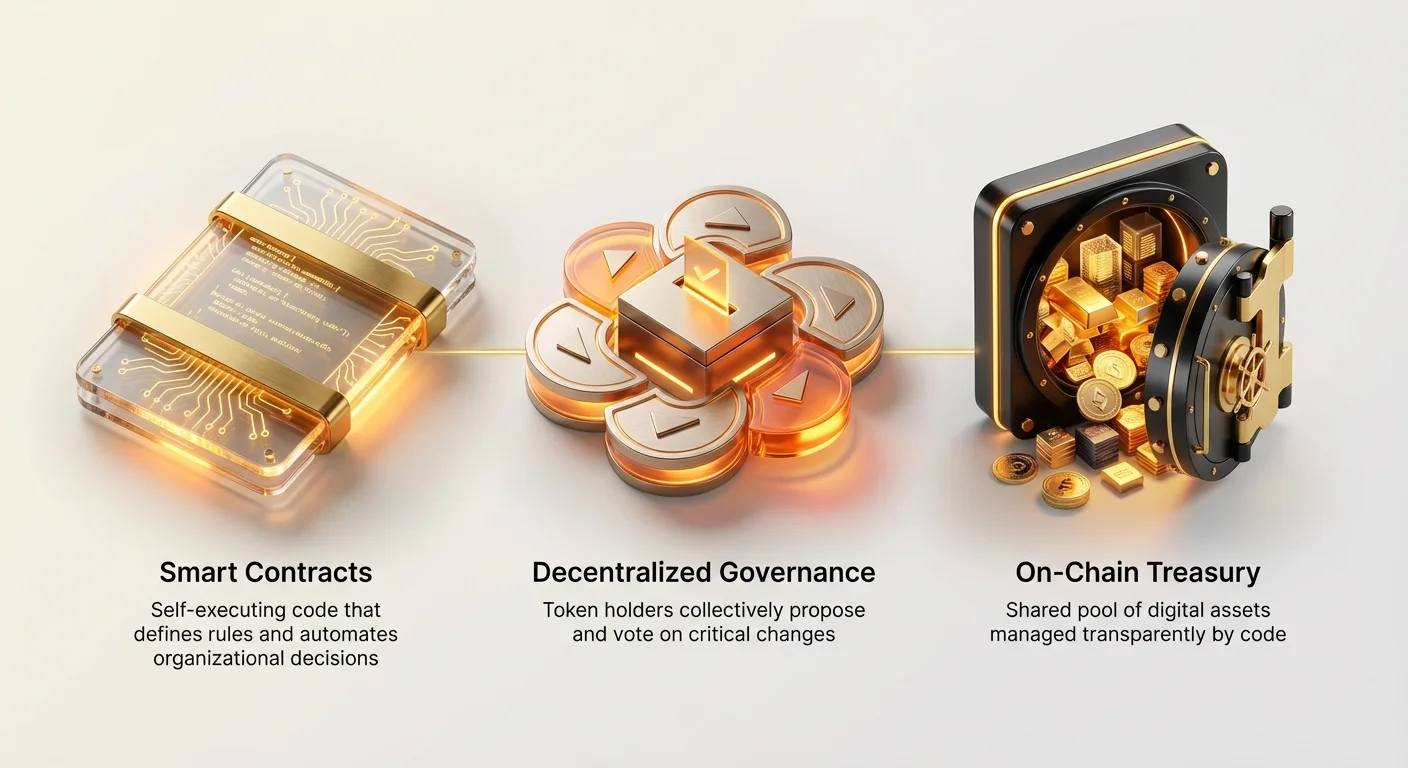
A DAO is an organization governed entirely by code and consensus. It operates transparently on a blockchain, using smart contracts to encode the rules, manage the treasury, and execute decisions automatically once voting thresholds are met.
The Foundation of the DAO: Smart Contracts
At the heart of every DAO is a set of smart contracts. These contracts serve as the organization's constitution, bylaws, and operating manual simultaneously. They define critical parameters such as:
- Voting Mechanics: How proposals are submitted, how long voting lasts, and the quorum (minimum participation rate) required for a vote to pass.
- Treasury Management: The allocation, vesting, and spending rules for the DAO’s funds.
- Token Distribution: The rules governing how the governance tokens are initially issued and how they are earned or distributed over time.
Because these rules are written into immutable code on the blockchain, the DAO operates without the need for human intermediaries. If a proposal passes according to the smart contract rules, the action is executed automatically.
DAO Structure vs. Traditional Companies
To understand the revolutionary nature of a DAO, it helps to compare it to a traditional, centralized corporation:
| Feature | Centralized Corporation | Decentralized Autonomous Organization (DAO) |
|---|---|---|
| Authority | CEO, Board of Directors, Legal Entities | Smart Contracts and Token Holders |
| Decision Making | Executive Order or Shareholder Meeting | On-chain Voting and Consensus |
| Transparency | Private financials, disclosed quarterly | All funds, proposals, and votes are public |
| Geographic Scope | Limited by country and jurisdiction | Global and Borderless by default |
| Access | Requires formal employment/investment | Open to anyone who holds the governance token |
The shift from private boards and executive decisions to open, transparent, automated governance is the promise of DAO models. However, realizing this promise requires overcoming significant technical and political hurdles.
II. The Governance Challenge: Centralization Risk in Decentralization
The core challenge facing all decentralized autonomous organization models is the tension between efficiency and true decentralization. An organization must be able to make decisions quickly and securely, but if a small group of highly active or wealthy members dominates the decision-making process, the DAO becomes functionally centralized, defeating the purpose of decentralized governance.
The Centralization Paradox: The "Whale Problem"
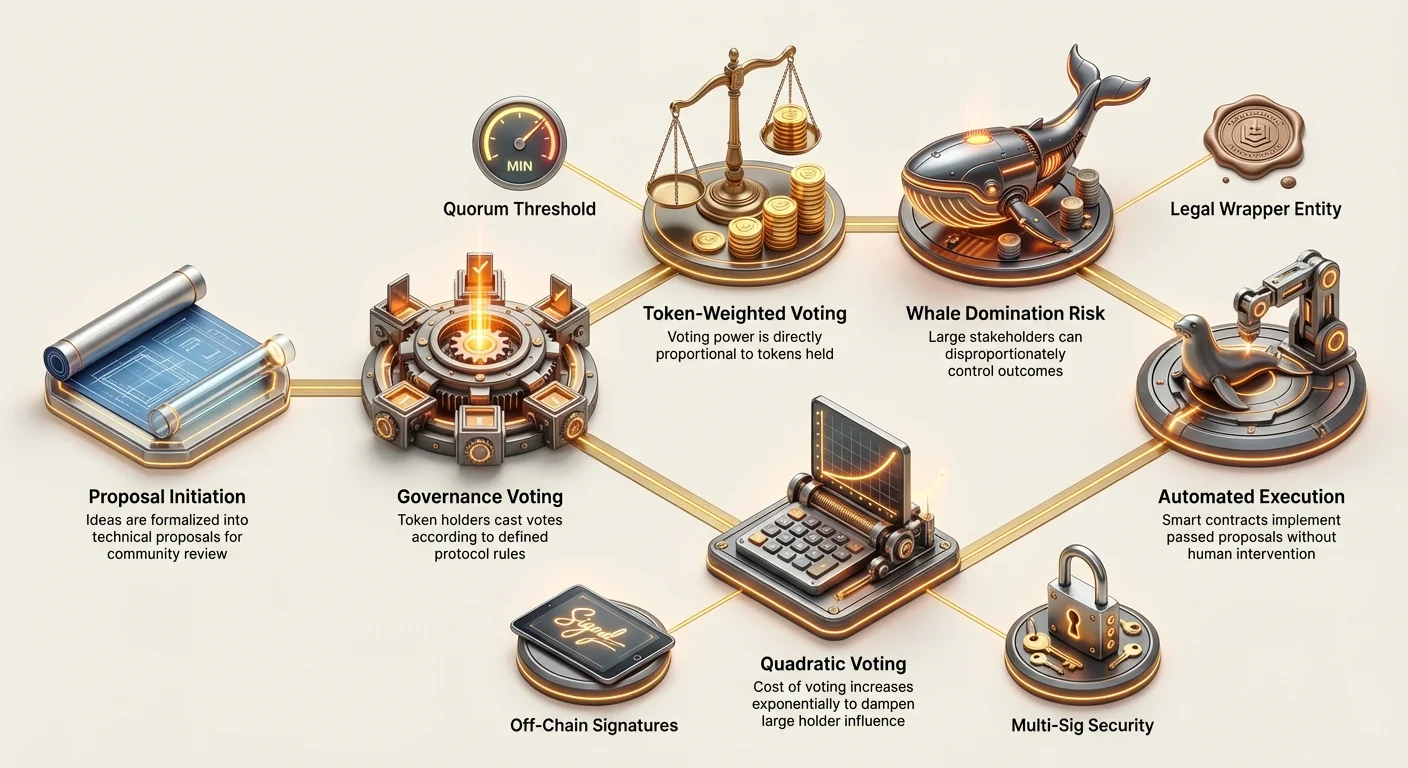
The most prevalent and scrutinized DAO voting mechanism is Token-Weighted Voting. In this system, one token equals one vote. This model is popular because it aligns economic incentive with governance participation: those who have the largest financial stake in the project have the largest say in its future.
However, this design leads directly to the Centralization Paradox (or "Whale Problem"):
- Concentrated Power: Since a large portion of governance tokens (often held by founders, early investors, or large investment funds) can be concentrated in relatively few wallets, a handful of participants can control the outcome of critical votes, such as software upgrades or treasury allocations.
- Apathy Among Small Holders: If a small token holder knows their vote will be mathematically irrelevant against the votes of the "whales" (large token holders), they have little incentive to participate in governance, further concentrating power among the largest holders.
- Vulnerability to Attack: If an attacker manages to acquire enough governance tokens (51% of the voting supply), they can effectively take control of the DAO and vote to drain the treasury or implement malicious code changes.
The very mechanism intended to secure the DAO (economic alignment) often creates a pathway back toward centralization.
The Role of Governance Token Design
The design of the governance token itself dictates the success or failure of a decentralized organization. A well-designed governance token must address two functions simultaneously:
- Utility: Does the token have a purpose beyond voting (e.g., staking, fee discounts)? This encourages long-term holding.
- Distribution: Was the initial distribution broad and fair? If 80% of tokens were given to insiders during the initial funding round, the DAO is born centralized, regardless of its subsequent voting rules.
Many DAOs attempt to mitigate early centralization through lock-up periods and slow vesting schedules for insiders, ensuring that control is gradually transferred to the wider community.
III. Standard Voting Systems and Their Limitations
To fully critique decentralized governance, we must analyze the mechanics of the most common voting systems and identify where they break down under the stress of real-world use.
Token-Weighted Voting: The Industry Standard
As noted, Token-Weighted Voting (T-WV) is the default for most major decentralized finance (DeFi) protocols and infrastructure DAOs.
Pros and Cons of Token-Weighted Voting
The simplicity of T-WV is its greatest asset. It is easy to understand, implement via smart contract, and provides a clear path for wealthy stakeholders to secure the protocol. However, the drawbacks are significant:
- Pro: Highly efficient. Large holders can quickly push through necessary technical upgrades.
- Pro: Strong alignment with financial security. Those who suffer the largest financial loss if the project fails are the ones making the decisions.
- Con: Ignores intellectual contribution. A developer who holds 10 tokens but writes vital code has less voting power than an unrelated investor who holds 10,000 tokens.
- Con: Creates a barrier to entry. If governance tokens are expensive, governance participation is restricted to the wealthy.
Addressing Low Voter Turnout (Quorum)
Low voter turnout is a persistent governance challenge. If only 5% of tokens participate in a vote, even if the proposal passes unanimously among those 5%, the decision lacks legitimacy.
DAOs address this through Quorum Requirements. A quorum is the minimum percentage of outstanding governance tokens that must participate for the vote to be considered valid. Setting the quorum too high (e.g., 40%) can lead to governance gridlock (inability to pass anything). Setting it too low (e.g., 5%) exposes the DAO to concentrated control and potential hostile takeovers. The ideal quorum is a delicate balance that allows for efficiency without sacrificing safety.
The Problem of Off-Chain Signatures
Another common limitation involves how the vote is recorded. While the execution of the decision (e.g., spending treasury funds) must happen on the blockchain, voting often occurs off-chain to save on gas fees (transaction costs).
DAOs use systems like Snapshot where token holders sign a message using their wallet (proving token ownership) without actually submitting a transaction to the blockchain. This improves voter accessibility but creates a challenge:
- Security Risk: Off-chain votes are only binding if the DAO’s smart contracts are designed to accept and trust the results submitted back to the chain. This requires an additional layer of trust or the use of Oracles (secure data feeds) to ensure the vote count is accurate before the execution contract is triggered.
IV. Alternative Governance Systems for Improved Fairness
Recognizing the flaws in pure Token-Weighted Voting, developers are exploring alternative governance models that aim to distribute power based on contribution, identity, or intensity of preference, rather than just wealth.
Quadratic Voting (QV): Measuring Preference Intensity
Quadratic Voting (QV) is one of the most promising alternatives to T-WV. It aims to reduce the disproportionate power of large token holders by making votes progressively more expensive.
How Quadratic Voting Works:
Instead of paying one token for one vote, the cost of adding a vote increases quadratically (exponentially).
- 1 vote costs 1 token.
- 2 votes cost tokens.
- 3 votes cost tokens.
- 10 votes cost tokens.
This structure allows small participants to voice their opinion without being drowned out, while making it prohibitively expensive for whales to stack hundreds of votes on a single proposal. This system shifts the focus from "how much money you have" to "how strongly you feel about this particular proposal."
Trade-offs of Quadratic Voting:
While QV enhances fairness, it introduces complexity. It requires a more sophisticated smart contract implementation and potentially higher operational costs. Furthermore, it doesn't entirely solve the issue of sybil attacks (using multiple identities) unless combined with a strong identity solution.
Identity and Proof-of-Personhood
In a pure T-WV system, we treat every token equally. In a democratic society, we treat every person equally ("one person, one vote"). To bring the decentralized organization closer to true democracy, the DAO must solve the problem of Sybil Resistance—ensuring that one person cannot use multiple wallets to cast multiple votes.
Proof-of-Personhood (PoP) systems attempt to link a blockchain wallet to a verified, unique human identity. This is critical for systems like Quadratic Voting, otherwise a whale could simply split 100 tokens into 10 separate wallets and buy 10 votes (at 1 token cost each), circumventing the quadratic cost mechanism.
Examples of PoP solutions include:
- Decentralized Identity (DID) Systems: Using verifiable credentials or biometric proofs tied to a cryptographic key.
- Social Graph Verification: Relying on web-of-trust models where people vouch for one another's uniqueness.
- Soulbound Tokens (SBTs): Non-transferable tokens that represent credentials, reputation, or identity, effectively acting as a digital passport.
While powerful, linking real-world identity to a DAO introduces major privacy and pseudonymity concerns, challenging the crypto ethos of anonymity.
Delegated Governance (Liquid Democracy)
Some DAOs find direct voting by all members (direct democracy) too slow and confusing, particularly for complex technical decisions. They adopt Delegated Governance or Liquid Democracy, mirroring representative governments.
In this model, token holders delegate their voting power to trusted individuals known as Delegates.
- Mechanism: Token holders retain ownership of their tokens but assign the voting rights to an expert (e.g., a core developer, an economist, or a community leader).
- Benefits: Speeds up decision-making and ensures that informed experts are making technical decisions, leading to a higher quality of governance.
- Risks: Creates a new layer of centralization risk. If too much voting power is delegated to a small number of delegates, those delegates can become a powerful, centralized elite, potentially acting in their own interests rather than the community’s. Regular community oversight and the ability for token holders to easily revoke delegation power are essential safeguards.
V. Practical Operations: Treasury Management and Proposal Flow
Beyond the theoretical voting structure, the functional success of a DAO relies on its ability to manage funds transparently and execute proposals reliably.
Treasury Management: Multisig and Vesting
The DAO’s treasury (the pool of funds controlled by the smart contract) is its lifeblood. Given the massive financial value often locked in these treasuries, security is paramount.
Many DAOs utilize Multi-Signature (Multisig) Wallets for added security in the short term, especially during the organization’s early stages. A multisig wallet requires several independent keys (held by different people, often core team members or elected council members) to sign a transaction before funds can be moved.
While multisig is excellent for security against a single point of failure, relying on a small group of key holders introduces a potential vector for centralization, as these individuals have temporary custodianship over the assets. Maturing DAOs often move toward full smart contract governance, where proposals are executed directly without the need for human multisig signers.
The Lifecycle of a DAO Proposal
The standard flow for a DAO decision ensures broad review and participation:
- Idea/Discussion: A token holder presents an idea in a public forum (e.g., Discord, forums).
- Temperature Check: The idea is put up for an informal, non-binding vote (often off-chain) to gauge initial community interest.
- Formal Proposal: If the temperature check is positive, the idea is formalized into a technical proposal, outlining the required code changes, funding needed, and implementation plan.
- On-Chain Vote: The proposal enters the official voting period, where token holders cast their votes based on the governance rules (T-WV, QV, etc.).
- Execution: If the quorum and approval thresholds are met, the smart contract automatically executes the transaction (e.g., disbursing funds, deploying new code), often requiring a connection to secure Oracles if the decision relies on external real-world data (such as a sports score or market price).
Actionable Tip: Participate in Governance
For new crypto users, interacting with DAO governance is essential to understanding the system.
- Start Small: Join the public forums of DAOs you invest in (or hold tokens for). Read the proposals before they reach the voting stage.
- Use Off-Chain Voting: Practice voting on platforms like Snapshot. It costs no gas and allows you to familiarize yourself with the proposal mechanisms.
- Vote Your Preference: Even if you hold only a small number of tokens, participate consistently. Widespread participation signals a healthy, decentralized community, which itself is a defense against centralization risks.
VI. The Legal and Regulatory Dilemma of DAOs
A significant challenge for decentralized organizations operating in a centralized world is their legal standing. Since a DAO lacks a physical location, traditional legal frameworks struggle to categorize it, leading to issues surrounding liability and regulatory oversight.
The Need for Legal Wrappers
To interact with the traditional financial world (e.g., hiring employees, signing contracts, holding fiat currency accounts), a DAO often needs a Legal Wrapper. This is a recognized legal entity—such as a Foundation, Limited Liability Company (LLC), or non-profit trust—that legally represents the DAO’s interests in the real world.
The choice of legal wrapper is crucial because it defines who is ultimately liable for the organization’s actions:
- Unincorporated Association Risk: If a DAO operates without any legal wrapper, members of the organization might be treated as partners in a general partnership, meaning all participants could be held personally liable for the DAO’s debts or illegal activities.
- Foundation Structures: Non-profit foundations (common in jurisdictions like the Cayman Islands or Switzerland) are often used to secure assets and intellectual property, distancing individual token holders from direct liability.
- DAO-LLC Hybrids: Some jurisdictions have started to recognize specific DAO LLC structures (e.g., Wyoming, USA), which grant limited liability protection to members while allowing the organization to be governed by code.
Jurisdiction and Compliance Challenges
Because DAOs are global, they face challenges adhering to the regulations of all jurisdictions where their members reside or operate. Regulatory requirements vary widely, particularly concerning Know Your Customer (KYC) and Anti-Money Laundering (AML) standards.
For DAOs that interact heavily with real-world assets (RWAs) or traditional banking, compliance becomes a major friction point. This often requires the DAO to build in specific mechanisms (like token whitelisting or identity verification procedures) that, while necessary for compliance, inherently introduce centralizing elements that limit open, permissionless access. This is yet another essential trade-off in the spectrum of autonomy.
VII. Analyzing the Spectrum of Autonomy
Ultimately, no DAO is perfectly decentralized. Every successful decentralized autonomous organization model sits somewhere on a spectrum defined by engineering trade-offs between efficiency, security, and true participation.
High Autonomy / Low Efficiency (Pure Decentralization)
These models prioritize maximum decentralization, often through advanced mechanisms like Quadratic Voting and stringent Proof-of-Personhood requirements.
- Characteristics: Slow decision-making, high voter effort, high resistance to takeover.
- Example: Protocols governing core, immutable blockchain infrastructure (where security is paramount).
Low Autonomy / High Efficiency (Controlled Decentralization)
These models prioritize speed and security, often relying on core teams and large stakeholders to guide the organization rapidly.
- Characteristics: Fast decision-making, high risk of whale control, simpler T-WV implementation.
- Example: DeFi applications requiring frequent parameter adjustments or projects needing rapid market pivots.
The Future of DAO Evolution
The future of decentralized governance is moving away from the "one-size-fits-all" governance token and toward specialized, modular systems. We are seeing the rise of Sub-DAOs or specialized working groups that handle specific areas (like grants, marketing, or development), each with its own tailored governance model.
This modular approach allows the core protocol to remain decentralized and slow (secure), while specific operational tasks can be delegated to smaller, more efficient groups using different voting systems—potentially combining Token-Weighted Voting for financial security with Identity-Based Voting for social and community proposals.
Conclusion
Decentralized Autonomous Organizations represent a paradigm shift in how human organizations can be structured and run. By encoding rules in transparent smart contracts, DAOs promise global, permissionless, and accountable governance.
However, moving from the theory of decentralized governance to practical, functioning organization requires navigating a complex minefield of engineering trade-offs. The analysis of decentralized autonomous organization models reveals that the standard Token-Weighted Voting system, while efficient, introduces significant centralization risk. Solutions like Quadratic Voting and Proof-of-Personhood systems are technical attempts to solve fundamentally human problems: greed, apathy, and the concentration of power.
As DAOs continue to evolve and accrue significant wealth and influence, the ongoing experimentation with governance models—from liquid democracy to specialized sub-DAOs—will determine if these organizations can truly deliver on the promise of an equitable, decentralized internet.