
Kriptovaliutų ir blokų grandinės technologijų pasaulis žada ateitį, apibrėžtą autonomija, skaidrumu ir pasitikėjimo nepriklausomybe. Tačiau šio vizijos pasiekimas reikalauja išspręsti vieną pagrindinių informatikos ir inžinerijos iššūkių: decentralizacijos trilemą.
Ši koncepcija, dažnai priskiriama Ethereum bendrasteigėjui Vitalikui Buterinui, teigia, kad decentralizuota knygos sistema gali efektyviai pasiekti tik dvi iš trijų pagrindinių savybių – decentralizaciją, saugumą ir mastelavimą – bet kuriuo metu. Blokų grandines kuriančius inžinierius nuolat verčia daryti sunkius dizaino pasirinkimus, paaukojant tam tikrą vieno stulpo laipsnį, kad maksimaliai padidintų kitų dviejų efektyvumą.
Trilemmos supratimas nėra tik akademinis; tai kritinis lęšis, per kurį analizuojame kiekvieną pagrindinį blokų grandinės projektą. Tai paaiškina, kodėl kai kurie tinklai yra neįtikėtinai saugūs, bet lėti, o kiti – žaibiškai greiti, bet remiasi mažiau dalyvių. Ši pagrindinė analizė nustato kontekstą visiems pažangiems sprendimams – nuo konsensuso mechanizmo atnaujinimų iki sudėtingų Layer 2 architektūrų – pririšdama juos prie decentralizuotos infrastruktūros centrinio konflikto.
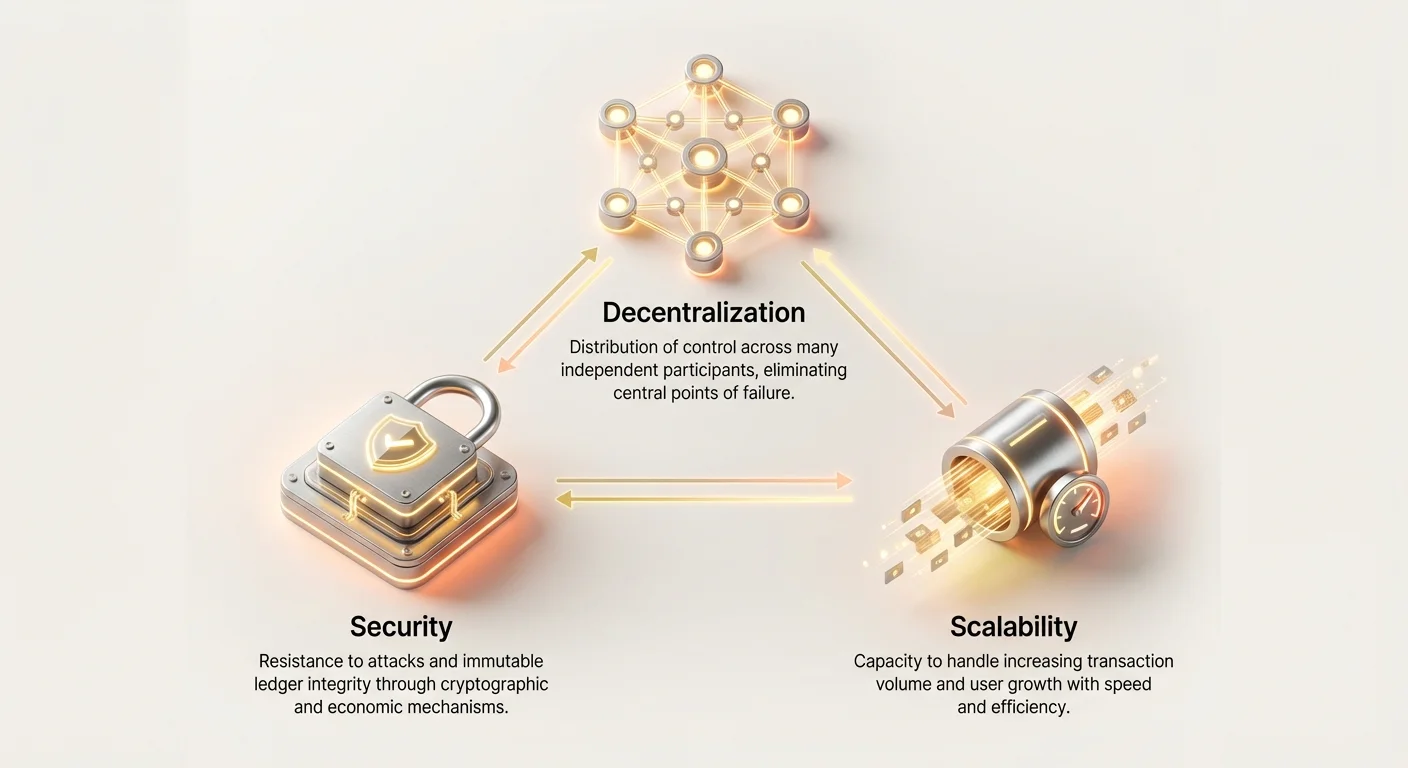
The Three Pillars of Blockchain Engineering
To fully appreciate the tradeoffs, we must first define the three pillars that form the corners of the Trilemma triangle. Each pillar represents an ideal state that crypto projects strive for, but cannot perfectly achieve simultaneously.
Pillar 1: Decentralization—The Heart of Crypto
Decentralization refers to the distribution of power and control away from a single point or small group of intermediaries. It is the defining feature of public blockchains, designed to eliminate the need for banks, governments, or tech giants as central authorities.
Defining Node Count and Distribution
A truly decentralized network is one where thousands of independent computers (nodes) across the globe store a copy of the ledger and validate transactions. The more widespread and varied the participants, the higher the degree of decentralization.
Why it matters: If a network is decentralized, it is censorship-resistant, meaning no single government or malicious actor can shut it down, tamper with history, or unilaterally refuse transactions. High decentralization ensures the network remains permissionless and trustless.
The Cost of Global Verification
Decentralization relies on every participant agreeing on the state of the network. This means every transaction must be propagated, verified, and recorded by every node. While this ensures integrity, it inherently slows down the system. Imagine trying to coordinate a simple meeting time across a thousand people versus across three—the verification process becomes exponentially more complex and time-consuming the more people you involve.
Pillar 2: Security—Protecting the Unstoppable Ledger
Security, in the context of a public blockchain, refers to the network’s ability to defend itself against external attacks and internal collusion, ensuring that once data is written to the ledger, it cannot be altered or reversed.
Attack Vectors and the 51% Problem
The most common theoretical threat to a decentralized public blockchain is the "51% attack." In networks using Proof-of-Work (PoW) or Proof-of-Stake (PoS), if a single entity controls more than half (51%) of the mining power or staked capital, they theoretically gain the power to reverse transactions, censor blocks, or prevent new transactions from being confirmed.
Security measures are designed to make controlling 51% prohibitively expensive or practically impossible.
The Relationship between Stake, Cost, and Security
Security is often directly tied to economic cost.
- For PoW chains (like Bitcoin), security is measured by the sheer amount of energy and hardware required to participate in mining. The high cost of this infrastructure makes a 51% attack economically unfeasible for a rational actor.
- For PoS chains (like Ethereum), security is measured by the total value of cryptocurrency locked up (staked) by validators. If a validator misbehaves or attempts to attack the network, their stake is automatically destroyed (slashed), imposing a heavy financial penalty.
Pillar 3: Scalability—Achieving Real-World Adoption
Scalability is the network's ability to handle a growing number of transactions and users without suffering from high fees, latency, or congestion. In simple terms, it measures how fast and cheap the blockchain is to use.
The Bottleneck: Transactions Per Second (TPS)
The speed of a blockchain is usually measured in Transactions Per Second (TPS). Traditional centralized payment processors (like Visa) handle tens of thousands of TPS, making real-time, global commerce possible. By contrast, early decentralized blockchains, prioritizing security and decentralization, have inherently low throughput:
- Bitcoin: Approximately 7 TPS
- Ethereum (before major upgrades): Approximately 15-30 TPS
This low throughput creates a bottleneck. When demand for block space exceeds capacity, transaction fees skyrocket, and confirmation times slow down, making the network impractical for everyday micro-transactions.
The Necessity of Efficient Data Processing
To achieve scalability, a blockchain must increase the speed at which it processes data (block speed) or increase the amount of data it processes in each block (block size). However, these increases directly impact the other two pillars.
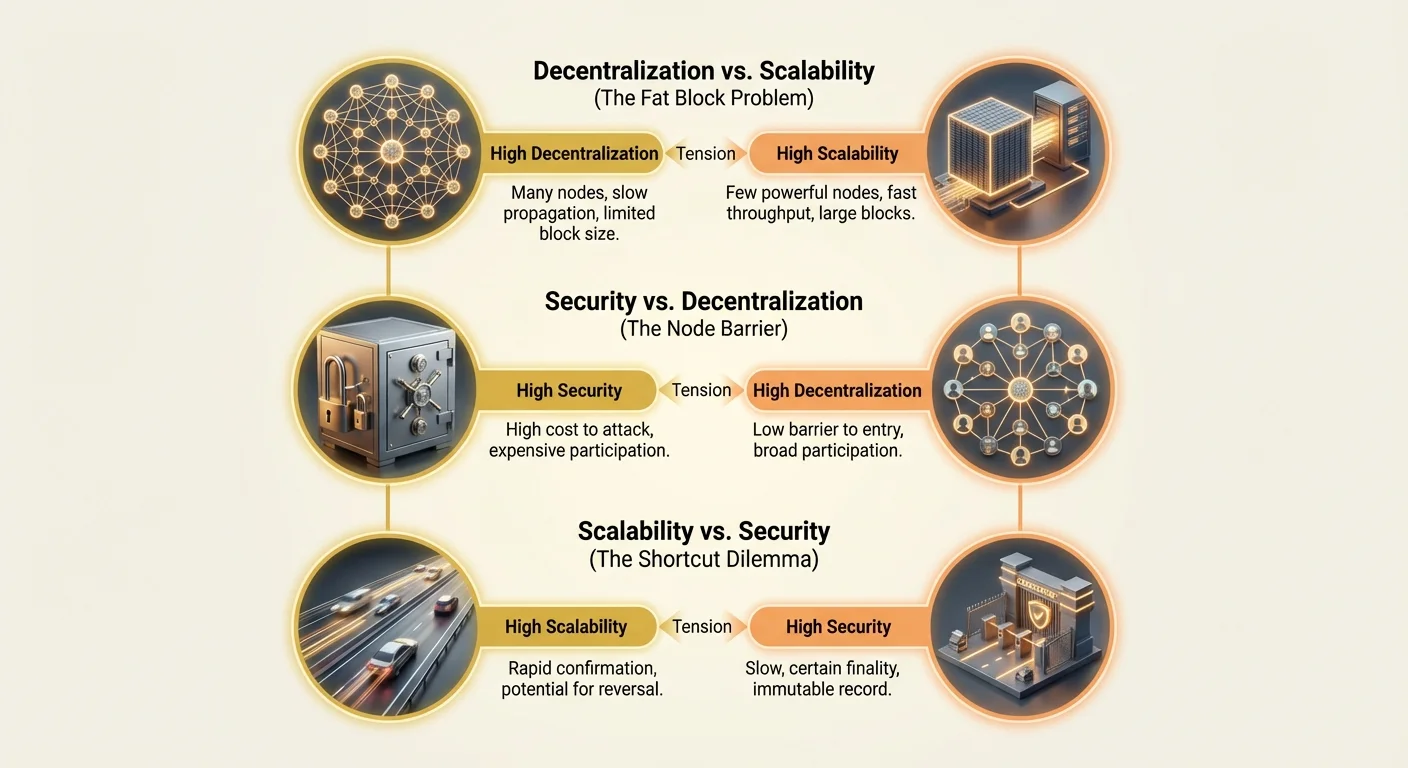
The Tradeoff in Practice: Analyzing the Core Conflicts
The Trilemma manifests as a set of direct conflicts, where optimizing for one pillar invariably diminishes another. This choice dictates the fundamental character and utility of the blockchain.
Conflict 1: Decentralization vs. Scalability (The Fat Block Problem)
This is perhaps the most obvious tradeoff. To make a blockchain faster (more scalable), engineers must find ways to process more data more quickly.
If a network dramatically increases its block size or block frequency (e.g., creating a new block every second instead of every ten minutes):
- Node Cost Increases: Larger blocks require nodes to have faster internet connections, more powerful CPUs, and significantly more hard drive space to store the ledger history.
- Decentralization Suffers: When the hardware requirements to run a full node become too high, only specialized entities (data centers, corporations, or wealthy individuals) can afford to participate.
- Outcome: The network becomes more centralized, as fewer people worldwide can run the verifying software. While fast, the network relies on a smaller, potentially colluding, group of validators, undermining its core trustlessness.
Analogy: Imagine a village trying to store all its financial records. If they only write down one transaction per day (low scale, high decentralization), anyone can easily keep a copy in a small notebook. If they decide to record a million transactions per minute (high scale), only institutions with massive server farms can keep up, centralizing control over the data.
Conflict 2: Security vs. Decentralization (The Node Barrier)
Security requires integrity, which is achieved either through immense economic commitment (PoS) or computational power (PoW). However, if the requirements to maintain security become too stringent, it can deter decentralization.
If a network requires validators to stake an enormous amount of capital (e.g., $10 million worth of crypto) to participate, the security of the network is high because the cost of attack is immense (losing $10 million).
However, by setting the bar for participation so high:
- Validator Pool Shrinks: The network is only run by a small number of extremely wealthy, known entities.
- Risk of Collusion: This smaller pool increases the risk of collusion or regulatory pressure from centralized governments targeting the handful of validators.
- Outcome: High security is achieved, but at the expense of decentralization. The network becomes resistant to external attack, but vulnerable to internal political or economic capture.
Conflict 3: Scalability vs. Security (The Shortcut Dilemma)
Trying to push transactions through too quickly can sometimes compromise the rigorous verification necessary for security.
If a blockchain speeds up block confirmation dramatically without relying on strong cryptographic proofs or economic incentives, it risks:
- Losing Finality: Transactions might be quickly confirmed but could potentially be reversed later, undermining the ledger’s integrity.
- Propagation Issues: Nodes in different parts of the world might receive blocks out of sync, leading to temporary forks or inconsistent states, making the network brittle and easier to attack.
A secure network must be able to withstand simultaneous data propagation worldwide and maintain consistent consensus, which inevitably imposes a speed limit.
Case Studies in Compromise: How Major Blockchains Choose
Every successful blockchain represents a conscious strategic decision about which pillar to emphasize and which to compromise on.
1. Bitcoin and Ethereum (Prioritizing Decentralization and Security)
Both Bitcoin and Ethereum were designed explicitly to maximize decentralization and security, often accepting slow transaction speeds and high fees as a consequence.
Bitcoin: The Immutable Digital Gold
Bitcoin is the classic example of prioritizing security and decentralization above all else. Its block time is ten minutes, resulting in low TPS. However:
- Decentralization: Its relatively small block size (1 MB) and open participation (Proof-of-Work mining) make it possible for nearly anyone to run a full node on consumer-grade hardware, ensuring a robust, globally distributed network.
- Security: The sheer economic cost of attacking Bitcoin’s PoW system is astronomical, making it the most secure ledger ever created.
- Tradeoff: It is not scalable for day-to-day coffee purchases, necessitating the creation of specialized scaling solutions like the Lightning Network (a Layer 2) to handle micro-transactions off-chain.
Ethereum: Evolving the Compromise
Ethereum initially followed the Bitcoin model but, with the transition to Proof-of-Stake (the Merge) and the implementation of sharding, it made a major engineering shift focused on scaling while retaining strong security.
- Security: By requiring validators to stake 32 ETH, Ethereum maintains a very high economic security budget.
- Decentralization: It lowered the hardware requirement for running a node post-Merge, improving accessibility, but participation in staking still requires significant capital, creating a minor centralization pressure point compared to Bitcoin’s open mining pool.
- Tradeoff: Ethereum accepts that the base layer (Layer 1) cannot handle global throughput alone. Instead, its scalability strategy involves building a "data availability" layer that supports a massive ecosystem of specialized Layer 2 solutions (like rollups), which handle the bulk of the transaction load.
2. High-Throughput Chains (Prioritizing Scalability)
Newer generations of blockchains, often referred to as "Layer 1 competitors," frequently prioritize high throughput to compete with centralized financial systems.
Example: Chains Built for Speed
Certain networks achieve thousands of TPS by employing exotic consensus mechanisms that require far fewer, yet far more powerful, validating nodes.
- Scalability: Extremely high TPS and low latency, making them suitable for trading, gaming, and high-frequency applications.
- Decentralization: The requirement for high-end, costly hardware and specific network architectures often restricts the validating pool to large enterprises or specialized data centers.
- Tradeoff: Users gain speed and low cost, but must accept a potentially weaker degree of decentralization, as the network relies on a smaller, more easily identifiable set of operators.
Inžineriniai sprendimai: Pabėgimas iš trilemos per sluoksnius
Trilemmos centrinis tikslas yra parodyti, kad viena monolitinė blokų grandinė negali pasiekti visų trijų tikslų vienu metu. Pramonės sprendimas buvo perdefininti problemą, specializuojant funkcijas per kelis sluoksnius.
Layer 2 sprendimai ir sharding (Kelias į masinį įsisavinimą)
Modernus mastelavimo požiūris apima sunkiausio sandorių darbo perkėlimą antriniams tinklams (Layer 2), remiantis labai saugiu, decentralizuotu baziniu sluoksniu (Layer 1) tik galutiniam duomenų atsiskaitymui ir saugumo garantijoms.
- Layer 1 (Bazė): Fokusas maksimaliam saugumui ir decentralizacijai. Jo darbas – lėtas, bet tikras konsensusas ir duomenų prieinamumas. (Pvz., Ethereum, Bitcoin).
- Layer 2 (Masteliuotojas): Fokusas maksimaliam mastelavimui. Šie tinklai apdoroja milijonus sandorių pigiai ir greitai, bet periodiškai paskelbia kriptografinį visos jų veiklos įrodymą atgal į Layer 1 galutiniam patvirtinimui.
Šis specializuotas požiūris leidžia visai ekosistemai pasiekti visus tris tikslus nekompromituojant pagrindinio šakninės knygos saugumo. Tai kelias į masinį įsisavinimą.
Orakulų vaidmuo palaikant vientisumą
Kai protingos sutartys tampa sudėtingesnės, joms reikia prieigos prie realaus pasaulio duomenų – kaip turto kainos, oro sąlygos ar sporto rungtynių rezultatas – specifiniams komandoms vykdyti. Tačiau protingos sutartys gyvena saugioje, uždaroje blokų grandinės aplinkoje.
Blokų grandinės orakuls veikia kaip tiltas, saugiai ir patikimai importuodami išorinį, off-chain duomenį į blokų grandinę.
- Trilemmos kontekstas: Orakuls yra esminiai maksimaliai protingų sutarčių funkcionalumui (ir todėl efektyviam mastelavimui). Tačiau jei pats orakulas yra centralizuotas, jis sukuria vienintelį gedimo tašką, kompromituojantį visos sutarties saugumą ir decentralizaciją.
- Sprendimas: Decentralizuoti orakuls (kaip tie, kuriuos teikia Chainlink) užtikrina, kad duomenys, tiekiami protingai sutarčiai, patikrinami decentralizuoto nepriklausomų duomenų tiekėjų tinklo, išlaikant pagrindinį sistemos saugumą ir decentralizaciją, tuo pačiu leidžiant galingą išorinę funkcionalumą.
Išvada: Kompromisai kaip dizaino pasirinkimai
Decentralizacijos trilema nėra trūkumas blokų grandinės technologijoje; tai pagrindinis apribojimas kuriant globaliai paskirstytą, nekintamą viešą įrašą, veikiantį be centrinės kontrolės. Kiekvienas dizaino pasirinkimas, kurį daro blokų grandinės inžinierius – nuo konsensuso mechanizmo pasirinkimo iki bloko dydžio ribų nustatymo – yra sąmoningas sprendimas, kaip valdyti šiuos kompromisus.
Pradedančiam vartotojui esmė paprasta:
- Jei prioritetizuojate saugumą ir autonomiją (kaip ilgalaikio turto saugojimą), remsitės grandinėmis, prioritetizuojančiomis decentralizaciją ir saugumą (net jei jos lėtos ir brangios).
- Jei prioritetizuojate greitį ir žemą kainą (kaip kasdienę prekybą ar aukšto dažnio žaidimus), naudosite labai masteliuojamus Layer 2 tinklus, pasitikėdami, kad jų saugumas yra inkaruotas robustaus pagrindinio Layer 1.
Supratę trilemą, įgysite žodyną analizuoti blokų grandinės infrastruktūrą ne tik pagal tai, ką ji daro, bet pagal inžinerinius kompromisus, kuriais ji buvo sukurta. Šios žinios yra esminės informuotiems sprendimams, kur sandorinti, saugoti vertę ir kurti decentralizuotų aplikacijų ateitį.