
Bitcoin's journey from an obscure digital experiment in 2009 to a globally recognized financial instrument has been defined by dramatic cycles of volatility and resilience. Initially dismissed by traditional finance as a speculative novelty, the cryptocurrency has gradually carved out a position as a distinct asset class. Investors and economists now increasingly analyze Bitcoin through a macroeconomic lens, evaluating its potential role as a macro hedge against monetary expansion and systemic instability.
The asset no longer operates in a vacuum. In its early years, price movements were largely driven by niche retail enthusiasm and technological curiosity. Today, however, Bitcoin's trajectory is often correlated with global liquidity cycles, interest rate decisions by central banks, and geopolitical shifts. This evolution requires market participants to understand the deeper mechanics of the network and how they interact with the broader financial environment.
As inflation concerns persist in various economies, the narrative of Bitcoin as "digital gold" has gained traction. This thesis suggests that, like precious metals, Bitcoin may serve as a store of value that preserves purchasing power over time. Understanding this role requires a close examination of its scarcity mechanisms, its historical performance compared to traditional assets, and the growing infrastructure that connects it to institutional capital.
Defining Bitcoin as an Asset Class
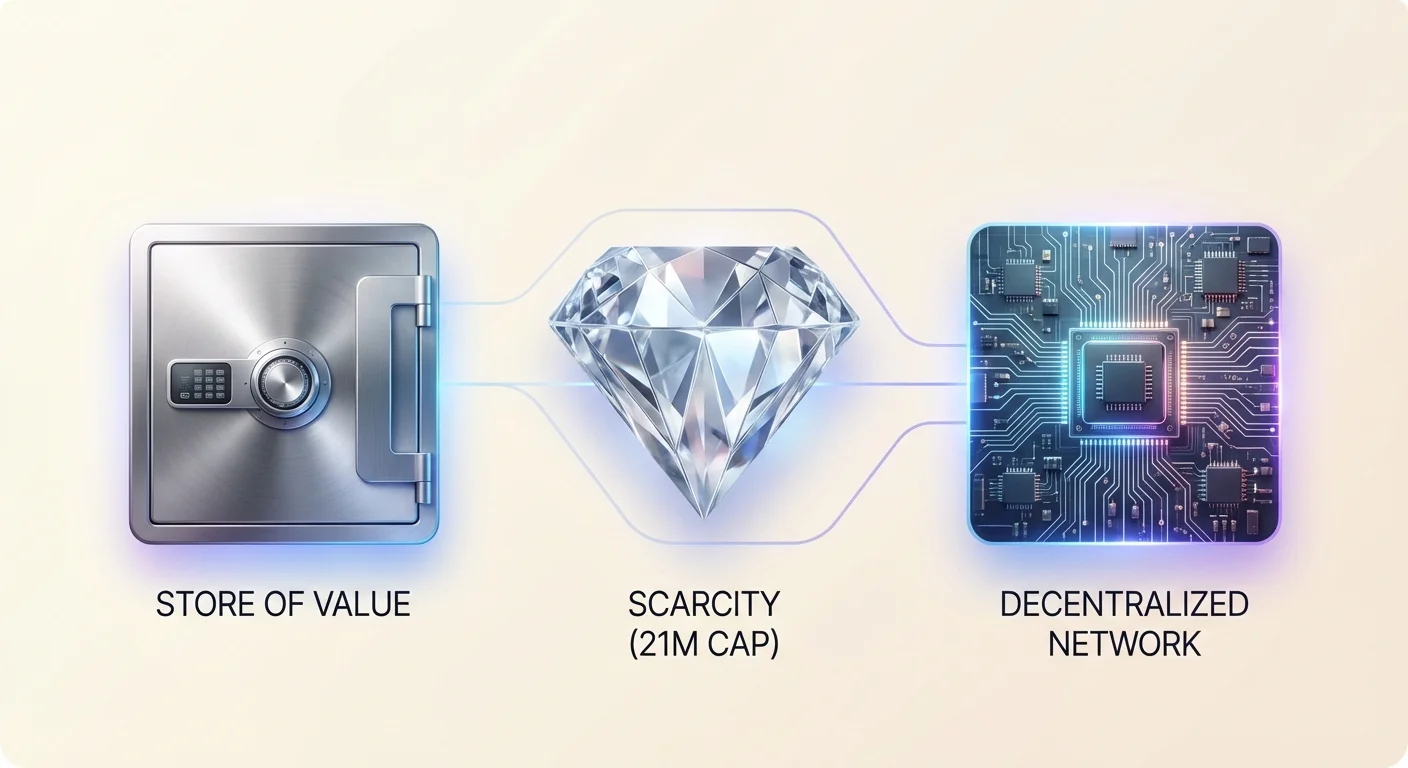
For years, financial experts struggled to categorize Bitcoin. It possesses characteristics of a currency, a commodity, and a high-growth technology stock. This ambiguity initially led to skepticism, but major financial institutions have since acknowledged it as an investable asset class. The primary appeal for many investors lies in its distinct risk-return profile.
Historically, Bitcoin has outperformed major asset classes such as equities, bonds, and gold over ten-year horizons. However, this high performance comes with significant volatility. During periods of economic expansion and high liquidity, Bitcoin has often behaved like a "risk-on" asset, mirroring the movements of the technology sector. Yet, it also possesses fundamental properties that align it with "risk-off" assets like gold, particularly regarding its supply schedule.
This dual nature makes Bitcoin a unique tool for portfolio diversification. While equities generally perform well during economic growth and gold shines during downturns or high inflation, Bitcoin has demonstrated the ability to decouple from these correlations in certain market conditions. Its inclusion in a portfolio is often driven by the desire to capture asymmetric upside potential while hedging against the devaluation of fiat currencies.
The Mechanics of Scarcity
The argument for Bitcoin as a monetary hedge is fundamentally rooted in its supply mechanics. Unlike fiat currencies, which can be printed in unlimited quantities by central banks, Bitcoin has a hard-capped supply of 21 million coins. This fixed limit is enforced by the network's code and cannot be altered by any single entity or government. This is the cornerstone of Bitcoin’s digital scarcity.
This absolute scarcity is designed to counter the effects of inflation. When the money supply expands drastically, as seen in various global economies, the purchasing power of each unit of currency tends to decrease. Bitcoin's supply schedule operates in the opposite direction. New coins are issued at a predictable, decreasing rate, making the asset disinflationary by design.
A critical component of this model is the "halving." Approximately every four years, the reward that miners receive for processing transactions is cut in half. This event reduces the rate of new supply entering the market by 50%. Historically, these halving events have been associated with the start of new market cycles. As the flow of new Bitcoin restricts, assuming demand remains constant or increases, the price discovery mechanism often shifts upward to accommodate the scarcity.
Comparing Stores of Value
To evaluate Bitcoin's viability as a hedge, it is essential to compare it with gold, the traditional standard for preserving wealth. Both assets share key characteristics that define a store of value. They are both scarce, durable, and independent of specific governments. However, Bitcoin introduces digital properties that physical gold cannot replicate.
The following table outlines the core differences between these two store-of-value assets:
| Feature | Bitcoin | Gold |
|---|---|---|
| Scarcity | Strictly fixed (21 million max) | Limited but supply increases via mining |
| Portability | Send anywhere globally in minutes | Heavy, expensive to transport and secure |
| Verifiability | Mathematically verifiable by anyone | Requires expensive assays and expert testing |
While gold has a track record spanning millennia, Bitcoin offers superior portability and divisibility. A user can divide a single Bitcoin into 100 million units called satoshis, allowing for precise transaction amounts. Furthermore, verifying the authenticity of Bitcoin requires only a network connection and software, whereas verifying gold bars requires physical testing equipment to detect forgery.
Gold maintains the advantage of lower volatility and a lack of reliance on technological infrastructure like the internet. However, for modern investors, the ability to transport billions of dollars of value across borders without physical logistics gives Bitcoin a distinct utility in the digital age.
Institutional Adoption and Financialization
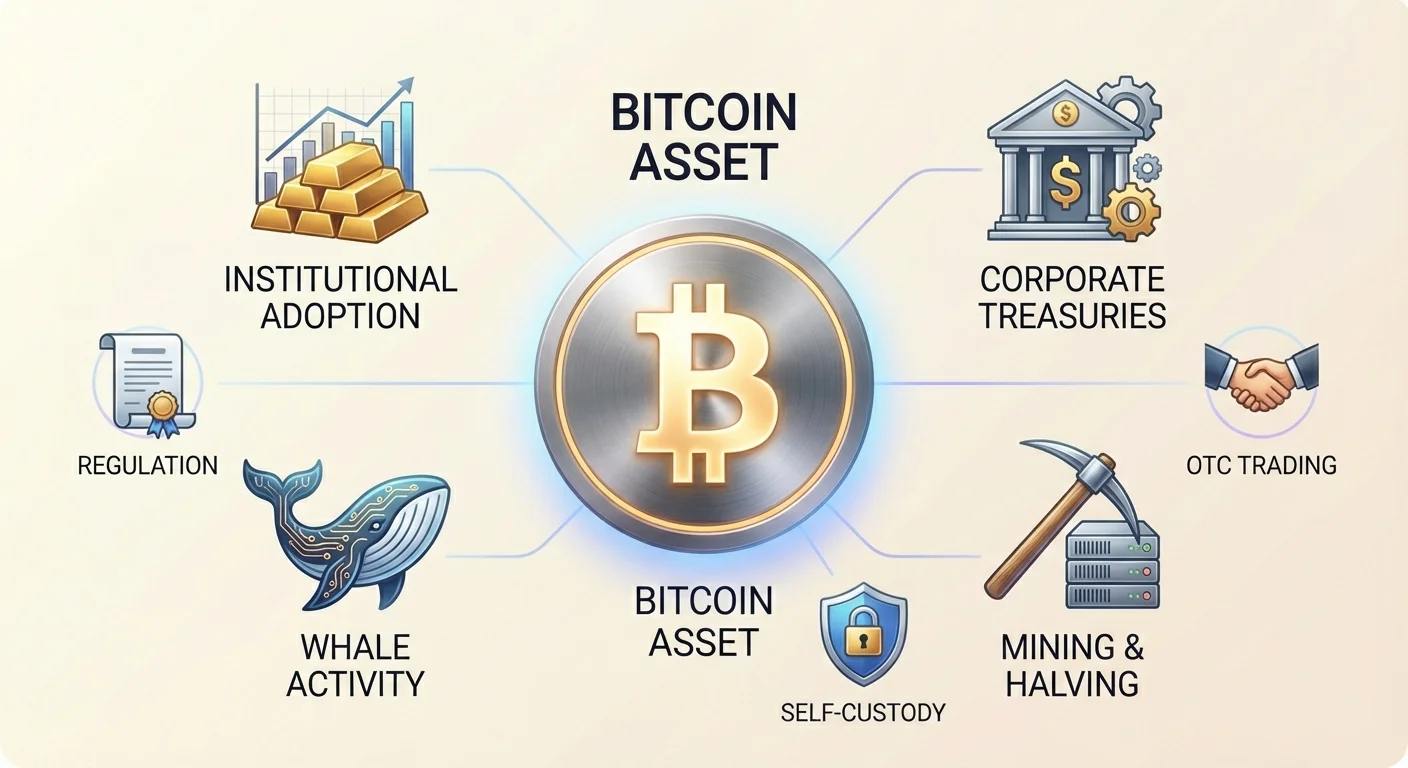
The landscape of Bitcoin ownership has shifted dramatically with the entrance of institutional capital. In the early years, the market was dominated by retail traders and tech enthusiasts. The recent approval of Bitcoin Exchange-Traded Funds (ETFs) in major markets like the United States has opened the floodgates for traditional finance (TradFi) to participate.
The Impact of ETFs
Bitcoin ETFs allow investors to gain exposure to price movements without the complexities of managing private keys or self-custody wallets. This financialization integrates Bitcoin into standard brokerage accounts and retirement funds. However, it introduces a layer of separation. Investing in an ETF means owning shares in a fund that tracks Bitcoin, rather than owning the asset itself.
This structure brings convenience but also counterparty risk. ETF investors rely on the fund provider to manage the underlying assets securely. There are also management fees, typically ranging from 0.5% to 2% annually, which can eat into long-term returns. In contrast, holding Bitcoin directly in a self-custody wallet eliminates these ongoing fees and ensures the owner retains full control over their assets, free from third-party solvency risks.
Corporate Treasury Strategies
Beyond investment funds, operating companies have begun adding Bitcoin to their corporate treasuries. Firms such as MicroStrategy and Tesla have allocated portions of their cash reserves to Bitcoin. This strategy is often employed to protect the company's balance sheet from inflation.
When a company holds large amounts of cash, inflation erodes the real value of those reserves over time. By converting a portion of that cash into Bitcoin, companies aim to preserve purchasing power. This trend signals a shift in how corporations view risk management, treating Bitcoin as a legitimate reserve asset alongside cash and short-term bonds.
Market Dynamics: Whales and OTC Trading
Understanding Bitcoin's price action requires analyzing the behavior of its largest holders, often referred to as "whales." A whale is an entity or individual that holds a significant amount of Bitcoin, typically enough to influence market prices with a single trade. These participants range from early adopters to institutional funds and exchanges.
Whale activity is closely monitored by analysts because their accumulation or distribution phases can signal broader market trends. When whales are buying, it is often interpreted as a sign of confidence, potentially leading to price appreciation. Conversely, when large holders move funds to exchanges to sell, it can create downward pressure on the market.
The Role of Over-The-Counter (OTC) Trading
To avoid destabilizing the market, whales and institutions often utilize Bitcoin OTC Desks. OTC trading occurs directly between two parties, bypassing public exchange order books. If a large investor wanted to buy $50 million worth of Bitcoin on a standard exchange, the sudden spike in demand could drive the price up significantly before the order is filled, resulting in a poor entry price.
OTC brokers facilitate these large block trades privately. This mechanism provides liquidity and discretion, ensuring that massive transfers of value do not immediately trigger volatility in the wider market. However, because these trades happen off-chain or internally within broker networks, they can make it difficult for retail investors to gauge the true depth of supply and demand at any given moment.
Bitcoin Dominance as a Market Signal
A key metric for analyzing the crypto macro environment is "Bitcoin Dominance." This figure represents the percentage of the total cryptocurrency market capitalization that is held by Bitcoin. It serves as a barometer for market sentiment and the flow of capital between Bitcoin and the wider ecosystem of alternative cryptocurrencies, or "altcoins."
Bitcoin dominance is calculated by dividing Bitcoin's market cap by the total market cap of all crypto assets. When dominance is rising, it generally indicates a "flight to safety" within the crypto market. During bearish trends or periods of uncertainty, capital tends to cycle back into Bitcoin due to its perceived stability relative to smaller, more volatile assets.
Conversely, falling dominance often signals a "risk-on" environment. When investors feel confident, they may rotate profits from Bitcoin into altcoins in search of higher returns. Monitoring this metric helps investors understand the current phase of the market cycle. A sustained decline in dominance might suggest a maturing market with diverse use cases, while a sharp rise often accompanies macroeconomic stress where Bitcoin acts as the primary refuge for liquidity.
Regulatory and Environmental Considerations
As Bitcoin integrates deeper into the global financial system, it faces increased scrutiny regarding regulation and sustainability. Government policies play a massive role in shaping the macro environment for digital assets. Clear regulatory frameworks can encourage adoption by providing legal certainty for banks and corporations. Conversely, restrictive bans or aggressive taxation can stifle growth and drive innovation offshore.
The debate around Bitcoin's environmental impact also influences its acceptance as a mainstream ESG (Environmental, Social, and Governance) asset. Critics point to the energy-intensive nature of mining, which secures the network through Proof-of-Work. However, proponents argue that mining increasingly utilizes stranded energy resources and renewable power, potentially acting as a grid stabilizer.
From a security perspective, the decentralized nature of the network makes it resistant to censorship and seizure. This "censorship resistance" is a core value proposition for Bitcoin as a monetary hedge. In a macro environment characterized by geopolitical sanctions and frozen assets, the ability to hold wealth outside of the traditional banking system becomes a tangible utility for nation-states and individuals alike.
Analyzing the Risks
While the narrative of Bitcoin as a hedge is compelling, it is not without risks. Volatility remains the primary concern for short-term investors. The price of Bitcoin can fluctuate wildly based on news cycles, regulatory announcements, or leverage liquidations in the derivatives market. This volatility challenges the definition of a "store of value" over short timeframes, even if the long-term trend has been upward.
Furthermore, the security of the asset falls entirely on the holder. Unlike bank deposits, which may be insured, Bitcoin held in self-custody is the sole responsibility of the owner. Losing private keys results in the permanent loss of funds. This necessitates a robust understanding of digital security, including the use of hardware wallets and backup protocols.
Regulatory uncertainty also persists. While some jurisdictions have embraced Bitcoin, others remain hostile. Changes in tax laws or banking access can impact liquidity and the ease with which investors can enter or exit positions. Therefore, viewing Bitcoin as a hedge requires a long-term horizon and a tolerance for periods of regulatory and price turbulence.
Conclusion
Bitcoin has evolved from a fringe technology into a significant component of the global financial landscape. Its fixed supply and decentralized nature offer a stark contrast to the inflationary policies governing fiat currencies. For investors navigating a macro environment defined by monetary expansion and economic uncertainty, Bitcoin presents a unique option for preserving value and diversifying portfolios.
The maturation of the market, driven by institutional adoption, ETFs, and corporate treasury integration, has added layers of legitimacy and liquidity. While risks regarding volatility and regulation remain, the fundamental properties of scarcity and digital portability position Bitcoin as a modern alternative to traditional safe-haven assets. As the digital asset class continues to develop, its interaction with broader economic forces will likely deepen, reinforcing its role as a monetary hedge for the digital age.
Bitcoin offers a decentralized alternative to traditional finance, combining the scarcity of gold with the speed of the internet.