
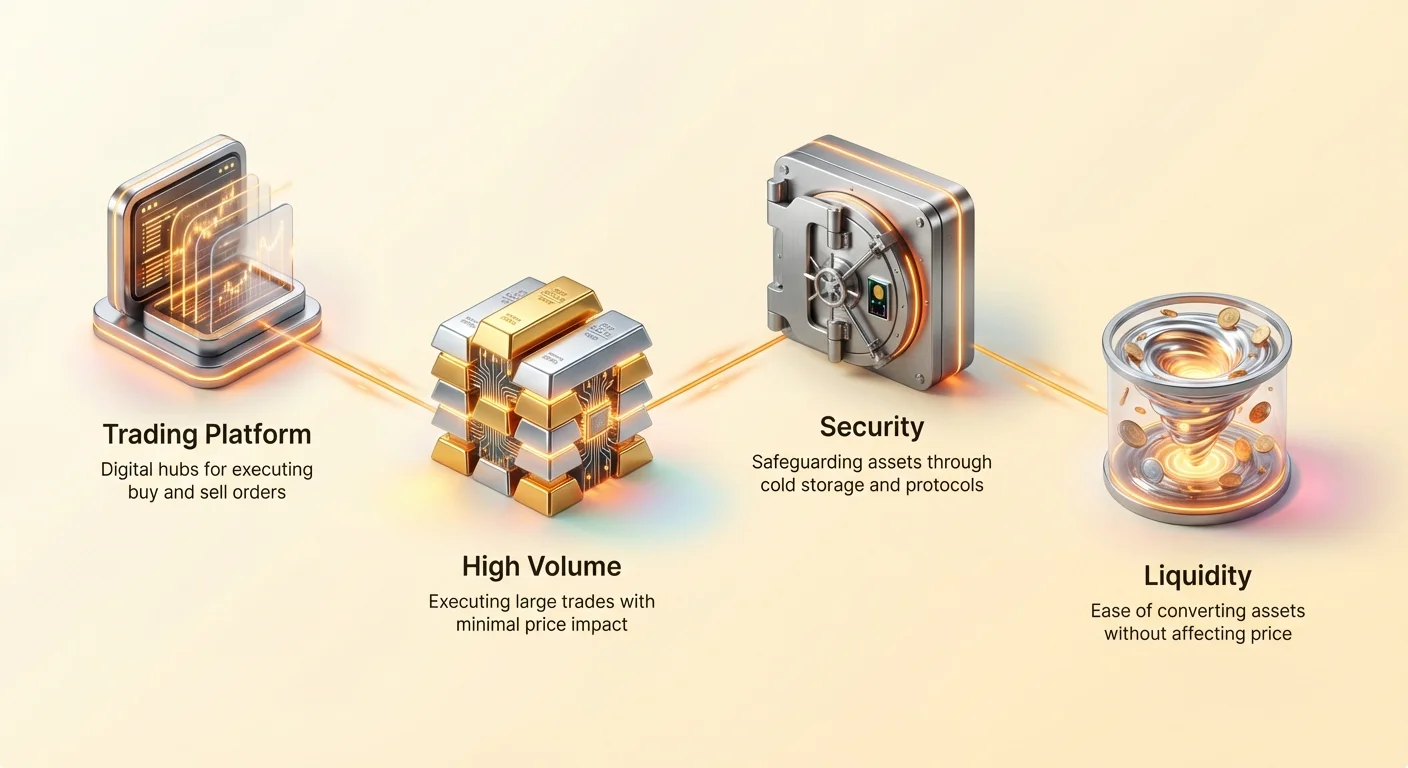
The landscape of digital asset trading has matured significantly, evolving from simple peer-to-peer transfers into a sophisticated financial ecosystem. For traders moving large amounts of capital, the requirements for a trading platform go far beyond basic buy and sell buttons. High-volume trading demands a distinct set of features designed to ensure execution speed, minimize costs, and maximize capital efficiency.
Institutional-grade platforms and top-tier retail exchanges now offer complex tools that mirror traditional financial markets. These include deep order books to absorb large trades without significant price impact, advanced margin capabilities for leveraged positions, and robust security protocols to safeguard substantial holdings. Understanding the mechanics behind these features is essential for any trader looking to operate at scale.
As the market grows, the distinction between different types of platforms becomes critical. Traders must navigate between centralized entities that offer high speed and custodial services, and decentralized protocols that prioritize autonomy. The choice of venue impacts everything from tax reporting and regulatory compliance to the specific fee schedules that apply to high-frequency transactions.
Furthermore, the integration of derivatives, such as futures and perpetual swaps, has transformed how volume is generated in the crypto space. These instruments allow for hedging strategies and speculation that exceed the limitations of spot trading. To succeed in this environment, one must grasp the technical nuances of liquidity, leverage management, and the security infrastructure that underpins the entire system.
The Structure of Centralized Exchanges
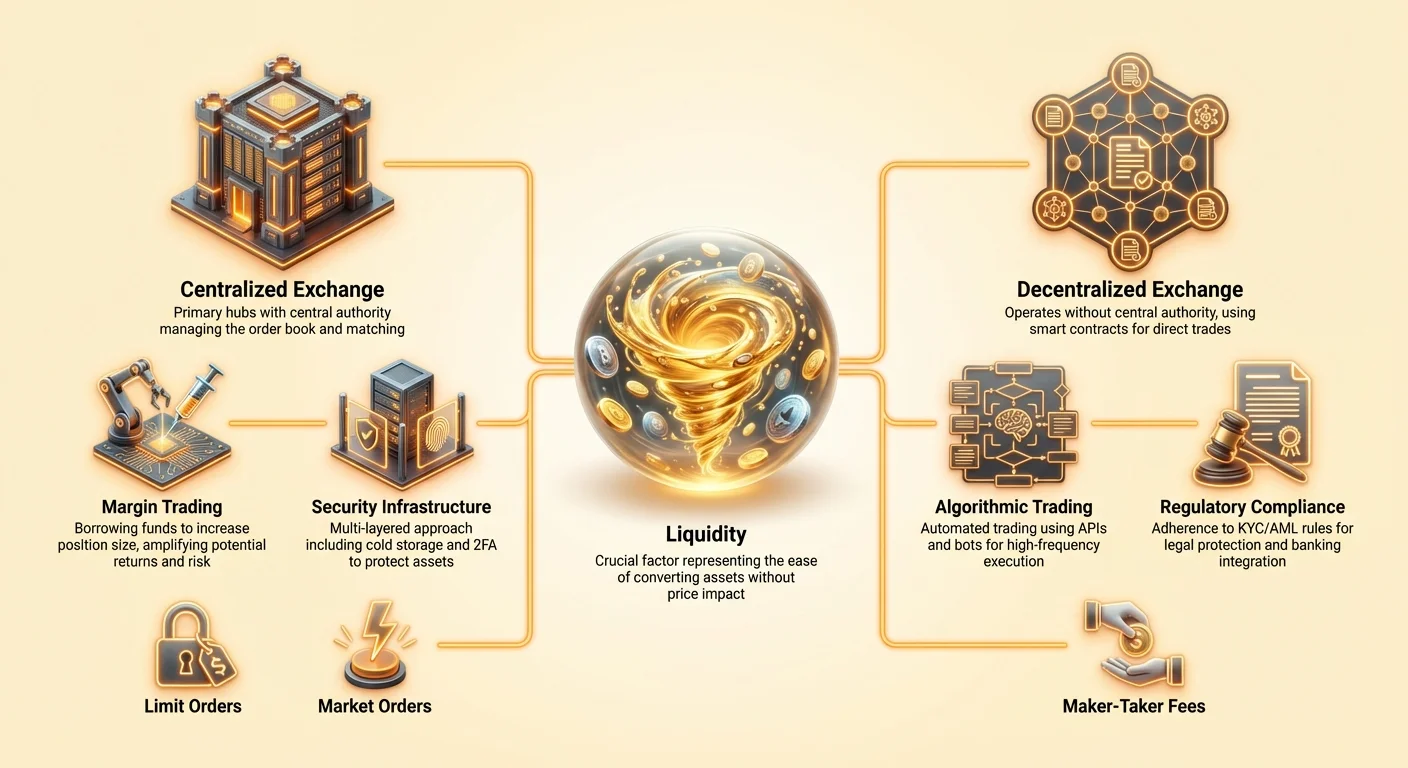
Centralized exchanges (CEXs) act as the primary hubs for high-volume activity in the cryptocurrency market. These platforms function similarly to traditional stock exchanges, where a central authority manages the order book, matches buyers with sellers, and facilitates the settlement of trades. The primary advantage of a CEX for high-volume traders is the efficiency of the matching engine.
These engines can process thousands of transactions per second, ensuring that orders are filled almost instantly. This speed is vital for active traders who rely on fleeting market opportunities. Additionally, centralized platforms typically offer the deepest liquidity, meaning there are enough buy and sell orders at various price points to accommodate large trade sizes without causing drastic price swings.
Users on centralized platforms generally do not interact directly with the blockchain for every trade. Instead, the exchange updates internal ledgers to reflect account balances, only settling on-chain during deposits or withdrawals. This off-chain mechanism drastically reduces transaction fees and latency compared to executing every trade directly on a blockchain network.
Decentralized vs. Hybrid Alternatives
While centralized platforms dominate volume, decentralized exchanges (DEXs) and hybrid models offer alternative infrastructures. DEXs operate without a central authority, using smart contracts to facilitate trades directly between users or against liquidity pools. This structure eliminates the need to trust a third party with custody of funds, addressing a major security concern for some high-net-worth individuals.
However, DEXs often face challenges with liquidity depth and transaction speed, which can be detrimental for high-volume execution. To bridge this gap, hybrid exchanges attempt to combine the speed of centralized matching engines with the non-custodial security of decentralized settlement.
In a hybrid model, the order matching happens off-chain to ensure speed, but the actual settlement of funds occurs on the blockchain via smart contracts. This aims to provide the best of both worlds, though these platforms often struggle to match the sheer volume and user base of fully centralized giants.
Understanding Liquidity Mechanics
Liquidity is arguably the most critical factor for high-volume trading. In the context of cryptocurrency, liquidity refers to the ease with which an asset can be converted into another asset without affecting its market price. A market is considered liquid if there are many buyers and sellers active at any given time, creating a dense order book.
For large traders, thin liquidity is a significant risk. If a trader attempts to sell a large quantity of an asset in an illiquid market, they may be forced to accept progressively lower prices to fill the entire order. This phenomenon effectively devalues the asset during the sale process and results in realized losses compared to the theoretical market price.
Platforms catering to professional traders prioritize liquidity aggregation. They may connect to multiple liquidity sources or incentivize market makers to populate the order book. This ensures that even substantial market orders can be executed with minimal price disruption, a necessity for institutional participants and whales.
The Concept of Slippage
Slippage occurs when the execution price of a trade differs from the expected price. This usually happens when there is insufficient liquidity at the requested price level to fill the entire order. In high-volume trading, even a fraction of a percentage in slippage can translate to significant financial loss.
For example, if a trader places a market order to buy a large amount of Bitcoin, the engine will fill the order by consuming the cheapest sell orders first. Once those are exhausted, it moves up to the next available price level. The average price paid for the total acquisition ends up being higher than the initial market price displayed.
Minimizing slippage is a primary goal for exchange selection. Top-tier exchanges maintain deep order books where the gap between the highest buy order (bid) and lowest sell order (ask)—known as the spread—is very narrow, and the volume available at each price increment is substantial.
Measuring Order Book Depth
Order book depth is the visual and statistical representation of liquidity. It shows the cumulative volume of buy and sell orders pending at various price levels. A "deep" order book has a significant amount of volume resting close to the current market price. This depth acts as a buffer against volatility.
When a large market order hits a deep order book, it is absorbed by the resting liquidity with little impact on the overall price. Conversely, in a shallow order book, a relatively small whale order can crash or pump the price significantly. Traders analyze depth charts to assess the market's ability to handle their trade size without incurring heavy slippage costs.
Advanced platforms provide detailed depth charts and data visualizations, allowing traders to see "buy walls" or "sell walls." These walls represent large concentrations of orders at specific price points, indicating strong support or resistance levels that can influence trading strategies.
Margin Trading and Leverage Tools
Margin trading is a cornerstone of high-volume strategies, allowing traders to borrow funds to increase their position size. By using leverage, a trader can amplify their potential returns, though this comes with a corresponding increase in risk. Exchanges facilitate this by lending assets to the trader, using the trader's existing capital as collateral.
The mechanics of margin involve maintaining a specific ratio of collateral to debt. If the market moves against the leveraged position, the value of the collateral drops. If it falls below a critical threshold, the exchange may forcibly close the position to recover the borrowed funds. This process is known as liquidation.
Access to margin allows for capital efficiency. Instead of locking up the full value of a position, a trader only needs to post a fraction of it. This frees up capital for other opportunities or hedging strategies. However, the volatility of cryptocurrency makes margin trading particularly hazardous, requiring strict risk management protocols.
Cross Margin vs. Isolated Margin
Platforms typically offer two distinct modes of margin management: cross margin and isolated margin. Understanding the difference is vital for risk control. In an isolated margin mode, the risk is limited to a specific position. The trader allocates a set amount of collateral to a single trade, and if that trade fails, only that specific collateral is lost.
Cross margin, on the other hand, utilizes the entire available balance of the account as collateral for all open positions. This helps prevent liquidation of a single losing position as long as other positions are profitable or the overall account balance is sufficient. It provides flexibility but carries the risk of wiping out the entire account balance if the market moves severely against multiple positions simultaneously.
High-volume traders often switch between these modes depending on their strategy. Isolated margin is preferred for speculative, high-risk plays where the loss needs to be capped. Cross margin is often used for hedging or managing complex portfolios where the overall health of the account is the priority.
Funding Rates and Perpetual Swaps
A significant portion of crypto margin trading occurs via perpetual swaps, a type of futures contract without an expiry date. To keep the price of the perpetual contract aligned with the spot market price, exchanges employ a mechanism called the funding rate. This involves periodic payments between long and short traders.
When the perpetual price is higher than the spot price, the funding rate is positive. In this scenario, traders holding long positions pay a fee to those holding short positions. This incentivizes traders to open short positions, driving the price down towards the spot. Conversely, if the perpetual price is lower, shorts pay longs.
For high-volume traders holding positions over long periods, funding rates can become a significant cost or a source of income. Smart traders monitor these rates across different platforms to execute arbitrage strategies, profiting from the differences in funding costs between exchanges.
| Feature | Description | Risk Level |
|---|---|---|
| Spot Trading | Buying/selling actual assets | Low/Medium |
| Margin Trading | Borrowing funds to trade spot | High |
| Futures | Contracts to buy/sell at future date | High |
Types of Orders for Precision Execution
Executing large trades requires more than just hitting a "buy" button. Professional platforms offer a suite of advanced order types designed to give traders control over price, timing, and visibility. The most basic distinction is between market orders, which execute immediately at the current price, and limit orders, which execute only at a specific price or better.
For volume traders, limit orders are often preferred to avoid slippage. However, simply placing a large limit order can signal intent to the market, potentially causing other traders to front-run the trade. To mitigate this, sophisticated execution strategies are employed.
Stop-loss orders are essential for risk management. These orders become market orders once a specific trigger price is reached, helping to cap losses during downturns. Conversely, take-profit orders ensure that gains are realized automatically when price targets are met, removing emotional decision-making from the equation.
OCO and Conditional Orders
One of the most useful tools for active traders is the "One-Cancels-the-Other" (OCO) order. This combines a stop-loss order with a limit sell order. If one of the orders is triggered and executed, the other is automatically cancelled. This allows a trader to set both a profit target and a maximum loss limit simultaneously.
Conditional orders expand on this logic. These orders only become active if a certain set of criteria is met, such as a price breakout above a resistance level or a drop in volume. By automating these entry and exit points, traders can execute complex strategies without needing to monitor the screen 24/7.
High-volume platforms may also offer algorithmic orders, such as "Time-Weighted Average Price" (TWAP) or "Iceberg" orders. An Iceberg order breaks a large trade into many smaller visible orders, hiding the total size of the transaction to prevent market panic or price manipulation by other participants.
Algorithmic and API Trading
For institutional-grade volume, manual trading is often insufficient. Traders rely on Application Programming Interfaces (APIs) to connect automated trading bots and custom software to the exchange. These APIs allow for high-frequency trading (HFT), where algorithms execute thousands of orders in fractions of a second based on pre-set criteria.
A robust API is a hallmark of a professional exchange. It must be stable, low-latency, and capable of handling high request loads. Traders use APIs to pull real-time market data, manage portfolio balances, and execute trades across multiple markets simultaneously.
This automation facilitates arbitrage, where traders exploit small price differences between different exchanges. It also allows for market making, where traders provide liquidity to the order book in exchange for fee rebates, profiting from the spread between bid and ask prices.
Analyzing Fee Structures
Trading fees are a primary consideration for high-volume platforms. Unlike casual investors who might overlook a 0.5% fee, high-volume traders operate with thin margins where fees can erode profitability. Exchanges typically employ a maker-taker fee model to incentivize liquidity.
In this model, "makers" are traders who place limit orders that are added to the order book. Because they provide liquidity to the market, they are charged a lower fee (or sometimes given a rebate). "Takers" are those who place market orders that remove liquidity by filling existing orders; they are charged a higher fee.
Understanding this dynamic is crucial. A strategy that relies on market orders will be significantly more expensive than one that patiently utilizes limit orders. High-volume traders almost exclusively aim to be makers to minimize overhead costs.
Volume-Based Tiers and Discounts
To attract heavy traders, exchanges offer tiered fee schedules. As a user's 30-day trading volume increases, their fee percentage decreases. At the highest VIP levels, maker fees can drop to zero or even become negative (rebates), effectively paying the trader to trade.
Additionally, many platforms have issued native utility tokens. Holding these tokens in a trading account often unlocks further discounts on trading fees. For example, paying fees with the exchange's native token might result in a 25% reduction in costs.
It is vital to calculate the "all-in" cost of trading, which includes not just the trade fee, but also deposit fees, withdrawal fees for moving fiat or crypto off the platform, and the spread. Some "no-fee" brokers make their money by widening the spread, which can be more expensive than a transparent commission for large trades.
Non-Trading Fees
Beyond execution costs, traders must navigate a landscape of non-trading fees. These can include withdrawal fees, which vary significantly by blockchain network. For example, withdrawing Bitcoin or Ethereum during times of network congestion can be costly.
Some platforms also charge inactivity fees if an account remains dormant for a long period, or overnight financing fees for keeping leveraged positions open past a certain time (often called swap fees in CFD trading). Margin interest is another major cost; borrowing funds for leverage accrues interest hourly or daily.
For high-volume traders, the cost of moving capital is just as important as the cost of the trade itself. Platforms that support cheap, fast transfer networks (like Layer 2 solutions or low-cost blockchains such as Solana or Tron for stablecoin transfers) are often preferred for operational efficiency.
Security Infrastructure
Security is the bedrock of any high-volume trading platform. When managing large sums of digital assets, the risk of theft or hacking is a constant threat. The safest exchanges employ a multi-layered security approach, starting with the storage of assets.
The industry standard for asset protection is cold storage. This involves keeping the vast majority of user funds (often 95% or more) in offline wallets that are not connected to the internet. These wallets are "air-gapped," making them inaccessible to remote hackers. Only a small portion of funds is kept in "hot wallets" (online) to facilitate immediate withdrawals and operational liquidity.
For the user, security features must extend to account access. Two-factor authentication (2FA) via authenticator apps or hardware keys (like YubiKeys) is mandatory on professional platforms. SMS verification is generally considered less secure due to the risk of SIM swapping attacks.
Insurance and Proof of Reserves
Trust in centralized entities has been tested by high-profile insolvencies. In response, top exchanges have adopted "Proof of Reserves" (PoR). This is a cryptographic verification method that allows an exchange to demonstrate that it actually holds the assets it claims to hold on behalf of its users.
Audited PoR provides transparency, assuring high-volume traders that their funds are backed 1:1 and are not being lent out or misused. Furthermore, some exchanges maintain insurance funds. These are emergency reserves set aside to cover user losses in the event of a hack or a failure in the liquidation engine during extreme volatility.
While no platform is immune to risk, the presence of a substantial, verifiable insurance fund and regular third-party security audits are key indicators of a platform's maturity and reliability.
Regulatory Compliance and KYC
Regulation plays a dual role in the crypto ecosystem. On one hand, strict Know Your Customer (KYC) and Anti-Money Laundering (AML) regulations reduce anonymity and require users to submit government ID, proof of address, and sometimes proof of funds. This can be seen as a friction point for privacy-focused individuals.
On the other hand, regulated entities offer a higher degree of legal protection and stability. For institutions and high-volume retail traders, using a regulated platform minimizes the risk of the exchange being shut down by authorities. It also facilitates smoother banking integrations, allowing for larger fiat deposits and withdrawals.
Withdrawal limits are often tied to KYC levels. Unverified accounts typically have very low daily withdrawal caps, which are unsuitable for volume trading. Completing full verification usually unlocks unlimited or very high limits, necessary for moving significant capital.
Privacy and Anonymity Considerations
Despite the push for regulation, a segment of the market prioritizes privacy. Anonymous or "No-KYC" exchanges allow users to trade without submitting personal identification. These platforms often rely on cryptocurrency-only transfers, avoiding the traditional banking system entirely.
For high-volume traders, anonymous exchanges present a trade-off. They offer privacy and often list a wider variety of exotic altcoins that regulated exchanges avoid. However, they typically have lower liquidity and stricter withdrawal limits for unverified accounts.
Furthermore, the security and recourse on anonymous platforms are generally lower. If funds are lost or an account is locked, there is often little legal ground to stand on. Traders using these platforms for volume usually split their capital across multiple accounts or use them specifically for assets not available elsewhere.
Payment Methods and On-Ramps
The bridge between traditional fiat currency and cryptocurrency is known as an on-ramp. For beginners, ease of use is key, often leading them to use credit cards or payment processors like PayPal. These methods are instant and convenient but often come with high processing fees, sometimes exceeding 3-5%.
For high-volume traders, these fees are unacceptable. Instead, professional traders utilize bank wires (SWIFT, SEPA, ACH) which, while slower, typically incur flat fees or very low percentages. This is crucial when moving five or six-figure sums.
Off-ramps (converting crypto back to fiat) are equally important. A platform must have reliable banking partners to process large withdrawals without triggering freezes or extended delays. Peer-to-Peer (P2P) marketplaces offer an alternative, allowing users to sell crypto directly to other users for fiat, but this method can be slow and carries counterparty risk for large amounts.
| Method | Speed | Fees | Suitability for Volume |
|---|---|---|---|
| Credit Card | Instant | High (2-5%) | Low |
| Bank Wire | 1-3 Days | Low/Flat | High |
| Crypto Deposit | Varies | Network Fee | High |
Integration with Payment Processors
Some exchanges have integrated directly with major payment networks to streamline the process. For example, platforms supporting PayPal allow for quick transfers, though usually for smaller amounts. These integrations are beneficial for agility—quickly adding capital to buy a dip—but are rarely the primary funding channel for large accounts.
The rise of stablecoins (like USDT and USDC) has effectively created a new on-ramp layer. Many traders convert fiat to stablecoins at a dedicated fiat-gateway exchange (known for compliance and banking ties) and then transfer those stablecoins to high-performance trading platforms to execute their strategies.
Specialized Trading Platforms
The crypto market is no longer "one size fits all." Specialized platforms have emerged to cater to specific trading styles. Brokers, for instance, differ from exchanges. A broker acts as an intermediary, often selling assets from its own inventory or routing orders to other exchanges. They simplify the interface but may charge higher spreads.
Social trading platforms have gained popularity, allowing users to automatically copy the trades of successful investors. For a fee or a percentage of profits, a novice trader can mirror the portfolio of a veteran. This "Copy Trading" feature requires transparent performance metrics and risk controls.
Derivatives-only exchanges focus exclusively on futures and options. By stripping away spot trading, they optimize their engines for the high-speed calculations required for leverage and liquidation, offering superior performance for margin traders.
Hybrid and Multi-Asset Platforms
Some platforms have evolved into multi-asset ecosystems. They allow users to trade cryptocurrencies alongside traditional assets like forex pairs, commodities (gold, oil), and stock indices, all from a single account using Bitcoin or Tether as collateral.
This convergence is attractive for macro traders who want to hedge crypto exposure against traditional markets without moving funds between different brokers. It simplifies capital management but requires the trader to understand the different trading hours and regulations governing traditional assets versus the 24/7 crypto market.
Analyzing User Interface and Experience
The user interface (UI) is the cockpit for the trader. For high-volume execution, clarity and customization are paramount. Professional dashboards allow users to arrange modules—charts, order books, trade history, open positions—to fit their workflow.
Advanced charting tools, often integrated from TradingView, are standard. These allow technical analysts to draw patterns, apply indicators, and visualize market trends directly on the trading screen. The ability to place orders directly from the chart (visual trading) speeds up reaction times.
Mobile applications have also improved, though serious volume trading is rarely conducted solely on a phone due to the limitations of screen real estate and network stability. However, a robust mobile app is essential for monitoring positions and executing emergency exits while away from the desk.
API and Connectivity
For the highest tier of traders, the graphical interface is secondary to API connectivity. The quality of an exchange's API documentation, the limits on requests per second (rate limits), and the stability of the connection during market turbulence are the true tests of a platform's professional capability.
Websocket connections are preferred over REST APIs for real-time data streaming, as they provide push updates on price and order status with lower latency. Exchanges that cater to algorithmic traders often provide colocation services, allowing institutional clients to place their servers in the same data center as the exchange's matching engine for nanosecond advantages.
Selecting the Right Platform
Choosing a platform for high-volume trading involves weighing conflicting priorities. A trader focusing on arbitrage needs low withdrawal fees and fast transfer times. A directional swing trader needs deep liquidity and stable margin tools. A scalper needs the lowest possible taker fees and zero latency.
Geographic location is a hard constraint. Many top global exchanges are restricted in jurisdictions like the United States due to regulatory hurdles. Traders must select platforms that legally service their region to avoid the risk of account freezing.
Reputation remains the ultimate filter. An exchange might offer low fees and high leverage, but if it has a history of outages during volatility or unresolved hacks, the counterparty risk outweighs the benefits. Checking the longevity of the exchange and its track record through multiple "crypto winters" is a prudent step.
Managing Risk in High-Volume Environments
Trading large volumes amplifies not just potential profits, but also the impact of errors. Operational security hygiene is non-negotiable. This includes using dedicated email addresses for exchange accounts, enabling whitelisting for withdrawal addresses (so funds can only be sent to known wallets), and using hardware security keys.
Market risk management involves strict discipline with stop-losses and position sizing. High-volume traders never go "all in" on a single trade. They diversify exposure and keep a significant portion of capital in stable assets or cold storage.
Finally, platform risk must be managed by diversification. Institutional traders rarely keep all their assets on a single exchange. By splitting capital across two or three reputable platforms, they mitigate the risk of a single point of failure, ensuring that a technical outage or insolvency event at one venue does not wipe out their entire portfolio.
Conclusion
The ecosystem of high-volume crypto trading platforms has diversified to meet the demands of sophisticated investors. From the raw speed of centralized matching engines to the autonomy of decentralized protocols, traders have more choices than ever. Success in this arena requires a deep understanding of liquidity mechanics, fee structures, and the nuances of margin tools. By leveraging advanced order types and maintaining rigorous security standards, traders can navigate the volatility of the market effectively.
Ultimately, the "best" platform is subjective, depending heavily on specific trading strategies and geographic restrictions. Whether prioritizing the anonymity of a no-KYC exchange, the regulatory safety of a US-compliant broker, or the leverage capabilities of a derivatives platform, the key is to align the venue's features with one's operational needs. As the market continues to mature, the integration of traditional financial standards with blockchain innovation will likely drive the next generation of trading infrastructure.
Professional trading requires balancing speed, liquidity, and security; choose platforms that align with your specific strategy and risk tolerance.