
The cryptocurrency market has evolved significantly beyond simple spot trading, where investors buy assets hoping for price appreciation. Today, the digital asset landscape is dominated by complex financial instruments that allow for sophisticated strategies, including hedging, speculation, and yield generation. Derivatives such as futures and options, have become the primary venue for price discovery and volume in the crypto ecosystem. These tools allow traders to manage risk more precisely and express views on market direction with greater capital efficiency.
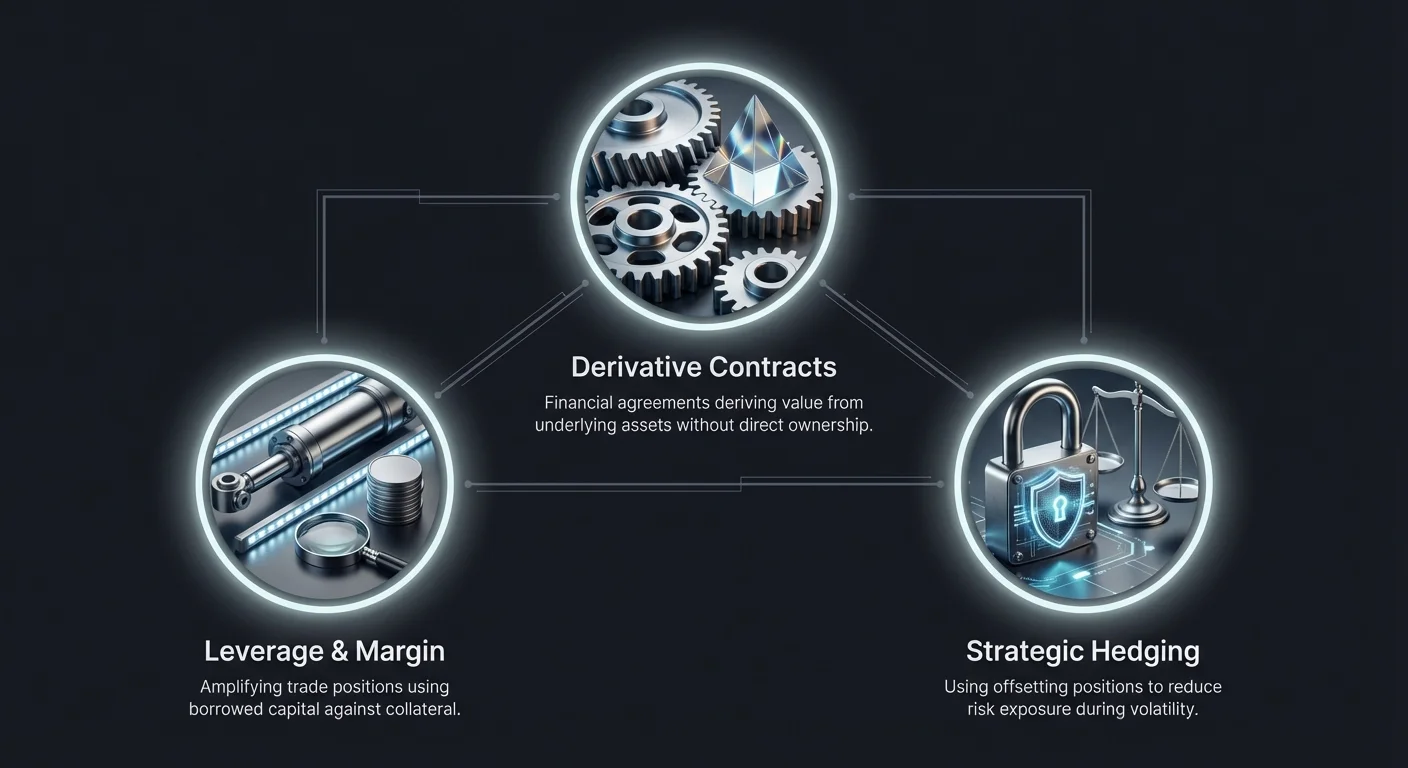
Derivatives are financial contracts between two or more parties that derive their value from an underlying asset, such as Bitcoin or Ethereum. Unlike spot trading, where immediate settlement occurs, derivatives involve agreements to buy or sell assets at future dates or under specific conditions. This structure introduces unique dynamics to the market, enabling strategies that are impossible with spot holdings alone. Understanding these instruments is essential for navigating advanced market conditions.
Traders utilize these instruments not just for speculation, but to construct portfolios that are resilient to volatility. By separating the financial exposure from the physical ownership of the asset, market participants can isolate specific risks. This capability is the foundation of modern financial engineering in the crypto space. It allows for strategies that can profit in bear markets or remain neutral while harvesting yields.
The Fundamentals of Crypto Derivatives
At the core of advanced trading lies the derivative contract. These instruments are distinct from the underlying asset but track its price performance. The most common types in the cryptocurrency market are futures, perpetual swaps, and options. Each serves a different purpose and carries a unique risk profile.
Futures contracts commit parties to transact an asset at a predetermined date and price. This rigidity provides certainty for miners or institutions looking to lock in prices for their future production or holdings. It eliminates the uncertainty of future market fluctuations for the hedger participant. However, for the speculator, it offers a way to bet on price movements without holding the coin.
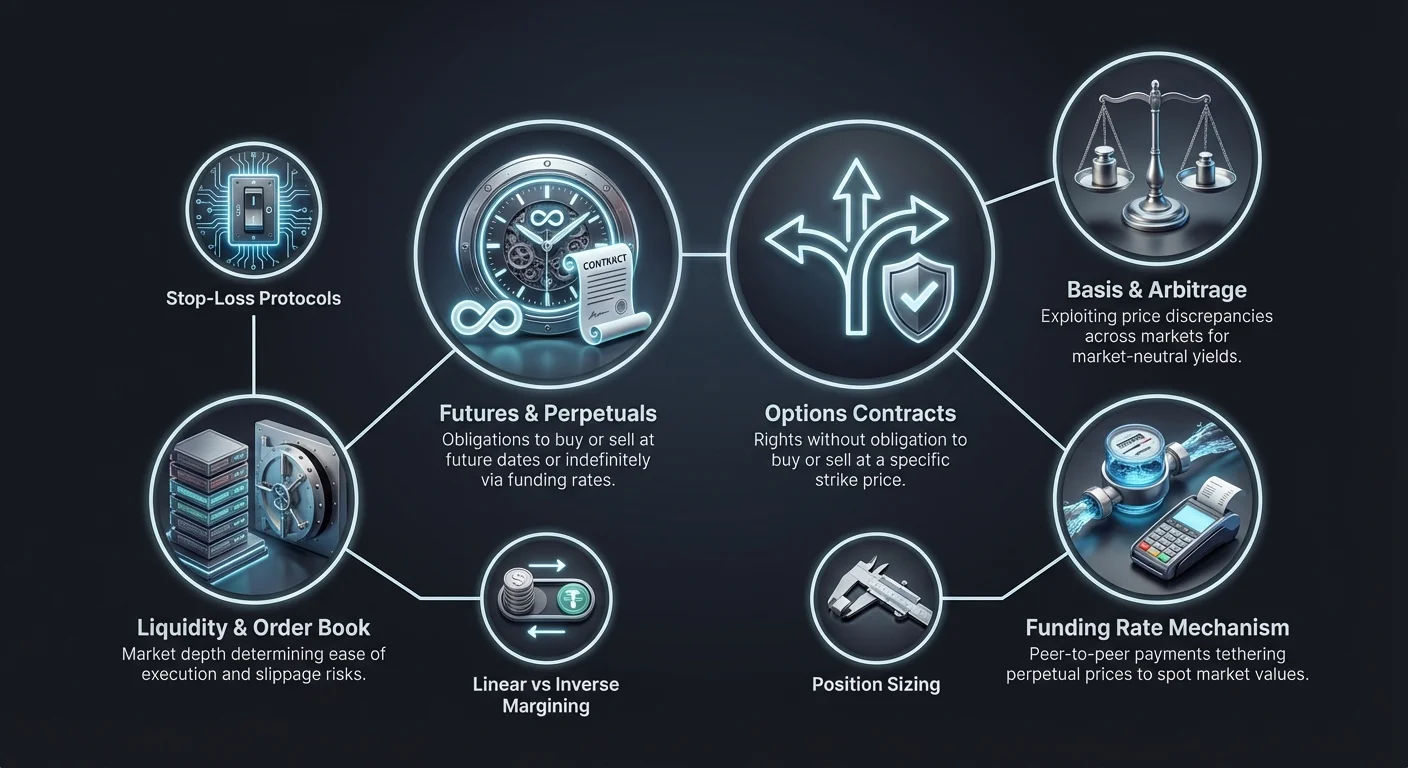
Perpetual futures, often called "perps," modify the traditional futures model by removing the expiration date. This innovation allows traders to hold leveraged positions indefinitely, provided they maintain sufficient margin. To keep the contract price aligned with the spot market, perps utilize a funding rate mechanism. This periodic payment ensures convergence between the derivative price and the underlying asset price.
Options contracts introduce asymmetry to the trade. Unlike futures, which carry an obligation to transact, options grant the buyer the right, but not the obligation, to buy or sell. This requires an upfront payment known as a premium. The seller of the option takes on the obligation and collects the premium, effectively selling risk to the buyer.
| Instrument | Obligation | Expiry | Primary Cost |
|---|---|---|---|
| Futures | Yes | Fixed Date | Spread/Basis |
| Perpetual | Yes | None | Funding Rate |
| Options | No (for buyer) | Fixed Date | Premium |
Mechanics of Futures and Basis Trading
Traditional futures contracts rarely trade at the exact same price as the spot market. They typically trade at a premium or discount depending on market sentiment and the time remaining until expiration. This price difference is known as the "basis." Understanding the basis is critical for advanced traders.
When a futures contract trades higher than the spot price, the market is in a state often referred to as contango. This usually signals bullish sentiment, as traders are willing to pay a premium to lock in future exposure. Conversely, when futures trade below the spot price, the market is in backwardation, often indicating bearish sentiment or a shortage of immediate liquidity.
Basis trading involves exploiting these price discrepancies. A trader might buy the spot asset and simultaneously sell a futures contract trading at a premium. Since the futures price and spot price must converge at expiration, the trader can capture the spread as profit, regardless of market direction. This is a market-neutral strategy that relies on convergence rather than directional accuracy.
The profit in basis trading comes from the time value of money and the cost of carry. In a highly volatile crypto market, premiums can become significant, offering substantial yields to those willing to take the other side of the trade. This strategy effectively hedges out price risk while capturing the inefficiency between the two markets.
Perpetual Futures and the Funding Rate
Perpetual futures dominate crypto trading volume due to their flexibility. Without an expiry date, the mechanism that tethers the contract price to the spot price is the funding rate. This is a peer-to-peer payment exchanged between long and short traders, typically every eight hours.
When the perpetual contract trades above the spot price, the funding rate becomes positive. In this scenario, traders with long positions pay traders with short positions. This payment incentivizes longs to close positions and shorts to open positions, pushing the price down toward the spot level. It acts as a self-correcting mechanism to prevent price decoupling.
Conversely, if the contract trades below the spot price, the funding rate becomes negative. Short position holders must pay long position holders. This encourages shorts to close and longs to open, driving the price back up. Smart traders monitor these rates closely, as they represent a cost of holding a position or a potential revenue stream.
Strategies can be built entirely around harvesting funding rates. If funding is consistently positive, a trader can buy the spot asset and short the perpetual contract. The price movements cancel each other out, but the trader collects the funding payments from the short position. This is a form of arbitrage that seeks to generate yield from market bullishness.
Leverage and Margin Management
One of the defining features of derivatives trading is the ability to use leverage. Leverage allows traders to control a position size that exceeds their actual capital. For example, with 10x leverage, a trader can control $10,000 worth of Bitcoin with only $1,000 of collateral.
Leverage amplifies both profits and losses. A small percentage move in the underlying asset translates to a large percentage move in the trader's equity. While this can lead to rapid gains, it also introduces the risk of liquidation. If the market moves against the position, the exchange may close the trade to prevent the loss from exceeding the collateral.
Margin management is the primary skill required for survival in leveraged trading. Exchanges typically offer two modes: isolated margin and cross margin. Isolated margin allocates a specific amount of capital to a single trade. If that trade fails, only the allocated amount is lost, protecting the rest of the portfolio.
Cross margin utilizes the entire account balance as collateral for all open positions. This is useful for hedging, as profits in one position can offset losses in another, preventing premature liquidation. However, it carries the risk that a single disastrous trade could drain the entire account balance.
Effective leverage usage involves understanding the maintenance margin requirement. This is the minimum equity required to keep a position open. When equity falls near this level, a margin call occurs, requiring the trader to add funds or face liquidation.
Shorting Strategies for Market Downturns
Shorting is the practice of selling an asset one does not own with the intention of buying it back at a lower price. This strategy allows traders to profit from market declines, providing a way to generate returns even in bear markets. Derivatives are the primary vehicle for executing short strategies in crypto. For a deeper dive into these tactics, consult our guide on crypto short selling mechanics.
In a short trade, the mechanics involve borrowing the asset (or entering a contract that simulates this) and selling it at the current market price. If the price falls, the trader repurchases the asset at the new, lower price to return the borrowed amount. The difference between the sell price and the buy price constitutes the profit.
Shorting carries distinct risks compared to long positions. When buying an asset, the maximum loss is limited to the invested amount (if the price goes to zero). However, when shorting, the potential loss is theoretically unlimited because there is no cap on how high an asset's price can rise. A rapid price increase can force short sellers to buy back assets to close positions, driving prices even higher in a "short squeeze."
Traders use shorting not only for speculation but for hedging existing portfolios. If an investor holds a large amount of altcoins but fears a short-term market dip, they might short Ethereum or Bitcoin to offset potential losses. If the market drops, the gains from the short position help neutralize the devaluation of the spot holdings.
Options Trading: Calls and Puts
Options trading offers a non-linear payoff structure that differs from the linear gains and losses of futures. Options are contracts that give the holder the choice to execute a trade at a specific "strike price" on or before a certain date. There are two primary types: calls and puts.
A call option gives the buyer the right to purchase the asset. Traders buy calls when they expect the price to rise. If the market price exceeds the strike price at expiration, the option is profitable. If the price remains below the strike, the option expires worthless, and the trader only loses the premium paid.
A put option gives the buyer the right to sell the asset. Traders buy puts when they expect prices to fall or to protect a portfolio against downside. If the market price drops below the strike price, the put option gains value. This makes puts an excellent tool for insurance.
Options can be "American" or "European" style. American options can be exercised at any time before the expiration date, offering maximum flexibility. European options can only be exercised on the specific expiration date. Most crypto options platforms specify which style they utilize, affecting strategic planning.
Sellers of options, also known as writers, take on the obligation to fulfill the contract. They receive the premium as compensation for this risk. Option selling strategies are often used to generate income in sideways markets where prices are not moving significantly enough to justify directional trades.
Advanced Hedging Techniques
Hedging is the practice of reducing risk exposure by taking an offsetting position. In the volatile world of cryptocurrency, hedging is a vital tool for preserving capital. The goal of a hedge is not necessarily to make a profit, but to prevent a loss.
A common hedge involves using futures to protect a spot portfolio. If a trader owns 10 BTC and wants to protect against a potential drop without selling the assets (perhaps for tax reasons or long-term conviction), they can open a short position of equivalent value in the futures market.
If the price of Bitcoin falls, the spot holdings lose value, but the short futures position gains value. The two movements cancel each other out, effectively locking in the portfolio's dollar value at the time the hedge was placed. This technique is key to building resilient portfolios. This strategy effectively creates a synthetic stablecoin position using volatile assets.
Options offer a more dynamic form of hedging. Buying protective puts allows a trader to establish a "floor" for their portfolio. If prices crash, the put option increases in value, offsetting the spot losses. Unlike a futures hedge, which caps upside potential, a protective put allows the trader to still participate in gains if the market rises, minus the cost of the option premium.
Arbitrage Opportunities in Crypto Derivatives
Arbitrage is the strategy of profiting from price differences of the same asset across different markets. The fragmented nature of the crypto landscape creates numerous arbitrage opportunities, particularly within the derivatives sector.
Funding rate arbitrage involves capitalizing on the difference between the perpetual contract price and the spot price. When funding rates are extremely high, arbitrageurs can buy spot and short the perpetual. They earn the funding rate yield with minimal price risk. This is often referred to as "cash and carry" in the perpetual market.
Cross-exchange arbitrage exploits price variances between different platforms. A futures contract might trade at a higher price on Exchange A than on Exchange B. A trader can short the contract on Exchange A and go long on Exchange B, capturing the spread. This requires careful management of transfer times and withdrawal fees.
Spot-futures arbitrage relies on the convergence of dated futures. If a quarterly futures contract is trading at a significant premium to spot, a trader buys spot and sells the future. They hold both positions until expiry, when the prices must match. This captures the basis spread as a guaranteed return, assuming counterparty risks are managed.
Risk Management Protocols
Engaging in advanced futures and options trading requires strict risk management protocols. The high volatility of crypto combined with leverage creates an environment where capital can be depleted rapidly. Successful traders focus as much on defense as they do on offense.
Stop-loss orders are the first line of defense. These are automated orders that close a position when the price reaches a specific level. A stop-loss prevents a manageable loss from turning into a catastrophic one. Trailing stops are a variation that moves the stop price up as the market moves in the trader's favor, locking in profits.
Position sizing is crucial. Traders should never risk a significant portion of their portfolio on a single leveraged trade. Calculating the risk per trade ensures that a string of losses does not result in ruin. This often involves determining the distance to the stop-loss and adjusting the position size so that the dollar loss is within acceptable limits.
Understanding liquidation prices is mandatory. Before entering a trade, a trader must know the exact price at which their collateral will be exhausted. Maintaining a buffer above this price is essential to avoid being wiped out by momentary wicks or "flash crashes" that are common in crypto markets.
| Risk Tool | Function | Best Use Case |
|---|---|---|
| Stop-Loss | Auto-close at loss | Preventing large drawdowns |
| Trailing Stop | Auto-adjusting stop | Locking in profits during trends |
| Take-Profit | Auto-close at gain | Securing target returns |
The Role of Liquidity
Liquidity refers to the ability to buy or sell an asset quickly without causing a significant impact on its price. In derivatives trading, liquidity is paramount. It determines the ease of entering and exiting positions, the width of the spread, and the accuracy of trade execution.
High liquidity ensures that there is always a counterparty willing to match a trade. In illiquid markets, a trader might find themselves unable to close a position during a market panic, or they might suffer from "slippage," where the executed price is far worse than the expected price.
For futures and options, liquidity is segmented by contract expiration and strike price. The "front month" or nearest expiry contracts typically have the highest liquidity. Far-dated contracts or options with strike prices far from the current price (deep out-of-the-money) may have very thin order books.
Traders must assess the order book depth before entering large positions. A lack of depth means that a market order could sweep through multiple price levels, resulting in a poor average entry price. Advanced traders often use limit orders to provide liquidity rather than take it, which also often results in lower fee structures.
Understanding Trading Fees and Costs
Costs in derivatives trading extend beyond the visible price of the asset. Fees can significantly erode profitability, especially for high-frequency strategies or leveraged positions. Understanding the fee structure of a platform is a component of strategy development.
Trading fees are typically divided into "maker" and "taker" fees. Makers are traders who place limit orders that sit in the order book, adding liquidity. They are often rewarded with lower fees or even rebates. Takers place market orders that execute immediately, removing liquidity. They generally pay higher fees.
In perpetual futures, the funding rate is a variable cost. While it can be a source of income, it can also be a significant expense. Holding a position against the majority sentiment (e.g., being long when the market is bullish) usually incurs funding costs. Over time, these payments can reduce the net profit of a trade.
Margin interest is another cost factor. When borrowing funds to short or leverage a position, interest accumulates over time. This is particularly relevant for margin trading on spot markets, where interest is charged hourly or daily. Traders must calculate whether the potential return outweighs the cost of borrowing capital.
Market Analysis for Derivatives
Analyzing the derivatives market requires looking at data points that differ from spot market analysis. Open Interest (OI) is a key metric. It represents the total number of outstanding derivative contracts that have not been settled.
Rising Open Interest accompanied by rising prices often confirms a strong uptrend, indicating that new money is entering the market to support the move. Conversely, if prices rise but Open Interest declines, it may suggest that the move is driven by short covering (shorts buying back to close) rather than aggressive new buying, potentially signaling a weak trend.
The Long/Short ratio provides insight into market sentiment. It shows the proportion of net long positions versus net short positions. Extreme readings in either direction can act as a contrarian indicator. If the market is overwhelmingly long, a price dip could trigger a cascade of liquidations, known as a "long squeeze."
Implied Volatility (IV) is crucial for options traders. It measures the market's expectation of future price fluctuations. High IV increases option premiums, making buying expensive but selling lucrative. Low IV suggests the market expects stability, making options cheaper to purchase.
Regulatory and Platform Safety
The venue chosen for trading derivatives introduces its own set of risks and considerations. Platforms range from fully regulated centralized exchanges to decentralized protocols running on smart contracts. Each has advantages and trade-offs regarding security and access.
Centralized exchanges generally offer higher liquidity, faster execution speeds, and customer support. However, they require users to deposit funds into custodial wallets, introducing counterparty risk. If the exchange fails or is hacked, user funds can be lost. These platforms also enforce strict KYC (Know Your Customer) and AML (Anti-Money Laundering) regulations.
Decentralized derivative platforms allow users to trade directly from their private wallets, maintaining custody of their assets. This eliminates centralized counterparty risk but introduces smart contract risk—the possibility of bugs or exploits in the code. Liquidity on decentralized platforms may be lower, and execution speeds are limited by the underlying blockchain's performance.
Regulatory environments vary globally. Understanding taxation and regulatory requirements is essential for global trading compliance. Some jurisdictions ban crypto derivatives entirely, while others have strict frameworks. Traders must ensure they are using platforms that are legally accessible in their region to avoid account freezes or legal complications.
Advanced Order Types
To execute complex strategies effectively, traders rely on advanced order types beyond simple buy and sell buttons. These tools allow for precision in entry and exit, automating responses to market movements.
Limit orders allow traders to set a specific price at which they are willing to buy or sell. The trade will only execute if the market reaches that price. This guarantees the price but not the execution. If the market never reaches the limit, the trade is missed.
Market orders execute immediately at the best available price. They guarantee execution but not the price. In volatile markets, the final price might differ significantly from the last displayed price due to slippage.
Stop-limit orders combine the features of a stop loss and a limit order. When the stop price is triggered, a limit order is placed. This gives the trader control over the execution price after a trigger event, preventing a stop loss from filling at a disastrous price during a flash crash, though it risks the order not filling at all.
The Psychology of Leveraged Trading
The introduction of leverage significantly alters the psychological landscape of trading. The amplification of gains and losses can induce heightened emotional states, leading to irrational decision-making. Fear and greed are magnified when the stakes are raised.
Over-leveraging is the most common psychological trap. The temptation to turn a small amount of capital into a fortune quickly often leads traders to take on excessive risk. When a position is highly leveraged, even normal market "noise" can look like a major trend reversal, causing traders to panic sell or close positions prematurely.
Confirmation bias can be dangerous in derivatives markets. Traders may ignore data that contradicts their directional view, especially if they are financially committed to a leveraged position. Maintaining objectivity requires discipline and a strict adherence to a pre-defined trading plan.
Successful derivatives traders often treat trading as a business rather than a gamble. They focus on probability and risk-reward ratios rather than the absolute dollar amount of potential profit. Emotional detachment from individual trades allows for better long-term decision making.
Scalping and Swing Trading with Derivatives
Derivatives are versatile tools used by traders across different timeframes. Two popular approaches are scalping and swing trading, each requiring different strategies and risk management techniques.
Scalping involves making numerous trades throughout the day to capture small price movements. Scalpers often use high leverage to magnify these small gains. Perpetual futures are ideal for scalping due to their high liquidity and low fees for maker orders. Speed is of the essence, and scalpers rely heavily on technical analysis and order flow data.
Swing trading focuses on capturing larger moves that play out over days or weeks. Swing traders are less concerned with minute-by-minute fluctuations and more focused on broader trends. They typically use lower leverage than scalpers to withstand intraday volatility without being liquidated.
Swing traders often utilize dated futures or options. Dated futures allow them to take a position without worrying about fluctuating funding rates that might eat into profits over time. Options allow swing traders to position for a move with a defined risk (the premium) while keeping exposure open for the duration of the contract.
Contract Trading Specifications
Every derivative instrument has a contract specification that defines its rules. Traders must understand these details to avoid costly mistakes. Key specifications include the contract size, tick value, and settlement method.
Contract size refers to the amount of the underlying asset covered by a single contract. For example, one Bitcoin futures contract might represent 1 BTC, or it might be a "micro" contract representing 0.1 BTC. This determines the minimum position size and the granularity of position management.
Tick value is the minimum price movement allowed for the contract and the value of that movement per contract. Understanding this helps in calculating potential profit and loss. If the tick size is $0.50, the price moves in $0.50 increments.
Settlement method is crucial. Contracts can be physically settled or cash-settled. In physical settlement, the trader actually receives the cryptocurrency upon expiration. In cash settlement, the profit or loss is credited to the account in stablecoins or the base asset, but no actual exchange of the underlying asset occurs. Most crypto derivatives are cash-settled.
Inverse vs. Linear Contracts
Crypto derivatives come in two primary distinct structures regarding how margin is posted and how profits are paid out: inverse contracts and linear (or vanilla) contracts.
Inverse contracts are margined in the cryptocurrency itself (e.g., BTC-margined). The trader deposits Bitcoin to trade Bitcoin futures. If the price of Bitcoin rises, the value of the collateral rises, and the trader earns more Bitcoin. This provides a compounding effect in a bull market. However, in a bear market, the value of the collateral drops while losses are incurred, increasing liquidation risk.
Linear contracts are margined in stablecoins like USDT or USDC. The profit and loss are calculated in stablecoins. This structure is more intuitive for traders accustomed to fiat markets. It makes calculating returns easier and protects the collateral value during market downturns.
Linear contracts have become the industry standard for many retail traders due to their simplicity. They allow traders to keep their powder dry in stable assets during volatility. Inverse contracts remain popular among miners or long-term holders who want to accumulate more of the specific coin regardless of its dollar value.
Conclusion
The landscape of cryptocurrency trading offers a depth of financial instrumentation that rivals traditional markets. From the continuous liquidity of perpetual swaps to the strategic asymmetry of options, these tools empower traders to navigate volatility with precision. Advanced strategies like basis trading and funding rate arbitrage transform market inefficiencies into opportunities, allowing for yield generation beyond simple price speculation.
However, the power of leverage and the complexity of derivative structures necessitate a disciplined approach to risk. The mechanics of liquidation, funding rates, and contract specifications create a steep learning curve where mistakes are penalized financially. Success in this arena requires not just an opinion on price direction, but a thorough command of the instruments used to express that opinion. Mastering these concepts allows market participants to move from passive holding to active portfolio management.
Derivatives are powerful tools that separate financial exposure from asset ownership, enabling precise risk management and profit generation in any market condition.