
The moment you click "Send" on a cryptocurrency transfer, you initiate a complex sequence of events involving cryptography, consensus algorithms, and decentralized network communication. For newcomers, the process often seems magical: the crypto leaves one wallet and appears in another. For those transitioning into intermediate practice, however, understanding the mechanics behind the transfer is essential for efficiency, cost control, and security.
This guide moves beyond the simple 'send and receive' function. We will dissect the life cycle of a cryptocurrency transaction—from its initial construction and signature to its final, irreversible confirmation. Mastering these technical flows allows you to stop overpaying for speed, diagnose why a transaction is stuck, and optimize your asset management strategy, regardless of the blockchain network you are using.
By the end of this comprehensive manual, you will be equipped with the knowledge needed to strategically manage network fees, troubleshoot common issues like transaction backlogs, and gain true self-sovereignty over your digital assets.
The Anatomy of a Blockchain Transaction
Before a transaction can be processed, it must first be properly structured and cryptographically signed. This structure varies fundamentally between the two major architectural types: the Unspent Transaction Output (UTXO) model (used by Bitcoin) and the Account-Based model (used by Ethereum). For a deeper look at blockchain state management models, consult our comparative guide.
UTXOs vs. Account-Based Models
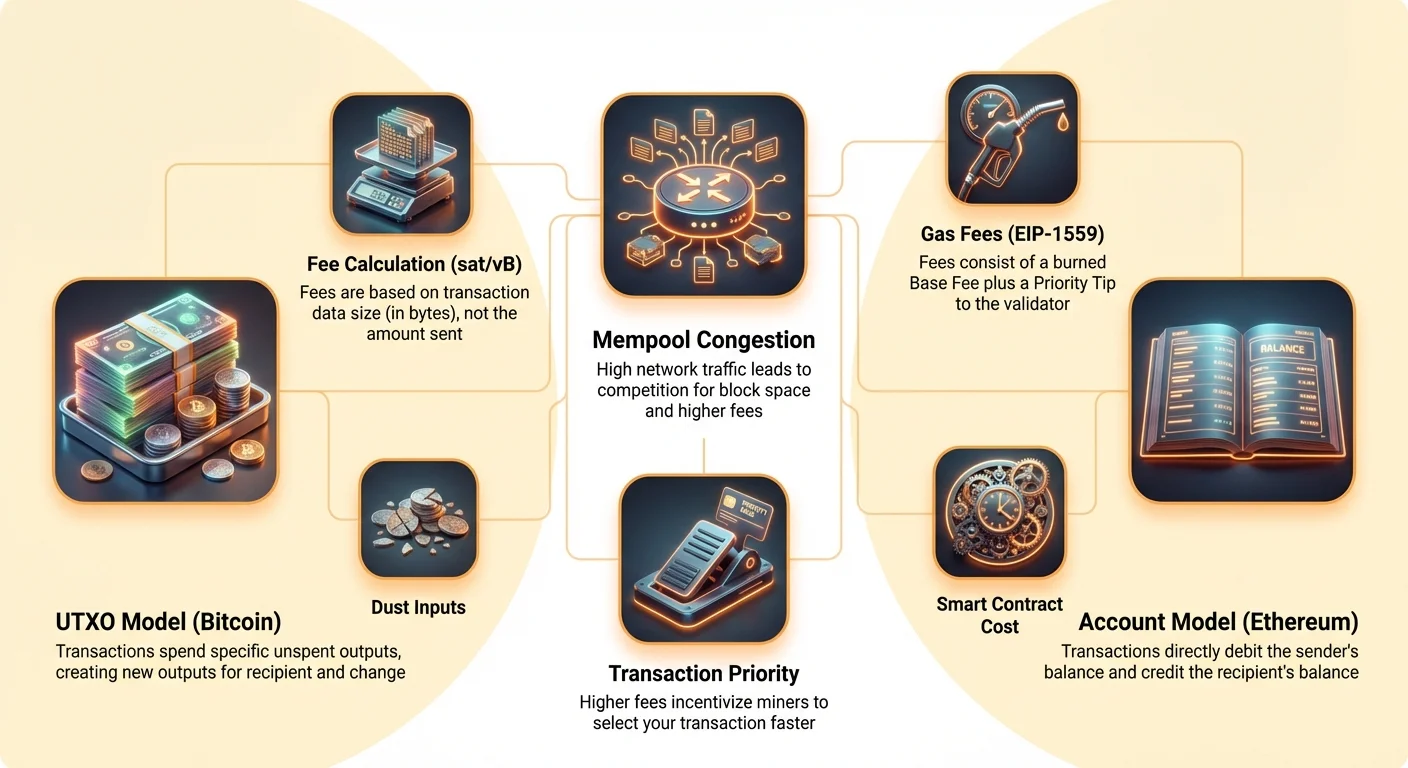
Most traditional financial systems operate on an account-based ledger (like checking your bank balance). Ethereum and similar blockchains (e.g., Solana) adopt this model: your wallet holds a single, verifiable balance, and a transaction simply reduces that balance and increases the recipient's balance.
The UTXO model, however, is radically different. Bitcoin does not track balances; it tracks inputs and outputs.
- UTXO (Unspent Transaction Output): Think of UTXOs as individual digital banknotes of specific values residing in your wallet address. When you receive 0.1 BTC, that 0.1 BTC becomes an unspent output. When you want to spend 0.05 BTC, you must "spend" the entire 0.1 BTC UTXO, designating 0.05 BTC to the recipient and returning the remaining 0.05 BTC (minus fees) back to yourself as a new UTXO.
Understanding UTXOs is crucial for fee optimization. If you have many tiny UTXOs (a phenomenon called "dust"), your transactions become mathematically complex, requiring more data (bytes), and thus costing more in fees.
Inputs, Outputs, and Change Addresses
Every Bitcoin transaction must satisfy a simple accounting rule: Inputs must equal Outputs + Fees.
- Inputs: These are the UTXOs you are spending (consuming the digital banknotes). Each input requires a cryptographic signature.
- Outputs: These define where the money is going. There are usually two outputs:
- The recipient's address and amount.
- The change address and amount (the remaining funds from the UTXO sent back to a new address controlled by you).
- Fees: The difference between the sum of the inputs and the sum of the outputs. This excess is claimed by the miner or validator who includes the transaction in a block.
In account-based systems (Ethereum), this is simplified. The transaction specifies the amount to send and the required gas limit and price, directly debiting the sender's account balance.
The Digital Signature: Proving Ownership
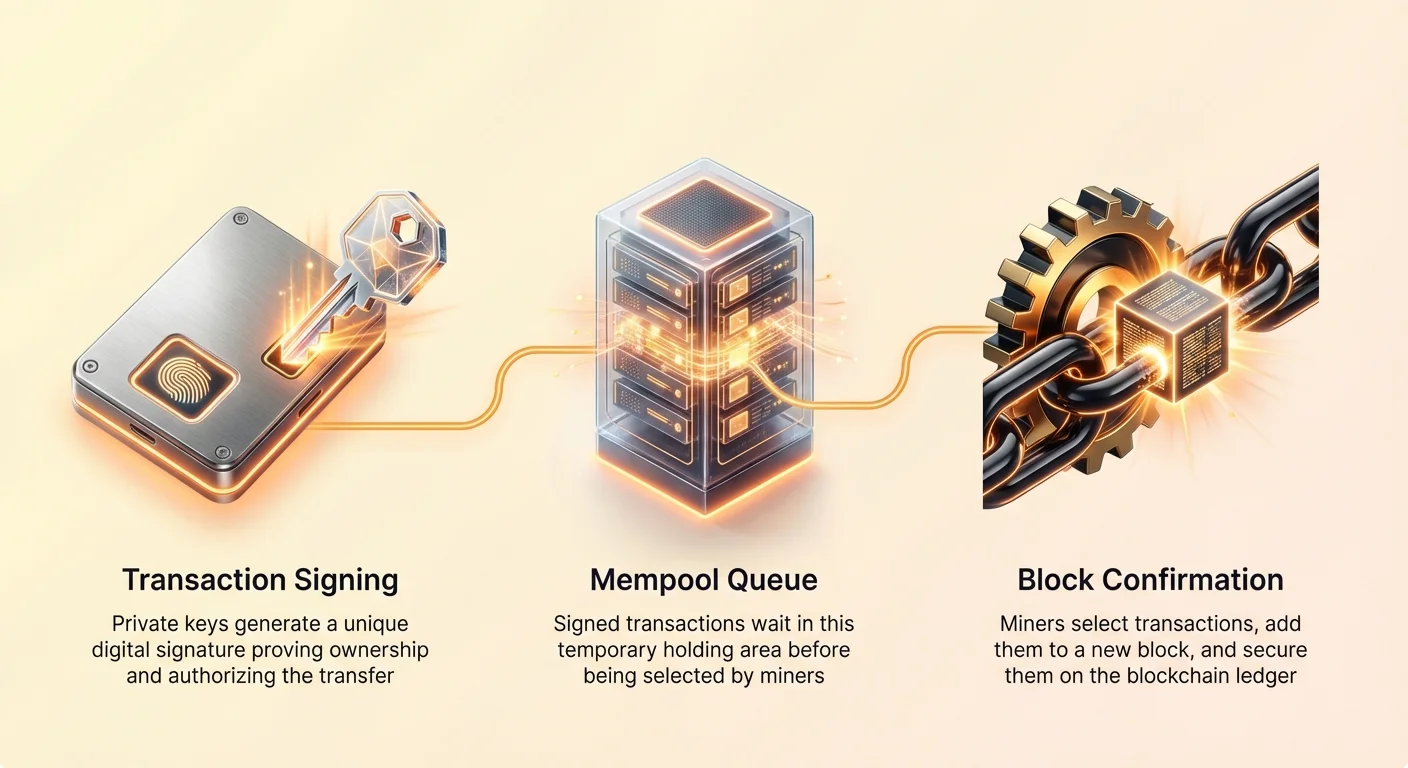
A transaction is only valid if it includes a verifiable digital signature. This signature is generated using your wallet’s private key and digital signature mechanics. The signature proves two things:
- That the funds were authorized to be spent by the true owner of the public address.
- That the transaction data (recipient, amount, fee) has not been tampered with since the signature was generated.
Once signed, the transaction is broadcast to the network, entering the public waiting room known as the Mempool.
Understanding Network Traffic: The Mempool and Transaction Priority
The Mempool (Memory Pool) is arguably the most critical component for understanding transaction speed and cost. It acts as a staging area or waiting room for all pending, unconfirmed transactions on a blockchain network.
What is the Mempool? (The Unconfirmed Queue)
When you broadcast a signed transaction, it doesn't instantly appear in a block. First, it propagates across the network's nodes, and each node temporarily stores it in its local memory pool—the Mempool.
The size and congestion of the Mempool directly dictate how long you wait and how much you must pay.
- High Congestion: When thousands of transactions are waiting, competition for scarce block space skyrockets.
- Low Congestion: Transactions are often processed instantly with minimal fees.
Tracking Mempool data through dedicated explorers or dashboard sites is the primary way sophisticated users estimate optimal fee rates.
How Miners Select Transactions (The Fee/Byte Ratio)
Miners (or Validators in Proof-of-Stake systems) have limited space in each block they create. Since their goal is profit maximization, they prioritize transactions based on the density of the fee relative to the size of the transaction data.
For Bitcoin, this is measured in Satoshis per Virtual Byte (sat/vB).
- A miner wants to pack the most satoshis into their limited block space. Therefore, a transaction offering 10 sat/vB will be prioritized over a transaction offering 5 sat/vB, even if the total fee amount is lower, because the 10 sat/vB transaction is a more efficient use of the miner's block capacity.
For Ethereum, priority is based on the Gas Price and the Priority Fee (or Tip). While the Base Fee is burned, the Priority Fee goes directly to the validator, incentivizing them to include the transaction quickly.
Block Space Limitations and Propagation
Every blockchain has limits on block size or block gas limit (Ethereum). This hard limit is what creates the scarcity that drives transaction costs. If a network sees a sudden surge in demand (e.g., during a major token launch or market volatility), the Mempool quickly overflows, forcing users to dramatically increase their fees to jump the queue.
- Propagation: After broadcasting, the speed at which your transaction reaches a sufficient number of miners/validators affects its chances of inclusion. Generally, major wallet software ensures rapid propagation, but heavy network loads can sometimes delay this, leading to the perception of a "stuck" transaction even before it hits the Mempool widely.
The Science of Fees: Gas, Satoshis, and Network Congestion
Transaction fees are not arbitrary; they are the market price for accessing shared decentralized computing power and data storage. Mastering fee structures is the key to optimizing costs.
Bitcoin Fees: Satoshis per Virtual Byte (vByte)
Bitcoin transactions are measured in bytes, and fees are quoted in Satoshis (the smallest unit of BTC) per virtual byte (vB).
- Transaction Size: The size (in vB) depends primarily on the number of inputs (UTXOs) used and the number of outputs created. Transactions spending many small UTXOs are large and expensive.
- Fee Rate: This is the rate you choose (e.g., 20 sat/vB).
- Total Fee: Transaction Size (vB) x Fee Rate (sat/vB).
If your wallet estimates your transaction size is 200 vB, and you choose a priority rate of 50 sat/vB, your total fee will be 10,000 Satoshis (0.0001 BTC). Optimizing this size, especially by adopting modern standards, is critical for fee control. Learn how SegWit improved Bitcoin transaction efficiency.
Ethereum Gas Model (Base Fee + Priority Tip)
Ethereum operates using "Gas," a unit representing the computational effort required to execute a transaction or a smart contract function. The EIP-1559 upgrade dramatically changed Ethereum's fee structure in 2021, making fees more predictable and separating the burned fee from the validator payment. We explain the full mechanics of Base Fees and Priority Fees in detail.
- Gas Limit: The maximum amount of computational effort you are willing to pay for the transaction. If the transaction finishes before reaching the limit, you get the excess back. If it hits the limit before finishing, it fails, but you still pay the consumed gas (always set a reasonable Gas Limit).
- Base Fee: This fee is dynamically determined by the network congestion and is required to be paid. Crucially, the Base Fee is burned (destroyed), helping to manage the circulating supply of Ether (ETH).
- Priority Tip (Max Priority Fee): This is the optional tip paid directly to the validator to incentivize them to include your transaction quickly. When the network is highly congested, increasing this tip is necessary to jump ahead of others.
- Max Fee: The absolute maximum you are willing to pay per unit of gas (Base Fee + Priority Tip).
The total fee paid is (Gas Used x Base Fee) + (Gas Used x Priority Tip).
The Impact of Transaction Complexity
It is a common misconception that sending a large amount of crypto costs more than sending a small amount. Fees are dictated by complexity, not value.
- Bitcoin: Complexity relates to the data size (inputs/outputs). A transaction using 20 inputs to consolidate "dust" will cost far more than a transaction using one large UTXO.
- Ethereum: Complexity relates to the contract function called. A simple ETH transfer requires a fixed amount of gas (21,000 units). Interacting with a decentralized exchange (DEX) or minting an NFT requires hundreds of thousands of gas units because the contract execution is highly complex.
If your fee seems unusually high on Ethereum, check the gas limit your wallet has set; it might be calculating the cost for a complex smart contract interaction instead of a simple transfer.
Strategic Fee Management and Cost Optimization
Optimizing blockchain costs requires planning and utilizing real-time data. The goal is to set the lowest possible fee that still guarantees inclusion in the next few blocks.
Utilizing Fee Estimation Algorithms and Oracles
Relying solely on your wallet’s default fee setting is inefficient. These settings often err on the side of caution (overpaying) to ensure the transaction doesn't get stuck.
Tools for Smart Fee Estimation:
- Mempool Trackers: Dedicated sites that visualize the current transaction queue, showing the minimum fee rate needed for 1-block, 3-block, or 6-block confirmation certainty.
- Wallet Integration: Many modern self-custody wallets integrate API calls to reputable fee prediction services (oracles). Ensure your wallet is set to use these dynamic predictions rather than fixed rates.
- Historical Analysis: Learn when your target network (e.g., Ethereum) is typically least busy. Weekends and late night/early morning hours (UTC) often see significantly lower gas prices than peak U.S. trading hours.
Actionable Tip: If your transaction is not time-sensitive, always check the current fee market. Often, waiting 30 minutes can save you 30-50% on fees during volatile periods.
Time Sensitivity: Trading Off Speed and Cost
Fee optimization is fundamentally a trade-off between cost and speed. Define your necessity:
| Goal | Fee Strategy (Bitcoin Example) | Fee Strategy (Ethereum Example) |
|---|---|---|
| Urgent/Priority | Set the highest rate shown by the 1-block estimator (e.g., 80 sat/vB). | Set a high Priority Tip to compete immediately. |
| Standard/Normal | Set the average rate needed for confirmation within 3-6 blocks (e.g., 30 sat/vB). | Use a moderate Priority Tip; rely on the Base Fee dynamics. |
| Economy/Slow | Use the lowest rate that has historically cleared within 24 hours (e.g., 5 sat/vB). | Accept the lowest suggested Priority Tip and wait for low network demand. |
If you are just moving assets between your own hardware wallets, selecting an economy rate and waiting for several hours during off-peak times is a highly effective cost-saving measure.
Batching Transactions
Transaction batching is an advanced technique, most commonly utilized by centralized exchanges (CEXs) and large custodians, but also relevant for individual users consolidating UTXOs.
Batching involves combining multiple send requests into a single blockchain transaction.
- Benefit: Since a large part of the transaction fee is related to the fixed overhead (input signatures, header data), combining multiple outputs (recipients) into one transaction is significantly more efficient per transfer than sending separate transactions.
- Application: If you plan to send funds to three different people using the Bitcoin network, sending them simultaneously in a single transaction will save fees compared to initiating three separate sends.
For Ethereum users, batching often takes the form of using layer 2 (L2) rollups, which bundle hundreds of L2 transactions into a single L1 transaction proof, massively reducing the effective gas cost per user.
Troubleshooting Stuck Transactions and Ensuring Finality
The most frustrating scenario for any crypto user is the "stuck" transaction—the funds have left the wallet but have not appeared in the recipient's balance after a lengthy delay. Get a comprehensive guide on troubleshooting stuck crypto transactions. Troubleshooting this requires understanding network timing and intervention methods.
Identifying a Stuck Transaction (Why it Happens)
A transaction is "stuck" when it has been broadcast to the Mempool but has not yet been included in a block. This usually occurs because the fee you attached was too low to compete with the current network demand.
Common Reasons for Getting Stuck:
- Fee Undercutting: The network fee rate spiked immediately after you broadcast the transaction, rendering your fee uncompetitive.
- Node Drop: Some smaller nodes dropped the transaction from their local Mempool after too much time elapsed (usually 1-2 weeks), but major nodes might still hold it.
- Local Wallet Error: The transaction broadcast failed initially, but your wallet incorrectly marked the funds as "pending."
How to Check: Always find your transaction ID (TXID) and paste it into a reliable block explorer. If the explorer shows the transaction as "Unconfirmed," it is stuck in the Mempool. If it shows "Not Found," the broadcast failed entirely.
Transaction Acceleration Services (Third-party Pool Boosting)
If your transaction is stuck and urgent, you have two primary options for accelerating its confirmation: using a third-party service or performing a manual replacement.
1. Third-Party Accelerators (Paid Services): Some mining pools or dedicated acceleration services offer paid solutions. You provide your TXID, and they guarantee to resubmit your transaction directly to their mining pool with high priority, ensuring it gets picked up quickly for a fee. This is common for Bitcoin acceleration during periods of extreme congestion.
2. Manual Replacement Techniques (RBF/Cancel):
For self-custody users, manually replacing the transaction is often the best route:
- Replace-by-Fee (RBF - Bitcoin): If your original transaction was broadcast with the RBF flag enabled, you can create a new transaction with the exact same inputs (UTXOs) but with a higher fee. When broadcast, the network sees the conflict (double spend) but prioritizes the one with the higher fee, replacing the original stuck transaction.
- Cancel and Resubmit (Nonce Management - Ethereum): On Ethereum, you can cancel a stuck transaction by sending a new transaction to yourself (or any address) using the exact same Nonce (sequence number) as the stuck transaction, but with a sufficiently high gas price (higher than the pending transaction) and an ETH amount of zero. The new, zero-value transaction will get confirmed, overriding and nullifying the original stuck transaction.
Checking Transaction Finality and Confirmation Times
Confirmation is the process where a block containing your transaction is added to the blockchain. Finality refers to the degree of certainty that the transaction cannot be reversed.
Bitcoin Confirmation: Transactions are considered increasingly final with each subsequent block that is mined on top of the initial confirmation block.
- 1 Confirmation: Included in the ledger (usually safe for small amounts).
- 6 Confirmations (Roughly 1 hour): Generally considered the industry standard for irreversible finality (safe for large amounts).
Ethereum Finality: Because of the move to Proof-of-Stake, Ethereum finality relies on Epochs and Checkpoints. While a single block confirmation (L1) provides high certainty, full finality (checkpoint finalization) usually takes around 13 minutes.
If your funds are stuck, always track the number of confirmations on the block explorer. Until a transaction reaches a few confirmations, never assume it is irreversible.
Advanced Mechanics: Double Spends and Replace-by-Fee (RBF)
The concepts of double spending and RBF are inextricably linked to transactional security and fee optimization. Understanding them is key to advanced asset management.
The Mechanics of Replace-by-Fee (RBF)
RBF is a protocol feature designed specifically to address the problem of stuck transactions on the Bitcoin network.
When enabled (which is often done by default in modern wallets), the RBF flag signals to the network that the sender is permitted to attempt to replace the transaction later with one paying a higher fee.
- Why use RBF? If you set a fee too low and the Mempool spikes, you can easily use RBF to "bump" the fee without the hassle of waiting.
- RBF and Zero-Confirmation Risk: The inherent security risk of RBF is that it allows the sender to intentionally double-spend. If a merchant accepts a payment before it has been confirmed (a "zero-confirmation transaction"), and the sender then broadcasts a higher-fee RBF transaction sending the same funds to their own address, the merchant may receive nothing. This is why merchants accepting payments for large values always demand multiple confirmations.
Double Spend Prevention
A double spend is the act of using the same cryptocurrency unit more than once. The primary defense against this is the requirement for network consensus (mining/validation).
- The Attack Vector: A user broadcasts Transaction A to a merchant (low or zero fee) and simultaneously broadcasts Transaction B (sending the same funds back to themselves) with a significantly higher fee.
- The Defense: The decentralized network sees two conflicting transactions attempting to spend the same UTXO. Since miners prioritize profit, they will overwhelmingly choose Transaction B (the high-fee transaction) and include it in the block, effectively invalidating Transaction A. The moment Transaction B is confirmed, Transaction A is permanently rejected.
This mechanism highlights why waiting for confirmations is paramount for receiver security.
Sequence Numbers and Nonces (Ethereum Equivalent)
Ethereum, using the Account-Based model, relies on a concept called the Nonce (Number used once) to prevent double spending and manage transaction order.
- What is a Nonce? It is a sequential counter associated with an Ethereum address, starting at 0. Every transaction initiated by that address must use the next available Nonce (0, 1, 2, 3, etc.).
- Double Spend Prevention: If an address has a Nonce of 5, the network will only accept a transaction with Nonce 5. If the user tries to submit two different transactions both labeled Nonce 5, only the first one confirmed (usually the one with the highest gas price) will be accepted, and the other will be permanently rejected.
- Troubleshooting Tool: Manually adjusting the Nonce is how you cancel or replace stuck transactions on Ethereum, as described earlier. If your wallet gets out of sync (rare but possible), transactions might get stuck if the wallet tries to submit a Nonce lower than the last confirmed transaction.
Conclusion
Mastering transactional mechanics transforms you from a passive user of decentralized technology into an active, strategic participant. Understanding the structure of UTXOs, the dynamics of the Mempool, and the differences between Bitcoin's sat/vB fee structure and Ethereum's EIP-1559 gas model allows for precision cost control.
The ability to accurately estimate fees, utilize RBF, or manually override a stuck transaction through Nonce manipulation is essential for managing assets efficiently and securely during periods of high network congestion. By prioritizing strategic efficiency and regulatory mastery over simple execution, you gain the skills necessary to optimize your asset flow, minimize costs, and reinforce the self-sovereignty that cryptocurrency promises.