
Ethereum has firmly established itself as the second most recognized cryptocurrency and the foundational layer for a vast decentralized financial system. However, this success has created significant challenges. The network regularly processes over one million transactions daily, yet the demand for block space far exceeds the available capacity. This congestion leads to exorbitant gas and fees that price out many users from participating in the ecosystem.
To address these limitations, the network is undergoing a series of profound technical upgrades. The goal is to transform the blockchain into a scalable, efficient global computer without sacrificing security or decentralization. This evolution involves moving beyond the original design limitations to support a new generation of applications.
The core of this transformation lies in changing how the network handles data and consensus. By shifting from Proof of Work to Proof of Stake and implementing complex scaling solutions like sharding, developers aim to solve the "blockchain trilemma." This concept suggests that decentralized networks struggle to optimize security, decentralization, and scalability simultaneously.
The Evolution of Network Consensus
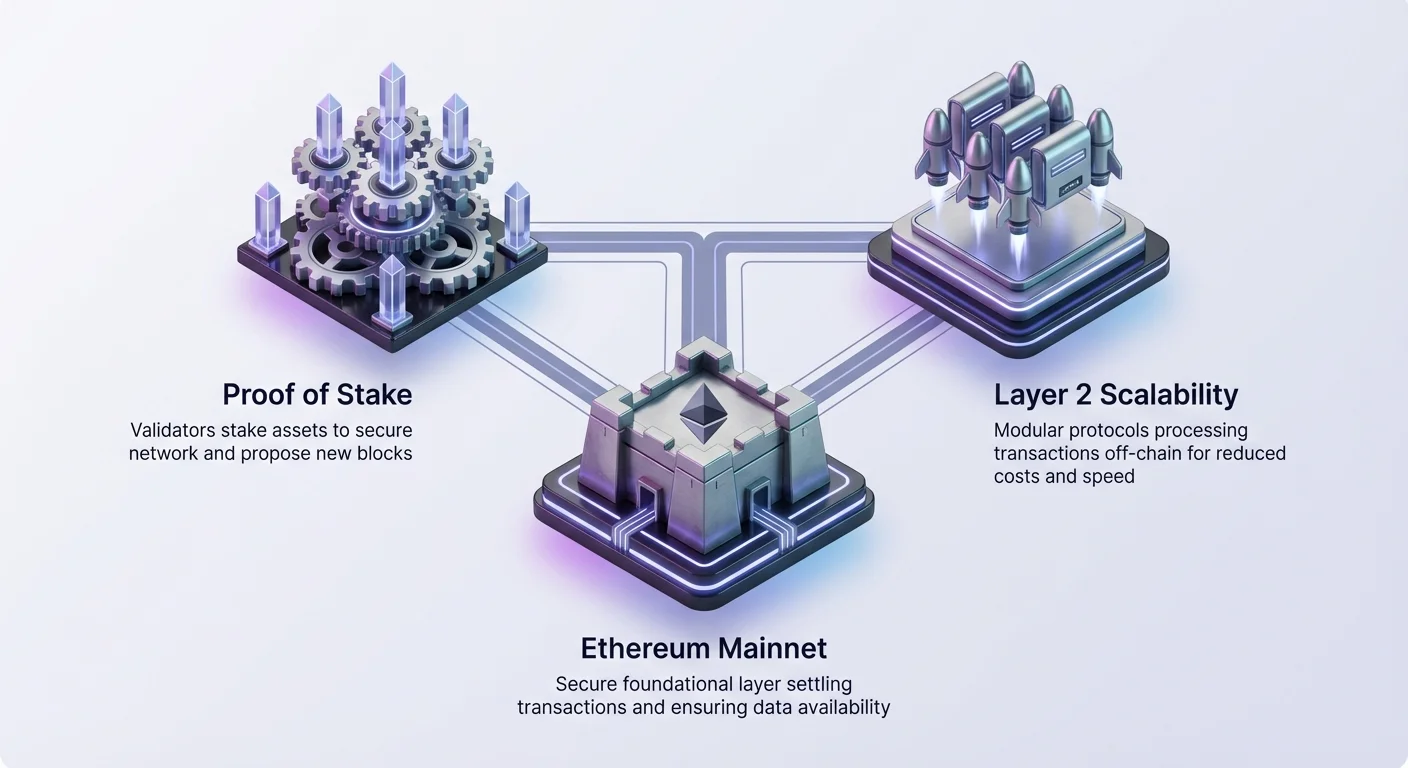
The transition to Proof of Stake (PoS) marked a pivotal moment in this roadmap. In a PoS system, the energy-intensive mining farms of Proof of Work are replaced by validators. These participants lock up, or "stake," crypto assets in a smart contract to secure the network. They are then selected at random to propose new blocks and validate transactions.
This shift was necessary not just for energy efficiency, but to enable future scaling technologies. The implementation of sharding, for example, requires the validator structure provided by PoS. In the old mining model, sharding would have lowered the hashing power needed to compromise specific segments of the network, reducing overall security.
Under PoS, validators are randomly assigned to different duties. This randomness makes it extremely difficult for malicious actors to coordinate attacks on specific parts of the network. This structural change laid the necessary groundwork for the data availability improvements that are now being prioritized to drive mass adoption.
Understanding the Scalability Bottleneck
The primary hurdle facing Ethereum today is the limited amount of data that can be processed and stored in each block. On the mainnet, known as Layer 1, every node must download and verify every transaction. This redundancy ensures high security but creates a severe bottleneck for throughput.
When the network becomes congested, users engage in a bidding war to have their transactions included in the next block. This mechanism drives up gas prices, making simple actions like swapping tokens or purchasing NFTs prohibitively expensive for the average user.
The Limits of Layer 1
Layer 1 operates as a monolithic chain where execution, consensus, and data availability happen together. While robust, this design is not optimized for speed. The current architecture limits the network to a low number of transactions per second.
Because the supply of block space is inelastic, any spike in demand results in immediate fee increases. This economic reality has driven the development of Layer 2 solutions, which aim to move the bulk of transaction processing off the main chain while leveraging its security.
The Role of Data Availability
For Layer 2 solutions to work effectively, they must be able to post data back to the main Ethereum network. This ensures that the history of transactions is preserved and verifiable. However, because block space on Layer 1 is expensive, posting this data remains costly.
This is where the concept of "data availability" becomes critical. If the network can be optimized to provide cheap, abundant space specifically for data storage rather than transaction execution, the cost of using Layer 2 networks would drop purely.
Layer 2 Solutions and Rollups
Layer 2 is an umbrella term for solutions built on top of the Ethereum mainnet to improve scalability. These protocols handle transaction execution outside the main chain, reducing the burden on Layer 1. They then settle the final state or proofs back to the Ethereum network.
There are several approaches to Layer 2, including channels, independent sidechains, and rollups. Rollups have emerged as the most promising technology for long-term scaling. They work by bundling hundreds of transactions into a single batch, processing them off-chain, and sending only the essential data to Layer 1.
Optimistic Rollups
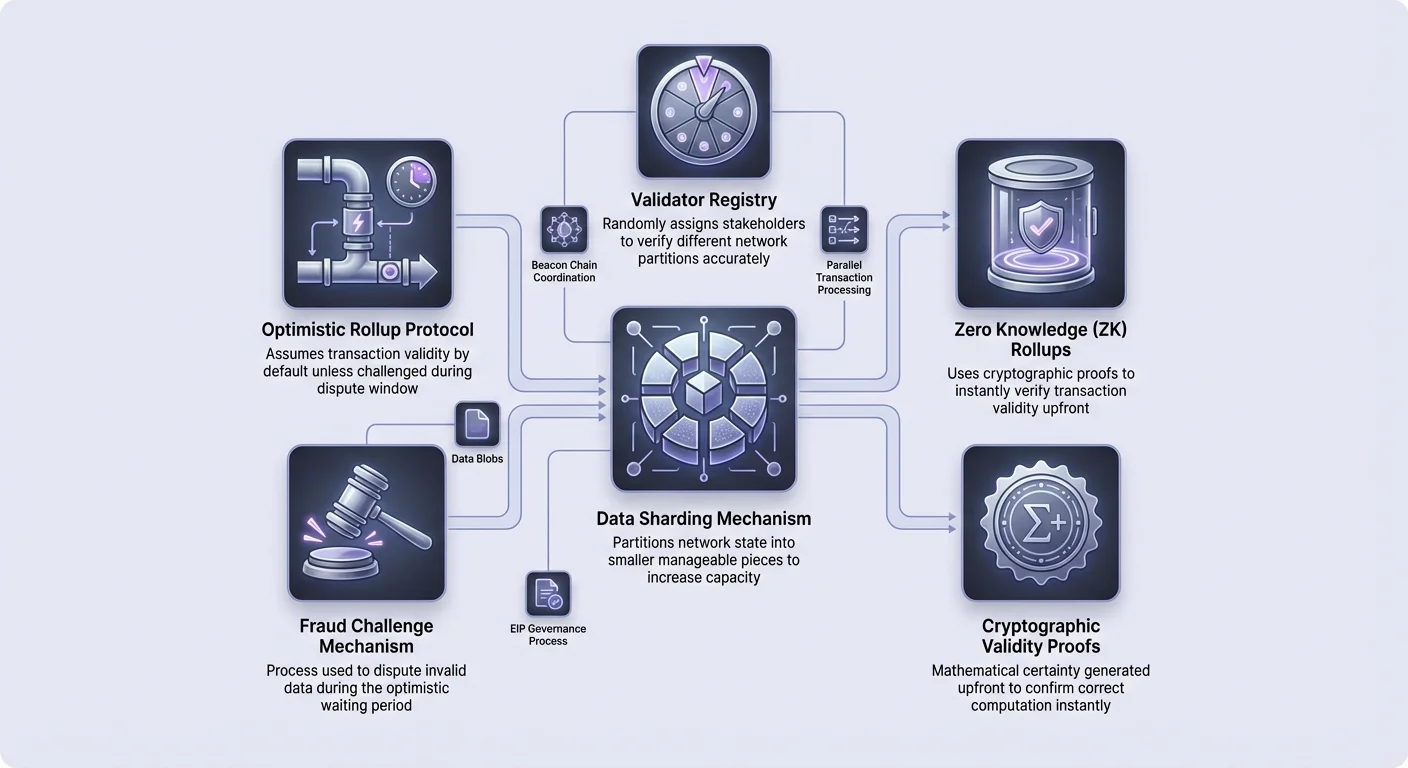
Optimistic rollups operate on a presumption of validity. They assume that transactions are valid by default and only perform computation if a challenge is raised. This approach significantly speeds up processing.
When a batch of transactions is submitted, there is a challenge period (usually seven days) during which validators can dispute the data. If fraud is detected, the invalid transactions are reverted, and the malicious actor is penalized.
This method is compatible with the Ethereum Virtual Machine (EVM), making it easy for developers to port existing applications. However, the reliance on a dispute window means that withdrawing assets back to Layer 1 can be slow.
Zero Knowledge (ZK) Rollups
Zero Knowledge rollups take a different approach. Instead of assuming validity, they generate a cryptographic proof that validates the transactions in the batch. This proof is submitted to Layer 1 along with the data.
Zero Knowledge rollups take a different approach. Instead of assuming validity, they generate a cryptographic proof that validates the transactions in the batch. This proof is submitted to Layer 1 along with the data. Because the validity is mathematically proven upfront, there is no need for a challenge period. This allows for faster withdrawals and immediate finality. ZK rollups are technically complex and require significant computational power to generate proofs, but they offer a highly secure and efficient scaling path.
| Feature | Optimistic Rollups | ZK Rollups |
|---|---|---|
| Validation | Assumes validity; fraud proofs | Cryptographic validity proofs |
| Withdrawal Time | Long (approx. 7 days) | Instant / Short |
| Complexity | Lower; easier to implement | High; math-intensive |
Sharding: The Path to Massive Capacity
Sharding is a scaling technique designed to split the network's entire state into smaller, manageable pieces called "shards." Each shard operates somewhat like a separate blockchain with its own account balances and smart contracts.
Unlike independent blockchains, shards communicate and coordinate through the main chain. This allows the network to process many transactions in parallel rather than sequentially.
Partitioning the Network
In a fully sharded system, the responsibility for data processing is distributed across multiple shards. Validators are assigned to specific shards rather than the whole network. This parallelization is what promises to increase Ethereum's capacity by orders of magnitude.
The initial implementation of sharding focuses specifically on data availability. Rather than trying to shard the execution of smart contracts immediately, the network prioritizes creating "data shards." These shards serve as storage lanes for the data generated by Layer 2 rollups.
Enhancing Layer 2 Efficiency
By providing dedicated space for data, sharding directly addresses the cost bottleneck for rollups. Currently, rollups must compete with regular transactions for expensive Layer 1 block space.
With sharded data availability, rollups will have access to vast amounts of cheap storage. This allows them to process thousands of transactions per second at a fraction of the current cost. The main Ethereum chain effectively becomes a settlement and data availability layer, while execution moves to Layer 2.
The Governance of Protocol Upgrades
Implementing these massive changes requires rigorous governance. Ethereum is not a static protocol; it evolves through a formalized process known as Ethereum Improvement Proposals (EIPs).
Changes are proposed, debated, and tested by the community of developers, node operators, and stakeholders. Achieving consensus in a decentralized system is a quasi-political process involving persuasion and deliberation.
The EIP Process
An EIP starts as a draft submitted by individuals or teams. The community debates its merits, technical feasibility, and economic impact. Proposals are amended and refined based on feedback.
Once a rough consensus is achieved, the code is written, audited, and tested on testnets. Finally, node operators must voluntarily choose to update their software to include the new rules. This ensures that no single entity can force changes onto the network.
Credible Neutrality
A guiding principle for Ethereum governance is "credible neutrality." This concept asserts that the protocol design should not discriminate for or against any specific people or use cases. The mechanism must treat everyone fairly.
This principle is vital when discussing scaling upgrades. Changes must benefit the ecosystem as a whole rather than specific stakeholders. The move to sharding and data availability is viewed as neutral because it lowers barriers for all users and developers equally.
Security in a Sharded Network
Security is the paramount concern when fragmenting a blockchain. In a Proof of Work system, splitting the network would dilute the hash rate, making individual shards vulnerable to attacks.
Proof of Stake addresses this by using a registry of validators on the Beacon Chain. The protocol randomly assigns validators to verify different shards. This random assignment prevents an attacker from concentrating their stake on a single shard to take control.
Validator Responsibilities
Validators play a crucial role in maintaining data consistency. They must ensure that the data published to the shards is actually available to the network. If data is unavailable, the state of the Layer 2 chains cannot be verified.
The protocol includes penalties for validators who act maliciously or fail to perform their duties. This "carrot and stick" approach incentivizes participants to secure the network accurately.
Decentralization and Node Operations
Critics often argue that scaling can compromise decentralization by making it harder to run a node. If the blockchain becomes too large, only data centers can store the history.
Sharding mitigates this by distributing the load. No single validator needs to store the entire history of all shards. This keeps the hardware requirements for participation reasonable, preserving the network's decentralized nature.
The Future of Transaction Costs
The combination of Layer 2 rollups and data availability sharding represents the endgame for Ethereum scalability. This modular architecture allows the network to specialize.
Layer 1 focuses on security, consensus, and data availability. Layer 2 focuses on fast, cheap execution. This separation of concerns allows each layer to optimize for its specific role without compromising the others.
Economic Impact
As these upgrades roll out, the cost structure of the network will change fundamentally. High gas fees on Layer 1 act as a barrier to entry today. By offloading execution and providing cheap data blobs, fees should drop significantly.
This reduction in cost is essential for high-frequency applications like gaming, social media, and micro-transactions. These use cases are currently priced out of the ecosystem but become viable with massive scalability.
Continued Evolution
The roadmap is a multi-year journey. The transition to Proof of Stake was the first major step. The implementation of data sharding follows. Future phases may include execution sharding, where shards can process smart contracts independently.
The network will continue to evolve based on real-world usage and technological advancements. The governance process ensures that these changes reflect the needs and values of the community.
Conclusion
The path to massive scalability for Ethereum is paved with complex technical upgrades that fundamentally reshape how the blockchain operates. By transitioning from Proof of Work to Proof of Stake, the network established a secure and energy-efficient foundation necessary for future growth. This shift enabled the development of sharding, a technique that partitions the network to handle vastly more data than was previously possible.
The integration of data availability improvements specifically targets the economic bottlenecks hindering Layer 2 solutions. By providing cheap, dedicated storage for rollup data, the protocol empowers these external execution layers to process thousands of transactions per second. This modular approach preserves the security of the main chain while offloading the heavy computational work, effectively solving the scalability issues that have historically plagued decentralized networks.
Ultimately, these advancements are about more than just technical specifications; they are about accessibility. Reducing transaction costs and increasing throughput democratizes access to the decentralized financial system. As the network matures through these upgrades, it moves closer to realizing its vision of becoming a neutral, global platform for the next generation of the internet.
Ethereum is evolving from a simple execution layer into a high-speed data foundation for the future internet.