
When exploring the world of decentralized finance, it’s easy to get distracted by the technological bells and whistles—fast transaction speeds, new applications, and sleek user interfaces. However, the true sustainability of any Layer 1 (L1) blockchain—the base foundational network like Ethereum, Solana, or Cardano—rests not on its technology alone, but on its underlying economic model, or tokenomics.
Understanding L1 economics means moving beyond simple price movements and analyzing the mechanisms that secure the network, incentivize participants, and manage the asset’s supply over time. These models dictate whether the yield you earn is sustainable "real yield" or merely "inflationary subsidy."
For anyone aiming for long-term self-sovereignty and sustainable growth in the digital economy, dissecting these incentive structures is paramount. This guide provides a deep dive into the financial engine of Layer 1 blockchains, focusing on how inflation, staking, and utility combine to determine long-term asset value.
The Core Mechanics of Layer 1 Tokenomics
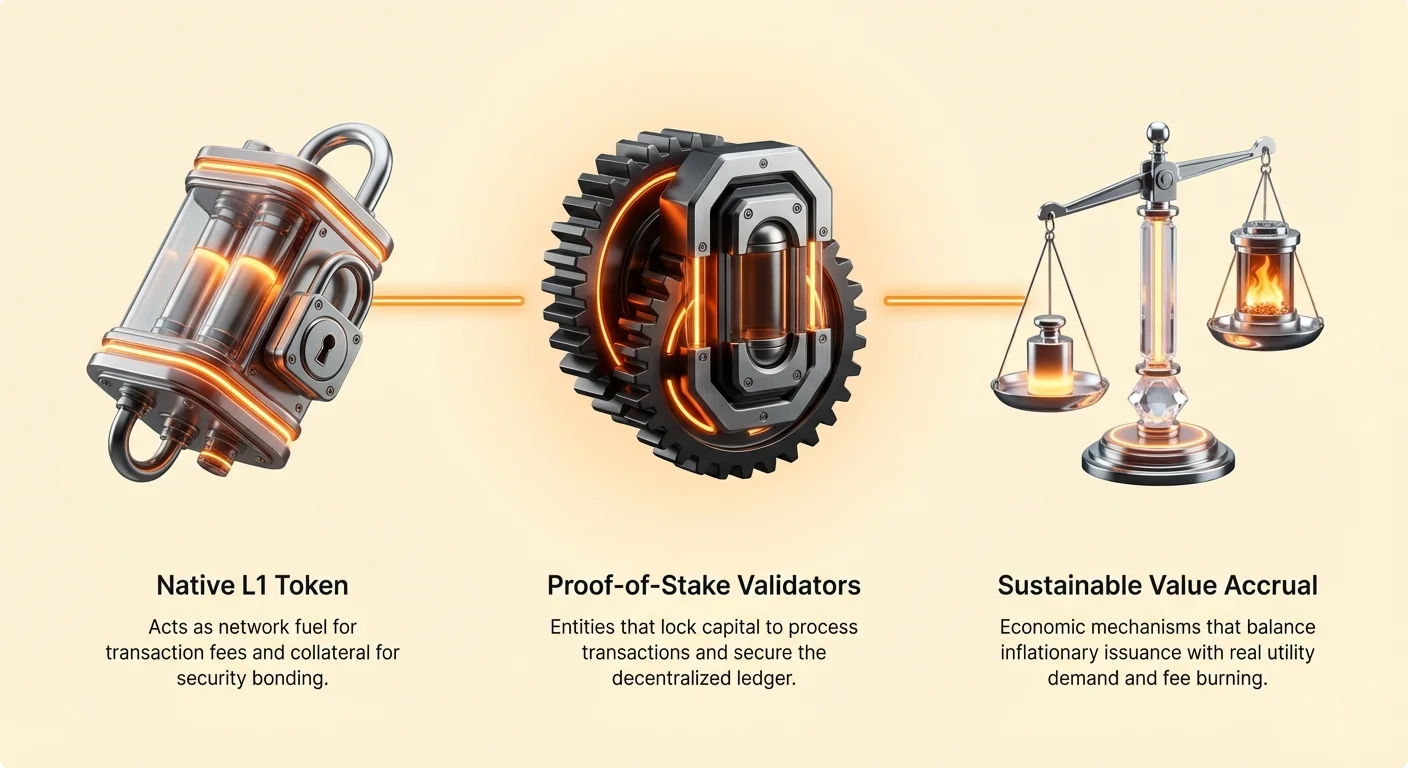
A Layer 1 blockchain’s native token serves multiple critical economic functions simultaneously. It is the lifeblood of the network, acting as fuel, security collateral, and a mechanism for governance. Before analyzing incentives, we must understand why these tokens exist.
The Role of the Native Asset: Utility and Security
The primary function of any L1 native token (e.g., Ether, SOL) is to ensure the network can operate securely and efficiently.
- Gas/Transaction Fees (Utility): Every action taken on the blockchain—sending a token, swapping assets, or interacting with a decentralized application (dApp)—requires computational effort. Users must pay a small fee, called "gas," denominated in the native L1 token. This creates constant, organic demand for the asset and prevents spamming of the network.
- Staking Collateral (Security): In Proof-of-Stake (PoS) systems, validators must lock up (stake) a significant amount of the native token to participate in validating transactions and proposing new blocks. This staked capital acts as a bond; if the validator acts maliciously or fails to perform, a portion of their stake can be destroyed (slashed). This mechanism directly links the economic value of the token to the security level of the entire network.
Supply and Demand Fundamentals
The value of an L1 asset is a product of its fundamental utility (demand) and its supply schedule (issuance/inflation).
- Demand Drivers: Network activity (how many dApps are running), user adoption, speculative interest, and the necessity of the token for collateral (staking).
- Supply Drivers: The protocol's predetermined inflation schedule (how many new tokens are created daily) and any deflationary mechanisms (how many tokens are burned).
A sustainable L1 economy thrives when genuine utility creates strong demand that constantly pressures the asset’s price upward, ideally offsetting or exceeding any supply inflation.
Proof-of-Stake (PoS) and Incentive Engineering
Proof-of-Stake is the dominant consensus mechanism for modern Layer 1 networks. It replaces the energy-intensive mining of Proof-of-Work (PoW) with an economic incentive system: stake your crypto, secure the chain, and earn rewards.
The Staking Rewards Mechanism
Staking rewards are not arbitrary handouts; they are essential security expenses paid by the protocol. The purpose of issuing rewards is threefold:
- Incentivizing Participation: Staking requires locking assets, incurring opportunity cost (the inability to use those assets elsewhere). Rewards compensate stakers for this lockup and the risk of technical failure or slashing.
- Achieving Decentralization: Higher rewards encourage more individuals to run validators, increasing the total amount staked and distributing control across more parties, thus improving censorship resistance.
- Security Budget: The total cost of staking rewards represents the network’s annual security budget. If rewards are too low, participants might withdraw their stake, making the network cheaper and easier for an attacker to compromise (e.g., executing a 51% attack).
Validator Economics: Costs and Benefits
For serious participants, becoming a validator is a business operation involving economic trade-offs:
| Economic Component | Impact on Validator |
|---|---|
| Capital Requirement | The cost of acquiring the minimum required L1 tokens to stake. This is the largest initial investment. |
| Operational Costs | Hardware, internet connectivity, and maintenance fees (e.g., cloud hosting). |
| Risk of Slashing | Economic penalty for downtime or malicious activity. Requires constant monitoring and expertise. |
| Staking Rewards | The primary benefit, typically paid in newly minted tokens (inflationary) and/or transaction fees (real yield). |
Sophisticated participants compare the expected Annual Percentage Yield (APY) of staking against the risks and operational costs. The protocol must ensure the reward rate is high enough to attract sufficient stake while low enough not to severely dilute the existing token holders.
The Inflationary Dilemma: Subsidized vs. Sustainable Yield
The most critical analytical concept for evaluating an L1 tokenomics model is distinguishing between yield generated through network productivity and yield generated through artificial supply expansion. This differentiation defines the long-term sustainability of the asset.
Yield Generated by Inflationary Subsidies
Many Proof-of-Stake networks initially rely heavily on inflationary issuance—minting new tokens—to pay staking rewards. This is common in newer L1s trying to quickly boost their security budget.
The Economic Challenge (Dilution): If an L1 protocol pays a 10% staking reward by simultaneously inflating the total token supply by 10%, a staker’s percentage ownership of the network remains constant. While the staker’s nominal token count increases, their purchasing power relative to the network’s total valuation may not increase at all.
This inflationary issuance is essentially a subsidy. It guarantees a high reward rate to secure the chain, but it comes at the cost of dilution for all token holders.
Understanding Real Yield
In contrast to inflationary subsidies, Real Yield is income derived from genuine network activity that does not require the creation of new supply. For L1s, real yield primarily comes from: Transaction Fees (gas payments). MEV (Maximal Extractable Value) captured by validators.
- Transaction Fees: The portion of gas fees paid by users that is distributed back to the validators who process the transactions.
- MEV (Maximal Extractable Value): Profit validators can gain by strategically reordering, inserting, or censoring transactions within a block they propose.
An L1 that covers a large portion of its staking rewards using these sources is deemed economically stronger, as its security budget is sustained by demand (utility) rather than by supply expansion (inflation). This is the definition of a sustainable economic model.
Seigniorage: The Tax on Non-Stakers
The inflation mechanism inherent in many PoS systems creates a subtle but powerful economic force known as crypto seigniorage.
In traditional finance, seigniorage is the profit government makes by issuing currency. In crypto, it describes the economic impact of new token issuance designed to fund staking rewards.
How it Works: When new tokens are minted to pay stakers, the total pool of tokens grows. This growth devalues every token currently in circulation.
- Stakers: They receive the new tokens, compensating them for the inflation. Their net economic position is generally positive (their rewards usually slightly outweigh the general inflation rate).
- Non-Stakers (Passive Holders): They suffer the devaluation of their tokens but receive no compensation.
Crucially, seigniorage acts as a decentralized tax on passive holders, compelling them to stake their assets to protect their purchasing power. This mechanism efficiently pushes the community towards maximizing the staked ratio, thereby increasing the network’s security. If you choose not to stake, you are essentially paying for everyone else’s security budget.
L1 Tokenomics Comparison: Sustainability Case Studies
Analyzing the balance between inflation and fees highlights the differences in economic design:
| L1 Network Type | Primary Reward Source | Impact on Supply | Economic Outlook |
|---|---|---|---|
| Early/High Inflation L1 | High fixed annual inflation (e.g., 5-15% target). | Supply expands rapidly, regardless of network demand. | High dilution risk; asset price relies heavily on future adoption offsetting inflation. |
| Fee-Dominant L1 (e.g., Post-Merge Ethereum) | Primarily transaction fees and real yield; issuance is low or potentially net negative. | Supply is relatively static or, due to fee burning, potentially deflationary. | Low dilution risk; high certainty that staking APY is "real." |
Actionable Tip: When analyzing an L1’s staking yield, ask: What is the net inflation rate of the token? If your staking reward (e.g., 8%) is only slightly higher than the inflation rate (e.g., 7%), your real return is minimal, even if the nominal APY seems high.
Analyzing Token Value Accrual
An L1 asset's long-term value is not just determined by its security model, but by its capacity to accumulate economic value over time. Sustainable value accrual often depends on mechanisms that limit supply while maximizing utility demand.
Fee Burning and Deflationary Pressure
One of the most powerful economic levers in L1 tokenomics is the permanent removal (burning) of tokens from the circulating supply.
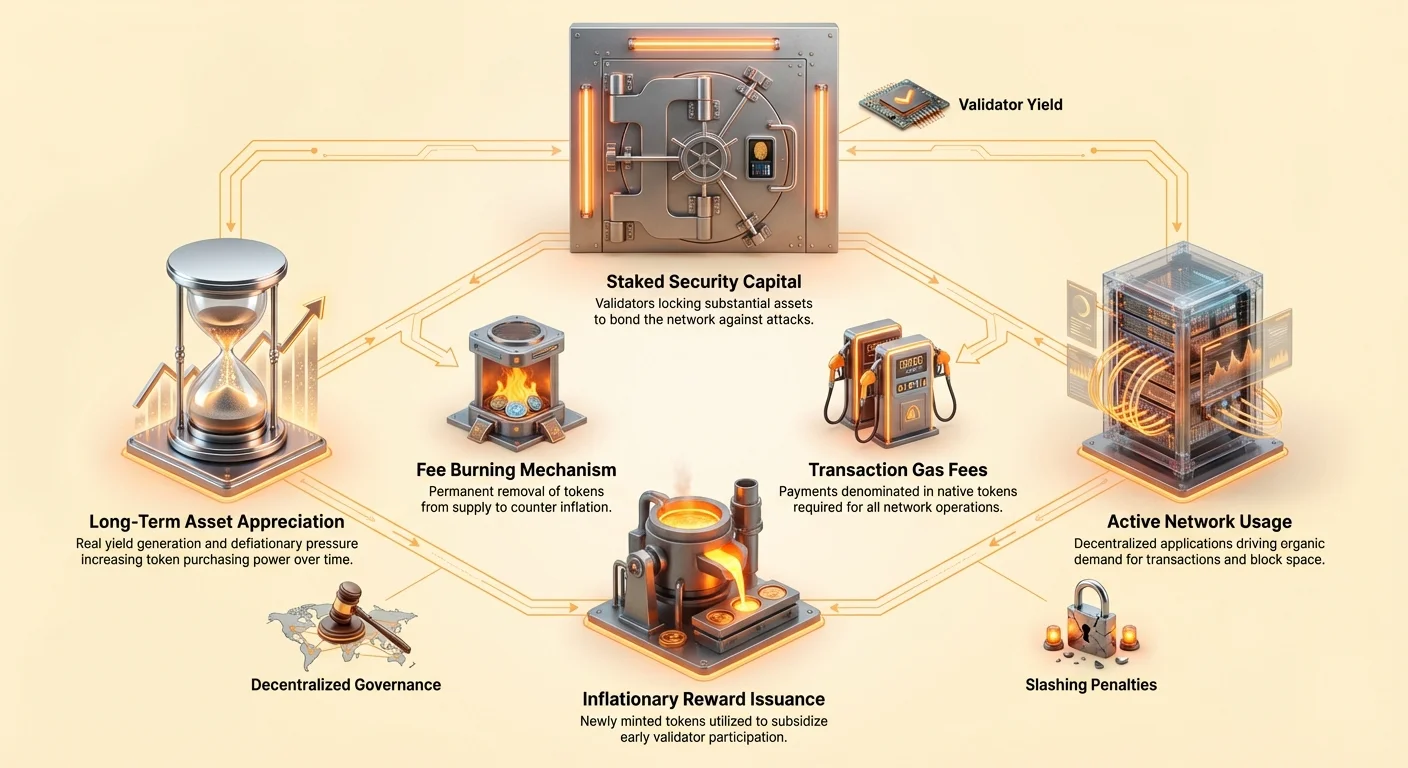
The implementation of mechanisms like Ethereum’s EIP-1559 demonstrated that burning a portion of transaction fees introduces a deflationary counterbalance to new issuance. When network activity is high, the amount of ETH burned can exceed the amount of new ETH minted for staking rewards, leading to a net deflationary supply.
Why this matters for value: If the supply is constantly decreasing, the value of each remaining token should, in theory, increase (assuming demand remains constant or grows). This makes the L1 asset an attractive scarcity-driven store of value, reinforcing its security through economic incentives.
Governance and Treasury Management
The design of an L1 includes the power of governance, which dictates how the asset’s economic future is managed. Governance models typically fall into two categories:
- Direct Staker Governance: Token holders vote on protocol upgrades, reward adjustments, and treasury spending. This grants economic control directly to the stakers, aligning their incentives with the network's long-term health.
- Foundation/Ecosystem Funds: Some L1s allocate a portion of newly minted tokens or transaction fees into a decentralized treasury, managed by the community or a development foundation. This treasury funds development, grants, and ecosystem growth, which indirectly drives utility and demand.
Investors must analyze the quality and transparency of the governance process. A system where rewards or parameters can be changed arbitrarily introduces significant economic risk. A well-managed treasury, however, can be a major driver of sustainable growth.
The Network Adoption Flywheel Effect
The ultimate goal of a successful L1 economic model is to create a positive feedback loop—the "flywheel effect"—that drives sustained value accrual:
- Security and Incentives: Attractive staking yields incentivize more users to lock up tokens, increasing the total staked value and thus the security of the chain.
- Developer Confidence: High security, combined with a robust economic model, attracts developers to build dApps on the L1.
- User Demand: New dApps attract more users, leading to higher transaction volume.
- Utility & Scarcity: Increased transaction volume means more gas fees are paid. If a portion of these fees is burned, the token supply tightens, and the real yield paid to stakers increases.
- Value Accrual: Increased scarcity and higher real yield drive up the token’s price, further reinforcing the value of the security collateral.
This flywheel ensures that network success translates directly into token value, cementing the L1’s long-term economic viability.
Validator Economics and Risk Management
While the general staking reward (APY) is the most visible metric, potential stakers and passive holders must look deeper into the mechanisms that affect profitability and risk.
Penalty Structures (Slashing)
Slashing is the ultimate economic disincentive for poor behavior. While running a validator node provides income, it also carries the risk of loss if the node double-signs transactions or goes offline for extended periods.
For individual investors using staking providers or liquid staking protocols, it is essential to understand:
- Delegation Risk: If you delegate your tokens to a validator, you are subject to the same slashing penalties they incur, even if their operational failure was outside your control.
- Protocol Insurance: Some liquid staking solutions offer built-in insurance or pooling mechanisms to mitigate the small risk of slashing, often for a fee, which reduces your overall effective APY.
The Importance of Staked Ratio
The staked ratio (the percentage of the total circulating supply locked in staking) is a critical economic health indicator.
- Low Staked Ratio: Often indicates that the staking rewards are insufficient to cover risks or opportunity costs, suggesting the network might be underspending on security.
- High Staked Ratio: Suggests high confidence in the network and high security coverage, but it can also lead to diminishing returns, as the fixed pool of rewards is distributed among more participants.
A robust L1 economic model aims to find the "Goldilocks Zone" where rewards are high enough to maintain a healthy security budget (e.g., 60-80% staked ratio) without relying on excessive inflation.
Advanced Risk: The Centralization of Staking
While L1 economic models incentivize participation, a concentration of staked assets within a small number of validators (or centralized staking services/exchanges) poses an economic risk to the network's decentralized promise.
If a majority of staked tokens are controlled by one or two entities, the network becomes susceptible to economic censorship or collusion, potentially undermining the long-term utility and value proposition. Investors committed to self-sovereignty should prioritize decentralized staking solutions and actively participate in governance to maintain the integrity of the economic model.
Conclusion
Understanding Layer 1 economic models means viewing crypto assets not just as tokens, but as shares in a decentralized company whose value is tied to its productivity and resource management.
For new adopters and financial analysts alike, the key takeaway is the distinction between "subsidized yield" (paid for via inflation and the dilution of non-stakers) and "real yield" (paid for via utility, fees, and network activity). Sustainable L1s transition over time from relying on inflationary subsidies to generating security budgets primarily through real yield and deflationary mechanisms, creating a powerful flywheel that drives utility and long-term asset value. By focusing on these core economic principles, investors can better assess risk and identify the platforms built for enduring self-sovereignty in the decentralized future.