
The dream of "free crypto" is one of the most compelling narratives in the digital asset space. This concept, known as an airdrop, involves decentralized projects distributing native tokens to early users, testers, and dedicated community members. These events are often life-changing for recipients, turning a few routine transactions into thousands of dollars overnight.
However, the days of simple, one-click qualification are over. As projects mature and the potential rewards increase, so does the competition. Airdrop hunting has evolved from a passive hobby into a sophisticated, long-term strategic endeavor—often called airdrop farming.
This comprehensive guide is designed to transform you from a casual observer into a methodical airdrop farmer. We will explore the rigorous strategies required to qualify, the techniques protocols use to filter out casual users (Sybil resistance), and crucially, how to efficiently realize profits while navigating the often-complex tax landscape. Your goal is not just to participate, but to implement the best crypto airdrop strategy possible, positioning your wallet for maximum return.
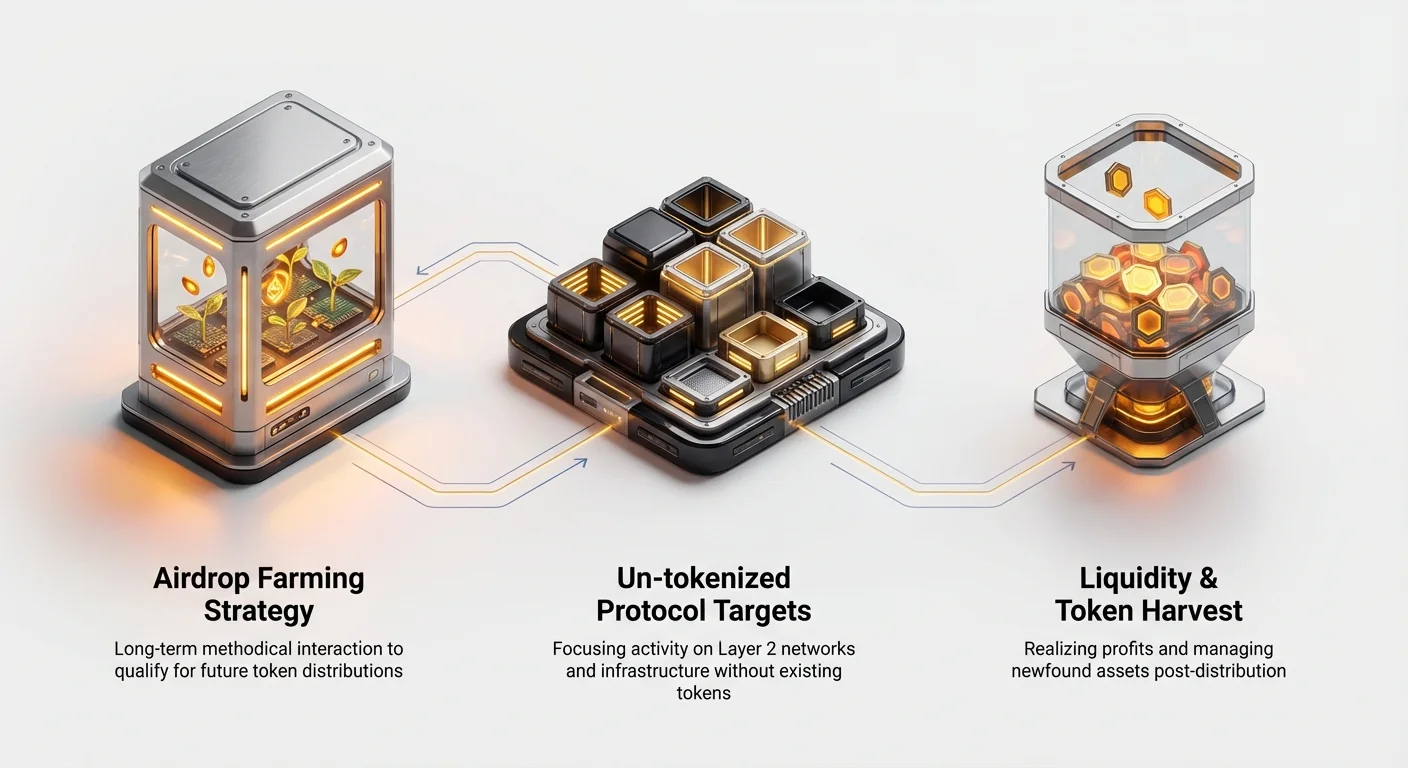
Understanding the Crypto Airdrop Landscape
Before diving into complex strategies, it’s vital to understand the fundamental mechanics: what an airdrop is, why projects execute them, and what types of drops offer the highest rewards.
What is a Retroactive Airdrop?
An airdrop is the distribution of tokens, usually for free, to specific wallet addresses. While some early airdrops were simple marketing tools, the most significant and lucrative events today are retroactive airdrops.
Retroactive airdrops reward users for specific actions performed in the past, often before the project even announced plans for a token. Projects use this method to achieve several critical goals:
- Fair Distribution: Instead of selling tokens to venture capitalists, airdrops ensure the tokens are owned by the actual users who tested and relied on the protocol.
- Decentralization: By distributing governance tokens widely, the project becomes less susceptible to centralization, improving security and credibility.
- Bootstrap Liquidity: Rewarding early adopters encourages them to remain engaged, trade the new token, and provide crucial liquidity to the ecosystem.
The goal of airdrop farming, therefore, is to appear as a genuine, long-term, and valuable early user of a protocol that has not yet released its own token.
The Cost/Benefit Analysis of Farming
While the rewards can be massive, farming requires an upfront investment that novice users often overlook. This investment is not the cost of the token itself, but the associated transaction fees, known as "gas."
When you perform an action (like a swap or a bridge), you pay a fee to the underlying blockchain (e.g., Ethereum or a Layer 2 network). A successful farming strategy requires hundreds of transactions over months.
- Investment: The cumulative gas fees spent across multiple networks and protocols.
- Return: The value of the tokens received, often months or a year later.
- Risk: Spending gas on a project that ultimately decides not to launch a token, or launches a token with zero value.
A strategic farmer approaches this as a venture capital investment: high risk, high reward, requiring calculated budgeting for gas expenses.
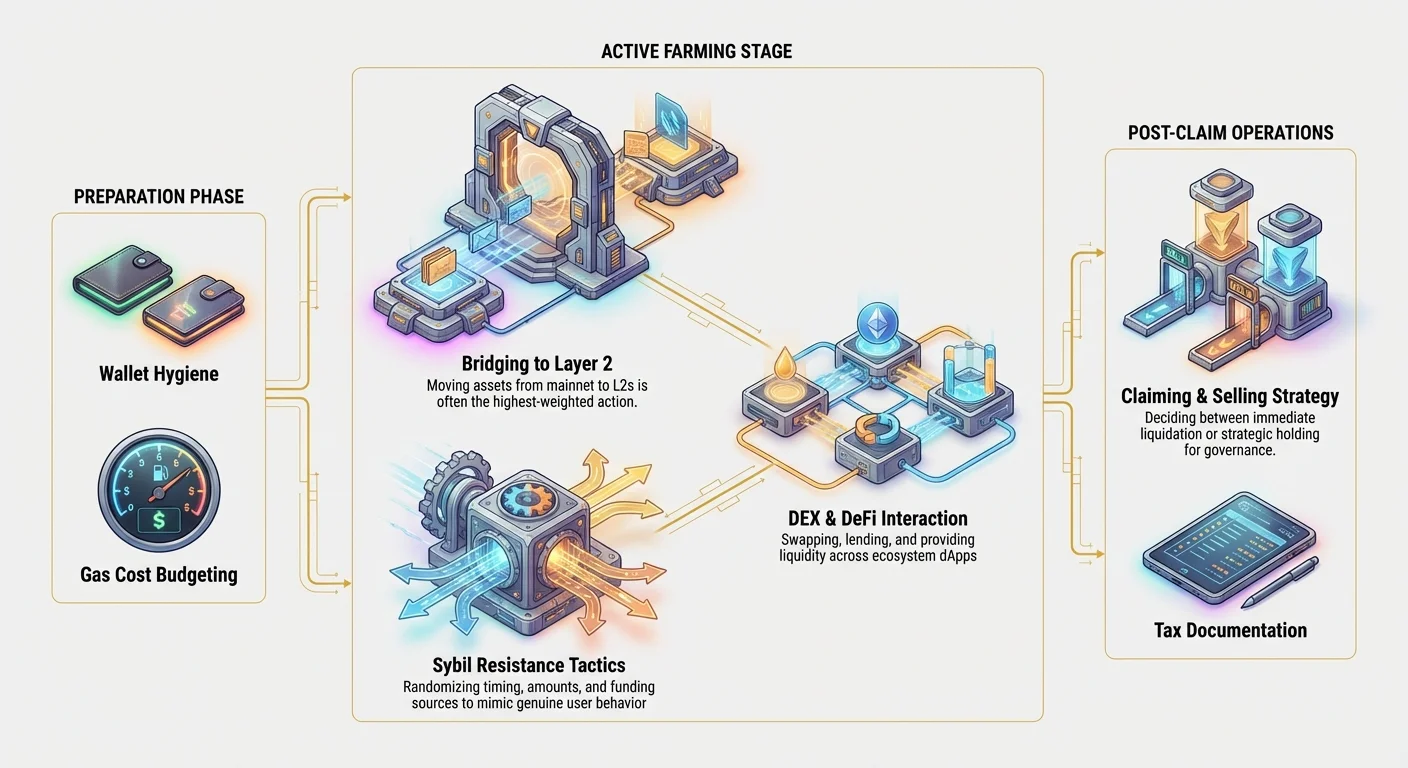
The Strategic Mindset: From Hunter to Farmer
A simple "hunt" involves chasing current announcements. A true "farm" involves identifying fertile ground and nurturing consistent activity over time. This long-term strategic methodology is crucial for maximizing airdrop profits.
Targeting Untokenized Protocols (The "Fertile Fields")
The primary focus of airdrop farming should always be protocols that have confirmed they will launch a token, or those that are highly anticipated to do so but haven't yet.
High-Value Targets Generally Include:
- Major Layer 2 Scaling Solutions (L2s): These are networks built atop Layer 1 chains (like Ethereum) to handle transactions faster and cheaper (e.g., zkSync, Starknet). They require users to validate their technology and build ecosystem momentum. If they haven't launched a token, they are prime candidates.
- Core Infrastructure Providers: Decentralized identity services, cross-chain bridges, or specific wallets that serve as core ecosystem tools.
- Highly Funded DeFi Protocols: Projects that have raised significant capital from major investors (like A16Z or Paradigm) but have not yet implemented a governance token. These firms often push for a "fair launch" via an airdrop to meet regulatory standards and enhance decentralization.
A strategic farmer focuses 80% of their effort on these un-tokenized giants, as these drops historically yield the largest returns.
Defining Quality Activity: Depth Over Breadth
Projects are not interested in rewarding users who performed one $5 swap and disappeared. They are seeking "proof of commitment." This is where the strategy shifts from mere volume to depth and consistency.
Protocols measure a user’s value based on several key metrics:
| Metric | Why it Matters | Farming Strategy |
|---|---|---|
| Transaction Count | Demonstrates multiple interactions with the smart contracts. | Aim for 25–100 transactions per wallet over several months. |
| Transaction Volume | Shows financial commitment and scale of usage (e.g., total dollars moved). | Aim for a cumulative volume over $1,000 or even $10,000 across the protocol. |
| Duration/Age of Wallet | Rewards long-term dedication, penalizes quick "sybils." | Interact in multiple calendar months (e.g., 3-6 months) and across different quarters. |
| Unique Contracts | Proves the user explored the full ecosystem, not just one feature. | Interact with 3–5 different dApps within the target L2/protocol (e.g., swap, lend, bridge, vote). |
| Holding Assets | Showing you are an actual ecosystem participant by holding tokens or providing liquidity. | Leave a small amount of native L2 gas token in the wallet at all times. |
Actionable Tip: To truly appear as a core user, don't just focus on the minimum required activity. If a protocol launches a token, ask yourself: "Would this protocol consider my wallet a valuable part of its community?"
Qualifying for the Drop: Sybil Resistance Mastery
The biggest hurdle in airdrop farming is Sybil resistance. A Sybil attack occurs when one entity controls numerous identities (wallets) to game the system and capture a disproportionate share of the rewards. Projects implement highly sophisticated algorithms to detect and filter out these bad actors.
Mastering Sybil resistance is central to any effective how to qualify for airdrops guide.
The Sybil Filter Checklist
To avoid being flagged as a Sybil entity, your farming activities must mimic genuine user behavior. Projects analyze transaction patterns, timing, and funding sources.
1. Diverse Funding Sources
If Wallet A funds Wallet B, and Wallet B funds Wallet C, and all three perform identical actions one minute apart, they will likely be grouped as a single entity and disqualified.
- Best Practice: Fund each farming wallet from a distinct, established source (e.g., separate transfers from a Tier 1 centralized exchange or separate withdrawal accounts). Never transfer identical, sequential sums between your own farming wallets.
2. Randomizing Activity
Genuine users don’t interact with a protocol at the exact same time every day, nor do they use the exact same input amounts.
- Best Practice: Vary your transaction volumes (e.g., one swap for $100, the next for $387.52). Vary the time of day, and ensure activity is spaced out over days or weeks, not hours.
3. Depth and Layering
Protocols often award bonus points (and thus larger airdrops) for users who engage with multiple tiers of the blockchain stack.
- Best Practice:
- Layer 1 Interaction (L1): Bridge assets from Ethereum L1 to the target L2 (this costs more gas but is a strong signal of commitment).
- Protocol Interaction (L2): Use the DEXs, lending platforms, and NFT marketplaces on the L2.
- Governance Interaction: If the protocol uses a testnet governance system or community forums, participate in discussions or vote on proposals, even if those proposals are non-binding.
Avoiding the Sybil Trap: Identical Twins
The most common mistake new farmers make is creating "identical twin" wallets. These are wallets that are mirror images of one another in terms of assets, timing, and actions.
For example, if you create 10 wallets and have them all:
- Receive $100.00 exactly.
- Swap ETH for USDC.
- Bridge the USDC back to L1.
- Perform these actions within the same hour.
These 10 wallets will almost certainly be flagged and filtered out by clustering algorithms. Always introduce unique variations into the workflow of each wallet.
Operational Strategy: Choosing and Working the Fields
A successful long-term strategy requires identifying the most promising networks and implementing consistent interaction patterns.
The Prime Targets: Layer 2 Solutions and Bridging
Layer 2 (L2) networks are arguably the most fruitful ground for farming today. Since their primary goal is to scale Ethereum, they need robust user activity to prove viability.
Farming the Bridge
The act of moving funds from the main Ethereum chain (L1) to the L2 chain is often the single highest-weighted qualification metric. For guidance on minimizing risk during transfer, reference our guide on using cross-chain bridges safely.
- Official Bridge Preference: Always use the protocol's native or "official" bridge (e.g., the zkSync Bridge, the StarkGate bridge). While third-party bridges are cheaper, using the native bridge demonstrates commitment to the L2’s security model and incurs higher gas costs, which paradoxically signals genuine intent.
- Volume and Frequency: Make several bridge transfers over time. Even small transfers performed months apart signal a high degree of commitment.
Ecosystem Penetration
Once funds are on the L2, spread your activity across various decentralized applications (dApps) within that ecosystem.
- Swapping (DEXs): Use the network’s native decentralized exchanges (DEXs). Perform swaps between different token pairs.
- Lending/Borrowing: Deposit funds into a lending protocol or borrow a small amount of crypto. Lending and borrowing shows maximum utilization of the protocol’s core function.
- Liquidity Provision: Pair two assets and deposit them into a liquidity pool. Even a small position held for a few weeks is a strong signal.
Testnets: Risk-Free Practice with Occasional Rewards
Testnets are copies of the main blockchain used by developers to test new features without risking real money. While most testnets do not lead directly to airdrops, interacting with them can sometimes be a secondary qualification factor.
- Value Proposition: Testnets cost zero real money (gas is free). They allow you to familiarize yourself with complex protocol features (like staking or advanced contract interactions) before you commit real funds on the mainnet.
- Strategy: If a major L2 or DeFi protocol is launching a complex new feature, always try it out on the testnet first. It costs nothing but time and might be used to filter out users who never tested the core product.
Documentation and Tracking (The Farmer’s Ledger)
When juggling multiple wallets across numerous un-tokenized protocols, organization is paramount. You need a system to ensure you hit all necessary Sybil resistance metrics for each field.
Essential Tools:
- Spreadsheet/Database: Track every wallet address, the total funds invested (in gas), the target protocols (zkSync, LayerZero, etc.), and the key metrics achieved (e.g., transactions: 45/50, volume: $2,500/$10,000, months active: 4/6).
- Private Notes: Keep secure notes of which wallet was funded by which source to avoid accidental Sybil linking.
Maximizing Profit and Post-Claim Liquidity
Successfully qualifying for an airdrop is only half the battle. The final, critical phase is realizing the profits efficiently while managing tax obligations and market dynamics. This stage is essential for maximizing airdrop profits.
Liquidity Realization Tactics: When to Sell?
When a major airdrop occurs, the token price often experiences extreme volatility. Millions of dollars worth of new tokens hit the market instantly.
1. The Immediate Dump (The Conservative Approach)
Many successful farmers adopt a risk-averse strategy: sell a significant portion (70% to 100%) immediately upon claim.
- Justification: This guarantees you realize the peak market excitement price and instantly recoup all your gas investments and secure a large profit. Prices often decline sharply shortly after an airdrop as euphoria wears off and other farmers dump their tokens.
2. The Strategic Hold (The Governance Approach)
Hold 20% to 30% of the token to participate in governance (voting) and potentially secure future, subsequent airdrops. Some projects reward users who hold their governance token or use it for staking.
- Rationale: Holding governance tokens cements your role as a true community member. This can sometimes qualify you for "Season 2" or subsequent airdrops from partners within that ecosystem.
3. Staking and Yield Opportunities
If the new token is integrated into DeFi platforms immediately, you can use it to earn yield rather than selling.
- Action: Deposit the token into a liquidity pool (LP) or stake it natively. This keeps the asset generating passive income, converting it into a productive asset rather than idle speculation. (Refer to the related page on DeFi Payment Rails: Web3 Wallets vs. Centralized Crypto Cards for more on yield generation).
Navigating Crypto Tax Implications
For many, the tax implications of receiving a substantial airdrop are the most complex part of the process. Airdrops are generally considered taxable events upon receipt.
Determining Taxable Income
In most jurisdictions, when you receive a crypto airdrop, it is treated as ordinary income based on its fair market value (FMV) at the precise moment it lands in your wallet.
Example:
- You receive 1,000 tokens at 10:00 AM UTC.
- At 10:00 AM UTC, the token's market price is $5.00.
- Taxable Income = 1,000 tokens * $5.00/token = $5,000.
You must pay income tax on that $5,000, even if you sell the tokens later when the price is lower.
Establishing Your Cost Basis
The FMV at the time of receipt becomes your cost basis for that crypto.
- If you sell the token for more than the FMV, the difference is a capital gain.
- If you sell the token for less than the FMV, the difference is a capital loss.
Actionable Tax Strategy:
- Immediate Documentation: As soon as you claim an airdrop, record the exact date, time, and the price of the token from a reliable index (like CoinMarketCap or CoinGecko) or the price on the DEX where you sell it.
- Tax Software Integration: Use specialized crypto tax software (see Crypto Tax Software Integration Guide) that automatically links to your DeFi wallet. This software can calculate the FMV at the time of transfer, simplifying reporting significantly.
- Hold Cash for Taxes: If you receive a significant airdrop, ensure you liquidate enough of the token, or have enough fiat cash reserves, to cover the resulting tax bill, especially if you plan to hold the tokens long-term.
Essential Safety and Risk Management
The high stakes of airdrop farming attract numerous scams and exploits. Proper wallet hygiene and risk mitigation are non-negotiable for protecting your assets.
Wallet Hygiene: Separating Your Risk
Never use your main, secure wallet (where you store long-term holdings) for active airdrop farming.
The "Burner" Wallet System
You should operate at least two distinct levels of wallets:
- Cold/Vault Wallet: Your primary storage for large, long-term holdings. This wallet should never interact with smart contracts, sign transactions on new websites, or be used for daily activity.
- Farming/Hot Wallet (The Burner): A dedicated wallet used solely for interacting with un-tokenized protocols, testnets, and making swaps. These are the wallets that face potential risk from faulty contracts or malicious websites.
By compartmentalizing risk, if a farming wallet is ever compromised due to a malicious contract signing, your main crypto wealth remains safe.
Guarding Against Airdrop Scams
Scammers actively target airdrop hunters with fraudulent links and fake token announcements.
Never Share Your Seed Phrase
No legitimate crypto project will ever ask you for your seed phrase (recovery words). Any pop-up, email, or message demanding these words is a scam.
Verify Claim Links
Always treat airdrop claim announcements with suspicion.
- Official Sources Only: Only use links provided directly by the project’s official Twitter/X account or Discord channel.
- Check URLs: Check the URL for the claiming website meticulously. Scammers often use subtle typos (e.g., "zksync.io" vs. "zksynk.io").
- Revoke Approvals: After interacting with a new DeFi protocol, use a token approval checker tool (like Etherscan’s approval tracker or a similar tool on your L2) to revoke permissions for that contract, preventing the contract from draining your funds later if it turns out to be malicious.
The Gas Cost Sinkhole
The most common financial risk in airdrop farming is the gas sinkhole: spending more money on transaction fees than the final airdrop is worth.
- Mitigation Strategy: Only interact during low gas periods (often late nights or early mornings UTC). Use L2 networks, as their fees are dramatically lower than Ethereum L1. Regularly assess your total gas spend against the estimated minimum value of a hypothetical airdrop. If you have spent $300 in gas farming a project whose comparable airdrop was only $200, you have made a loss. Be ruthless in cutting off unprofitable lines of activity.
Conclusion: Commitment, Calculation, and Consistency
Airdrop farming is fundamentally a test of patience, discipline, and strategic calculation. It is not about discovering a hidden secret; it is about publicly demonstrating undeniable value to a decentralized project over a long period.
By focusing on deep, unique interactions instead of mirroring behavior across multiple wallets, adhering to strict Sybil resistance protocols, and consistently interacting with high-potential, un-tokenized infrastructure, you position yourself as a priority target for future token distributions.
The best crypto airdrop strategy integrates financial prudence (budgeting gas), operational security (wallet separation), and post-claim wisdom (tax and liquidity management). Adopt the mindset of a long-term strategic farmer, and you will be well-prepared to harvest the next generation of decentralized rewards.