
The role of the corporate treasurer is fundamentally about managing liquidity, mitigating risk, and preserving capital. Traditionally, this involves utilizing highly liquid, low-risk instruments such as commercial paper, short-term government bonds, or bank deposits. However, in the rapidly evolving digital economy, corporations are increasingly dealing with funds that exist entirely outside of traditional banking rails.
Stablecoins—cryptocurrencies pegged to fiat currencies, typically the US Dollar—have emerged as a foundational technology for managing digital capital. They offer the speed and global reach of blockchain technology while maintaining the stability and reliability of a national currency. For institutional investors, venture funds, and especially corporate treasuries, stablecoins are no longer a novelty; they are a strategic asset class demanding a formalized strategy.
This guide explores how corporate treasurers can integrate stablecoins into their capital preservation and liquidity management frameworks, focusing on strategic adoption, risk mitigation, and advanced strategies like the use of tokenized treasury bills. Understanding these tools is essential for any CFO or treasurer seeking to optimize operational efficiency and enhance capital deployment in the 21st century.
The Corporate Case for Stablecoin Adoption
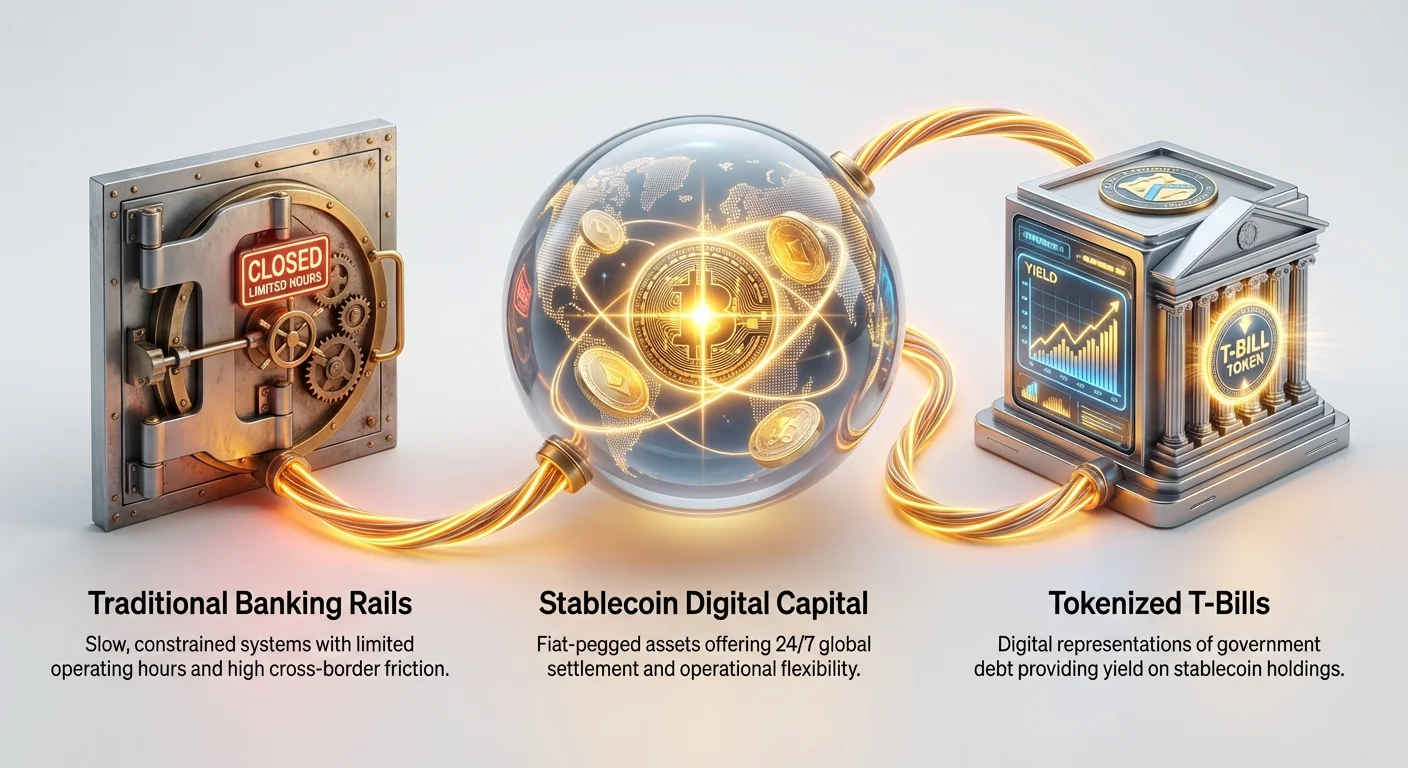
While individual investors might view stablecoins primarily as a trading pair, corporate treasuries view them as a technological upgrade to cash. The primary motivation for adopting a stablecoin corporate treasury strategy is the dramatic improvement in speed, global reach, and operational flexibility compared to traditional banking systems.
Enhanced Operational Liquidity and Settlement Speed
Traditional banking relies on systems like ACH, SWIFT, or wire transfers, which are often slow (taking hours or days), operate only during business hours, and incur substantial cross-border fees. This lack of continuous operation creates friction for businesses requiring immediate liquidity or global settlement.
Stablecoins, residing on public blockchains (like Ethereum or Solana), operate 24 hours a day, 7 days a week, 365 days a year. Transactions typically finalize in minutes, regardless of the sender’s or receiver’s geographic location.
Use Case Example: A multinational corporation manages vendors across Asia and Europe. Using traditional banking, issuing payments might involve high foreign exchange conversion fees and delays due to differing time zones and bank cut-off times. By holding a portion of their operational float in a stablecoin like USDC, the company can settle payments instantly and globally, improving supply chain stability and reducing costs. This continuous availability is key to effective stablecoin liquidity management.
Mitigating Foreign Exchange Risk for Digital Native Businesses
Corporations generating revenue primarily in cryptocurrencies (e.g., crypto exchanges, mining operations, Web3 companies) face constant price volatility. If a company holds its revenue in Bitcoin or Ethereum, the value of its treasury assets could fluctuate wildly before the funds are needed for operational expenses (payroll, rent, taxes).
By converting volatile crypto revenue directly into audited, fiat-backed stablecoins, the corporate treasury effectively "locks in" the USD value immediately upon receipt. This drastically reduces exposure to market volatility, simplifies financial reporting, and improves budgeting accuracy. Stablecoins act as the essential bridge between the decentralized economy and traditional USD-based accounting necessities.
Foundational Stablecoin Corporate Treasury Strategy
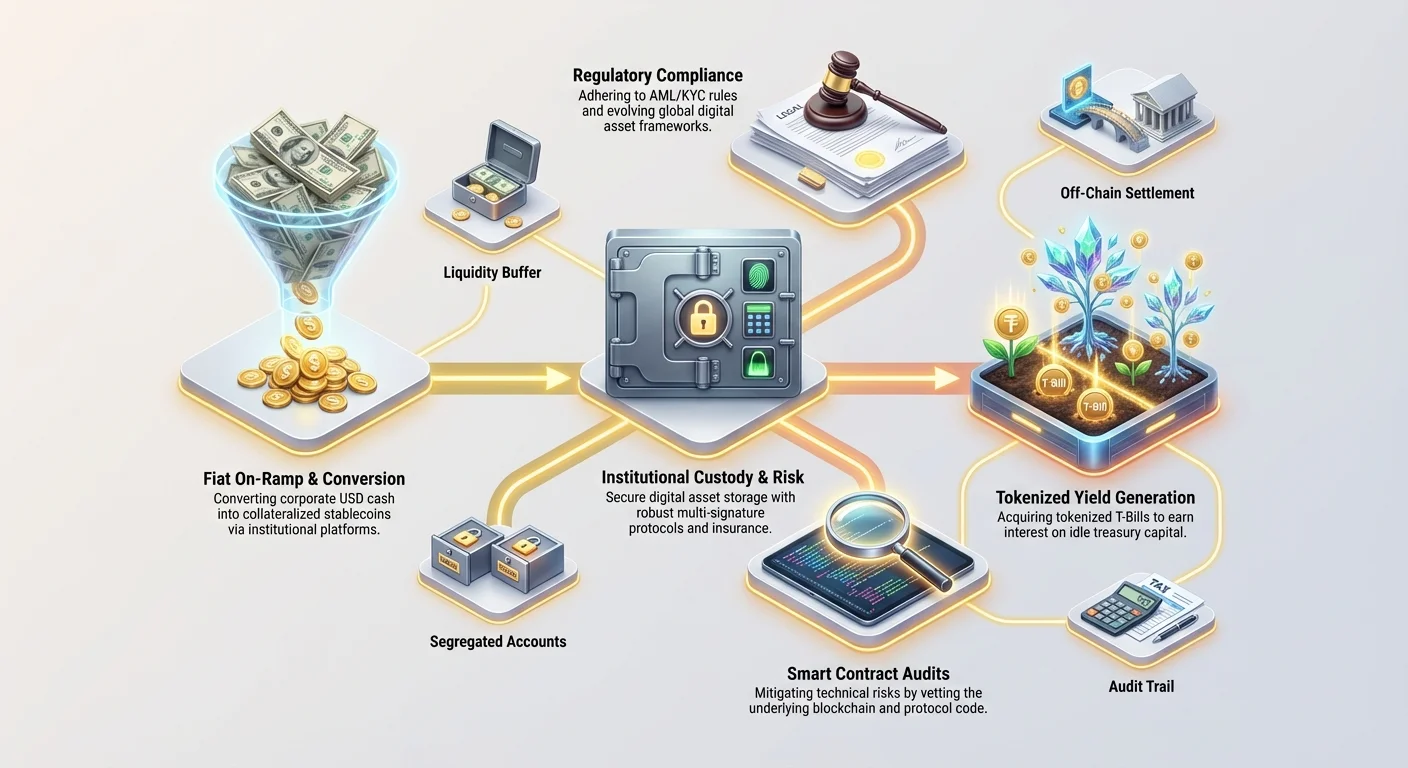
Adopting stablecoins requires more than simply buying them; it necessitates building robust operational infrastructure, defining risk tolerances, and establishing clear accounting policies.
Primary Use Case: Operational Float Management
For most corporations, the first step into stablecoin adoption involves using them to manage the operational float—the short-term cash needed to cover daily expenses. This strategy ensures rapid deployment of funds without the risk associated with investing in volatile assets.
Key Components of Operational Float Management:
- Selection of Stablecoin: Corporate treasuries must exclusively select fully collateralized stablecoins that undergo rigorous, regular audits by reputable firms. These stablecoins must demonstrate a 1:1 backing of fiat currency or high-quality cash equivalents (like short-term US Treasury bills). The current market leaders often utilized by institutions are USD Coin (USDC) and Tether (USDT), though due diligence on the issuer's collateral structure is paramount.
- Custodian Selection: Unlike cash held in a bank, stablecoins require specialized digital asset custody solutions. Corporations must choose institutional-grade custodians that provide robust security, multi-signature authentication, and insurance coverage. The custodian selection is a key component of the overall stablecoin corporate treasury strategy.
- Segregation of Funds: Similar to traditional treasury management, stablecoin holdings must be segregated from operational exchange accounts (used for trading or fee payments). Treasury funds should reside in secure, cold-storage custody accounts, only accessible via stringent internal control mechanisms.
Risk Management Frameworks for Stablecoin Holdings
While stablecoins aim for stability, they introduce new forms of risk that treasurers must address:
- Counterparty Risk (Issuer Risk): The risk that the stablecoin issuer fails to maintain the 1:1 peg or becomes insolvent. Mitigation involves continuous monitoring of issuer attestations, regulatory compliance, and collateral transparency reports.
- Smart Contract Risk (Technical Risk): The risk that the underlying blockchain or the stablecoin's smart contract is exploited, leading to loss of funds. Mitigation requires choosing stablecoins deployed on battle-tested, highly secured blockchains and ensuring custody solutions utilize audited smart contracts.
- Custody Risk: The risk associated with the security provider or the loss of private keys. Mitigation involves selecting regulated custodians that adhere to institutional security standards (often including third-party insurance policies and SOC 2 audits).
Actionable Tip: Any stablecoin holding should be treated as an off-balance sheet asset until converted into fiat cash. Establish clear policies dictating maximum stablecoin allocation and the internal approval process required for converting fiat into stablecoins and vice versa.
Advanced Capital Preservation: Introducing Tokenized Treasury Bills
One of the primary historical drawbacks of holding stablecoins as a treasury asset was the lack of yield. Traditional bank deposits or short-term T-Bills provide a modest return, whereas holding stablecoins passively results in zero interest.
The advent of tokenized real-world assets (RWAs), particularly tokenized US Treasury Bills, is solving this problem and is rapidly becoming a cornerstone of sophisticated stablecoin corporate treasury strategy.
What are Tokenized Real-World Assets (RWAs)?
RWAs are digital tokens that represent ownership of tangible, non-crypto assets residing outside the blockchain, such as real estate, fine art, or, most importantly for treasuries, government debt (T-Bills).
Tokenization bridges the traditional financial world with decentralized finance (DeFi). In the case of tokenized T-Bills, a regulated financial entity (often a broker-dealer or registered investment advisor) purchases actual US Treasury securities and then issues a corresponding digital token on a blockchain. This token represents a fractional or whole ownership claim to the yielding T-Bill.
Mechanics of Tokenized T-Bills for Treasury Management
For a corporate treasury, tokenized T-Bills offer the perfect synthesis of safety and efficiency:
- Safety and Compliance: The underlying asset is highly regulated, low-risk US government debt—the global benchmark for safety.
- Yield Generation: Instead of holding zero-yield stablecoins, the treasury holds tokens that automatically accrue interest based on the underlying T-Bill yield.
- 24/7 Liquidity: Unlike traditional bond purchases, which may involve lengthy settlement periods, the tokenized asset can be traded or redeemed instantly on-chain, offering superior stablecoin liquidity management.
Process Flow for a Corporate Treasury:
- Conversion: Convert USD cash into a collateralized stablecoin (e.g., USDC).
- Acquisition: Use the stablecoin to purchase the tokenized T-Bill from an approved institutional platform.
- Accrual: The treasury holds the token, which automatically generates the yield.
- Redemption: When capital is needed, the tokenized T-Bill can be instantly sold for the stablecoin, which can then be used for payments or redeemed for fiat USD.
This approach allows corporate capital to remain highly secure (backed by government debt) while being digitally native and immediately deployable, a significant leap forward for stablecoin corporate treasury strategy.
Accounting and Regulatory Considerations for RWAs
The introduction of tokenized assets complicates standard accounting procedures. Treasurers must work closely with specialized crypto accounting firms to ensure compliance with standards like GAAP or IFRS.
- Classification: How should the tokenized T-Bill be classified on the balance sheet? Since the token represents ownership of a debt instrument, it may be treated as a security or an investment, requiring mark-to-market valuations and specific disclosure notes, differing significantly from the standard accounting treatment of utility tokens.
- Fair Value Determination: The fair value of the token is directly linked to the fair value of the underlying T-Bill, which provides a transparent valuation method, unlike some complex DeFi protocols.
- Tax Implications: The yield generated by the tokenized asset is typically treated as interest income, subject to standard corporate income tax. However, the exact tax jurisdiction and timing of taxable events (e.g., when yield is earned vs. when the token is redeemed) must be carefully analyzed for global digital asset tax compliance.
Navigating Regulatory and Compliance Risks
Corporate adoption of stablecoins is governed by a stringent mandate for regulatory compliance. CFOs and treasurers must prioritize compliance equally alongside technological benefits. The regulatory landscape for stablecoins is diverse and constantly shifting, impacting everything from custody requirements to anti-money laundering (AML) protocols.
Understanding Stablecoin Regulatory Risk
Stablecoins face two major categories of regulatory risk:
1. Issuer Regulation
The oversight of the stablecoin issuer dictates the safety of the asset. The goal of regulators globally (such as the US Treasury, the EU’s MiCA framework, or MAS in Singapore) is to ensure that stablecoins operate transparently and maintain verifiable collateral.
- Mitigation Strategy: Treasuries should prioritize stablecoin issuers that are registered financial institutions (e.g., trust companies or banks) and comply with existing banking regulations. Avoid decentralized or algorithmic stablecoins, as their regulatory status is highly uncertain and they carry inherent systemic risks.
2. Jurisdictional Risk
The classification and use of stablecoins vary widely by country. A stablecoin strategy effective in Singapore might be non-compliant in Germany or the US.
- Mitigation Strategy: For multinational corporations, the stablecoin strategy must align with the most stringent jurisdiction where the funds are held or where the corporation is domiciled. This often requires utilizing sophisticated software tools to track jurisdictional flows and generate necessary reporting for global digital asset tax compliance.
Due Diligence on Stablecoin Providers and Custodians
Due diligence for stablecoins goes beyond simply checking the website. It involves institutional-grade vetting processes focused on compliance infrastructure.
| Due Diligence Area | Key Questions for the Treasury Team |
|---|---|
| Collateral Structure | Are reserves held in segregated, audited accounts? What is the specific composition (Cash, T-Bills, Commercial Paper)? How often are third-party attestations released? |
| Regulatory Status | Is the issuer licensed as a Money Transmitter, Trust Company, or Bank? Which jurisdiction provides the primary oversight? |
| Custody & Security | Is the custodian regulated (e.g., state-chartered)? Does the custodian offer insurance? What are the physical and digital security protocols for private key management? |
| AML/KYC Capabilities | Can the stablecoin issuer or platform comply with institutional Know Your Customer (KYC) requirements? Can they freeze or blacklist addresses if legally required (essential for institutional compliance)? |
Integrating Crypto Tax Reporting and Accounting
For corporations, every transaction—from converting fiat to stablecoins, earning yield on tokenized assets, to paying vendors—generates a taxable event or requires specific accounting treatment.
To maintain compliance and prepare for audits, corporate treasuries must utilize dedicated crypto tax platforms. These platforms automate the aggregation of transaction data from custodians and exchanges, calculating capital gains/losses (if trading occurs) and tracking income from yielding assets.
Best Practice: Establish an internal mandate that ensures all digital asset activities are seamlessly integrated into the existing Enterprise Resource Planning (ERP) system for accurate, timely financial reporting, adhering to established crypto accounting standards. This proactive integration prevents end-of-year compliance bottlenecks and ensures audit readiness.
Stablecoin Liquidity Management Best Practices
Effective stablecoin liquidity management ensures that digital assets are secure, optimally deployed, and available instantly when needed, without compromising regulatory boundaries.
Dynamic Rebalancing and Allocation
Just as traditional treasury management involves dynamically shifting funds between low-interest accounts and higher-yield instruments, stablecoin management requires continuous optimization.
Treasurers should define "liquidity tiers" for their stablecoin holdings:
- Tier 1: Ultra-Liquid Operational Float (0-30 days): Stablecoins held directly in institutional custody, earmarked for immediate payroll or vendor payments. These funds remain non-yielding but instantly accessible.
- Tier 2: Short-Term Yield (30-90 days): Funds allocated to tokenized T-Bills or highly liquid, regulated stablecoin pools designed to capture short-term yield. These offer rapid redemption (minutes/hours).
- Tier 3: Strategic Reserve (90+ days): Longer-duration stablecoin investments, potentially in slightly higher-yielding, institutionally managed DeFi strategies (if regulatory comfort allows), or longer-dated tokenized bonds.
Regularly review and rebalance these tiers based on projected operational needs, market interest rates, and changes in regulatory comfort.
The Importance of Off-Chain Settlement for On-Chain Assets
While stablecoins are on-chain, corporate treasuries often require the ability to settle transactions with traditional banks and fiat currency seamlessly.
Institutional stablecoin providers and specialized banking partners offer "on-ramps" and "off-ramps" that guarantee rapid conversion between fiat USD and stablecoins (e.g., 1:1 redemption services). Treasury strategy must include agreements with these partners to ensure reliable, high-volume fiat access. This ensures that the digital capital is never trapped on the blockchain and can be converted into traditional liquidity on demand.
Conclusion
The integration of stablecoins, particularly through advanced methods like tokenized treasury bills, marks a fundamental transformation in corporate treasury management. Stablecoins provide corporations with unprecedented speed and global reach, drastically improving operational liquidity and minimizing volatility risk for digital native income streams.
While the technical complexity and regulatory ambiguity remain higher than traditional finance, the competitive advantages of an effective stablecoin corporate treasury strategy are becoming undeniable. Success hinges not just on technological adoption, but on rigorous due diligence, the implementation of robust internal controls, and proactive engagement with specialized accounting and compliance partners. For the modern CFO, mastering stablecoin capital preservation is now essential for optimizing capital efficiency and securing the business in the decentralized future.