
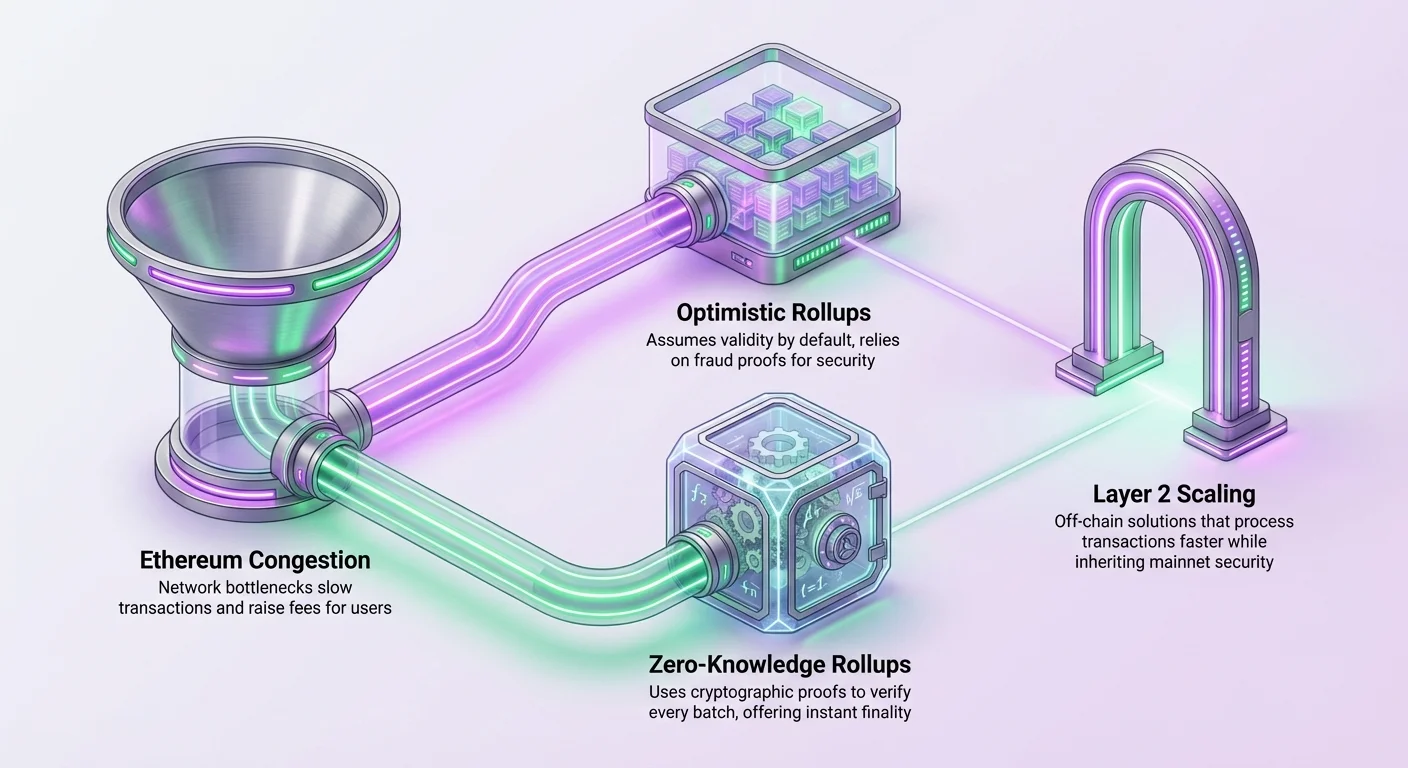
Ethereum has established itself as the dominant smart contract blockchain, serving as the foundation for a vast ecosystem of decentralized finance applications, non-fungible tokens, and enterprise solutions. However, this popularity has come at a steep cost. The network was not originally architected for the mass adoption it currently experiences, leading to periods of extreme congestion.
When thousands of users attempt to transact simultaneously, the network becomes a bottleneck. Transaction speeds slow to a crawl, and gas fees skyrocket, making the chain prohibitively expensive for everyday users. This scalability trilemma has necessitated the development of Layer 2 solutions, which operate on top of Ethereum to process transactions more efficiently while inheriting its security.
The race to scale Ethereum has created a competitive landscape known as the "scaling wars." While there are various approaches to this problem, two dominant technologies have emerged as the frontrunners: Optimistic Rollups and Zero-Knowledge (ZK) Rollups. Each offers a distinct path toward a faster, cheaper blockchain future, but they differ fundamentally in their security models, economic structures, and technical architecture.
Understanding the nuances between these two approaches is essential for developers building the next generation of applications and investors navigating the evolving market. The choice between an Optimistic or ZK-based solution impacts everything from transaction finality speeds to the cost of executing a trade on a decentralized exchange.
The Evolution of Ethereum Scaling
To appreciate the current battle between rollup technologies, one must look at the history of scaling solutions. Early attempts to solve congestion focused on sidechains. A prominent example is the original Matic Network, which launched in 2017. Founded by a team of developers including Jaynti Kanani and Sandeep Nailwal, it sought to solve scalability through a Proof-of-Stake sidechain.
These sidechains run parallel to the main Ethereum network. They process transactions independently and periodically checkpoint data back to the main chain. This method proved effective for reducing costs, allowing projects to grow without the burden of mainnet gas fees. In 2021, the Matic Network rebranded to Polygon, signaling a shift from a single sidechain solution to a broader ecosystem of scaling infrastructure.
Despite the success of sidechains, they often require users to trust a separate set of validators. This trade-off sparked the development of "rollups," a more secure form of Layer 2 scaling. Rollups execute transactions off-chain but post the transaction data directly to Ethereum. This ensures that the security of the execution is tied more closely to the main Ethereum network rather than a completely independent set of validators.
As the industry matured, the distinction between different rollup types became the focal point of development. The ecosystem split into two primary camps. One camp favored the immediate implementation and compatibility of Optimistic Rollups, while the other focused on the mathematical purity and long-term potential of Zero-Knowledge technology.
The Optimistic Approach to Scaling
Optimistic Rollups serve as one of the primary pillars of the current Layer 2 landscape. Major networks like Arbitrum One and Optimism utilize this technology to handle billions of dollars in transaction volume. The core philosophy behind this technology is implied by its name: it is "optimistic."
How Optimistic Execution Works
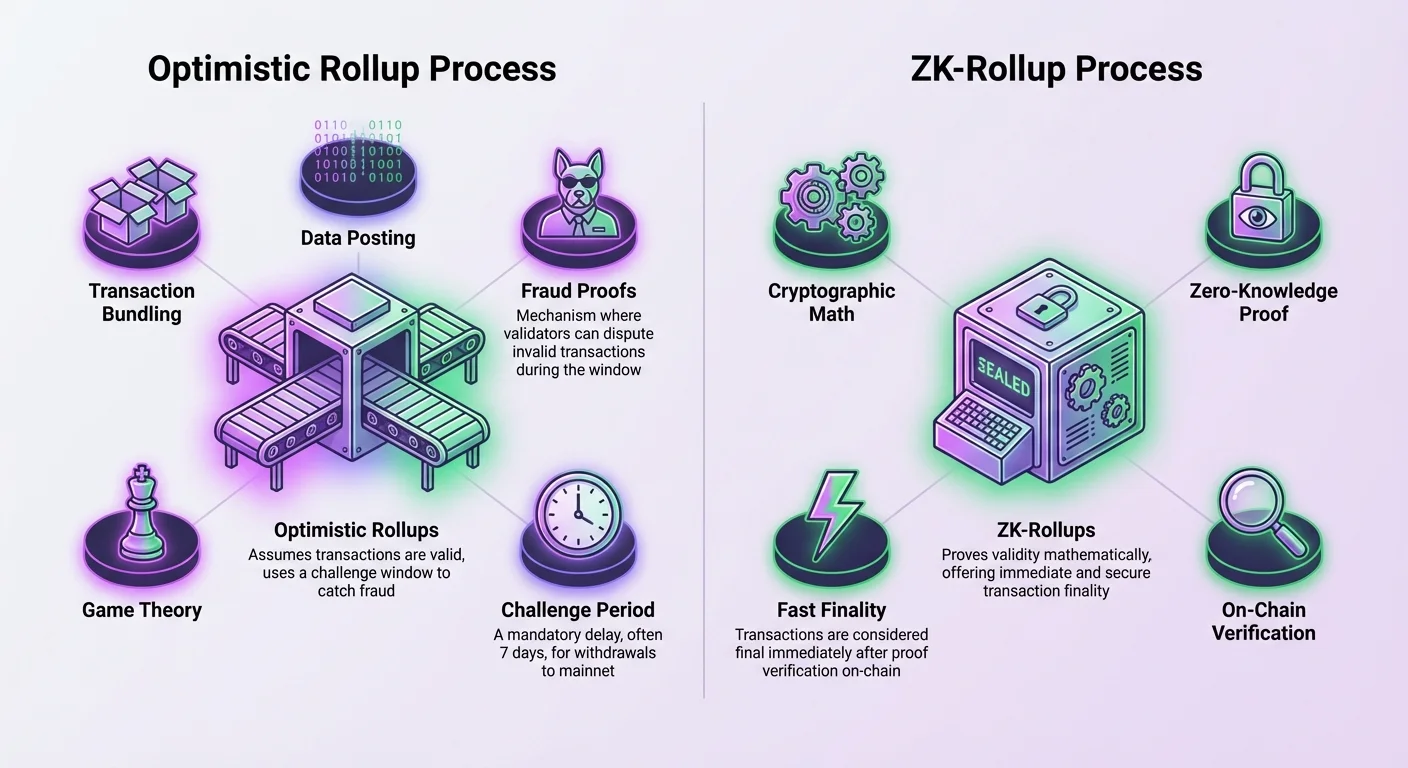
When a transaction occurs on an Optimistic Rollup, the network assumes the transaction is valid by default. It does not immediately verify every single signature or contract interaction on the main Ethereum chain. Instead, it bundles or "rolls up" thousands of transactions and posts the data to Ethereum, assuming everything is correct.
This assumption allows for significant speed improvements. Because the network is not bogged down by heavy computation for every transaction, it can process activity much faster than the mainnet. However, this system requires a safeguard to prevent bad actors from processing invalid transactions.
The Fraud Proof Mechanism
To ensure security, Optimistic Rollups rely on a mechanism called "fraud proofs." After a batch of transactions is posted, there is a specific time window known as the challenge period. During this time, validators or "watchers" can dispute a transaction if they believe it is fraudulent.
If a challenge is issued, the network executes a fraud proof to verify the computation. If the transaction is indeed invalid, it is rolled back, and the malicious actor is penalized. This system creates a game-theoretic security model where honest participants are incentivized to keep the network secure.
The Withdrawal Delay
The reliance on a challenge period introduces a specific limitation regarding transaction finality. Source data indicates that Optimistic Rollups typically have a slower finality speed compared to their ZK counterparts. Specifically, moving funds from an Optimistic Layer 2 back to the Ethereum mainnet usually triggers a 7-day exit period.
This delay is necessary to allow sufficient time for any potential fraud proofs to be submitted. While users can transact instantly within the Layer 2 network, the bridge back to Layer 1 is constrained by this security window. This creates capital inefficiency for users who need to move liquidity quickly between chains without using third-party bridging services that charge extra fees for faster liquidity.
Zero-Knowledge Rollups: The Math-Based Alternative
Zero-Knowledge (ZK) Rollups represent a fundamentally different approach to scaling. Instead of assuming transactions are valid until proven otherwise, ZK-rollups prove that every transaction is valid before it is finalized on Ethereum. This is achieved through complex cryptographic proofs known as validity proofs.
Platforms like the Polygon zkEVM leverage this technology to mirror the Ethereum Virtual Machine environment while providing enhanced performance. In this model, the Layer 2 operator generates a cryptographic proof—a "Zero-Knowledge" proof—that certifies the correctness of a batch of transactions. This proof is then submitted to the Ethereum mainnet.
Because the Ethereum network can verify this proof quickly, there is no need for a 7-day challenge period. Once the proof is verified on-chain, the transactions are considered final. This results in what is described as "Fast" finality in technical comparisons.
The mathematical certainty provided by validity proofs eliminates the need for game theory or active watchers to prevent fraud. The network cannot accept an invalid transaction because a valid cryptographic proof cannot be generated for it. This offers a higher level of inherent security, as the system relies on cryptography rather than economic incentives.
However, generating these proofs is computationally intensive. It requires significant processing power, which historically made ZK-rollups harder to develop and more expensive to operate than Optimistic solutions. Recent advancements, however, have significantly narrowed this gap, making ZK technology more accessible and cost-effective.
Comparative Analysis: Economics and Performance
When evaluating these two technologies side-by-side, several key differentiators emerge regarding user experience and economic structure. The choice of technology directly influences the fees users pay and the speed at which they can settle assets.
| Feature | ZK-Rollups (e.g., Polygon zkEVM) | Optimistic Rollups (e.g., Arbitrum, Optimism) |
|---|---|---|
| Validation | Validity Proofs (Math-based) | Fraud Proofs (Game theory-based) |
| Finality | Fast (Minutes) | Slow (7-day exit window) |
| Gas Fees | Low | Moderate |
As indicated in the table above, ZK-rollups generally offer a "Low" fee structure compared to the "Moderate" fees found on Optimistic networks. While Optimistic rollups are significantly cheaper than Ethereum mainnet, they still require posting substantial data on-chain to allow for potential challenges.
ZK-rollups can theoretically compress data more efficiently because they only need to prove the final state changes, not necessarily all the witness data required for a fraud proof. This efficiency creates an economic advantage for high-frequency trading and complex DeFi applications where margins are thin.
Furthermore, the finality speed is a critical economic factor. For institutional investors or arbitrage traders, having capital locked for seven days in an Optimistic bridge is a significant opportunity cost. ZK-rollups allow for greater capital efficiency, as funds can move between layers rapidly without compromising security.
The Role of Tokens in the Scaling Ecosystem
The economics of scaling extend beyond gas fees to the design of the network's native tokens. Different platforms have adopted varying strategies for their assets, ranging from simple governance rights to complex utility models known as "hyperproductive" tokens.
Optimistic Rollup projects, such as Arbitrum and Optimism, utilize their native tokens (ARB and OP) primarily for governance. Holders of these tokens can vote on protocol upgrades, treasury allocation, and other administrative decisions. However, the tokens are not typically used to pay for gas on the network—users still pay in ETH—nor are they required for the validation process in the same way a Proof-of-Stake asset is.
In contrast, the Polygon ecosystem is transitioning toward a more utility-driven model with the introduction of the POL token. Under the Polygon 2.0 roadmap, POL is designed to be a "hyperproductive" asset. Unlike traditional staking tokens that secure a single chain, POL allows holders to validate multiple chains simultaneously within the ecosystem.
This restaking capability means that a single unit of capital (POL) can earn rewards from multiple sources by providing security to various ZK-powered Layer 2s. Validators can perform multiple roles, such as sequencing transactions or generating zero-knowledge proofs. This model aims to align the economic incentives of the token holders with the security and operation of the entire network infrastructure.
Infrastructure for Developers: CDK and Unichain
The scaling wars are not just about general-purpose blockchains; they are also about providing tools for developers to launch their own chains. As applications grow, they often require dedicated infrastructure to handle their specific throughput needs without competing for block space with other applications.
Polygon has introduced the Chain Development Kit (CDK), a toolkit that allows developers to launch customizable Layer 2 chains powered by zero-knowledge technology. These chains are interoperable, meaning they can share liquidity and communicate seamlessly. This enables big brands and enterprises to build "app-chains" that leverage ZK security while maintaining control over their specific parameters.
A prime example of an application transitioning to its own infrastructure is Uniswap. Originally launching on Ethereum, Uniswap expanded to support major Layer 2s including Arbitrum, Optimism, and Polygon. However, with the announcement of Uniswap v4 and Unichain, the protocol is taking a step further.
Unichain is a unified, cross-chain protocol designed to streamline the trading experience. By mid-2025, reports indicated that Unichain accounted for roughly 75% of all Uniswap v4 transaction volume. This specialized chain boasts 1-second block times and roughly 95% lower gas fees than Ethereum Layer 1.
It also utilizes a Trusted Execution Environment (TEE) based block builder to protect against Miner Extractable Value (MEV), a common issue in decentralized trading. This shift demonstrates how top-tier applications are moving toward dedicated scaling environments that offer specific optimizations—like faster block times and MEV protection—that general-purpose rollups might not prioritize.
The Role of Oracles in Layer 2 Security
Regardless of whether a network uses Optimistic or ZK technology, the security and functionality of the decentralized finance (DeFi) ecosystem rely heavily on accurate data. Smart contracts operating on Layer 2s face the same "Oracle Problem" as those on the mainnet: they cannot inherently access off-chain data.
Chainlink serves as a critical infrastructure piece in this puzzle. It acts as a decentralized oracle network that bridges the gap between smart contracts and real-world data. For a lending protocol on an L2 to function, it needs accurate price feeds to determine collateralization ratios. If the price data is manipulated or delayed, the protocol can suffer catastrophic bad debt.
In the context of scaling, oracles must operate at the speed of the Layer 2. If a ZK-rollup processes transactions in milliseconds, the oracle providing price updates must also refresh at a comparable rate to prevent arbitrageurs from exploiting stale prices.
Chainlink solves this by having independent nodes retrieve data from off-chain sources, aggregate it, and deliver it to the smart contract. This ensures that whether a user is trading on an Optimistic Rollup like Arbitrum or a ZK-rollup like Polygon zkEVM, the financial data underpinning the transaction is secure and reliable.
Polygon 2.0 and the "Value Layer"
The ultimate goal of these scaling technologies is to create what is often described as the "Value Layer of the Internet." Polygon 2.0 represents a strategic pivot to realize this vision through an interconnected network of ZK-powered chains.
This roadmap moves away from isolated chains and toward an aggregated ecosystem. By using ZK proofs, different chains can verify the state of one another instantly. This solves the fragmentation issue that currently plagues the Layer 2 landscape, where liquidity is fractured across different optimistic rollups that cannot easily communicate.
The vision includes migrating the original Polygon Proof-of-Stake chain to a zkEVM validium, fully integrating it into this new architecture. This upgrade aims to combine the low fees of the legacy PoS chain with the high security guarantees of ZK technology.
Furthermore, the architecture is designed to support "infinite scalability" by allowing an unlimited number of chains to connect to the same liquidity pool. This would allow value to flow freely, securely, and equitably across the globe, removing the technical barriers that currently limit blockchain adoption to niche use cases.
Conclusion
The scaling wars between ZK and Optimistic rollups are driving rapid innovation in the blockchain sector. Optimistic rollups, with their moderate fees and game-theoretic security, currently command a significant portion of the market and offer a familiar environment for developers. However, their reliance on fraud proofs and the 7-day withdrawal window presents inherent limitations regarding capital efficiency and finality speed.
Zero-Knowledge rollups, championed by ecosystems like Polygon, offer a compelling alternative with mathematical security, fast finality, and potentially lower fees. With the advent of the POL token and the Polygon 2.0 vision, the industry is seeing a shift toward interconnected ZK chains that promise to solve liquidity fragmentation. As infrastructure improves and major applications like Uniswap deploy their own specialized chains, the line between these technologies will define the future efficiency of the decentralized economy.
Zero-Knowledge rollups offer superior long-term potential for speed and security compared to the slower settlement times of optimistic models.