
Bitcoin often carries the reputation of being "digital gold"—a stable, decentralized store of value with a simple architecture designed for security above all else. While this foundational philosophy has secured the network for over a decade, it has also led to the common misconception that Bitcoin’s base layer (Layer 1, or L1) is incapable of complex programming.
In contrast, other blockchains, most famously Ethereum, were specifically designed with rich smart contract capabilities, enabling a vast landscape of decentralized finance (DeFi) applications. For many years, if you wanted to build anything beyond a simple transaction, you had to look elsewhere, understanding Ethereum's Role in DeFi.
However, the Bitcoin development roadmap is steadily progressing. Through careful, measured upgrades—known as soft forks—the network is gaining new tools that dramatically enhance its capabilities without sacrificing its core security principles. Among the most anticipated of these tools is the reintroduction of a simple-sounding, yet profoundly powerful, command called OP_CAT. This small addition is poised to unlock the true potential of Bitcoin DeFi, fundamentally changing how users manage security, engage in self-custody, and execute sophisticated financial agreements directly on the most secure blockchain in the world.
The Building Blocks: Understanding Bitcoin Script
To appreciate the significance of a single opcode like OP_CAT, we first need to understand the underlying programming language of the Bitcoin blockchain: Bitcoin Script.
Bitcoin transactions are not simply debits and credits; they are small programs. When you send Bitcoin, you are creating an output that is locked by a script. To spend that Bitcoin, the recipient must provide a signature and data that satisfies the script's conditions.
What Are Opcodes?
Opcodes (short for "Operation Codes") are the basic commands used in Bitcoin Script. Think of them as verbs in the Bitcoin programming language. Every opcode instructs the computer to perform a specific action, such as checking a signature, hashing data, or requiring a time lock.
Because Bitcoin Script operates using a simple "stack-based" system—where instructions manipulate data organized in a list (the stack)—it is intentionally limited. This limitation, often described as Bitcoin being "not Turing complete" (meaning it cannot execute endless loops or handle complex state changes like Ethereum), is a deliberate design choice emphasizing security, predictability, and auditability. If a script is simple, it is easier to prove its safety.
Why Is Bitcoin Script Limited?
Satoshi Nakamoto built Bitcoin to be minimal and robust. The initial set of opcodes included many basic arithmetic and logic functions, but several were quickly disabled early in the network’s history due to potential security vulnerabilities, mainly related to denial-of-service attacks or buffer overflows (where data could be forced to exceed designated memory limits).
The philosophy is simple: if a feature doesn't absolutely need to be on the base layer, it shouldn't be. This constraint has forced developers to be highly creative, leading to improvements like SegWit, Taproot and MAST, and now, the push for more specific, simple opcodes to solve specific, high-value problems.
What is OP_CAT and Why Is It Necessary?
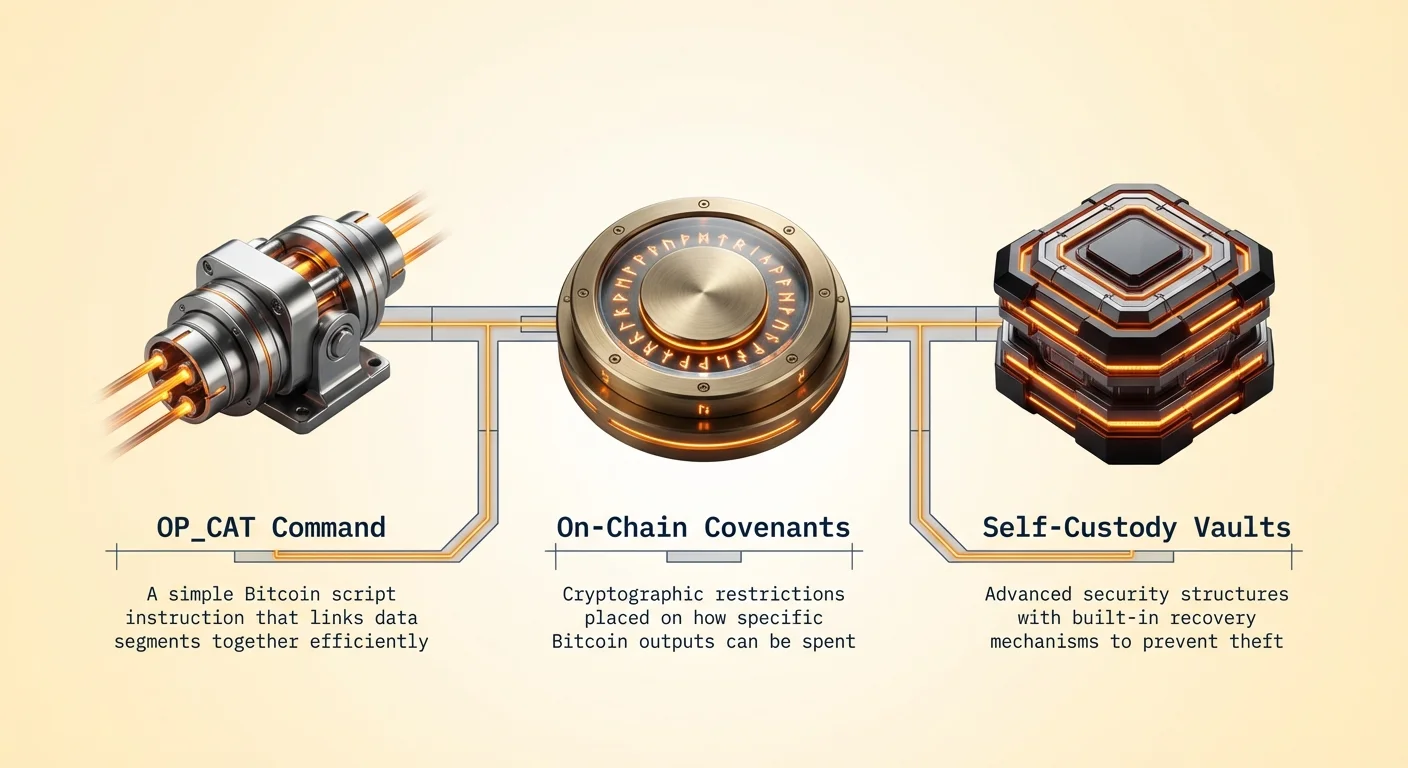
OP_CAT stands for "Concatenation." In computer science, concatenation simply means linking things end-to-end—like joining two strings of text or two segments of data.
The Functionality of Concatenation
If you have Data Piece A (e.g., "Hello") and Data Piece B (e.g., "World"), OP_CAT combines them into one single piece: "HelloWorld."
While this sounds basic, its absence severely restricts Bitcoin’s ability to handle dynamic data and construct complex proofs directly on L1. Before Taproot, developers often used inefficient workarounds or relied entirely on Layer 2 solutions for complex logic.
How OP_CAT works in Bitcoin Script:
- It takes two items from the top of the stack (data supplied by the user trying to spend the Bitcoin).
- It joins them together into a single, larger piece of data.
- The resulting data is put back onto the stack for further script validation.
This seemingly minor ability allows users to commit to pieces of data implicitly within a script and then reveal them later, proving that the revealed data matches the original commitment. This is the cryptographic key that unlocks highly efficient, complex contract structures.
The Historical Context and Modern Safety
OP_CAT was actually part of the original Bitcoin code but was disabled in 2010 due to concerns over denial-of-service attacks related to how much data could be generated and stored on the stack, potentially overwhelming node memory.
Today, thanks to significant advancements—particularly the implementation of Taproot and its accompanying scripting improvements, along with modern transaction limits and memory handling—these historical security risks have been mitigated. The modern proposal for OP_CAT includes strict limits on the size of the data segments, ensuring the network remains stable and secure while gaining powerful new functionality.
Unlocking Bitcoin Covenants and Vaults
The primary, most compelling application enabled by OP_CAT is the robust, trustless implementation of covenants—specifically, the creation of secure, self-custody Bitcoin vaults, a critical topic addressed in our ultimate guide to hardware wallets.
Defining Bitcoin Covenants
A covenant is a restriction placed on how an unspent transaction output (UTXO) can be spent in the future.
In standard Bitcoin transactions, the only restriction is who can spend the funds (i.e., possessing the correct private key and signature). Once the funds are unlocked, they can be sent to any address chosen by the spender.
A covenant adds another layer: it restricts where the funds can go. For example, a covenant might state: "These funds can only be spent if they are sent to Address X, OR if they are first locked for 90 days."
This concept is foundational to creating complex financial instruments and, critically, vastly improved self-custody solutions.
The Ultimate Self-Custody: Bitcoin Vaults
For self-custody adopters, the greatest risk isn't network failure; it's key loss, key theft, or human error. A Bitcoin Vault addresses the "all-or-nothing" problem of private key security, which necessitates careful Inheritance & Disaster Planning.
How OP_CAT enables a Vault structure:
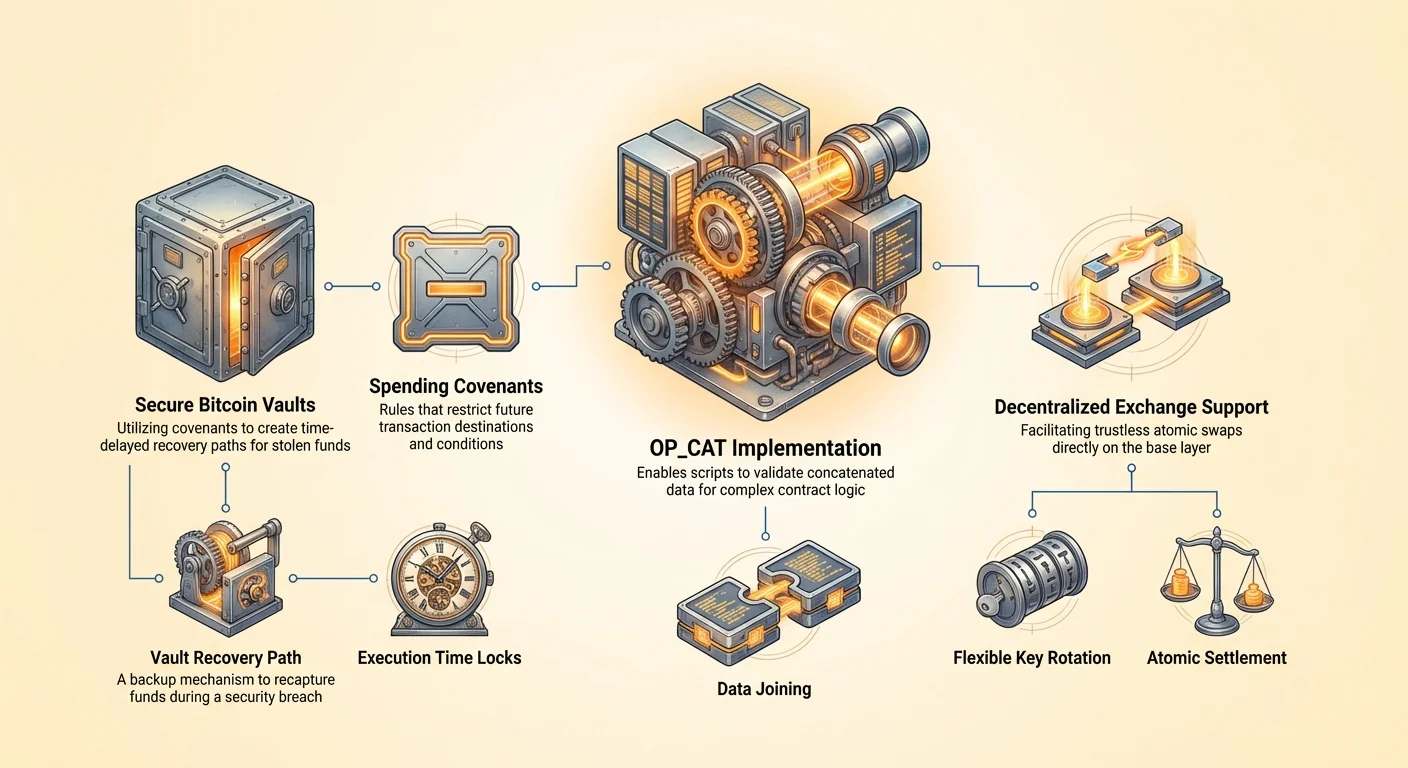
Without OP_CAT, creating an efficient vault is extremely cumbersome or impossible because the script needs a way to commit to the structure of the future spending transaction. OP_CAT allows the script to efficiently combine pieces of transaction data (like the destination address and the time lock parameters) and check them against the conditions required to spend the money.
Practical Example: The Time-Locked Recovery Vault
Imagine a high-net-worth individual storing large amounts of Bitcoin. They implement a vault with the following two spending paths (covenants):
- Standard Path (Quick Access): Spendable immediately using a hot key (Key A) for daily use or fast access.
- Recovery Path (Security Path): If Key A is compromised or lost, a backup key (Key B, stored offline/geographically separate) can initiate a recovery sequence.
The crucial part is the structure of the Recovery Path:
- Compromise Detected: If Key A is stolen, the attacker can try to spend the funds. Since the vault uses covenants enabled by
OP_CAT, the standard path might mandate that any spending transaction must first send the funds to a secondary, temporary address and lock them for seven days. - The Freeze Period: When the attacker attempts to spend, the funds are automatically frozen for seven days.
- User Intervention: During the seven-day period, the user, noticing the unauthorized transaction, can use their offline Key B to execute a parallel script (the "Recapture Script"). This script proves ownership and redirects the funds to a completely new, secure address before the attacker's seven-day lock expires.
In essence, OP_CAT allows the script to efficiently compare the attacker's attempted spending transaction against the predefined safety rules, creating a built-in alarm system and delay mechanism directly on the Bitcoin L1. This is arguably the single largest security upgrade for self-custody since the inception of Bitcoin.
Advanced DeFi Applications Enabled by OP_CAT
While vaults provide security, the ability to create covenants also fundamentally expands the range of financial contracts that can be securely executed without relying on trusted third parties. This is the essence of Bitcoin DeFi.
Trustless Decentralized Exchanges (DEXs)
Existing decentralized exchanges for Bitcoin often rely on Layer 2 solutions or complex cross-chain bridges, which introduce varying degrees of trust assumption or complexity. With powerful covenants, we can build Atomic Swap mechanisms directly on L1 with unprecedented efficiency.
- Conditional Trading Logic:
OP_CATallows the construction of scripts that efficiently check if a trading partner has adhered to the contract terms (e.g., verifying that the correct amount of the counter-asset has been paid). - Order Book Commitments: Users can cryptographically commit to their trading parameters (price, quantity) in a compact manner. The concatenation ability simplifies the verification process, making it cheaper and faster to settle complex trades directly on the base layer, ensuring atomicity—meaning the trade either happens completely, or it doesn't happen at all.
Sophisticated Multi-Signature Schemes
Multi-signature (multi-sig) setups are already a bedrock of security in the crypto world, requiring multiple keys to authorize a transaction (e.g., 3-of-5 keys required). However, traditional multi-sig is rigid.
OP_CAT enables Covenanted Multi-Sig, which introduces flexibility and responsiveness:
- Key Rotation: A company using a 3-of-5 multi-sig can covenant that any spending transaction must also be used to update the multi-sig structure itself, facilitating seamless, scheduled key rotation without requiring an expensive, separate transaction every time.
- Emergency Authorization: Logic can be scripted to define a "break glass" scenario where, if 48 hours pass without a 3-of-5 approval, a special 2-of-5 committee (e.g., the CEO and Legal Counsel) can spend the funds to a predefined safe address. This adds crucial operational flexibility and mitigates the risk of funds being permanently locked due to lost keys.
Enhanced Time Locks and Escrow Services
Time locks are currently used to restrict spending until a certain block height or time has passed. OP_CAT allows time locks to become conditional and composite, creating secure escrow and conditional payment systems without relying on external oracles or human intermediaries.
- Escrow: Funds can be locked, governed by a script that mandates that the funds can only be released if two out of three parties (Buyer, Seller, Arbitrator) sign off. With
OP_CAT, the script can efficiently verify the output address and structure based on which combination of signatures is provided, making the contract robust and trustless.
The Architectural Trade-Offs of L1 Complexity
If a simple opcode can unlock such powerful functionality, why hasn't Bitcoin just added a full virtual machine like Ethereum? The answer lies in the fundamental trade-off between security, decentralization, and functionality, often called the core tradeoffs of distributed ledger technology.
Security vs. Performance
Every operation executed on Bitcoin’s Layer 1 must be validated by every full node in the network forever. This universal validation is what guarantees Bitcoin’s security and finality.
- The L1 Imperative: Functionality on L1 must be extremely limited to maintain low validation costs and ensure the network remains decentralized (meaning anyone can run a node). If L1 transactions become too complex or large, it prices out casual node operators, leading to centralization.
- The Power of Simplicity:
OP_CATis an ideal solution because it is simple, predictable, and only slightly increases the maximum data size for scripts. It delivers high-value functionality (covenants) with minimal architectural risk.
Layer 1 vs. Layer 2 Philosophy
The debate over Bitcoin’s smart contract capabilities often centers on the purpose of each layer.
| Feature | Layer 1 (Base Chain) | Layer 2 (e.g., Lightning, Sidechains) |
|---|---|---|
| Primary Focus | Security, final settlement, high-value storage. | Speed, volume, cheap transactions, complex interaction. |
| Trust Model | Trustless (secured by proof-of-work). | Rely on L1 for settlement, may require slight trust assumptions. |
| Role of OP_CAT | Provides secure primitives (vaults, covenants) that Layer 2 solutions can rely on for ultimate safety and recovery. | Uses the security guarantees of the underlying L1. |
Bitcoin developers generally adhere to the "Layer 1 is for security, Layer 2 is for scaling" mantra. OP_CAT strengthens L1’s role as the security layer by allowing users to protect their large, long-term holdings with unbreakable, covenant-based security structures.
Why Not Just Use Ethereum or Solana?
For developers focused purely on functionality, using a highly programmable chain is easier. However, the unique value proposition of building DeFi on Bitcoin L1 (or L2s secured by L1 covenants) is the immense security budget and proven decentralization of the Bitcoin network.
When dealing with billions of dollars worth of value, marginal security improvements are worth the architectural constraints. Covenants enabled by OP_CAT allow Bitcoin to maintain its status as the most secure digital asset while enabling essential features that mitigate catastrophic failure modes (like key loss).
The Path Forward: Soft Forks and Community Consensus
Upgrading Bitcoin requires a soft fork—a backward-compatible change that requires high consensus from the community, miners, and node operators. This deliberate slowness is a feature, not a bug, protecting the network from hasty or poorly tested changes, a process documented in the history of Bitcoin's network splits.
The process of advocating for and eventually activating opcodes like OP_CAT involves intense scrutiny to ensure the upgrade is minimal, safe, and truly valuable. The successful implementation of Taproot (which provided the framework needed for more complex scripting) set the stage. The addition of OP_CAT and potentially other specialized opcodes would represent the next major evolution in Bitcoin’s utility.
The focus remains on simplicity: the goal isn't to replicate Ethereum’s environment but to provide simple cryptographic tools that enable specific, high-security applications that are essential for large-scale adoption, self-sovereignty, and the long-term health of the ecosystem.
Actionable Tips for Monitoring Bitcoin Development
- Study Taproot and MAST: The foundation for modern Bitcoin scripting is Taproot and the Merklized Abstract Syntax Tree (MAST). Understanding how these innovations bundle complex spending conditions helps clarify why
OP_CATis now necessary and safe. - Follow BIPs (Bitcoin Improvement Proposals): Technical changes like
OP_CATare formalized in BIPs. Reading the relevant BIPs provides deep insight into the security analysis and trade-offs considered by the core developers. - Focus on Use Cases, Not Code: As a newcomer, focus on the practical benefits. Ask: Does this upgrade make self-custody safer (vaults)? Does it make transactions more private (Taproot)? Does it simplify scaling (L2s)?
Conclusion
The evolution of Bitcoin is a marathon, not a sprint. The potential reintroduction of OP_CAT is not about turning Bitcoin into a faster, flashier chain; it’s about strategically equipping the most secure blockchain with the tools necessary for genuine self-sovereignty.
By enabling the efficient construction of powerful covenants, OP_CAT promises to transform large-scale custody through the implementation of highly secure Bitcoin vaults, while also opening the door to complex, trustless DeFi primitives like decentralized exchanges and flexible multi-signature governance.
This simple concatenation command is a major step toward a future where sophisticated financial contracts can be executed with the finality and security only Bitcoin’s Layer 1 can provide, solidifying its place not just as digital gold, but as the foundational security layer for the entire decentralized economy.