
Entering the world of Decentralized Finance (DeFi) offers exciting opportunities for passive income, especially through providing liquidity to decentralized exchanges (DEXs). This process, known as Liquidity Provision (LPing), involves depositing two assets into a pool to facilitate trading and earn a share of the transaction fees.
However, the LP game is not without its risks. The single largest, most complex, and often misunderstood risk facing liquidity providers is Impermanent Loss (IL). IL is the temporary loss of funds that occurs when the price ratio of the two assets in a pool changes after you deposit them. It’s the cost of being an automated market maker (AMM) rather than simply holding your assets.
For beginners, understanding Impermanent Loss is non-negotiable. This phenomenon can easily erase the trading fees you earn, resulting in lower returns than if you had simply held the underlying tokens in your wallet. This guide moves beyond the simple definition, offering a deep dive into how IL is calculated, the common scenarios where it strikes, and, most importantly, the practical strategies you can use to mitigate or entirely protect yourself from this fundamental DeFi risk.
The Core Concept: What Exactly is Impermanent Loss? (The Mechanics)
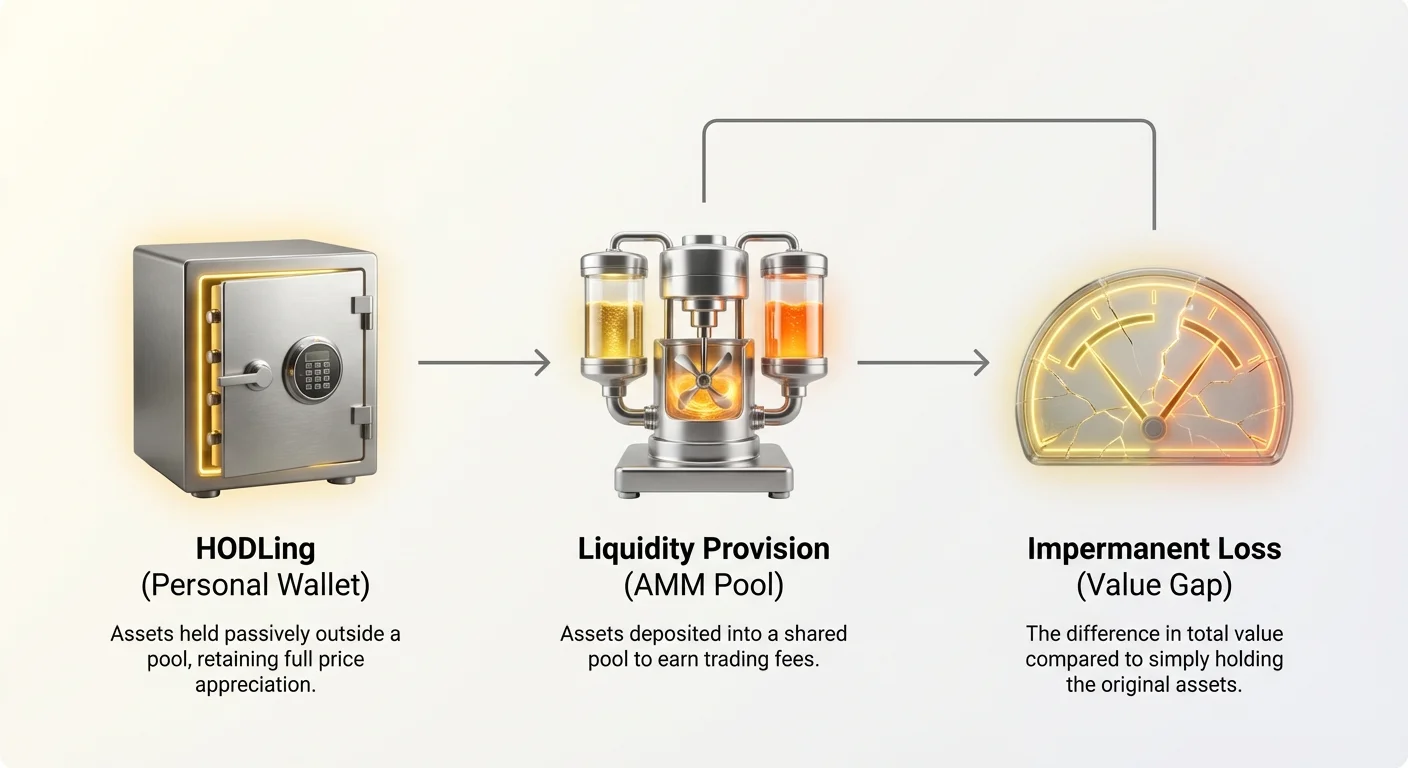
Impermanent Loss is defined as the difference in value between holding your tokens outside an LP pool (HODLing) and staking them inside an LP pool. This loss occurs because the Automated Market Maker (AMM) mechanism forces you to maintain an equal dollar value of both assets in the pool, regardless of how their individual prices move.
The Automated Market Maker (AMM) System
To understand IL, you must first understand the fundamental principle of the AMM, the engine that powers DEXs like Uniswap or SushiSwap. Most standard AMM pools use a simple constant product formula: $x * y = k$.
- $x$ = Quantity of Asset A
- $y$ = Quantity of Asset B
- $k$ = Constant value (the total liquidity in the pool)
This formula ensures that there is always liquidity available, automatically adjusting the price ratio based on supply and demand. When a trader buys Asset A using Asset B, the supply of A decreases and the supply of B increases, driving the price of A up and the price of B down within that pool.
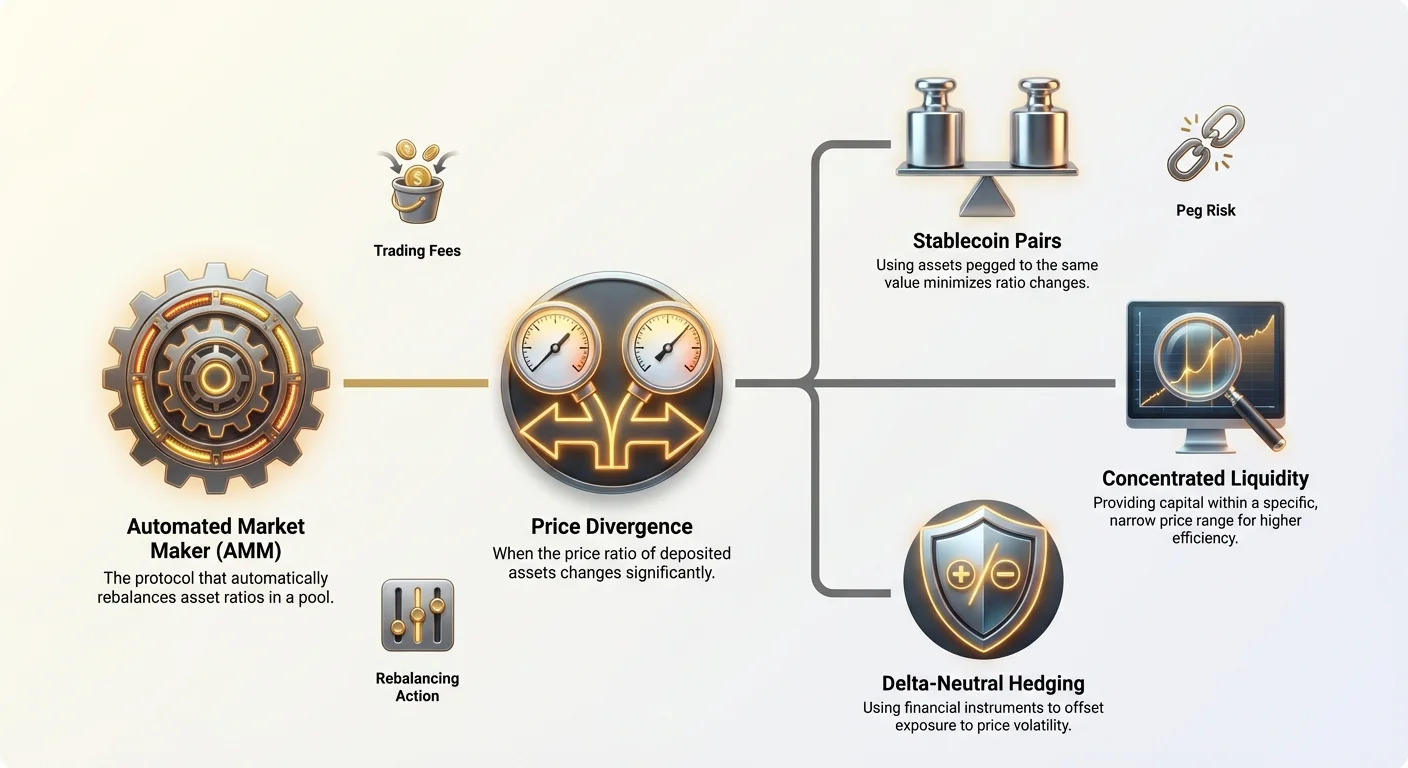
When the price of Asset A changes significantly on external markets (like centralized exchanges), arbitrage traders jump in. They buy the cheaper asset from the AMM pool until the pool’s internal price matches the external market price. This rebalancing is what causes IL. You are, essentially, forced to sell the token that has gone up in price and acquire more of the token that has gone down.
The Crucial Definition of "Impermanent"
The term "impermanent" is often misleading for new users. The loss is called impermanent because it only remains theoretical (unrealized) while your tokens are still deposited in the pool.
- If the prices of the two assets return to the exact ratio they were when you deposited them, the IL disappears. You would withdraw the same number of tokens you initially deposited (plus earned fees).
- The moment you withdraw your liquidity from the pool, the loss becomes permanent. If the price ratio has not recovered, the difference in token value compared to simply HODLing is locked in.
The longer a divergence in price ratio lasts, the more likely the IL is to outweigh the trading fees you have earned.
The Simple (Non-Calculated) Scenario Example
Let’s illustrate the mechanism of IL with a simple scenario involving an ETH/USDC pool:
- Initial Deposit: You deposit 1 ETH (worth $3,000) and 3,000 USDC. Total pool value: $6,000.
- Price Movement: ETH suddenly doubles in price to $6,000.
- Arbitrage & Rebalancing: Arbitrage traders buy ETH from the pool using USDC until the pool’s value rebalances, maintaining the $x*y=k$ constant. The pool now contains a new token distribution, perhaps 0.707 ETH and 4,242 USDC.
- Withdrawal: You withdraw your liquidity. Your withdrawn portfolio is worth: (0.707 ETH * $6,000) + 4,242 USDC = $4,242 + $4,242 = $8,484.
The Comparison (Impermanent Loss Calculation):
| Scenario | Value |
|---|---|
| HODLing (Original Assets) | 1 ETH ($6,000) + 3,000 USDC ($3,000) = $9,000 |
| LP Position (New Assets) | $8,484 |
| Impermanent Loss | $9,000 - $8,484 = $516 |
In this scenario, you lost $516 compared to simply holding the assets. This loss is the price you pay for providing liquidity and facilitating trades.
Calculating the Cost: Quantifying Impermanent Loss
While the scenario above provides the concept, liquidity providers need a quick way to estimate IL before entering a pool. The loss is directly correlated to the magnitude of the price change between the two tokens.
The Basic Formula Explained
The standard calculation for Impermanent Loss is based on the ratio of the final price () to the initial price (). The resulting percentage tells you how much value is lost relative to holding.
Where .
For practical purposes, crypto users rely on a handy chart that quickly maps price changes to the percentage of IL:
| Price Change Ratio | IL Percentage Loss |
|---|---|
| 1.25x (25% increase/decrease in one asset) | 0.6% IL |
| 1.5x (50% increase/decrease) | 2.0% IL |
| 2x (100% increase/decrease—doubling/halving) | 5.7% IL |
| 3x (200% increase/decrease) | 13.4% IL |
| 4x (300% increase/decrease) | 20.0% IL |
| 5x (400% increase/decrease) | 25.5% IL |
Key Insight: Impermanent loss is symmetrical. A 50% price increase of one token causes the exact same IL (2.0%) as a 50% price decrease. Only the price ratio matters.
Practical Example Calculation
Let’s apply the 2x ratio from the chart above (5.7% IL) to our $6,000 initial deposit example:
- Initial Investment: $6,000 (1 ETH and 3,000 USDC).
- Price Change: ETH price doubles (2x ratio).
- Expected HODL Value: $9,000.
- IL Calculation: $9,000 * 5.7% = $513$. (This is very close to our $516$ scenario result, with the minor difference due to rounding in the chart).
This calculation confirms that for any pool where one token doubles in price relative to the other, you automatically surrender 5.7% of the total potential dollar value.
The Role of Trading Fees (When does IL become Permanent?)
Impermanent Loss is only a true financial loss if the amount of IL exceeds the amount of trading fees and rewards you earn while the tokens are deposited.
The Golden Rule: You are profitable in an LP position only if: \text{Total Fees Earned} > \text{Impermanent Loss}
If the pool provides a high Annual Percentage Rate (APR) from fees, you may offset a minor or moderate amount of IL. However, highly volatile pairs (like new altcoin/ETH pairings) often experience rapid, massive price divergences (3x or 4x), causing IL (13%–20%) that is extremely difficult to overcome through fees alone. When you withdraw under these conditions, the loss is realized and becomes permanent.
Mitigation Strategy 1: Sticking to Stable Foundations
The most straightforward and essential strategy for mitigating Impermanent Loss is choosing pool assets that are designed to maintain a stable price ratio.
Stablecoin Pairs: The Ultimate Defense Against IL
The most common and effective method to minimize IL is to exclusively provide liquidity for pairs involving two stablecoins, known as stablecoin LPs.
Examples: USDC/USDT, DAI/USDC, FRAX/USDT.
Since stablecoins are algorithmically or custodially pegged to $1, their price ratio is designed to remain 1:1. If the price of USDC is $1.00 and the price of USDT is $1.00, the $P_{ratio}$ remains 1, and the IL remains effectively zero.
Benefit: Stablecoin LPs allow liquidity providers to focus solely on earning transaction fees and staking rewards without having to worry about market volatility impacting their principal investment.
Peg Risk vs. Price Volatility
While stablecoin LPs eliminate volatility-driven IL, they introduce a different form of risk known as Peg Risk.
Peg risk occurs if one or both of the stablecoins fail to maintain their $1.00 peg.
- Soft De-Peg: If USDC momentarily trades at $0.98 and DAI remains at $1.00, the ratio shifts slightly. This triggers a small amount of IL as the AMM tries to rebalance.
- Hard De-Peg: In a severe scenario (like the 2022 Terra UST collapse), if a coin collapses to a fraction of a cent, the ratio changes drastically. In an LP pool, the remaining liquidity providers are left holding a significantly larger amount of the de-pegged asset and a much smaller amount of the healthy stablecoin.
Actionable Tip: Always choose well-established, highly collateralized stablecoins for LPing to minimize peg risk. Look for high trading volume and clear audits of the underlying reserves.
Impermanent Loss vs. Single-Sided Staking
For novice users primarily interested in earning a stable return, it’s crucial to understand the difference between LPing and single-sided staking (often used in Proof-of-Stake protocols, or utilizing Liquid Staking Tokens (LSTs)).
- Staking (e.g., Ethereum PoS via Lido or Coinbase): You lock a single asset and earn rewards. You retain 100% of the price appreciation or depreciation of that asset. There is zero Impermanent Loss risk. (However, there is slashing risk—the risk of losing staked funds due to validator errors.)
- Liquidity Provision (LPing): You lock two assets. You gain fees but face IL risk.
If your primary goal is maximizing exposure to an asset (like ETH) while earning yield, single-sided staking (or using LSTs) is the fundamentally safer strategy regarding IL mitigation.
Mitigation Strategy 2: Specialized Pool Structures
Not all LP pools are built the same. Advances in DeFi have created structures that specifically aim to minimize IL, often by redefining the ratio the pool must maintain.
How Concentrated Liquidity Changes the IL Dynamic
Traditional AMMs use liquidity spread evenly across the entire price range (from zero to infinity). Newer protocols, most famously Uniswap V3, introduced Concentrated Liquidity.
Concentrated liquidity allows LPs to provide capital only within a specific, narrow price range (e.g., ETH between $2,800 and $3,200).
IL Mitigation Potential: By focusing liquidity where most trades occur, LPs earn exponentially higher fees on their capital. If the price stays within the chosen range, the fees can easily outweigh the minimal IL generated by small price fluctuations.
Active Management and Rebalancing (The Trade-Off)
Concentrated liquidity requires a significantly more active approach than traditional LPing, presenting a trade-off in risk management:
- If the price stays in range: Fees are high, IL is low. Highly profitable.
- If the price moves out of range: Your position becomes 100% composed of the less valuable asset, and you stop earning fees entirely. The IL is locked in until the price returns to your range, or until you manually "rebalance."
Rebalancing means withdrawing the funds and redepositing them into a new price range where the current market price sits. This incurs gas fees and transaction costs, which must be factored into the overall profitability. For beginners, this active management is often a source of increased risk and complexity.
Using Dynamic Pools for Greater Range Flexibility
Some protocols offer dynamic or multi-asset pools (often referred to as “balancer-style” pools). These pools may feature more than two assets (e.g., ETH/USDC/DAI) or use variable ratios (e.g., 80% ETH / 20% DAI).
Benefit: By weighting a pool heavily towards one asset (e.g., 80/20), the IL impact is lessened on the dominant asset. If ETH rises, the pool sells less of your ETH compared to a standard 50/50 pool. This structure is useful for LPs who are bullish on one asset but still wish to earn yield. However, the calculation of IL in these dynamic pools is much more complex.
Mitigation Strategy 3: Single-Asset Protection and Hedging Protocols
For LPs who want exposure to volatile assets without the downside of IL, several advanced tools and protocol designs have emerged to automate protection.
Using Vaults to Automate Protection
Yield aggregators and specialized DeFi vaults (like those offered by certain DeFi protocols) often provide single-asset deposit options for liquidity provision.
How it works: You deposit only Asset A (e.g., ETH). The protocol automatically takes half of your ETH, converts it to Asset B (e.g., USDC), and deposits the 50/50 pair into a DEX pool. Crucially, these vaults actively manage the position and often employ dynamic rebalancing or specific hedging mechanisms to maximize returns and mitigate IL.
While this removes the need for the user to manage two assets and pay two gas fees, it introduces smart contract risk (the risk that the vault's code has a vulnerability) and requires trusting the vault's strategy.
Impermanent Loss Insurance and Hedging Protocols
A niche, but growing, segment of DeFi involves protocols designed to offer protection against IL. These protocols work similarly to insurance:
- Risk Pool: Users stake funds into an insurance pool.
- Premium: LPs who want coverage pay a small premium (a percentage of their yield).
- Payout: If the LP withdraws their position and realizes a total loss that exceeds a certain threshold (calculated by the protocol), the insurance pool pays out the difference.
While promising, these protocols are still relatively new and complex, and the cost of the premium must be carefully weighed against the potential profit from the LP position.
Advanced Hedging Techniques for LP Risk Management
For sophisticated investors, the most complete method to eliminate IL while remaining in an LP position is to use a Delta-Neutral Strategy, typically involving derivatives.
The Futures Contract Hedge
IL is a loss experienced when the price of one asset rises relative to the other. To neutralize this, you can short the more volatile asset using a perpetual futures contract on a separate exchange.
Example: ETH/USDC LP
- Deposit $6,000 into the ETH/USDC pool.
- Simultaneously, open a short position on ETH futures for an equivalent dollar value (e.g., $3,000 worth of ETH).
The Result:
- If ETH price doubles: You experience IL in the LP pool (you sold ETH cheaply). However, your ETH short position makes an equivalent profit, canceling out the IL.
- If ETH price halves: You make a profit in the LP pool (you bought cheap ETH). However, your ETH short position loses an equivalent amount.
The Goal: The net profit from this delta-neutral position should be close to zero from price movements. Your total profit comes solely from the trading fees earned in the LP pool.
Single-Sided Exposure (Shorting the Divergence)
Some protocols (like those related to Liquid Staking Tokens, which feature in the source material) allow for LP pools that track the staked asset and its tokenized derivative (e.g., ETH/stETH). Since both tokens are pegged to the same underlying asset (ETH), the price ratio should remain close to 1:1, minimizing IL much like a stablecoin pair, provided the LST maintains its peg.
Actionable Best Practices for LP Risk Management
Mitigation isn't just about technical hedging; it's about preparation and due diligence. Beginners must adopt a disciplined approach before and during their LP journey.
1. The IL Calculator Guide (Practical Pre-Entry Check)
Before depositing any funds, always use a free, online impermanent loss calculator.
How to Use It:
- Input your current token prices.
- Input a range of projected future prices (e.g., "What if Asset A goes up 50%?" or "What if Asset B goes down 30%?").
- The calculator will instantly show you the percentage IL you will incur if you withdraw at those prices.
This simple step frames your risk-reward ratio clearly. If the projected IL is 5.7% (due to a 2x movement) and the advertised APR is only 15%, you know you only have a few months of fee earnings before that price movement wipes out your profit.
2. Analyzing APR vs. Real APY
Protocols often advertise a high Annual Percentage Rate (APR) based purely on projected trading fees and token rewards. This number often ignores the potential impact of Impermanent Loss.
Actionable Insight: When evaluating an LP pool, assume the risk of IL is real and subtract a reasonable, worst-case IL scenario from the advertised APR.
If Pool X offers 50% APR but is highly volatile, and you calculate a 15% reasonable worst-case IL, your actual expected annual return (Adjusted APY) is closer to 35%. This adjusted figure allows you to compare LPing risk more accurately against safer yield strategies, like stablecoin lending or basic single-asset staking.
3. Focus on Correlated Assets
The closer the price movements of the two assets are, the lower the IL. This happens when the tokens share the same underlying fundamentals or are part of the same ecosystem.
Good Correlated Examples:
- ETH/Layer 2 Token (e.g., Arbitrum/Optimism): Often move together, as L2s rely on ETH for security and settlement.
- BTC/ETH: Highly correlated, though ETH tends to be more volatile.
Poor Correlated Examples (High IL Risk):
- ETH/Low-Cap Altcoin: The altcoin’s price action is completely independent and often extreme, leading to maximum divergence and IL.
- BTC/Random NFT Project Token: Unrelated assets will cause the pool ratio to diverge frequently and significantly.
4. When to Exit a Pool (Defining Your Threshold)
The difference between successful and unsuccessful liquidity provision often comes down to discipline. Define your acceptable loss threshold before depositing funds.
Setting the Threshold:
- Financial Threshold: If the realized IL reaches 10% of my principal, I will withdraw.
- Time Threshold: If the pool’s net yield (Fees minus IL) is negative for 30 consecutive days, I will withdraw.
Using tools that track your real-time IL and fee earnings is essential. Don't wait for hope; stick to the data. Realized profits are always better than unrealized losses waiting to become permanent.
Conclusion
Impermanent Loss is the cost of doing business as a liquidity provider in decentralized finance. It is not an exotic risk, but rather an inevitable consequence of the constant product formula that governs most AMMs.
For beginner investors seeking passive income, the path to minimizing IL is clear:
- Start Safe: Prioritize stablecoin pairs (USDC/USDT) to minimize volatility exposure.
- Contrast Yields: Understand that single-sided staking and lending are often safer alternatives if your primary goal is preserving capital.
- Be Prepared: Always use an IL calculator and conservatively estimate the risk before deployment.
By understanding the mechanics of IL and diligently applying mitigation strategies—from simple stablecoin choice to advanced delta-neutral hedging—you can transform liquidity provision from a high-risk gamble into a strategic, yield-generating component of your DeFi portfolio.